
Best Life Insurance Companies USA 2026 — Rates, Reviews & How Much Coverage You Need
Most Americans are dangerously underinsured — or paying far too much for the wrong policy. Life insurance is one of those purchases where the difference between a good decision and a bad one can mean hundreds of thousands of dollars for your family. With over 800 companies offering life insurance in the United States, comparing options is overwhelming. This guide cuts through the noise: we rank the 8 best life insurance companies in the USA for 2026, explain every policy type in plain English, and give you a precise framework to calculate exactly how much coverage your family needs.
Key Takeaways — Life Insurance USA 2026
- Best overall: Haven Life — lowest term rates, fast approval, A+ rated
- Best for whole life: Northwestern Mutual — dividend-paying, strongest financial ratings
- Best for no-exam: Bestow — instant approval up to $1.5M, no medical exam
- Average 20-year term rate (healthy 35-year-old): $26–$32/month for $500K coverage
- Coverage rule of thumb: 10–12x your annual income
- 54% of Americans are underinsured or have no life insurance at all (LIMRA 2025)
- Best time to buy: In your 20s–30s — rates increase 8–10% with every year you wait
The 8 Best Life Insurance Companies in the USA — 2026 Comparison
We evaluated companies across six criteria: financial strength ratings (AM Best, Moody's), premium competitiveness, policy variety, underwriting flexibility, customer service scores, and claims payment history. Here are our top picks.
| Company | Best For | AM Best Rating | Term Rate (35, $500K, 20yr) | No-Exam Option | Rating |
|---|---|---|---|---|---|
| Haven Life Editor's Pick | Best overall term rates | A++ | $26/mo | Yes (up to $3M) | ⭐ 4.9/5 |
| Northwestern Mutual | Whole life & dividends | A++ | $34/mo | Limited | ⭐ 4.8/5 |
| Bestow No Exam | Instant approval, no exam | A+ | $28/mo | Yes (up to $1.5M) | ⭐ 4.7/5 |
| Protective Life | Longest term (40yr) | A+ | $27/mo | Yes | ⭐ 4.7/5 |
| Banner Life | Budget-conscious buyers | A+ | $25/mo | Limited | ⭐ 4.6/5 |
| MassMutual | Whole life & living benefits | A++ | $33/mo | Yes (SimpleTerm) | ⭐ 4.7/5 |
| Transamerica | Seniors & high-risk health | A | $30/mo | Yes | ⭐ 4.4/5 |
| Pacific Life | Universal life & high earners | A+ | $29/mo | Limited | ⭐ 4.5/5 |
Detailed Company Reviews — Pros, Cons & Best For
Haven Life consistently offers the most competitive term life insurance rates in the USA — often 20–30% below competitors for the same coverage. Backed by MassMutual (A++ AM Best), they combine startup-level digital experience with institutional financial strength. Their Haven Simple product offers instant approval up to $3,000,000 with no medical exam for qualified applicants. Apply online in 20 minutes at HavenLife.com.
✓ Pros
- Lowest term rates nationally
- No-exam up to $3M
- A++ financial strength (MassMutual)
- Fast online application — 20 min
- Accelerated death benefit rider included free
✗ Cons
- Term life only — no whole or universal
- No agents — fully online
- Not available in all states
Northwestern Mutual is the gold standard for whole life insurance in the United States. They have paid dividends to policyholders every single year since 1872 — through every recession, war, and financial crisis in American history. Their whole life policies build guaranteed cash value and earn dividends that can be used to reduce premiums, buy additional coverage, or taken as cash. They also hold the highest possible financial strength ratings from every major rating agency. Visit NorthwesternMutual.com to connect with a local advisor.
✓ Pros
- Highest financial strength ratings (all agencies)
- Uninterrupted dividends since 1872
- Strong cash value growth
- Excellent for estate planning
- Local advisors in all 50 states
✗ Cons
- Higher premiums than online competitors
- Requires agent to apply (no online purchase)
- Whole life not ideal for pure income replacement
Bestow is the fastest life insurance option in the United States — offering instant approval decisions in minutes with no medical exam required for coverage up to $1,500,000. Their proprietary algorithm uses health data, prescription history, and driving records to underwrite policies in real time. Ideal for healthy individuals aged 18–60 who want maximum coverage with minimum friction. Apply at Bestow.com.
✓ Pros
- Instant approval — no waiting weeks
- No medical exam required
- Simple online application
- Competitive rates for healthy applicants
✗ Cons
- Term life only
- May decline high-risk health conditions
- No riders or customization options
MassMutual is one of the oldest and most financially secure insurance companies in America, holding an A++ AM Best rating since the company's founding era. Their whole life policies are particularly strong — combining guaranteed death benefits, guaranteed cash value growth, and annual dividends. Their SimpleTerm product offers no-exam coverage up to $1,000,000 for healthy applicants aged 18–50. MassMutual also offers living benefit riders that allow early access to death benefits in the event of a terminal illness. Learn more at MassMutual.com.
✓ Pros
- A++ rating — industry's highest
- Strong dividend history
- No-exam option (SimpleTerm)
- Living benefits included
- Wide product range
✗ Cons
- Premiums above budget competitors
- Best products require agent
Types of Life Insurance — Which One Do You Actually Need?
The life insurance industry has an unfortunate tendency to oversell complex products when a simple term policy would better serve most families. Here is an honest breakdown of every major policy type.
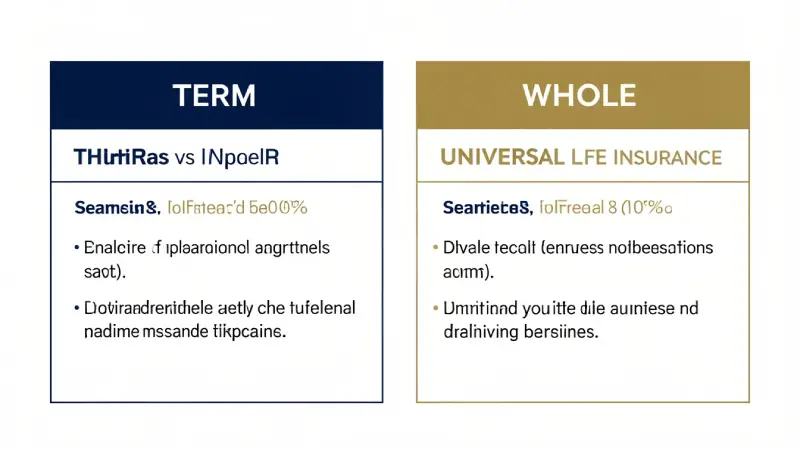
Term Life Insurance Best for Most People
Pure death benefit coverage for a fixed term — typically 10, 15, 20, or 30 years. If you die during the term, your beneficiaries receive the full payout. If you outlive the term, coverage ends with no cash value returned. Term life is the most affordable way to provide large coverage during your family's most financially vulnerable years — while children are young and the mortgage is high.
Whole Life Insurance
Permanent coverage that lasts your entire life, with guaranteed premiums, guaranteed death benefit, and a cash value component that grows at a fixed rate. Premiums are 5–15x higher than equivalent term coverage, but the policy never expires and builds tax-deferred cash value you can borrow against. Best for high-net-worth individuals using life insurance for estate planning, business succession, or as a conservative wealth-building vehicle.
Universal Life Insurance
A flexible permanent policy that allows you to adjust your premiums and death benefit over time within certain limits. Includes a cash value component that earns interest based on market rates. More flexible than whole life, but less predictable — if you underfund the policy, it can lapse. Indexed Universal Life (IUL) links returns to a stock market index with a floor (typically 0%) and a cap.
No-Exam Life Insurance Fast Approval
Policies that skip the traditional medical exam — using instead algorithmic underwriting based on health records, prescription data, and driving history. Approval takes minutes to days rather than 4–6 weeks. Rates are typically 10–20% higher than fully underwritten policies, but the convenience and speed make them ideal for healthy individuals who want immediate coverage. Companies like Bestow, Haven Life, and Ladder offer strong no-exam options.
💡 Term vs. Whole Life — The Honest Math: A healthy 35-year-old pays roughly $26/month for $500K of 20-year term vs. $400+/month for $500K of whole life. The "buy term and invest the difference" strategy — investing that $374/month difference in a low-cost index fund — historically outperforms whole life cash value by a wide margin. Whole life makes sense for specific estate and business planning purposes — not as a general investment vehicle for most families.
Life Insurance Rates by Age — 2026
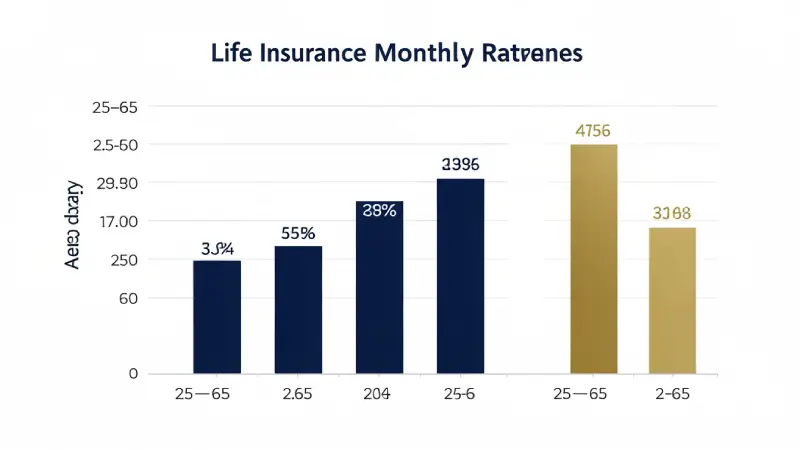
Your age at the time of application is the single biggest factor in your premium. Here are sample monthly rates for a healthy non-smoker purchasing a $500,000 20-year term policy:
| Age | Male Rate/mo | Female Rate/mo | Annual Cost (Male) | Total 20yr Cost |
|---|---|---|---|---|
| 25 | $19 | $16 | $228 | $4,560 |
| 30 | $22 | $19 | $264 | $5,280 |
| 35 | $26 | $22 | $312 | $6,240 |
| 40 | $38 | $32 | $456 | $9,120 |
| 45 | $62 | $50 | $744 | $14,880 |
| 50 | $105 | $80 | $1,260 | $25,200 |
| 55 | $178 | $130 | $2,136 | $42,720 |
| 60 | $310 | $225 | $3,720 | $74,400 |
*Sample rates for healthy non-smokers, preferred health class. Actual rates vary by company, state, and individual health factors. Source: industry averages compiled March 2026.
⏰ The Cost of Waiting: Buying a $500,000 20-year term policy at age 35 vs. age 45 costs $8,640 more over the policy term for a male. Waiting until 50 costs an additional $18,960 more than buying at 35. Every year you delay life insurance adds 8–10% to your lifetime cost — and at older ages, new health conditions can make you uninsurable or dramatically more expensive.
How Much Life Insurance Do You Actually Need?

The most common mistake in buying life insurance is choosing coverage based on what "feels right" or what an agent recommends without running the actual numbers. Here is a systematic approach used by certified financial planners:
The DIME Method
The DIME formula provides a comprehensive coverage calculation by summing four specific needs:
DIME Coverage Calculator — Example: $85,000/year earner, 2 kids
For many families, this calculation reveals a need for $1,500,000–$2,500,000 in coverage — far more than the $500,000 "standard" policy most people default to. The good news: even $2,000,000 of 20-year term life for a healthy 35-year-old costs roughly $80–$100/month — less than most car payments.
Quick Coverage Rule of Thumb
- Minimum: 10x annual income
- Recommended: 12x annual income + all debts + education costs
- High dependency (stay-at-home parent): Factor in full cost of childcare, household services — typically $50,000–$80,000/year in replacement value
- Business owners: Add key person insurance and buy-sell agreement funding on top of personal coverage
Life Insurance Rates by Health Classification
Insurance companies classify applicants into health tiers that significantly impact premiums. Understanding these classifications helps you set expectations and take steps to qualify for better rates:
| Health Class | Criteria | Rate Impact | Monthly Rate ($500K, 35M) |
|---|---|---|---|
| Preferred Plus / Super Preferred | Excellent health, ideal BMI, no family history | Lowest rates | $22–$26/mo |
| Preferred | Good health, minor issues, good family history | +10–20% | $26–$32/mo |
| Standard Plus | Average health, slightly elevated BMI or BP | +25–40% | $33–$38/mo |
| Standard | Managed conditions (controlled BP, cholesterol) | +40–60% | $38–$46/mo |
| Table Rating (1–16) | Significant health issues, high-risk factors | +50–300% | $50–$120/mo |
| Smoker / Tobacco | Any tobacco use in past 12 months | +200–300% | $85–$140/mo |

How to Get the Best Life Insurance Rates in 2026
1. Buy Early
Every year you wait costs 8–10% more in lifetime premiums. A healthy 30-year-old who buys $1,000,000 of 30-year term pays roughly $50/month. The same policy at 40 costs $90/month — $14,400 more over the term. The best time to buy life insurance is always now.
2. Improve Your Health Before Applying
If you're currently in the "Standard" health class, losing weight, bringing blood pressure under control, and stopping smoking for 12 months can move you up one or two health classes — reducing premiums by 20–40%. Wait to apply until your health improvements are reflected in lab results. Many applicants save $100+/month by taking 3–6 months to optimize before applying.
3. Shop Multiple Companies
Different insurers weigh health factors very differently. A company that rates you Standard for elevated cholesterol might rate another applicant Preferred Plus for the same numbers. Use comparison platforms like Policygenius, SelectQuote, or TermLife2Go to compare rates across 30+ carriers simultaneously.
4. Choose the Right Term Length
Match your term length to your actual financial exposure. If your youngest child will be independent in 18 years and your mortgage pays off in 22 years, a 20-year term covers both. Don't overpay for a 30-year term if you only need 20 years of protection. Conversely, don't underinsure with a 10-year term if you have 25 years of financial obligations.
5. Consider Layering Policies
Instead of one large policy, some financial planners recommend layering: a $1,000,000 30-year term (for long-term needs) plus a $500,000 20-year term (for peak financial obligations while kids are young). Total premiums are often lower than one large policy, and coverage decreases naturally as your financial obligations shrink over time.
6. Don't Rely Only on Group Life Insurance at Work
Employer-provided life insurance — typically 1–2x annual salary — is a valuable benefit but rarely sufficient. It's also not portable: if you change jobs, get laid off, or your employer changes benefit providers, your coverage disappears. Personal life insurance you own independently is always the foundation.
The Medical Exam Process — What to Expect

For fully underwritten policies (which offer the best rates), a paramedical exam is required. Here's what happens — and how to prepare for the best results:
What the Exam Includes
- Blood pressure, height, and weight measurement
- Blood draw (testing cholesterol, glucose, kidney/liver function, complete blood count)
- Urine sample (testing for drugs, protein, glucose)
- EKG for applicants over 50 or seeking large coverage amounts
- Medical history questionnaire
How to Prepare for the Best Results
- Fast for 8–12 hours before — especially important for glucose and cholesterol readings
- Avoid alcohol for 24 hours before the exam
- Avoid strenuous exercise for 24 hours — it can temporarily elevate protein in urine
- Drink water — good hydration makes blood draws easier and can improve blood pressure readings
- Schedule in the morning — blood pressure tends to be lower earlier in the day
- Avoid salty, fatty foods for 48 hours prior
💡 No-Exam Option: If your health is excellent and you value speed over absolute lowest premiums, no-exam policies from Haven Life, Bestow, or MassMutual's SimpleTerm offer instant coverage at rates only 10–15% above fully underwritten policies. For most healthy applicants under 45, the speed and convenience often justify the modest premium difference.
Life Insurance for Special Situations
Life Insurance for Parents of Young Children
This is where life insurance is most critical and most valuable. With young dependents, a spouse who may need to work reduced hours for childcare, and a new mortgage, the financial exposure is enormous. A $1,500,000–$2,000,000 20-year term policy for each parent provides the security needed — and at ages 28–38, costs remarkably little (often $40–$80/month for both parents combined).
Life Insurance for Business Owners
Business owners need life insurance on multiple levels: personal protection for their family, key person insurance to protect the business if a critical employee dies, and buy-sell agreement funding if a business partner dies. These are separate policies with different structures. An independent insurance broker with business experience is essential here. Use resources like SBA.gov for general business insurance guidance alongside specialized life insurance advice.
Life Insurance for Seniors
After age 60, term life insurance becomes significantly more expensive and harder to qualify for. The best options for seniors include: guaranteed universal life (permanent coverage with minimal cash value, more affordable than whole life), final expense life insurance (small coverage amounts of $10,000–$50,000 specifically for funeral and burial costs), and guaranteed issue life insurance (no medical questions, but very small coverage amounts and 2-year waiting periods). See our insurance comparison guides for more coverage options by age group.
Life Insurance if You Have Pre-Existing Conditions
Having a pre-existing condition — diabetes, high blood pressure, heart disease history, cancer history — does not automatically disqualify you from life insurance. It does affect which companies will offer you coverage and at what price. Working with an independent broker who can shop your specific health profile across multiple carriers is essential. Companies like Transamerica and Mutual of Omaha specialize in higher-risk health profiles. The National Association of Insurance Commissioners (NAIC) maintains resources for consumers navigating coverage with health conditions.
Comparing Term Life Rates Across Top States — 2026
| State | $500K, 20yr, Male 35 | $500K, 20yr, Female 35 | $1M, 20yr, Male 35 | Notable |
|---|---|---|---|---|
| California | $27/mo | $23/mo | $46/mo | Highly competitive market |
| Texas | $25/mo | $21/mo | $43/mo | No state income tax benefit |
| Florida | $26/mo | $22/mo | $45/mo | Hurricane risk minor factor |
| New York | $30/mo | $26/mo | $52/mo | Higher regulation = slightly higher rates |
| Illinois | $26/mo | $22/mo | $44/mo | Competitive Midwest market |
| Pennsylvania | $27/mo | $23/mo | $46/mo | Average rates |
FAQ — Best Life Insurance Companies USA 2026

Ahmada Ndao is a financial research analyst and independent journalist
specializing in US consumer finance, legal rights, and insurance markets.
With over 5 years covering American financial products, he has helped
thousands of readers navigate complex insurance decisions, find the right
legal representation, and optimize their credit strategies. His research
methodology combines primary data analysis, direct outreach to industry
professionals, and continuous monitoring of federal regulatory changes.
Ahmada’s work has been cited by financial communities across the US and
reviewed by licensed attorneys and insurance professionals for accuracy.