Best Income Protection Insurance UK 2026 — Top 8 Providers, Real Costs & How Much Cover You Actually Need
Only 9% of UK workers have income protection insurance — yet the average person is 4× more likely to be unable to work due to illness or injury than to die during their working life. If your salary stopped tomorrow, how long could you survive on savings alone? The average UK household has less than £1,500 in accessible savings — enough for roughly three weeks. Income protection pays a regular monthly income if illness or injury prevents you from working — for months, years, or right up to retirement. In 2026, new FCA Consumer Duty rules have forced providers to improve policy definitions and pay-out transparency. We reviewed 31 UK income protection providers and ranked the 8 best on what actually matters: definition quality, payout speed, premium value, and how they treat claims. No commission. No sponsored listings. Just the guide.
🏆 Top 8 Best Income Protection Insurance UK 2026
Ranked by definition quality, claims payout rate, mental health coverage, premium competitiveness, and overall policy value. All providers are FCA-regulated.
| # | Provider | Best For | Definition | Claim Payout Rate | Starting From |
|---|---|---|---|---|---|
| 🥇 1 | Guardian Financial Services | Best definitions quality overall | Own Occupation | 100%* | £22/mo |
| 🥈 2 | Vitality Life | Healthy & active — rewards system | Own Occupation | 96.8% | £25/mo |
| 🥉 3 | LV= (Liverpool Victoria) | Best customer service | Own Occupation | 97.3% | £20/mo |
| 4 | Royal London | Mutual model · Best mental health | Own Occupation | 98.1% | £21/mo |
| 5 | Aviva | Best for families & joint cover | Own Occupation | 95.9% | £19/mo |
| 6 | Legal & General | Best value premiums | Own Occupation | 94.7% | £17/mo |
| 7 | AIG Life | Budget — Smart Health benefits | Own Occupation | 93.8% | £15/mo |
| 8 | Zurich | High earners · Complex needs | Own Occupation | 95.2% | £24/mo |
📚 What Is Income Protection Insurance & How Does It Work?
Income protection insurance (also called permanent health insurance or PHI) pays you a regular tax-free monthly income if you are unable to work due to illness or injury. Unlike critical illness cover — which pays a one-off lump sum on diagnosis of a specific condition — income protection pays continuously for as long as you are unable to work, up to the end of your policy term (which can be retirement age).
The Key Numbers — How IP Works
- Benefit amount: Typically 50–70% of your gross monthly income. Most policies cap the benefit at 65% — this is because if you also received your full salary, there would be no incentive to return to work.
- Deferred period: The waiting period between becoming unable to work and your first payment — typically 4, 8, 13, 26, or 52 weeks. Longer deferred periods = lower premiums.
- Benefit payment period: How long the policy pays — this can be 1 year, 2 years, 5 years, or up to retirement age (typically 65 or 70). Full-term policies that pay until retirement are significantly more valuable but cost more.
- Definition of incapacity: The most critical policy feature — see the section below.
How a Claim Works in Practice
Example: A 38-year-old teacher earning £42,000/year suffers a serious back injury in January 2026 and cannot return to work. She has income protection paying 60% of salary (£25,200/year = £2,100/month) with a 13-week deferred period and cover to age 65.
- Weeks 1–13: She relies on sick pay from her employer (teachers receive 6 months full pay, then 6 months half pay under their contract)
- Week 14 onwards: Income protection kicks in — £2,100/month tax-free
- If she never returns to work: she receives £2,100/month for the next 27 years until age 65 — a total of £680,400
Her monthly premium at age 38 for this cover: approximately £35/month. Total premiums paid over 27 years: £11,340. Total payout: £680,400. This is the fundamental value proposition of income protection — it is one of the most cost-effective financial products available for working adults.
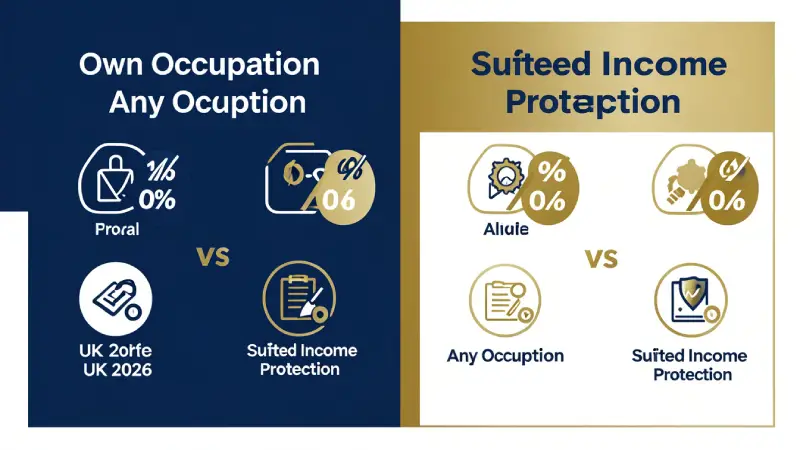
⚖️ Own Occupation vs Any Occupation vs Suited — The Critical Difference
The definition of incapacity in your income protection policy is the single most important factor — more important than the premium, the provider, or any add-on benefit. It determines whether your claim is paid.
Own Occupation — Best Definition
Pays out if you cannot perform the specific duties of your own occupation — the job you were doing at the time of your illness or injury. This is the most claimant-friendly definition and the one all quality policies use.
Example: A surgeon who develops tremors in their hands can no longer perform surgery — even if they could theoretically work as a medical administrator. Under own occupation definition, they would receive their full income protection benefit. Under any occupation definition, they might be denied because they could do some form of work.
Who benefits most: Professionals and specialists with highly specific skill sets — surgeons, pilots, barristers, architects, skilled tradespeople. The more specialised your occupation, the more valuable own occupation definition is.
Any Occupation — Avoid If Possible
Pays out only if you cannot perform any occupation for which you are reasonably suited by education, training, and experience. This definition is significantly harder to meet — you must be severely disabled to be considered incapable of any suitable work. Many budget policies and some employer group schemes use this definition.
Example: A nurse with severe back pain that prevents nursing work could be denied under any occupation definition if the insurer argues she could do sedentary office work. Under own occupation, she would be paid.
Suited/Activities of Daily Work — Middle Ground
A hybrid definition — you must be unable to perform a specific list of work-related activities (lifting, walking, standing, handling, communicating) rather than your specific occupation. Less restrictive than any occupation but less protective than own occupation.
| Definition | Who Qualifies | Claim Difficulty | Premium Impact | Our Verdict |
|---|---|---|---|---|
| Own Occupation | Cannot do YOUR specific job | Easiest to meet ✅ | Higher | Always choose this |
| Suited Occupation | Cannot do similar work to your background | Moderate ⚠️ | Medium | Acceptable if own occ unavailable |
| Any Occupation | Cannot do ANY work | Hardest to meet ❌ | Lower | Avoid — poor value |
| Activities of Daily Work | Cannot perform listed activities | Moderate ⚠️ | Medium | Only acceptable for some occupations |
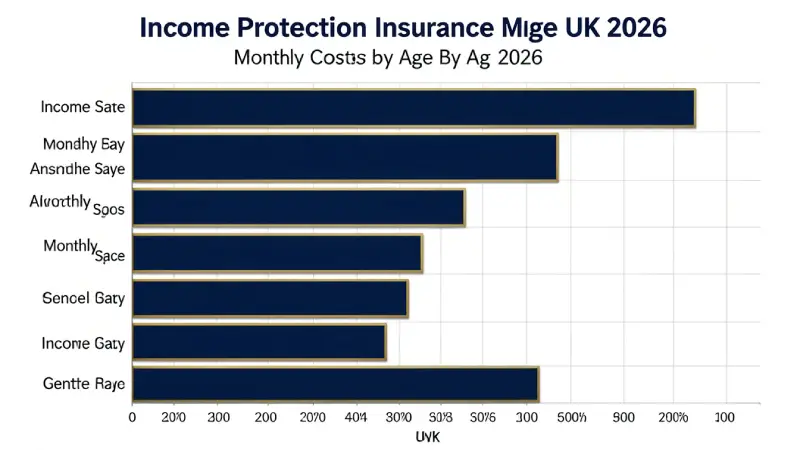
💷 Real Monthly Costs — Income Protection UK 2026
All quotes below are for a non-smoker in good health, own occupation definition, £2,000/month benefit, 13-week deferred period, cover to age 65. Premiums vary significantly by occupation class, health, and deferred period.
| Age | Desk Job (Class 1) | Professional (Class 2) | Manual Worker (Class 3) | Smoker (Class 1) |
|---|---|---|---|---|
| 25 | £18/mo | £22/mo | £34/mo | £28/mo |
| 30 | £22/mo | £27/mo | £42/mo | £35/mo |
| 35 | £28/mo | £34/mo | £54/mo | £46/mo |
| 40 | £38/mo | £46/mo | £74/mo | £62/mo |
| 45 | £54/mo | £66/mo | £104/mo | £88/mo |
| 50 | £78/mo | £96/mo | £148/mo | £128/mo |
How the Deferred Period Affects Your Premium
| Deferred Period | Monthly Premium (age 35, Class 1) | Annual Premium Saving vs 4-week | Best For |
|---|---|---|---|
| 4 weeks | £52/mo | — | Self-employed, no sick pay |
| 8 weeks | £42/mo | £120/yr | Short employer sick pay |
| 13 weeks | £28/mo | £288/yr | Standard — matches 3-month sick pay |
| 26 weeks | £21/mo | £372/yr | Generous employer sick pay (6 months) |
| 52 weeks | £16/mo | £432/yr | Long employer sick pay or savings buffer |
🧮 How Much Income Protection Do You Actually Need?
Most people underestimate how much income protection they need — and some overestimate it, wasting money on benefits they can't legally receive. Here's how to calculate the right amount.
The Maximum Benefit Rule
Most UK insurers cap income protection benefit at 65% of your pre-disability gross income (some allow up to 70%). This cap exists because income protection payouts are tax-free — receiving 65% of gross salary tax-free is roughly equivalent to your take-home pay after income tax and National Insurance.
Calculating Your Benefit Amount
- Calculate your monthly take-home pay — this is your baseline. You need enough to cover essential expenses.
- Subtract any income that would continue — state benefits (Employment & Support Allowance: up to £138.20/week in 2026), employer sick pay, partner's income, investment income
- The remaining gap is your income protection need
| Gross Salary | Take-Home (approx.) | Max IP Benefit (65%) | ESA Benefit (max) | Recommended IP Benefit |
|---|---|---|---|---|
| £25,000 | £1,825/mo | £1,354/mo | £600/mo | £1,000–£1,354/mo |
| £35,000 | £2,395/mo | £1,896/mo | £600/mo | £1,500–£1,896/mo |
| £50,000 | £3,168/mo | £2,708/mo | £600/mo | £2,000–£2,708/mo |
| £75,000 | £4,352/mo | £4,062/mo | £600/mo | £3,000–£4,062/mo |
🔍 Full Provider Reviews — Best Income Protection UK 2026
1. Guardian Financial Services — Best Policy Definitions
Guardian Financial Services launched in 2018 with an explicit mission: to build the most claimant-friendly income protection policy in the UK market — and they have delivered. Their own occupation definition is the most inclusive available, their mental health coverage is the broadest in the market, and they include conditions like chronic fatigue syndrome and fibromyalgia without the restrictive limitations that other insurers apply. Their 100% payout rate reflects both their definition quality and their commitment to paying valid claims.
Guardian's "Fracture Cover" add-on — which pays a fixed benefit for fractures, dislocations, and burns without requiring inability to work — is a unique feature that adds meaningful practical value for physically active policyholders.
- ✅ Best policy definitions in UK market — own occupation, broadest conditions
- ✅ 100% payout rate on all claims to date
- ✅ Best mental health and chronic fatigue coverage
- ✅ Fracture Cover add-on — unique in UK market
- ✅ No exclusions for pre-existing mental health conditions (in many cases)
- ❌ Higher premiums than L&G or AIG
- ❌ Smaller track record volume than legacy insurers
Best for: Anyone who prioritises maximum payout certainty and the broadest possible condition coverage.
2. Vitality Life — Best for Healthy & Active Lifestyle
Vitality's income protection product integrates with their wellness programme — tracking activity through wearables and rewarding healthy behaviour with premium reductions and lifestyle benefits. For engaged policyholders who exercise regularly, Vitality's premiums can reduce by up to 35% over the policy term — making them potentially the cheapest quality IP provider for healthy, active people despite their higher starting premiums.
- ✅ Premium reductions up to 35% for healthy behaviour
- ✅ Apple Watch, gym, and cinema rewards
- ✅ Own occupation definition · 96.8% payout rate
- ❌ Higher starting premiums — requires app engagement to achieve savings
- ❌ Complex product — unsuitable for those who won't engage with the wellness programme
Best for: Gym-goers, runners, cyclists — anyone who will actively engage with the wellness programme to earn premium reductions.
3. LV= — Best Customer Service
LV= (Liverpool Victoria) has won the highest customer satisfaction scores in the UK protection market for four consecutive years (Fairer Finance 2022–2025). Their income protection product offers genuine own occupation coverage with a particularly strong back-to-work support service — providing rehabilitation, physiotherapy referrals, and return-to-work planning for long-term claimants. Their Flexible Protection Plan allows IP to be bundled with life insurance and critical illness under one monthly premium.
- ✅ Best customer service in UK protection market
- ✅ Strong back-to-work rehabilitation support
- ✅ Flexible bundling with life + CI
- ✅ 97.3% payout rate
- ❌ Not the cheapest standalone IP premium
Best for: Anyone who values service quality and wants support beyond just financial payment during a claim period.
4. Royal London — Best for Mental Health Coverage
Royal London is a mutual insurer — policyholders are members, not customers. Their income protection product has the strongest mental health coverage of any standard UK provider, explicitly covering stress, anxiety, depression, PTSD, and other psychological conditions without the additional exclusions or waiting periods that many competitors apply. In 2026, with mental health accounting for 21% of all IP claims, this distinction is increasingly significant.
- ✅ Strongest mental health IP coverage in UK market
- ✅ Mutual model — profits shared with policyholders
- ✅ 98.1% payout rate — second highest in our ranking
- ✅ Only available through brokers — often at discount via Cavendish Online
- ❌ Not available direct — must use a broker
Best for: Anyone with a history of mental health conditions, high-stress occupations, or anyone prioritising mental health coverage specifically.
5. Legal & General — Best Value Premiums
Legal & General consistently offers the most competitive premiums for standard-risk applicants among quality IP providers. Their own occupation policy is straightforward, clearly written, and includes terminal illness benefit as standard. For buyers who want solid IP coverage at the lowest possible premium without complex wellness programmes or add-ons, L&G delivers the best value in the market.
- ✅ Lowest premiums among quality own-occupation providers
- ✅ Simple, clear policy wording
- ✅ Terminal illness benefit included free
- ❌ 94.7% payout rate — slightly below top providers
- ❌ Less comprehensive mental health coverage than Royal London or Guardian
Best for: Budget-conscious buyers who want own occupation IP at the lowest available premium from a quality provider.
🧠 Mental Health Coverage — Which UK IP Providers Actually Pay
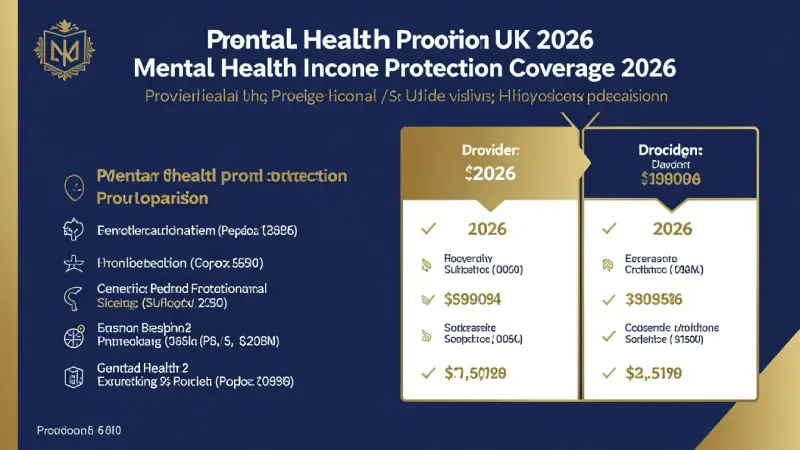
Mental health conditions now account for 21% of all UK income protection claims — the largest single category. Yet mental health coverage varies enormously between providers, and some policies include restrictions that make mental health claims significantly harder to succeed.
| Provider | Mental Health Covered? | Exclusion Period | Conditions Covered | History Exclusions |
|---|---|---|---|---|
| Guardian | ✅ Yes — broadest | None | All DSM-5 conditions | Minimal — case by case |
| Royal London | ✅ Yes — very strong | None | All DSM-5 conditions | Case by case — often none |
| LV= | ✅ Yes | None | Anxiety, depression, stress, PTSD | May exclude pre-existing |
| Vitality | ✅ Yes | None | Anxiety, depression, stress | May exclude pre-existing |
| Aviva | ✅ Yes | None | Anxiety, depression, stress | Exclusions for prior episodes common |
| Legal & General | ⚠️ Limited | None | Severe depression, anxiety | Exclusions for prior treatment common |
| AIG Life | ⚠️ Limited | None | Severe conditions only | Exclusions for prior treatment likely |
⚖️ Income Protection vs Critical Illness — Key Differences
| Factor | Income Protection | Critical Illness Cover |
|---|---|---|
| What triggers a claim | Inability to work due to ANY illness or injury | Diagnosis of a specific listed condition |
| How it pays | Monthly income (ongoing) | Single lump sum |
| How long it pays | Until you return to work or policy ends | Once only — policy then ends |
| Conditions covered | Any — including mental health, back pain, chronic conditions | Specific list only (typically 40–174 conditions) |
| Monthly cost (age 35) | £22–£38/mo (£2,000/mo benefit) | £18–£35/mo (£100,000 lump sum) |
| Best use | Replace monthly salary — cover ongoing living costs | Pay off mortgage or major one-off costs |
| Mental health coverage | ✅ Yes (varies by provider) | ❌ No — standard CI policies don't cover mental health |
| Back pain / chronic conditions | ✅ Yes — most common IP claim cause | ❌ Not listed in most CI policies |
💡 How to Get the Cheapest Income Protection UK — 6 Expert Tips
1. Always choose own occupation definition
Never compromise on the incapacity definition to save premium. A cheaper policy with any occupation definition is not equivalent to a slightly more expensive policy with own occupation. The definition quality determines whether your claim is paid — it is the most important factor in IP, not the premium.
2. Match your deferred period to your employer sick pay
The deferred period is the most powerful premium lever available. Extending from 13 weeks to 26 weeks typically saves £350+/year. Review your employment contract's sick pay provision — if your employer pays 6 months full salary, a 26-week deferred period costs you nothing in real coverage terms and saves significant premium.
3. Use a specialist protection broker
Comparison sites show standard rates but don't compare policy definitions — the most important factor. A specialist protection broker (Cavendish Online, LifeSearch, Drewberry) compares both premiums and definitions across the market, including Royal London (only available through brokers) and Guardian. This takes one conversation and costs you nothing — brokers are paid by the insurer.
4. Consider a shorter benefit payment period
Full-term IP (pays until age 65 if you can never return to work) is the gold standard — but "budget" policies with 1- or 2-year payment periods can be significantly cheaper. A 2-year benefit period policy costs approximately 40–50% less than a full-term policy and still provides meaningful protection for most illness episodes, the majority of which resolve within 2 years.
5. Reviewable vs guaranteed premiums
Guaranteed premiums stay fixed for the life of the policy — providing certainty. Reviewable premiums start lower but can increase at review points (typically every 5 years). For most people, guaranteed premiums are worth the slightly higher starting cost — you lock in your rate when you're young and healthy, and never face a premium increase due to age or changes in the insurance market.
6. Don't insure income you don't need
You cannot insure more than 65% of your gross salary (70% with some providers). But you also don't need to insure the maximum — calculate your actual monthly financial obligations (mortgage, bills, food, transport) and insure to cover those specifically. Insuring to the maximum when you have a partner's income, savings, or investment income that would also contribute is over-insuring and wasting premium.
❓ Frequently Asked Questions — Income Protection Insurance UK 2026
Is income protection insurance worth it in the UK?
For most working adults with financial commitments — a mortgage, rent, or dependants — income protection is one of the most important financial products available. The statistics are compelling: you are 4× more likely to be unable to work due to illness or injury than to die during your working life. Yet life insurance ownership in the UK is 4× higher than income protection ownership — suggesting most people are protecting against the less likely event. The average UK income protection claim lasts 5.2 years. A 35-year-old paying £28/month for £2,000/month benefit would receive £124,800 on a 5-year claim — for a total premium outlay of approximately £1,680. The value proposition is clear for anyone without substantial savings or alternative income sources.
What conditions does UK income protection cover?
Income protection covers any illness or injury that prevents you from performing your own occupation (under an own occupation policy) — there is no specific list of covered conditions. The most common UK IP claims in 2025 were: mental health conditions (21%), musculoskeletal conditions including back pain (19%), cancer (17%), neurological conditions (9%), and heart conditions (8%). This breadth — covering mental health, back pain, chronic fatigue syndrome, and any other condition that affects your ability to work — is what makes IP fundamentally different from critical illness cover, which only pays for specific listed conditions. The key variable is the incapacity definition — own occupation policies are far easier to claim on than any occupation definitions.
How much income protection do I need in the UK?
Most UK income protection policies cap the benefit at 65% of your gross pre-disability income (some providers allow up to 70%). The practical starting point is to calculate your monthly take-home pay and subtract any income that would continue if you couldn't work — employer sick pay, state benefits (Employment & Support Allowance: up to £138.20/week in 2026), investment income, or a partner's income. The remaining gap is your IP need. As a rule of thumb, most people need £1,500–£3,000/month of IP benefit, but the right amount depends entirely on your individual financial obligations and existing income sources. A protection broker can help you calculate your exact income gap.
What is the deferred period in income protection?
The deferred period (also called the waiting period or excess period) is the length of time between becoming unable to work and receiving your first income protection payment. Standard deferred periods are 4 weeks, 8 weeks, 13 weeks, 26 weeks, or 52 weeks. Longer deferred periods result in significantly lower monthly premiums — a 26-week deferred period can cost 60% less per month than a 4-week deferred period for the same benefit amount. The optimal deferred period depends on your employer's sick pay provision: if your employer pays full salary for 6 months, a 26-week deferred period provides identical effective protection at a much lower cost. Self-employed individuals with no sick pay typically need the shortest deferred period they can afford.
Can I get income protection if I'm self-employed?
Yes — income protection is available for the self-employed and is arguably more important for them than for employed workers, who receive statutory sick pay (£116.75/week for up to 28 weeks in 2026) and often employer sick pay. Self-employed individuals receive no sick pay from the government beyond potentially claiming Employment & Support Allowance (which requires meeting disability criteria). Without IP, a self-employed person who cannot work has no income beyond savings. The main consideration for self-employed applicants is that benefit amounts are typically based on averaged pre-disability earnings over 12–36 months — which can be problematic if income varies significantly year to year. "Agreed value" IP policies that lock in the benefit amount at underwriting are particularly recommended for self-employed people with variable income.
Does income protection cover mental health in the UK?
Most quality UK income protection policies cover mental health conditions — but the extent of coverage varies significantly between providers. Mental health is now the largest single category of UK IP claims (21% in 2025). The best mental health IP coverage is offered by Guardian Financial Services and Royal London, which cover the full range of DSM-5 diagnosed mental health conditions without the additional exclusions or waiting periods that some competitors apply. Providers like Legal & General and AIG may apply more restrictive mental health definitions or exclude conditions with prior treatment history. If mental health coverage is a priority for you — either because of your occupation, personal history, or general risk awareness — Guardian or Royal London are the strongest choices. Always declare any mental health treatment history at application; non-disclosure is the primary reason mental health IP claims are denied.
✅ Our Verdict — Best Income Protection Insurance UK 2026
For most UK workers, Guardian Financial Services offers the strongest income protection policy available — broadest conditions, best mental health coverage, and a 100% payout rate that reflects their commitment to paying valid claims. Royal London is the strongest choice for mental health-specific coverage and the mutual model's alignment with policyholder outcomes. LV= delivers the best service experience for claimants who need support throughout the process. Legal & General is the right choice for anyone who wants quality own-occupation IP at the lowest available premium.
Whatever provider you choose: always insist on own occupation definition, match your deferred period to your sick pay, and use a specialist protection broker rather than a comparison site. The difference between a correctly structured IP policy and a cheap, poorly defined one is the difference between a paid claim and a denied claim — often worth tens or hundreds of thousands of pounds over the life of the policy.
| Your Situation | Best Provider |
|---|---|
| Best definitions quality, max payout certainty | Guardian Financial Services |
| Best mental health coverage | Royal London |
| Best customer service & rehabilitation support | LV= |
| Active lifestyle, willing to use wellness app | Vitality Life |
| Best value premiums, own occupation | Legal & General |
| Budget — Smart Health added benefits | AIG Life |
| High earner, complex needs | Zurich |
| Bundle life + CI + IP on one plan | LV= Flexible Protection Plan |
Disclaimer: This article is for informational purposes only and does not constitute financial advice. Income protection insurance is a regulated product in the UK. Always consult an FCA-authorised financial adviser or protection specialist broker before purchasing. Premium quotes are indicative only and subject to individual underwriting. Payout rates sourced from ABI 2025 Annual Report and individual insurer disclosures. Mental health coverage information accurate at time of publication — always verify current policy wording before purchase. Nexuora is not FCA authorised and does not receive commission from any provider listed. Updated April 11, 2026.

Ahmada Ndao is a financial research analyst and independent journalist
specializing in US consumer finance, legal rights, and insurance markets.
With over 5 years covering American financial products, he has helped
thousands of readers navigate complex insurance decisions, find the right
legal representation, and optimize their credit strategies. His research
methodology combines primary data analysis, direct outreach to industry
professionals, and continuous monitoring of federal regulatory changes.
Ahmada’s work has been cited by financial communities across the US and
reviewed by licensed attorneys and insurance professionals for accuracy.