
Best Disability Insurance USA 2026 — Top 7 Providers, Real Costs & Who Has the Best Own-Occupation Coverage
A 35-year-old American worker earning $80,000/year who becomes disabled at 40 loses over $2 million in lifetime income. Yet fewer than 30% of American workers carry individual disability insurance — relying instead on inadequate employer group coverage, insufficient Social Security disability benefits (average: $1,583/month), or nothing at all. The statistics are stark: one in four Americans will experience a disability lasting 90+ days before retirement, according to the Social Security Administration. Disability insurance is the most commonly neglected major insurance product in America — and the most financially consequential gap in most households' financial protection plans. This complete 2026 guide compares the 7 best individual disability insurance providers in the United States across the criteria that actually matter: own-occupation definition, non-cancellable policies, benefit period, elimination period, and what claims actually look like in practice.

🏆 Top 7 Best Disability Insurance Providers USA 2026
| # | Provider | Best For | Own-Occ Definition | Non-Cancellable? | AM Best |
|---|---|---|---|---|---|
| 🥇 1 | Guardian Life | Physicians · Surgeons · Attorneys · Specialists | ✅ True own-occupation 🏆 | ✅ Yes — to age 65 | A++ Superior |
| 🥈 2 | Northwestern Mutual | Professionals wanting strongest protection money can buy | ✅ True own-occupation 🏆 | ✅ Yes — to age 65 | A++ Superior |
| 🥉 3 | MassMutual | Lifetime own-occupation rider · Long-term protection | ✅ True + lifetime option | ✅ Yes — to age 65 | A++ Superior |
| 4 | Principal Financial | Small business owners · Self-employed | ✅ Own-occupation | ✅ Yes | A+ Superior |
| 5 | The Standard | Group + individual · Employer market specialist | ⚠️ Own-occ (limited) | ✅ Yes (selected plans) | A Superior |
| 6 | Mutual of Omaha | Budget-conscious · Short-term · No exam options | ⚠️ Modified own-occ | ⚠️ Guaranteed renewable | A+ Superior |
| 7 | Breeze (marketplace) | Online-first · Fast approval · Compare multiple carriers | Varies by carrier | Varies | Varies |
⚖️ Own-Occupation vs Any-Occupation — The Most Critical Decision in Disability Insurance

The disability definition is the most consequential term in any disability insurance policy — more important than the benefit amount, the benefit period, or the premium cost. It determines precisely when your insurer considers you "disabled" and therefore eligible for benefits. There are three main definition types, and the difference between them can mean the difference between receiving full benefits and receiving nothing.
True Own-Occupation (Best)
Under a true own-occupation definition, you are considered totally disabled — and receive 100% of your monthly benefit — if you are unable to perform the material duties of your own specific occupation, regardless of whether you choose to work in another occupation or not. This is the gold standard definition, and it is the definition that Guardian Life, Northwestern Mutual, and MassMutual offer for their premium plans.
The real-world impact: A hand surgeon who develops nerve damage that prevents surgery is considered totally disabled under a true own-occupation policy — even if they can teach medical school, consult, or practice in non-surgical medicine. They receive 100% of their monthly disability benefit while working in another capacity and earning income from it. Without true own-occupation coverage, the same surgeon receives nothing because they are theoretically able to work in some occupation. For high-income professionals whose specific skills are the foundation of their earning power, true own-occupation coverage is non-negotiable.
Modified Own-Occupation (Common — More Restrictive)
Modified own-occupation policies define you as disabled if you cannot perform your occupation's duties AND you are not working in any other occupation. The moment you accept any gainful employment — even at a fraction of your prior income — the modified own-occupation definition may reduce or eliminate your benefits. Many Mutual of Omaha, The Standard, and employer group policies use modified own-occupation definitions that sound similar to true own-occupation but provide significantly less protection in practice.
Any-Occupation (Weakest — Avoid)
Under any-occupation definitions, you are considered disabled only if you cannot perform the duties of any occupation for which you are reasonably qualified by education, training, or experience. This definition effectively provides benefits only when you are completely and totally unable to work in any capacity — a much higher and harder-to-meet standard. Most Social Security Disability Insurance (SSDI) uses an any-occupation standard, which is why SSDI denial rates are so high. Avoid any-occupation definitions in individual disability policies — they provide very little practical protection for most working professionals.
| Scenario | True Own-Occ | Modified Own-Occ | Any-Occ |
|---|---|---|---|
| Surgeon can't operate, teaches medicine | ✅ Full benefits | ❌ No benefits (working) | ❌ No benefits |
| Attorney with cognitive impairment, does light admin work | ✅ Full benefits | ❌ Reduced/no benefits | ❌ No benefits |
| Dentist with hand tremor, can't practice dentistry | ✅ Full benefits if not practicing | ⚠️ Depends on other work | ❌ Only if can't work at all |
| Completely unable to work in any capacity | ✅ Full benefits | ✅ Full benefits | ✅ Full benefits |
💰 Real Costs — What Disability Insurance Costs in 2026
Individual long-term disability insurance typically costs 1–3% of your annual income for a comprehensive policy with true own-occupation coverage, a 90-day elimination period, and benefits to age 65. This percentage range is driven primarily by your age, health status, occupation risk class, income, and policy terms.
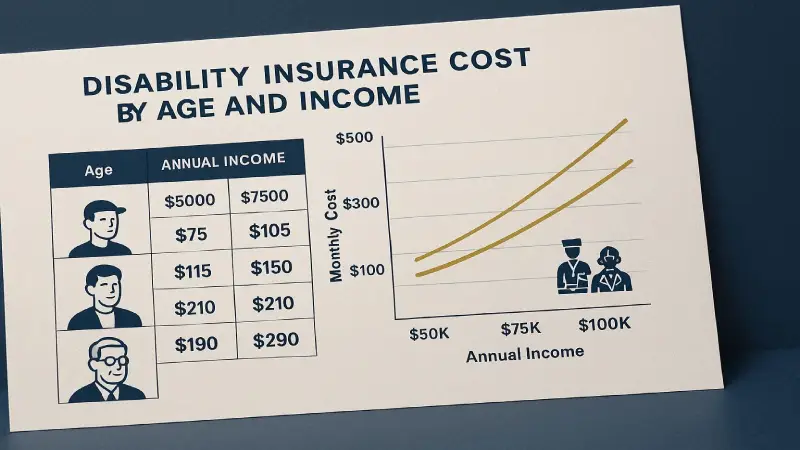
| Income | Age | Occupation | Monthly Benefit (60%) | Annual Premium (est.) | % of Income |
|---|---|---|---|---|---|
| $60,000 | 30 | Office/Admin (Class 4) | $3,000/mo | $900–$1,400 | 1.5–2.3% |
| $100,000 | 35 | Attorney (Class 6) | $5,000/mo | $2,200–$3,800 | 2.2–3.8% |
| $150,000 | 40 | Physician (Class 6) | $7,500/mo | $4,800–$7,200 | 3.2–4.8% |
| $200,000 | 35 | Surgeon (Class 6) | $10,000/mo | $5,500–$9,000 | 2.75–4.5% |
| $80,000 | 45 | Engineer (Class 5) | $4,000/mo | $2,800–$4,200 | 3.5–5.25% |
| $120,000 | 50 | Business owner (Class 4) | $6,000/mo | $5,400–$8,400 | 4.5–7% |
What Drives Your Disability Insurance Premium
Age is the most powerful pricing factor — premiums increase approximately 5–8% per year of age. A 30-year-old paying $1,200/year will pay approximately $2,400/year for the same coverage at age 45. Buying early and locking in a non-cancellable rate is the most cost-effective long-term strategy. Occupation class reflects your profession's physical risk and the complexity of disability determination. Class 6 (surgeons, attorneys, dentists — higher risk of specific-skill impairment) typically pays 20–40% more than Class 4 (general office professionals). Benefit period dramatically affects premium — a benefit period to age 65 costs 50–80% more than a 5-year benefit period. Elimination period — the waiting period before benefits begin (30, 60, 90, or 180 days) — inversely affects premium. A 90-day elimination period is the industry standard balancing cost and protection. Extending to 180 days reduces premium by 10–20%.
🔍 Full Provider Reviews — Top 7 Detailed 2026
1. Guardian Life — Best for Medical and Legal Professionals
Guardian Life has been the gold standard for physician and attorney disability insurance for decades. Their Provision Plus product offers the strongest true own-occupation definition in the market — with specialty-specific definitions for surgeons, dentists, and other proceduralists that define disability based on the inability to perform the specific procedures that generate the majority of their income, even if they remain physically able to perform other tasks. Guardian's maximum monthly benefit is approximately $15,000 for individual coverage, with higher limits available through multi-life employer programmes. Their non-cancellable, guaranteed renewable policy structure means premiums are locked in at issue — Guardian cannot raise your rate or cancel your policy as long as you pay premiums. Guardian's AM Best rating is A++ — the highest possible. For any physician, surgeon, dentist, or attorney purchasing individual disability insurance, Guardian Life should be the first quote obtained.
- ✅ Strongest true own-occupation definition — specialty-specific for proceduralists
- ✅ Non-cancellable to age 65 — locked-in premiums
- ✅ A++ AM Best financial strength
- ✅ Maximum benefit $15,000/month individual
- ✅ Mental nervous coverage included (not a sub-limit)
- ✅ Residual disability rider available — partial disability coverage
- ❌ Requires agent to purchase — no direct online application
- ❌ More expensive than Mutual of Omaha or The Standard
2. Northwestern Mutual — Best for Professionals Wanting Maximum Protection
Northwestern Mutual's disability income insurance product is consistently rated the strongest comprehensive protection available for high-income professionals. As a mutual insurer (policyholders are owners), Northwestern Mutual's interests are fundamentally aligned with its policyholders' — it earns no profit from denying claims. Their true own-occupation coverage, non-cancellable policy structure, and A++ AM Best rating are equivalent to Guardian's strengths. Northwestern Mutual's distinctive advantage is its comprehensive financial planning integration — disability insurance is positioned as part of a complete income protection strategy alongside life insurance, retirement planning, and investment management. For professionals who want a single advisor managing all aspects of their financial protection, Northwestern Mutual's comprehensive model has no direct competitor.
- ✅ True own-occupation — full benefits even while working another occupation
- ✅ Non-cancellable, guaranteed renewable to age 65
- ✅ Mutual structure — policyholder-aligned interests
- ✅ Dividend history — potential premium reduction over time
- ✅ A++ AM Best — identical to Guardian
- ❌ Available only through Northwestern Mutual agents — no independent broker access
- ❌ Comprehensive planning model may not suit purchasers who only want DI
3. MassMutual — Best for Lifetime Own-Occupation Rider
MassMutual offers the only standard product in the US disability insurance market that includes a lifetime own-occupation rider option — providing own-occupation benefits not just to age 65, but for the insured's entire lifetime. This rider is particularly relevant for younger professionals whose disability risk extends well beyond 65 as working lives extend into the 70s. MassMutual's Radius Plus product combines strong true own-occupation coverage with the most flexible rider menu in the market — including a cost of living adjustment (COLA) rider that increases benefits 3–6% annually during a disability claim to maintain purchasing power. Their A++ AM Best rating and 170-year history provide unmatched financial strength confidence.
- ✅ Lifetime own-occupation rider — unique in the market
- ✅ Best COLA rider options — up to 6% annual increase
- ✅ A++ AM Best — 170+ year history
- ✅ Mutual insurer structure
- ✅ Strong residual disability coverage
- ❌ Premium for lifetime rider is significantly higher than standard to-age-65 coverage
4. Principal Financial — Best for Small Business Owners
Principal Financial specialises in disability insurance products specifically designed for self-employed individuals and small business owners — a segment that faces unique disability challenges that W-2 employees do not. Business overhead expense (BOE) coverage — which pays for the fixed costs of running your business (rent, utilities, staff salaries, equipment leases) while you are disabled and unable to generate revenue — is Principal's most distinctive product. BOE coverage ensures that your business remains viable during a disability rather than collapsing under fixed-cost burden while you are unable to work. Principal also offers key person disability insurance — covering a business against the financial loss resulting from a key employee's disability — and buy-sell disability coverage — funding partner buyouts in businesses where a disability creates succession issues.
- ✅ Best Business Overhead Expense (BOE) coverage
- ✅ Strongest small business and self-employed disability products
- ✅ Key person and buy-sell disability coverage available
- ✅ A+ AM Best — strong financial position
- ✅ Competitive pricing for business owner profiles
- ❌ Individual product less compelling than Guardian or Northwestern for employed professionals
5. The Standard — Best for Employer Group Integration
The Standard (Standard Insurance Company) is the largest provider of employer-sponsored group disability insurance in the United States. For employers building comprehensive disability benefits programmes, The Standard's integration of group short-term disability, group long-term disability, and individual supplemental disability into a coordinated benefits package is unmatched. Employees at companies using The Standard for group disability can often purchase individual supplemental coverage with simplified underwriting — reducing the application burden and expanding their protection beyond the group policy's limits.
6. Mutual of Omaha — Best for Budget-Conscious and No-Exam Coverage
Mutual of Omaha provides the most accessible entry-level disability insurance in the US market — with no-exam policies available up to $5,000/month in monthly benefits, simplified underwriting, and the fastest policy issuance timeline of any major disability insurer. For younger workers who need disability protection but find the comprehensive Guardian or Northwestern Mutual products financially out of reach, Mutual of Omaha's Disability Income product provides meaningful protection at a meaningfully lower cost. The trade-off: Mutual of Omaha uses a modified own-occupation definition (not true own-occupation) and offers guaranteed renewable rather than non-cancellable policies — meaning premiums can be adjusted at renewal.
7. Breeze — Best Online Comparison Platform
Breeze is the disability insurance equivalent of Squaremouth for travel insurance — an online-first platform that aggregates quotes from Guardian, MassMutual, Assurity, Ameritas, and Principal into a single comparison interface. Breeze's fully digital application (the first in the disability insurance market) allows users to complete the application, underwriting, and policy issuance process entirely online — a significant improvement over the traditional agent-only model that has historically made disability insurance purchasing laborious. For straightforward disability insurance needs (standard occupation class, good health), Breeze's digital process can reduce a 6-week traditional application to 24–48 hours.
📋 Key Policy Terms Every Disability Insurance Buyer Must Understand

Non-Cancellable vs Guaranteed Renewable
These two terms describe how your policy's premium and continuation work and are among the most important policy features to evaluate. Non-cancellable means your insurer cannot cancel your policy, raise your premiums, or reduce your benefits as long as you pay premiums — regardless of changes in your health, occupation, or industry conditions. Your premium is locked in forever at the rate you paid when you first bought the policy. Guardian, Northwestern Mutual, and MassMutual's premier products are non-cancellable — this is the strongest consumer protection available. Guaranteed renewable means your insurer cannot cancel your individual policy and must allow you to renew it — but reserves the right to raise premiums for your "class" of policyholders if claims experience deteriorates. Mutual of Omaha and The Standard's individual products are typically guaranteed renewable rather than non-cancellable. For young buyers purchasing coverage for 30+ years, the premium increase risk of guaranteed renewable policies is a meaningful consideration.
Elimination Period (Waiting Period)
The elimination period is the waiting period between when a disability begins and when benefit payments start. Standard options are 30, 60, 90, or 180 days. The 90-day elimination period is the industry standard — it balances manageable premium cost against the period most people can self-insure through emergency savings. Choosing a 90-day elimination period means you need approximately 3 months of expenses in liquid savings to cover the gap between disability and your first benefit payment. A 180-day elimination period reduces your premium by 10–20% but requires 6 months of liquid savings — appropriate for those with substantial emergency funds or robust short-term disability coverage through their employer.
Benefit Period
The benefit period defines how long your insurer pays benefits during a qualifying disability. Options range from 2 years to lifetime, with the most common choices being 2 years, 5 years, 10 years, to age 65, or lifetime. To-age-65 is the recommended minimum for most workers — because disability can occur at any age, and a disability that strikes at 40 creates 25 years of potential benefit need that a 5-year benefit period would not cover. The additional premium for to-age-65 versus 5-year coverage is typically 50–80% — a meaningful cost increase, but the to-age-65 coverage provides protection against the catastrophic scenario (young onset, permanent disability) that is most financially devastating.
Residual Disability Rider
A residual (or partial) disability rider pays benefits proportional to your income loss when you are partially disabled — able to work in your occupation, but at reduced capacity and therefore reduced income. Without a residual disability rider, you receive benefits only when totally disabled. With the rider, a physician who can work 60% of their previous hours (and earns 60% of their prior income) receives 40% of their monthly disability benefit — covering the income gap caused by partial disability. Residual disability is more common than total disability in practice — most long-term disabilities allow some continuing work capacity, making the residual rider valuable for most policyholders.
COLA Rider (Cost of Living Adjustment)
The COLA rider increases your disability benefit annually during a claim — typically by 3–6% per year — to offset inflation. Without COLA, a $10,000/month benefit received in 2026 has the purchasing power of approximately $7,400/month by 2036 (assuming 3% annual inflation). With a 3% COLA rider, the same benefit grows to approximately $13,440/month by 2036 — fully maintaining purchasing power. The COLA rider adds 10–25% to your base premium, depending on the adjustment rate and your age at purchase.
🧮 How Much Disability Coverage Do You Need?
The standard guidance is that disability insurance should replace 60–70% of your gross income. This percentage reflects the tax advantage of individually purchased disability insurance: if you pay the premiums yourself with after-tax dollars, the benefits are received income-tax-free — making 60% replacement effectively higher in purchasing power than 60% of your gross pre-tax income.
The Disability Coverage Calculation
Step 1: Calculate your monthly take-home pay after taxes and retirement contributions. Step 2: Estimate your essential monthly expenses — mortgage or rent, food, utilities, transportation, health insurance, minimum debt payments, and insurance premiums. Step 3: Subtract any other disability income you would receive — Social Security disability (if eligible), employer group disability, and any passive income. The difference between your essential monthly expenses and your other disability income is your disability coverage gap — the amount your individual disability policy should cover. For most professionals, this gap represents 50–70% of gross income.
Maximum Benefit Limits
Insurers limit monthly disability benefits to 60–80% of your pre-disability income — regardless of what you apply for. This limitation reflects the principle that disability insurance should not create a financial incentive to remain disabled. For high-income professionals, this cap creates multi-provider stacking strategies — purchasing the maximum benefit from one carrier and supplemental coverage from a second insurer to more completely replace income. Guardian, Northwestern Mutual, and MassMutual all allow benefit stacking with other carriers, subject to overall income replacement limits.
🎯 Best Disability Insurance by Profession
| Profession | Best Provider | Critical Feature | Key Consideration |
|---|---|---|---|
| Surgeons / Proceduralists | Guardian Life 🏆 | Specialty-specific own-occupation | Definition must cover inability to perform procedures |
| Physicians (non-surgical) | Guardian / Northwestern Mutual | True own-occupation | Mental nervous condition coverage without sub-limits |
| Dentists | Guardian Life 🏆 | Specialty-specific own-occupation | Hand/vision coverage critical |
| Attorneys | Northwestern Mutual / Guardian | True own-occupation | Cognitive impairment coverage important |
| Business owners / Self-employed | Principal Financial 🏆 | Business overhead expense + individual DI | BOE covers business fixed costs during disability |
| Corporate professionals | MassMutual / Principal | Non-cancellable · COLA rider | Supplement employer group with individual policy |
| Budget-conscious / early career | Mutual of Omaha / Breeze | No-exam · Fast issuance | Accept modified own-occ for lower cost entry |
📊 Employer Group vs Individual Disability Insurance — Key Differences

| Feature | Employer Group DI | Individual DI |
|---|---|---|
| Income covered | Base salary only (60%) | All income including bonuses, commissions |
| Benefit taxation | Taxable if employer pays premium | Tax-free if you pay premiums |
| Portability | Disappears when you leave job | Yours forever — portable |
| Premium stability | Can change annually with employer | Locked in (non-cancellable policies) |
| Disability definition | Usually any-occupation after 2 years | Own-occupation options available |
| Mental health coverage | Often sub-limited to 24 months | Full coverage available with Guardian/NML |
| Cost | Often employer-subsidised or free | 100% your premium |
The optimal strategy for most professionals: participate in employer group disability insurance at the maximum available benefit (it is typically subsidised or free), and supplement with an individual policy to cover the gaps — the income above 60% of base salary, the tax disadvantage, the portability gap, and the definition of disability weakness. For a complete picture of income protection strategies alongside disability insurance, including how umbrella insurance and home insurance fit into financial protection planning, see our guides on Best Umbrella Insurance USA 2026 and Best Home Insurance Companies USA 2026.
❓ Frequently Asked Questions — Best Disability Insurance USA 2026
What is the best disability insurance company in the USA in 2026?
Guardian Life is the best disability insurance company for physicians, surgeons, dentists, and attorneys in 2026 — offering the strongest true own-occupation definition in the market, non-cancellable premiums to age 65, and an A++ AM Best rating. Northwestern Mutual is an equally strong alternative with the added benefit of mutual ownership structure and dividend history. MassMutual is best for professionals who want the unique lifetime own-occupation rider option. Principal Financial is best for small business owners who need Business Overhead Expense coverage alongside individual disability protection. For budget-conscious buyers or early-career professionals, Mutual of Omaha provides accessible coverage with no-exam options and fast issuance.
How much does individual disability insurance cost per month?
Individual disability insurance costs approximately 1–3% of annual income for comprehensive own-occupation coverage with a 90-day elimination period and benefits to age 65. Monthly premiums range from approximately $75–$120 per month for a 30-year-old in a standard office occupation seeking $3,000/month in benefits, to $400–$750 per month for a 45-year-old physician seeking $10,000/month in benefits. The most significant premium drivers are age (premiums increase 5–8% per year), occupation class (surgeons and proceduralists pay more than office professionals), benefit amount, and benefit period. Buying early and locking in a non-cancellable premium is the most cost-effective long-term strategy — a 30-year-old locks in rates for 35 years, avoiding compounding premium increases from aging.
What is own-occupation disability insurance?
Own-occupation disability insurance pays full benefits when you cannot perform the material duties of your own specific occupation — regardless of whether you can work in another capacity. Under a true own-occupation policy, a surgeon who develops nerve damage preventing surgery is considered totally disabled and receives 100% of monthly benefits even if they teach medical school or consult at a significantly lower income. This is distinct from any-occupation coverage, which only pays when you cannot work in any occupation for which you are qualified — a much harder standard to meet. True own-occupation coverage is offered by Guardian Life, Northwestern Mutual, and MassMutual, and is considered the gold standard for high-income professionals whose specific skills drive their earning power.
Is disability insurance worth it for the average American worker?
Yes — for the vast majority of American workers who depend on their earned income, disability insurance is one of the most cost-effective financial protections available. The financial case is straightforward: one in four Americans will experience a disability lasting 90+ days before retirement. Social Security Disability Insurance averages only $1,583/month and takes an average of 2 years to begin after application. Most employer group policies cover only 60% of base salary, are taxable, and disappear when you leave your job. For a worker earning $80,000/year, a disability at age 40 represents $2.5 million in lost lifetime income — which individual disability insurance protects at a cost of $1,200–$2,000/year. The cost of disability insurance is approximately 1–3% of the income it protects — a highly favourable expected-value calculation given the 25% lifetime disability probability.
How long does disability insurance pay benefits?
Disability insurance benefit periods range from 2 years to lifetime, depending on the policy you purchase. Common benefit periods are: 2 years (low premium, limited protection — avoids the most common short disabilities), 5 years (moderate premium, covers medium-term disabilities), 10 years (good mid-range option for older purchasers), to age 65 (the recommended standard for most workers — covers disability from any age to traditional retirement), and lifetime (available as a rider from MassMutual — protects against permanent disability extending into retirement). The to-age-65 benefit period is the recommended minimum for most workers under 50 — because a disability at age 40 could create 25 years of benefit need that a 5-year policy would not cover. The lifetime option is worth considering for younger purchasers whose working lives may extend well past 65.
Can I get disability insurance if I have a pre-existing condition?
Yes — but with limitations. Unlike health insurance (which cannot exclude pre-existing conditions under the ACA), disability insurance underwriting evaluates your health history and can: approve your application with standard rates if your condition is well-controlled and unlikely to cause disability; approve with an exclusion rider that excludes disability claims related to the pre-existing condition while covering all other causes of disability; approve at a higher premium tier reflecting the elevated risk; or decline coverage if the condition creates too high a risk of imminent disability claim. Many conditions — well-controlled diabetes, treated hypertension, remote history of minor conditions — are insurable with standard or near-standard rates. Serious conditions, active cancer treatment, recent heart events, and progressive neurological conditions are more likely to result in exclusion riders or declines. The best approach: apply through an independent disability insurance broker who can identify which carriers have the most favourable underwriting guidelines for your specific medical history.
✅ Final Verdict — Best Disability Insurance USA 2026
Disability insurance is the most commonly overlooked major financial protection product in America — and the most consequential gap in most households' financial plans. Guardian Life is the top choice for physicians, surgeons, dentists, and attorneys who need true own-occupation protection. Northwestern Mutual is the alternative for professionals who want mutual ownership structure and comprehensive financial planning integration. MassMutual is best for the unique lifetime own-occupation rider. Principal Financial is essential for small business owners who need Business Overhead Expense coverage. Mutual of Omaha serves early-career professionals and budget-conscious buyers who need accessible coverage quickly.
Whatever provider you choose: buy early (premiums are 5–8% lower for each year younger you purchase), buy non-cancellable (not just guaranteed renewable), buy to-age-65 benefit period minimum, and buy true own-occupation if your specific professional skills drive your income. For complete financial protection beyond disability insurance, see our guides on Best Life Insurance Companies 2026 and Best Umbrella Insurance USA 2026.
Disclaimer: Disability insurance is a complex financial product — individual coverage terms, pricing, and eligibility vary significantly by health history, occupation, state, and provider. Always consult a licensed independent disability insurance specialist before purchasing. Premium ranges are approximate market averages based on publicly available rate data. Nexuora does not receive commission from any insurer listed. Updated April 22, 2026.

Ahmada Ndao is a financial research analyst and independent journalist
specializing in US consumer finance, legal rights, and insurance markets.
With over 5 years covering American financial products, he has helped
thousands of readers navigate complex insurance decisions, find the right
legal representation, and optimize their credit strategies. His research
methodology combines primary data analysis, direct outreach to industry
professionals, and continuous monitoring of federal regulatory changes.
Ahmada’s work has been cited by financial communities across the US and
reviewed by licensed attorneys and insurance professionals for accuracy.