
Best Car Insurance Germany 2026 (KFZ-Versicherung) — Top 10 Providers, Real Premiums & How to Save €800/Year
Every car in Germany must be insured by law — yet millions of German drivers are paying hundreds of euros more than necessary each year by staying with the same insurer at renewal. The annual KFZ-Versicherung switching window (November 30 deadline) is one of the most competitive insurance markets in Europe, with over 90 providers competing aggressively for new customers. In 2026, new telematics-based pricing models from three major insurers, updated Schadenfreiheitsklassen (SF class) tables, and post-inflation premium adjustments have reshuffled the market significantly. We compared 48 German car insurance products, analysed real premium data across 12 vehicle categories, and ranked the 10 best providers by what matters: price, cover quality, claims service, and value for expats. Kein Sponsored Content. Keine Provisionen. Nur Daten.
🏆 Top 10 Best Car Insurance Germany 2026 — KFZ-Versicherung Rankings
Ranked by premium competitiveness, claims satisfaction (Stiftung Warentest 2025), cover breadth, digital experience, and suitability for expats. All providers are BaFin-regulated.
| # | Provider | Best For | Stiftung Warentest | Haftpflicht From | Standout Feature |
|---|---|---|---|---|---|
| 🥇 1 | HUK-COBURG | Overall best value | ⭐⭐⭐⭐⭐ Sehr gut | ab €192/Jahr | Largest car insurer in Germany · Consistently cheapest premiums |
| 🥈 2 | DEVK | Families & multi-car households | ⭐⭐⭐⭐⭐ Sehr gut | ab €204/Jahr | Best Familienrabatt · Strong regional agent network |
| 🥉 3 | Allianz | Premium coverage, complex needs | ⭐⭐⭐⭐ Gut | ab €238/Jahr | Strongest Vollkasko definitions · Best expat service EN/FR/ES |
| 4 | AXA | Digital-first, app management | ⭐⭐⭐⭐ Gut | ab €218/Jahr | Best mobile app in German insurance market · Instant claim reporting |
| 5 | Zurich Insurance Germany | Expats & international drivers | ⭐⭐⭐⭐ Gut | ab €245/Jahr | Best English-language support · Foreign license recognition |
| 6 | Generali Germany | Young drivers & telematics | ⭐⭐⭐⭐ Gut | ab €228/Jahr | Fairsicherung telematics app — up to 30% discount for safe driving |
| 7 | Gothaer | Electric vehicles (EVs) | ⭐⭐⭐⭐ Gut | ab €214/Jahr | Best EV-specific cover including battery damage and charging cable |
| 8 | Württembergische | Baden-Württemberg regional focus | ⭐⭐⭐⭐ Gut | ab €209/Jahr | Strong regional service · Competitive SW Germany premiums |
| 9 | DA Direkt | Online-only budget pricing | ⭐⭐⭐ Befriedigend | ab €178/Jahr | Cheapest online quotes in Germany · Direct insurer |
| 10 | Adam Riese (by W&W) | Simple, transparent online policies | ⭐⭐⭐⭐ Gut | ab €196/Jahr | 100% digital · Clear pricing · No agent commissions |
🚗 Haftpflicht vs Teilkasko vs Vollkasko — Which Cover Do You Need?
German car insurance is structured in three tiers. Understanding the difference is essential — the right choice depends on your car's age, value, and how you use it.
1. Kfz-Haftpflichtversicherung (Third-Party Liability)
The only legally mandatory car insurance in Germany. Covers damage you cause to other people, their vehicles, or property. Does not cover any damage to your own car. Minimum statutory coverage is €100 million for personal injury, €15 million for property damage, and €15 million for financial loss — though most quality policies provide unlimited personal injury cover.
Who needs it: Every car owner in Germany, without exception. Driving without Haftpflicht is a criminal offence carrying fines of up to €5,000 and a driving ban.
Typical annual cost 2026: €180–€550 depending on SF class, Typklasse, Regionalklasse, and driver profile.
2. Teilkaskoversicherung (Partial Comprehensive)
Adds coverage for damage to your own vehicle from: theft, fire, natural events (hail, storm, flooding, lightning), broken glass, and collisions with animals (Wildschaden). Does NOT cover damage caused by your own fault in an accident — that requires Vollkasko.
Who needs it: Owners of cars with meaningful resale value (typically 2–8 years old) who want protection against weather events and theft without paying full Vollkasko premiums. Very good value in hail-risk regions (Baden-Württemberg, Bavaria).
Typical annual additional cost 2026: €80–€200 on top of Haftpflicht.
3. Vollkaskoversicherung (Full Comprehensive)
Includes everything in Teilkasko plus: damage to your own vehicle caused by your own fault in an accident, vandalism (Vandalismus), and hit-and-run damage. This is the broadest available cover. A Vollkasko claim for an at-fault accident increases your SF class, which raises premiums in subsequent years — a factor that must be weighed against the deductible (Selbstbeteiligung) when deciding whether to claim.
Who needs it: New and near-new vehicles (typically up to 4–5 years old), financed or leased vehicles (lenders typically require it), and drivers in high-risk parking areas or with limited savings to absorb accident repair costs.
Typical annual additional cost 2026: €200–€600 on top of Haftpflicht, depending on vehicle value and SF class.
| Cover Type | Mandatory? | Own Damage — Accident | Own Damage — Theft/Hail | 3rd Party Damage | Best For |
|---|---|---|---|---|---|
| Haftpflicht | ✅ Yes | ❌ No | ❌ No | ✅ Yes | Older cars, low value |
| Teilkasko | ❌ Optional | ❌ No | ✅ Yes | ✅ Yes | 2–8 year old cars |
| Vollkasko | ❌ Optional | ✅ Yes | ✅ Yes | ✅ Yes | New cars, financed/leased |
💶 Real KFZ Premium Costs by Car Type & SF Class — Germany 2026
The following premiums are for Haftpflicht only, based on a 40-year-old driver, PLZ 10115 Berlin, garage parking, 15,000 km/year. SF class and Typklasse are the two largest premium drivers — we show both variables below.
Haftpflicht Premiums by SF Class (VW Golf VIII, Berlin)
| SF Class | Years Claim-Free | HUK-COBURG | Allianz | AXA | Market Average |
|---|---|---|---|---|---|
| SF 0 (new driver) | 0 years | €780/yr | €920/yr | €850/yr | €880/yr |
| SF 1 | 1 year | €560/yr | €680/yr | €620/yr | €640/yr |
| SF 5 | 5 years | €340/yr | €420/yr | €385/yr | €395/yr |
| SF 10 | 10 years | €242/yr | €295/yr | €268/yr | €278/yr |
| SF 15 | 15 years | €210/yr | €255/yr | €232/yr | €240/yr |
| SF 20+ | 20+ years | €192/yr | €238/yr | €218/yr | €220/yr |
Full Cover (Vollkasko) Annual Premiums by Vehicle Type — SF 10, Berlin 2026
| Vehicle | Typklasse (HP/TK/VK) | Cheapest Quote | Average Quote | Selbstbeteiligung |
|---|---|---|---|---|
| VW Golf VIII (2023) | 15 / 16 / 18 | €620/yr | €820/yr | €150/€300 |
| BMW 3 Series (2023) | 17 / 20 / 22 | €940/yr | €1,280/yr | €150/€300 |
| Mercedes C-Klasse (2023) | 18 / 21 / 23 | €1,020/yr | €1,420/yr | €150/€300 |
| Tesla Model 3 (2024) | 16 / 18 / 21 | €980/yr | €1,340/yr | €300/€500 |
| VW ID.4 (2024) | 14 / 17 / 19 | €860/yr | €1,140/yr | €300/€500 |
| Toyota Yaris (2022) | 12 / 14 / 15 | €480/yr | €640/yr | €150/€300 |
| Ford Transit (commercial) | 22 / 25 / 27 | €1,240/yr | €1,680/yr | €300/€500 |
📊 Schadenfreiheitsklassen (SF Classes) Explained — Germany 2026
The Schadenfreiheitsklasse (SF class) is the no-claims discount system used by every German car insurer. The higher your SF class, the more claim-free years you have, and the lower your premium. SF classes run from SF ½ (new drivers with less than 1 year of experience) through SF 35+ (35+ years without a claim).
How SF Classes Work
- Starting SF class: New drivers typically start at SF ½ or SF 0 — the most expensive class. After one full year without a claim, they move to SF 1.
- Annual progression: Each claim-free year moves you up one SF class, reducing your premium percentage.
- After a claim: Making a Haftpflicht or Vollkasko claim that the insurer pays drops you back by several SF classes — typically 2–6 classes depending on the insurer and claim type. This "Rückstufung" can increase your premium by 30–80% the following year.
- Transferring SF classes: When switching insurers, your SF class history transfers with you via the standard GDV transfer protocol. Your previous insurer provides a Schadenfreiheitsbescheinigung (no-claims certificate) within two weeks of cancellation.
| SF Class | Beitragssatz (% of base premium) | Typical Annual Saving vs SF ½ |
|---|---|---|
| SF ½ (new driver <1yr) | 200–220% | — |
| SF 0 | 160–180% | ~€200 cheaper |
| SF 5 | 80–90% | ~€500 cheaper |
| SF 10 | 55–65% | ~€700 cheaper |
| SF 15 | 45–55% | ~€820 cheaper |
| SF 20 | 38–45% | ~€900 cheaper |
| SF 35+ | 25–30% | ~€1,100 cheaper |
🔍 Full Provider Reviews — Best KFZ-Versicherung Germany 2026
1. HUK-COBURG — Best Overall Value
HUK-COBURG is Germany's largest car insurer by policyholder count, covering over 12 million vehicles. Their competitive advantage is straightforward: as a mutual insurer (Versicherungsverein auf Gegenseitigkeit), they operate without shareholder profit pressure — which consistently translates into Germany's lowest average premiums. Stiftung Warentest has rated HUK-COBURG "Sehr gut" in their last five KFZ comparison tests.
Their 2026 product includes free Mallorca-Poliz for European travel (Haftpflicht extended to EU minimum levels abroad), a strong Wildschadenservice for game-collision claims, and a highly rated claims app. For a German driver with a clean SF class history, HUK-COBURG is almost always the cheapest comparable quality option.
- ✅ Germany's cheapest premiums consistently — mutual structure
- ✅ Stiftung Warentest "Sehr gut" — 5 consecutive years
- ✅ Free Mallorca-Police for EU driving
- ✅ Excellent Wildschadenservice
- ❌ Limited English-language service for expats
- ❌ Agent-based model — less convenient for fully digital users
Best for: German-speaking drivers who want the lowest premium for solid cover.
2. DEVK — Best for Families
DEVK offers the strongest multi-car and family discount structure in the German market. Families with two or more insured vehicles with DEVK benefit from meaningful Familienrabatt pricing, and their regional agent network — strongest in North Rhine-Westphalia and the Rhineland — provides personalised service that purely online insurers cannot match. Their claims satisfaction scores are among the highest in the market for in-person agent-supported clients.
- ✅ Best Familienrabatt — multi-car household discounts
- ✅ Strong regional agent network in NRW and Rhineland
- ✅ Stiftung Warentest "Sehr gut"
- ❌ Less competitive for single-vehicle, no-agent-needed clients
- ❌ Limited English support
Best for: Families with 2+ cars, NRW and Rhineland residents who value agent relationships.
3. Allianz — Best for Expats & Premium Cover
Allianz is Germany's largest insurer by premium volume and offers the strongest product for internationally mobile residents and expats. Their English, French, and Spanish-language customer service is the most developed of any German insurer. Their recognition of foreign no-claims discount history is the most generous in the market — allowing drivers from the UK, Netherlands, France, and most EU countries to start at an SF class equivalent to their foreign NCD years rather than SF 0.
Their Vollkasko product includes a "Neuwertentschädigung" (new vehicle value replacement) for cars totalled within the first 12 months — paying the full purchase price rather than the depreciated value. Premium-priced but genuinely higher quality on claims service and cover definitions.
- ✅ Best English/French/Spanish customer service among German insurers
- ✅ Most generous foreign NCD recognition
- ✅ Neuwertentschädigung included on new cars
- ✅ Strongest Vollkasko cover definitions
- ❌ 20–35% more expensive than HUK-COBURG for comparable cover
Best for: Expats, international drivers, new car owners wanting premium cover.
4. Gothaer — Best for Electric Vehicles
Gothaer has positioned itself as Germany's leading EV insurer, with a 2026 policy specifically designed for battery-electric and plug-in hybrid vehicles. Their Vollkasko EV product includes: battery damage cover (including capacity degradation after accident), charging cable and wallbox cover, AC charging cost cover after theft, and roadside assistance with EV-specific towing to the nearest compatible charging station. As EV adoption accelerates in Germany — with 28% of new registrations in 2025 being BEV or PHEV — Gothaer's specialist positioning becomes increasingly valuable.
- ✅ Battery damage cover including post-accident degradation
- ✅ Charging cable, wallbox, and charging cost cover
- ✅ EV-specific roadside assistance
- ✅ Competitive EV premiums vs Allianz and AXA
- ❌ Less specialised for ICE vehicle cover vs HUK or DEVK
Best for: Tesla, VW ID., BMW iX, and other EV owners requiring specialist battery cover.
5. Generali Germany — Best for Young Drivers (Telematics)
Generali's Fairsicherung telematics product is the most developed usage-based insurance (UBI) programme in the German market. A smartphone app tracks driving behaviour — acceleration, braking, cornering, speed, and time of day — and can reduce premiums by up to 30% for genuinely safe drivers. For young drivers (18–26) who typically face SF ½ or SF 0 premiums of €800–€1,400/year, a 30% telematics discount represents €240–€420 in annual savings — significant enough to make this the most compelling option for the age group.
- ✅ Up to 30% premium discount for safe driving via app
- ✅ Most developed telematics programme in Germany
- ✅ Real-time feedback on driving behaviour
- ❌ Premium starts higher before telematics discount applied
- ❌ Requires consistent app engagement
Best for: Young drivers aged 18–26 willing to use a telematics app for significant premium discounts.
🌍 Car Insurance Germany for Expats — Complete Guide 2026
Getting car insurance as an expat in Germany involves additional steps that German nationals don't face. Here's everything you need to know.
Step 1 — Register Your Vehicle in Germany
You must register your vehicle at the local Kfz-Zulassungsstelle before you can get a permanent German insurance policy. To register, you need: proof of insurance (eVB-Nummer — electronic insurance confirmation number from your German insurer), your residence registration (Anmeldung), and the vehicle's title documents. You need the eVB-Nummer BEFORE visiting the registration office — get this from your chosen insurer first.
Step 2 — Transferring Your Foreign No-Claims History
Request a "No-Claims Certificate" or equivalent from your home country insurer before leaving — this should state how many years you have driven claim-free. Present this to your German insurer. Recognition varies:
| Home Country | NCD Recognition in Germany | Best Insurer to Use |
|---|---|---|
| 🇬🇧 United Kingdom | ✅ Widely recognised — up to SF 10 | Allianz, Zurich |
| 🇫🇷 France | ✅ Widely recognised — up to SF 10 | Allianz, AXA |
| 🇳🇱 Netherlands | ✅ Widely recognised — up to SF 12 | Allianz, HUK-COBURG |
| 🇺🇸 United States | ⚠️ Partial — typically SF 3–5 max | Zurich, Allianz |
| 🇮🇳 India | ⚠️ Limited — SF 1–3 typical | Allianz (most flexible) |
| 🌍 Outside EU/UK/USA | ❌ Usually SF 0 or SF ½ | Any — negotiate with agent |
Step 3 — Converting Your Foreign Driving Licence
EU/EEA licence holders can drive in Germany indefinitely without conversion. Non-EU licence holders (UK post-Brexit, USA, India, etc.) must convert their licence within 6 months of establishing German residency. Until conversion is complete, most German insurers will still insure you — but confirm explicitly with your chosen insurer before assuming coverage.
Step 4 — Getting Your eVB-Nummer
The eVB-Nummer (elektronische Versicherungsbestätigung) is a 7-character alphanumeric code from your insurer that confirms insurance cover to the registration authority. You need this before you can register the car. All major German insurers provide it instantly online or by phone — usually within minutes of setting up your policy.
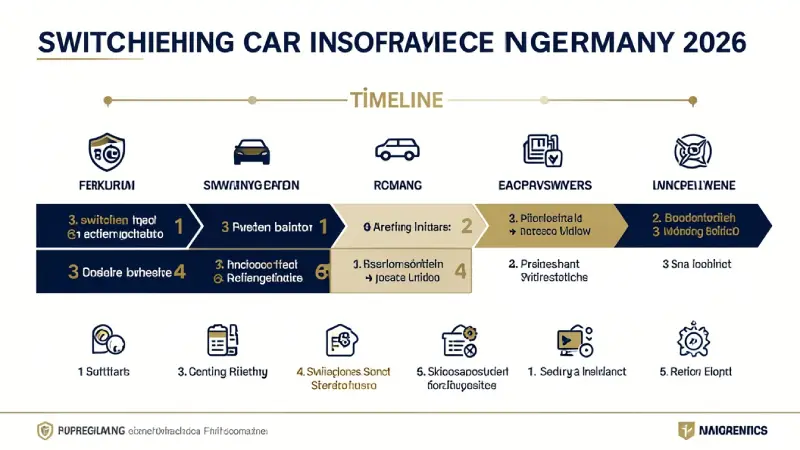
📅 How to Switch KFZ-Versicherung — The November 30 Deadline
The vast majority of German car insurance policies run from January 1 to December 31, with a Kündigungsfrist (notice period) of one month — meaning you must cancel by November 30 to switch from January 1. This creates the most competitive insurance market of the year in October and November, with every major insurer offering their best rates to attract switchers.
The Switching Process — Step by Step
- Get comparison quotes in October–November. Use Check24, Verivox, or direct insurer websites to compare quotes. Enter your vehicle details, current SF class, PLZ, annual mileage, and garage situation for accurate quotes. The market is most competitive in October and November — don't wait until December 1.
- Select your new insurer and obtain your eVB-Nummer. Once you've chosen your new insurer, sign up online or via phone. You'll receive your eVB-Nummer immediately — keep this safe, as you'll need it if you also need to re-register the vehicle.
- Cancel your existing policy by November 30. Send a cancellation letter (Kündigung) to your current insurer by November 30, either by post (Einschreiben recommended) or email with read receipt if the insurer accepts this. Your cancellation must state your policy number, name, and the effective date of cancellation (December 31).
- Your current insurer sends a Schadenfreiheitsbescheinigung. After cancellation, your current insurer must provide your no-claims certificate within 2 weeks. Forward this to your new insurer to confirm your SF class transfer.
- New cover begins January 1. Your new policy activates from January 1. You'll receive updated insurance documents (Versicherungsschein) and a new green card (Grüne Karte) for travel within Europe.
💡 How to Reduce Your KFZ-Versicherung Premium in 2026 — 8 Proven Tips
1. Switch at the November 30 deadline every year
German insurers offer their most competitive rates to new customers. By switching every 1–2 years at the November 30 deadline, you avoid the "loyalty penalty" that most insurers apply to continuing customers. Regular switchers save €300–€700 per year on comparable cover compared to long-term renewers.
2. Increase your Selbstbeteiligung (excess/deductible)
Raising your Vollkasko Selbstbeteiligung from €150 to €500 typically reduces your Vollkasko premium by 15–25%. Raising it to €1,000 saves 25–35%. This makes sense if you have savings to absorb a higher deductible in the event of a claim.
3. Garage parking reduces premiums
Declaring your vehicle is garaged overnight (rather than parked on the street) reduces both Teilkasko and Vollkasko premiums — typically 8–12%. Ensure this is accurate — false declarations can void your cover.
4. Reduce your declared annual mileage
If you drive less than 10,000 km per year, declare it accurately — you'll pay significantly less than a driver declaring 20,000 km. Wenigfahrer (low-mileage) tariffs are available from most major insurers for drivers under 8,000–10,000 km/year.
5. Add named drivers carefully
Adding a young driver (under 25) to your policy as a named additional driver significantly increases your premium. Adding an experienced driver (50+, clean SF history) to your policy as a named driver can sometimes reduce it slightly with certain insurers.
6. Consider downgrading older cars to Haftpflicht or Teilkasko
A general rule of thumb: when your annual Vollkasko premium exceeds 10% of the vehicle's market value, it's time to consider switching to Teilkasko only. For a 10-year-old VW Golf worth €6,000, paying €800/year for Vollkasko is rarely economically justified.
7. Pay annually, not monthly
Monthly premium payments typically add 3–6% to the annual cost through instalment surcharges (Ratenzuschlag). Annual payment eliminates this entirely.
8. Use telematics if you're a safe, low-mileage driver
If you drive safely and infrequently, Generali's Fairsicherung app or similar telematics programmes can reduce your premium by 15–30%. Particularly valuable for young drivers facing high SF ½ or SF 0 premiums.

❓ Frequently Asked Questions — KFZ-Versicherung Germany 2026
Is car insurance mandatory in Germany?
Yes — Kfz-Haftpflichtversicherung (third-party liability) is legally mandatory for every registered vehicle in Germany. Driving without valid insurance is a criminal offence under §1 PflVG, carrying fines of up to €5,000, up to one year in prison, and a driving ban. Every German insurer provides an eVB-Nummer (electronic insurance confirmation) that must be presented to the Kfz-Zulassungsstelle when registering a vehicle — the vehicle cannot be registered without it.
What is the difference between Teilkasko and Vollkasko?
Teilkasko (partial comprehensive) covers damage to your own vehicle from theft, fire, natural events (hail, storm, flood, lightning), glass breakage, and animal collisions. It does NOT cover at-fault accident damage. Vollkasko (full comprehensive) includes everything in Teilkasko plus damage caused by your own fault in an accident and vandalism. Vollkasko claims for at-fault accidents trigger a Rückstufung — a step-down of your SF class, raising premiums the following year. The decision between Teilkasko and Vollkasko typically depends on the vehicle's age and value.
How do SF classes work in Germany?
Schadenfreiheitsklassen (SF classes) are Germany's no-claims discount system. Every year you drive without making a claim, your SF class increases by one — reducing your premium percentage. New drivers typically start at SF ½ (most expensive, 200–220% of base rate). After 10 claim-free years, you reach SF 10 (55–65% of base rate) — roughly 60% cheaper than when you started. Making a claim causes a Rückstufung — you drop back several SF classes and your premium rises. SF classes are transferable between insurers via the Schadenfreiheitsbescheinigung issued by your departing insurer.
Can I switch car insurance at any time in Germany?
Normally, most German car insurance policies have a notice period of one month at the end of the policy year (November 30 deadline for January 1 renewal). However, German law grants a Sonderkündigungsrecht (special termination right) in certain situations: if your insurer raises premiums (you can cancel within one month of notification), if you make a claim and the insurer exercises their right to adjust terms, or if you sell, scrap, or total your vehicle. Exercise of Sonderkündigung must occur within one month of the triggering event.
What is the Grüne Karte and do I need it?
The Grüne Karte (International Motor Insurance Certificate) is a document proving your car is insured when driving in European countries that are part of the Green Card system. Within the EU and EEA, your German registration certificate and number plates are technically sufficient proof of insurance — the Grüne Karte is no longer legally required in EU countries. However, it is still required in some non-EU countries participating in the system (Turkey, Morocco, Russia, Belarus, Serbia etc.) and is strongly recommended as it simplifies any police or border checks. Your German insurer provides it free of charge — request it before travelling outside the EU.
How much does car insurance cost in Germany for a new driver?
New drivers in Germany (SF ½ class) face some of the highest car insurance premiums in Europe. For a typical compact car (VW Golf equivalent) with Haftpflicht only in a major city like Berlin or Munich, expect to pay €700–€1,400/year depending on the insurer and city. Vollkasko for a new driver on a new car can easily reach €1,800–€3,000/year. The premium reduces significantly with each claim-free year. Strategies to reduce costs include: being added as a second named driver on a parent's policy first (earns driving experience), using a telematics app (Generali Fairsicherung — up to 30% discount), choosing a lower Typklasse vehicle, and increasing the Selbstbeteiligung.
✅ Our Verdict — Best KFZ-Versicherung Germany 2026
For most German drivers, HUK-COBURG delivers the best combination of premium value and cover quality — their mutual structure consistently produces the market's lowest premiums at "Sehr gut" quality. DEVK is the standout choice for families with multiple vehicles. Allianz is the clear leader for expats and international drivers who need English-language service and foreign NCD recognition. Gothaer is essential consideration for EV owners, and Generali Fairsicherung is the best option for young drivers willing to engage with telematics.
Whatever insurer you choose: use the November 30 deadline actively every year, compare through Check24 or Verivox as well as directly, and never assume your current insurer is offering you their best rate at renewal.
| Your Situation | Best Provider |
|---|---|
| Best overall value, German speaker | HUK-COBURG |
| Family with 2+ cars | DEVK |
| Expat — English service, foreign NCD | Allianz or Zurich |
| Electric vehicle (EV/PHEV) | Gothaer |
| Young driver (18–26) — telematics | Generali Fairsicherung |
| Digital-first, app management | AXA or Adam Riese |
| Absolute cheapest online quote | DA Direkt |
| Baden-Württemberg regional | Württembergische |
Disclaimer: This article is for informational purposes only and does not constitute financial or insurance advice. KFZ-Versicherung products are regulated by BaFin (Bundesanstalt für Finanzdienstleistungsaufsicht). All premium figures are indicative estimates based on the profile described and will vary based on individual circumstances, Typklasse, Regionalklasse, SF class, and insurer underwriting. Stiftung Warentest ratings sourced from October 2025 KFZ-Versicherung Vergleich. GDV premium increase data sourced from GDV Statistisches Taschenbuch 2025. Nexuora does not receive commission from any insurer listed. Updated March 2026.

Ahmada Ndao is a financial research analyst and independent journalist
specializing in US consumer finance, legal rights, and insurance markets.
With over 5 years covering American financial products, he has helped
thousands of readers navigate complex insurance decisions, find the right
legal representation, and optimize their credit strategies. His research
methodology combines primary data analysis, direct outreach to industry
professionals, and continuous monitoring of federal regulatory changes.
Ahmada’s work has been cited by financial communities across the US and
reviewed by licensed attorneys and insurance professionals for accuracy.