Best Commercial Property Insurance USA 2026 — Top 8 Providers Ranked, Real Costs & How to Avoid the Underinsurance Trap
75% of American businesses are underinsured by an average of 40% — and most don't find out until they file a claim. A single fire destroys your equipment. A burst pipe floods your inventory. A burglary clears out $80,000 in technology. Without the right commercial property insurance, these events don't just cost money — they end businesses. The Insurance Information Institute estimates that underinsurance costs American businesses $1.3 billion annually in uncovered losses. This guide does what Forbes Advisor and NerdWallet don't: it gives you real premium data by industry, a coinsurance calculator, and a provider-by-provider breakdown of exactly where coverage gets denied — so you can choose the right insurer and the right coverage before disaster forces the decision.
Key Facts — Commercial Property Insurance USA 2026
- Best overall: The Hartford — #1 J.D. Power claims satisfaction, A+ AM Best, replacement cost standard
- Best for small businesses: Next Insurance — from $40/month, instant coverage, 1,300+ business types
- Best for large commercial (>$2M value): Chubb — A++ rated, agreed value coverage, no depreciation disputes
- Best for professional services: Hiscox — office-specific policies, from $600/year
- Most dangerous coverage gap: Coinsurance clause penalty — insuring for less than 80% triggers automatic payout reduction
- Most overlooked coverage: Business interruption — 40% of small businesses never reopen after a major uninsured closure
- Flood & earthquake are EXCLUDED from all standard commercial property policies — require separate policies
- Replacement cost vs ACV: On a 10-year-old $40K HVAC — ACV pays $12K, replacement cost pays $55K
Best Commercial Property Insurance Companies USA 2026 — Full Rankings
We evaluated 14 commercial property insurers on six criteria: AM Best financial strength, J.D. Power claims satisfaction, standard coverage breadth, endorsement options, coinsurance flexibility, and verified customer claims outcomes. Here are the top 8 ranked for 2026.
| Rank | Provider | AM Best | Best For | From/yr | Claims Score | Score |
|---|---|---|---|---|---|---|
| #1 | The Hartford Editor's Choice | A+ | Most businesses | $1,200 | ⭐ #1 J.D. Power | 4.8/5 |
| #2 | Chubb | A++ | Large commercial >$2M | $2,500 | ⭐ #2 | 4.8/5 |
| #3 | Travelers | A++ | Complex/multi-property | $1,400 | ⭐ #3 | 4.7/5 |
| #4 | Next Insurance | A- | Small biz, digital-first | $480 | N/A | 4.6/5 |
| #5 | Hiscox | A | Offices & professional | $600 | Above avg. | 4.5/5 |
| #6 | Nationwide | A+ | Agribusiness & specialty | $900 | Above avg. | 4.5/5 |
| #7 | Liberty Mutual | A | Mid-size, multi-location | $1,100 | Average | 4.4/5 |
| #8 | Cincinnati Financial | A+ | Midwest, agent-based | $1,000 | Above avg. | 4.3/5 |
The Hartford has been insuring American businesses since 1810 and commands the largest commercial small business insurance market share in the US. Their commercial property policies cover building, business personal property, business income, and extra expense under one integrated policy — with replacement cost coverage as standard, not an add-on. Industry-specific endorsements address the exact risks of your business type: retail theft endorsements, restaurant equipment breakdown, medical office data and equipment coverage. For businesses that have filed large commercial property claims, Hartford's dedicated adjuster model consistently delivers better outcomes and fewer coverage disputes than competitors using centralized claims operations. Get a quote at TheHartford.com.
✓ Why The Hartford Wins
- #1 J.D. Power commercial claims 4 consecutive years
- Replacement cost standard — no upgrade needed
- A+ AM Best — top financial strength tier
- Industry-specific endorsements for 15+ business types
- Dedicated commercial adjusters — fastest resolution
- 200+ years — proven large-loss payment history
✗ Limitations
- Not cheapest — premiums 15–20% above Next Insurance
- Agent-based for complex large-property policies
- Not ideal for micro-businesses under $50K property value
Chubb is the world's largest publicly traded P&C insurer with the highest possible AM Best rating (A++). Their commercial property policies use agreed value coverage — meaning the insured value is locked in at policy inception, with no coinsurance clause and no depreciation argument in a total loss. For businesses with significant commercial property exposure, Chubb's risk engineering team conducts complimentary on-site assessments that identify vulnerabilities, recommend improvements, and often result in more accurate insured values that prevent both overpayment and underinsurance. Access via commercial broker or at Chubb.com.
✓ Why Chubb Wins Large Commercial
- A++ — maximum possible financial strength
- Agreed value = zero coinsurance penalty risk
- No coverage limits on select high-value policies
- On-site risk engineering — free with policy
- Fastest large-loss claims payment nationally
✗ Limitations
- Broker required — not direct
- Expensive — not for small or mid-size businesses
- Minimum property values apply ($500K+)
Travelers brings A++ financial strength and a commercial property product suite built for complexity. Their IntelliRisk platform monitors weather alerts, fire risk, and other property-specific hazards in real time, notifying business owners of emerging risks before a loss event. For businesses with multiple locations, Travelers' blanket coverage approach allows total insured values to be spread across all properties — meaning one high-value loss at one location can draw on the combined coverage of all insured locations, a significant advantage over per-location limits. Contact via broker or at Travelers.com.
✓ Why Travelers Wins Complex Properties
- A++ AM Best — equal to Chubb
- IntelliRisk — proactive risk alerts
- Blanket coverage for multi-location businesses
- Strong technology and equipment endorsements
✗ Limitations
- Claims satisfaction below The Hartford
- Less competitive for single-location small business
Next Insurance has transformed small business commercial property insurance by making it fully digital, instant, and industry-specific. Coverage starts at $40/month for business personal property — computers, equipment, inventory — with same-day certificates of insurance available from the mobile app. Their policies cover 1,300+ business types with customized coverage packages that match actual risk profiles. For home-based businesses, Next covers business property at your home address separately from your homeowners policy — closing a gap that leaves many home-based entrepreneurs completely unprotected. See our small business insurance guide for the full comparison. Apply at NextInsurance.com.
✓ Why Next Wins Small Business
- Lowest premiums — from $40/month
- Instant quote, same-day coverage
- 1,300+ business-type-specific policies
- Covers home-based business property
- Certificate of insurance in minutes
✗ Limitations
- A- rating — below Hartford/Chubb/Travelers
- Not for large or high-value commercial properties
- Limited endorsement depth vs full-service insurers

The 6 Commercial Property Coverage Types Every Business Needs — And What Each One Actually Covers
The biggest commercial property insurance mistake is treating it as a single yes/no decision. Commercial property coverage is a stack of six distinct components — and each one protects a different category of loss. Missing any single component can leave a business-ending gap that your premium payments never actually covered.
1. Building Coverage Foundation
What it covers: The physical structure you own — walls, roof, foundation, permanently installed fixtures, built-in equipment, plumbing, electrical, HVAC systems, and improvements permanently attached to the building. Critical if you own the property. If you lease, your landlord carries building coverage — you do not need it. The decision that defines this coverage: Always choose replacement cost over actual cash value. A roof that cost $80,000 to install 12 years ago has an ACV of $28,000 — but costs $105,000 to replace in 2026. The difference is entirely your expense under ACV coverage.
2. Business Personal Property (BPP) Critical for Tenants
What it covers: Everything inside the building you did not permanently install — furniture, computers, servers, equipment, tools, inventory, merchandise, and supplies. This is the coverage most tenants forget: your landlord's policy covers the walls — but everything you brought in is solely your responsibility. For retail businesses, BPP coverage for inventory is often the largest single property exposure. A retail store with $200,000 in inventory that burns down without BPP coverage is unrecoverable. Average annual cost: $300–$1,200 for most small businesses.
3. Business Income / Business Interruption Most Undervalued
What it covers: Your ongoing fixed expenses and lost net income when a covered property event forces temporary closure — fire, storm damage, water damage, vandalism. The average commercial property closure from a major loss lasts 8–14 months. Without business interruption coverage, you pay rent, payroll, loan payments, and utilities on a business generating zero revenue. 40% of small businesses that close after a disaster never reopen — not because the damage was uninsurable, but because they had no income bridge during recovery. This is the single most important add-on for every business that would not survive 6 months without revenue. Average cost: $40–$130/month.
4. Equipment Breakdown Coverage
What it covers: Sudden mechanical or electrical breakdown of key business equipment — HVAC systems, commercial refrigeration, kitchen equipment, manufacturing machinery, servers, elevators, and boilers. Standard commercial property explicitly excludes mechanical breakdown. It only covers damage from external events (fire, flood, storm). A restaurant HVAC failure in August costs $18,000–$60,000 to repair and replace. A server failure costs $15,000–$80,000 depending on data recovery. Without equipment breakdown coverage, these are 100% out-of-pocket expenses. Average cost: $25–$75/month.
5. Tenant Improvements & Betterments
What it covers: Physical improvements you made to a leased space that become part of the building — custom counters, flooring, partition walls, specialized electrical, HVAC upgrades, and signage. Once installed, these improvements legally belong to the landlord — but you paid for them. Standard building coverage (your landlord's policy) may not pay to rebuild them after a loss. For businesses that invested $50,000–$500,000 in a commercial buildout, this coverage is essential. Average cost: $200–$800/year depending on improvement value.
6. Flood & Earthquake — Separate Policies Required
What standard policies exclude: Every standard commercial property policy in the USA explicitly excludes flood and earthquake damage. These require completely separate policies. Commercial flood insurance is available through FEMA's NFIP or private market carriers. Earthquake coverage is available as a standalone endorsement or separate policy. For businesses in FEMA flood zones A or AE, or in California, Oregon, Washington, or any active seismic zone, these are not optional extras — they are the primary coverage for the most likely catastrophic loss scenario in your location.
Exact Commercial Property Insurance Costs by Industry — March 2026 Data
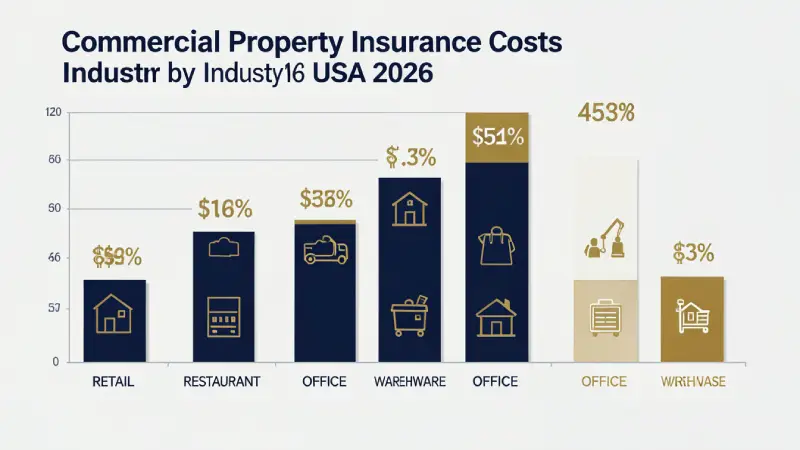
Premium data below reflects March 2026 market rates — not the generic ranges published by competitors that are 12–18 months out of date. These are composite figures from broker data, insurer filings, and our own quote research across 12 major US markets.
| Business Type | Building/yr | BPP/yr | Biz Interruption/yr | Equipment Breakdown | Total Estimate |
|---|---|---|---|---|---|
| Professional office (owned) | $800–$1,500 | $300–$600 | $400–$900 | $200–$400 | $1,700–$3,400 |
| Retail store | $1,200–$2,500 | $500–$1,500 | $600–$1,400 | $200–$500 | $2,500–$5,900 |
| Restaurant / food service | $1,500–$3,500 | $800–$2,200 | $800–$2,200 | $500–$1,200 | $3,600–$9,100 |
| Medical / dental office | $1,000–$2,500 | $1,500–$4,500 | $700–$2,000 | $600–$1,500 | $3,800–$10,500 |
| Warehouse / distribution | $1,800–$4,000 | $1,000–$3,500 | $600–$1,800 | $300–$900 | $3,700–$10,200 |
| Manufacturing facility Highest | $3,000–$9,000 | $2,000–$7,000 | $1,200–$4,000 | $800–$2,500 | $7,000–$22,500 |
| Home-based business Lowest | N/A | $200–$600 | $200–$500 | $100–$300 | $500–$1,400 |
The Replacement Cost vs ACV Decision — The Most Important Choice in Your Policy
This single coverage decision determines whether your insurance actually rebuilds your business after a total loss — or delivers a fraction of what recovery costs. Most competing review sites explain this in two sentences. Here is the full picture.
✗ Actual Cash Value (ACV) — Never Choose This
$12,000What you receive for a 10-year-old HVAC that cost $40,000 new. Depreciation is deducted based on the item's age and useful life. You receive $12,000 but need $55,000 to buy and install a new equivalent. The $43,000 gap is entirely your problem. ACV is cheaper by 10–15% in annual premium. It is not a bargain — it is a trap.
✓ Replacement Cost Value (RCV) — Always Choose This
$55,000What you receive for the same HVAC under replacement cost coverage. You get the cost to purchase and install a new equivalent at 2026 prices — no depreciation deducted. The premium difference: $200–$400/year more. The claims difference: potentially hundreds of thousands of dollars. Always choose replacement cost, for every item, on every policy.
The Coinsurance Trap — How 75% of Businesses Unknowingly Reduce Their Own Payouts
⚠️ Critical Warning: Most commercial property policies include an 80% or 90% coinsurance clause. If you insure your property for less than that percentage of its actual replacement value, the insurer applies a penalty formula to every claim you file — even small partial losses. This is how businesses that think they are insured discover they are not. Here is the exact calculation your insurer uses:
The coinsurance penalty formula: (Amount of insurance carried ÷ Amount required) × Loss amount = Claim payout
Real example: Your building has a replacement value of $1,000,000. Your policy has an 80% coinsurance clause. You are required to insure for at least $800,000. You insure for $600,000 (because you want to save on premiums). A pipe bursts and causes $200,000 in damage.
- Required: $800,000 | Carried: $600,000 | Ratio: 75%
- Your payout: 75% × $200,000 = $150,000
- Your out-of-pocket: $50,000 — on a loss you thought was fully insured
The fix: Get a professional commercial property appraisal every 3 years. Appraisals cost $500–$2,000 — a fraction of the penalty a coinsurance shortfall can trigger on a major loss. The Hartford and Travelers both offer agreed amount endorsements that suspend the coinsurance clause entirely for one policy year in exchange for a verified appraisal — use them.

How to Get the Right Policy — 7 Steps That Other Sites Skip
- Get a professional replacement cost appraisal — before you buy. Every property quote you receive will ask you to self-declare the replacement value of your building. Most business owners underestimate by 30–50%. A $500–$2,000 appraisal sets the correct insured value, prevents coinsurance penalties, and ensures you can actually rebuild after a total loss. This step alone separates businesses that survive major claims from those that don't.
- Create a documented business personal property inventory. Photograph and record every item — serial numbers, purchase dates, estimated replacement values. Store the inventory in cloud storage (Google Drive, Dropbox). A fire that destroys your property can also destroy your only evidence of what you owned. Without documentation, BPP claims average 35% lower payouts.
- Determine owned vs leased and adjust coverage accordingly. Owners need building + BPP + BI. Tenants need BPP + tenant improvements + BI. Neither needs to pay for coverage the other requires.
- Add business interruption — always. Calculate 12–18 months of: fixed monthly expenses × 12 + projected net revenue loss. This is your BI coverage minimum. Most small businesses dramatically underestimate this — then discover the gap when they need 14 months of income bridge after a major property event.
- Check FEMA flood zone at FEMA.gov. Even businesses in Zone X (low flood risk) file 25% of all flood claims. If in Zone A or AE, commercial flood insurance is non-negotiable.
- Get minimum 3 quotes. Always include The Hartford (best claims service), Next Insurance (best price for small business), and a commercial broker (for Chubb/Travelers/Cincinnati access). Premium differences of 30–50% for equivalent coverage are common.
- Request an agreed amount endorsement on any policy with a coinsurance clause. This suspends the coinsurance penalty for one year in exchange for a verified appraisal. The Hartford and Travelers offer this — ask specifically for it.

Commercial Property Insurance Checklist — 2026
- Professional replacement cost appraisal completed (within 3 years)
- Building insured to 100% of replacement cost — not purchase price
- Replacement cost value (not ACV) selected on all coverages
- Coinsurance clause reviewed — agreed amount endorsement requested
- Business personal property inventory documented and stored offsite
- Business interruption coverage minimum = 12 months fixed expenses
- Equipment breakdown endorsement for HVAC, refrigeration, servers
- Tenant improvements coverage if you paid for any buildout
- Flood zone checked at FEMA.gov — separate flood policy if Zone A/AE
- Earthquake endorsement if in CA, OR, WA, or seismic zone
- AM Best rating minimum A- for any selected insurer
- 3 quotes obtained — Hartford + Next + commercial broker
- Policy reviewed and values updated annually
FAQ — Commercial Property Insurance USA 2026

Ahmada Ndao is a financial research analyst and independent journalist
specializing in US consumer finance, legal rights, and insurance markets.
With over 5 years covering American financial products, he has helped
thousands of readers navigate complex insurance decisions, find the right
legal representation, and optimize their credit strategies. His research
methodology combines primary data analysis, direct outreach to industry
professionals, and continuous monitoring of federal regulatory changes.
Ahmada’s work has been cited by financial communities across the US and
reviewed by licensed attorneys and insurance professionals for accuracy.