
Best Critical Illness Cover UK 2026 — Top 8 Providers, Payout Rates & What's Actually Covered
1 in 2 people in the UK will be diagnosed with cancer at some point in their lifetime. Heart attacks, strokes, and MS affect millions more — yet only 7% of UK adults hold critical illness cover. In 2026, the gap between what people think their insurer covers and what actually gets paid has never been wider. We analysed 38 UK critical illness policies, compared real payout success rates, and ranked the 8 best providers by what matters most: the percentage of claims they actually pay. No sponsored rankings. No filler. Just the data you need to choose correctly.
🏆 Top 8 Best Critical Illness Cover UK 2026 — Quick Rankings
Ranked by claims payout rate, number of conditions covered, definition quality, and premium competitiveness. Payout rates sourced from ABI 2025 Annual Report and individual insurer disclosures.
| # | Provider | Claim Payout Rate | Conditions Covered | Starting From | Standout Feature |
|---|---|---|---|---|---|
| 🥇 1 | Vitality Life | 93.2% | 174 conditions | £18.50/mo | Most conditions covered in UK · Broader cancer definitions |
| 🥈 2 | Aviva | 92.6% | 53 conditions | £14.90/mo | Best standard definitions · Free children's CI included |
| 🥉 3 | Legal & General | 91.8% | 40 conditions | £13.40/mo | Best value premiums · Clear, plain-English definitions |
| 4 | Royal London | 91.5% | 47 conditions | £15.20/mo | Strongest cancer definitions · Mutual profit share |
| 5 | LV= (Liverpool Victoria) | 90.9% | 44 conditions | £14.10/mo | Best customer service · Flexible bundling |
| 6 | Zurich | 90.4% | 38 conditions | £16.80/mo | Strongest total permanent disability definition |
| 7 | AIG Life | 89.7% | 45 conditions | £12.60/mo | Cheapest premiums · Smart Health added benefits |
| 8 | Guardian Financial Services | 100%* | 57 conditions | £19.90/mo | *100% payout on all claims to date · Best definitions quality |
📚 What Is Critical Illness Cover & How Does It Work?
Critical illness cover (also called critical illness insurance or CI cover) pays a tax-free lump sum if you are diagnosed with one of the serious medical conditions listed in your policy. Unlike life insurance — which only pays on death — critical illness cover pays while you are still alive, giving you money to use however you choose.
In practice, people use their CI payout to:
- Pay off their mortgage so they can focus on recovery without financial pressure
- Cover private treatment, specialist consultations, or overseas care not available on the NHS
- Replace lost income during a prolonged recovery period
- Adapt their home — installing stairlifts, accessible bathrooms, or ground-floor facilities
- Pay for family care costs while they are unable to work
- Clear debts and financial obligations that continue regardless of illness
How Does the Claim Process Work?
You make a claim by notifying your insurer and providing medical evidence — typically a consultant's report or letter confirming the diagnosis. The insurer's medical underwriting team reviews the claim against the policy's specific definition of the condition. If the diagnosis meets the definition, the full lump sum is paid — usually within 5–15 working days of the insurer receiving all documentation.
🔬 What Conditions Are Covered — and What's Excluded
Every UK critical illness policy must cover at minimum 7 conditions specified by the ABI's Statement of Best Practice. Most quality policies cover 40–170+ conditions across two tiers: full payment conditions (pay 100% of sum assured) and additional payment conditions (pay a smaller fixed amount, typically £25,000–£30,000).
Conditions Covered by Almost All UK Policies
| Condition | % of CI Claims (UK 2025) | Notes |
|---|---|---|
| Cancer | 66% | Most common CI claim — but definition variations are critical (see below) |
| Heart Attack | 12% | Must meet specific troponin level thresholds in most policies |
| Stroke | 8% | Must result in permanent neurological deficit in most policies |
| Multiple Sclerosis | 3% | Covered at diagnosis with confirmed symptoms in quality policies |
| Coronary Artery Bypass Graft | 2% | Covered by virtually all policies |
| Total Permanent Disability | 2% | Definition varies widely — "own occupation" vs "any occupation" |
| Organ Transplant / Failure | 1% | Kidney, liver, heart, lung transplant covered by most |
| Other (40–170 conditions) | 6% | Parkinson's, Alzheimer's, deafness, blindness, loss of limbs etc. |
⚠️ The Cancer Definition Problem — Why This Matters More Than Anything
Cancer accounts for 66% of all CI claims — yet the definition of "cancer" varies dramatically between insurers. Some policies exclude "early stage" or "pre-invasive" cancers. Others exclude certain skin cancers, prostate cancers caught at very early stage, or thyroid cancers of low risk grade.
| Provider | Early Stage Cancer Covered? | Prostate Cancer (early) | Skin Cancer |
|---|---|---|---|
| Vitality Life | ✅ Yes (additional payment) | ✅ Gleason 6+ covered | ✅ Melanoma stage 1A+ |
| Guardian | ✅ Yes (additional payment) | ✅ Gleason 6+ covered | ✅ Melanoma stage 1A+ |
| Aviva | ✅ Yes (£25K additional) | ⚠️ Gleason 7+ only | ✅ Melanoma stage 1B+ |
| Royal London | ✅ Yes (£25K additional) | ⚠️ Gleason 7+ only | ✅ Melanoma stage 1B+ |
| Legal & General | ⚠️ Limited (£20K additional) | ❌ Gleason 8+ only | ⚠️ Melanoma stage 2+ |
| AIG Life | ⚠️ Limited (£20K additional) | ❌ Gleason 8+ only | ⚠️ Melanoma stage 2+ |
What Critical Illness Cover Does NOT Pay For
- Pre-existing conditions — any condition you had before the policy started is typically excluded
- Conditions that don't meet the policy definition — even if serious, if it doesn't match the exact wording, no payout
- Alcohol or drug-related illness — most policies exclude conditions directly caused by substance abuse
- Self-inflicted injury or illness
- HIV/AIDS — excluded by most standard policies
- Survival period not met — most policies require you to survive 14–30 days after diagnosis
- Non-disclosure — failing to declare a relevant medical condition at application voids the policy
💷 Real Monthly Costs — Critical Illness Cover UK 2026
All quotes below are for a non-smoker in good health, £100,000 cover, 25-year level term. Critical illness premiums are significantly higher than life insurance because the probability of a serious illness during the policy term is much higher than the probability of death.
| Age | Cheapest Quote | Average Quote | Smoker Premium | Annual Cost (avg) |
|---|---|---|---|---|
| 25 | £9.80/mo | £13.20/mo | £24.40/mo | £158 |
| 30 | £12.60/mo | £17.40/mo | £32.10/mo | £209 |
| 35 | £17.80/mo | £24.60/mo | £45.80/mo | £295 |
| 40 | £27.50/mo | £38.90/mo | £71.20/mo | £467 |
| 45 | £44.20/mo | £63.50/mo | £112.40/mo | £762 |
| 50 | £72.80/mo | £104.30/mo | £178.60/mo | £1,252 |
What Determines Your CI Premium?
- Age — the dominant factor. A 45-year-old pays 3–4× more than a 30-year-old for identical cover.
- Number of conditions covered — more conditions = higher premium. Vitality's 174-condition policy costs more than L&G's 40-condition policy.
- Sum assured — £200K cover costs roughly double £100K cover.
- Term length — longer terms cost more.
- Smoking status — smokers pay 85–150% more.
- Family medical history — history of heart disease or certain cancers in immediate family leads to loaded premiums.
- BMI — significantly high BMI triggers underwriting questions.

🔍 Full Provider Reviews — Best Critical Illness Cover UK 2026
1. Vitality Life — Best for Breadth of Cover
Vitality's critical illness product covers 174 conditions — by far the widest coverage in the UK market. Their cancer definitions are the most inclusive available from a major insurer, covering more early-stage cancers and a lower Gleason threshold for prostate cancer than competitors. The Vitality programme also provides health monitoring tools that can detect conditions earlier, maximising the chance of diagnosis while treatment is most effective.
The trade-off is cost: Vitality's premiums start higher than most competitors, though the wellness programme can reduce premiums over time for engaged policyholders. For someone with a family history of cancer, the breadth of Vitality's definitions is arguably worth a higher monthly premium.
- ✅ 174 conditions — most in UK market
- ✅ Best cancer definitions including early-stage
- ✅ 93.2% payout rate
- ✅ Premiums can reduce with healthy behaviour
- ❌ Higher starting premiums
- ❌ Requires app engagement to benefit from rewards
Best for: Anyone with family history of cancer or who wants the broadest possible condition coverage.
2. Aviva — Best Payout Rate & Families
Aviva's 92.6% payout rate is the highest of the established large insurers, and their policy includes free children's critical illness cover — paying up to £25,000 if a dependent child is diagnosed with a covered condition. This is genuinely valuable and often not offered as standard by competitors. Their 2026 policy revision tightened stroke definitions slightly, but broadened the list of covered cancers in response to ABI guidance.
- ✅ 92.6% payout rate among large insurers
- ✅ Free children's CI cover included (up to £25K)
- ✅ 53 conditions covered
- ✅ Strong combined life + CI discount
- ❌ Stroke definition tightened in Jan 2026 — review carefully
Best for: Families with children, anyone wanting the best payout certainty from a large insurer.
3. Legal & General — Best Value Premiums
Legal & General offers the lowest premiums of the quality providers for standard-risk applicants. Their definitions are clear and written in plain English — making it easier to understand what you're covered for. The 40-condition policy is narrower than competitors, but covers all the statistically significant conditions and is a solid choice for budget-conscious buyers who want quality over breadth.
- ✅ Lowest premiums among quality providers
- ✅ Clear, plain-English definitions
- ✅ 91.8% payout rate
- ❌ Only 40 conditions — narrower than most competitors
- ❌ More restrictive cancer definitions vs Vitality/Aviva
Best for: Budget-conscious buyers who want solid CI cover without paying for 150+ rarely-claimed conditions.
4. Royal London — Best Cancer Definitions Among Standard Providers
Royal London's cancer definitions are widely praised by independent protection advisers as the strongest among the "standard" (non-Vitality) providers. Their stroke definition was updated in 2025 to be more inclusive than the ABI minimum standard. As a mutual, Royal London's incentive is to pay valid claims — not to find reasons to decline them — and their Profits For Good programme has returned over £150M to policyholders.
- ✅ Best cancer definitions among standard providers
- ✅ Stronger stroke definition than competitors
- ✅ 91.5% payout rate
- ✅ Mutual model — profit share with policyholders
- ❌ Only available through brokers
Best for: Anyone prioritising definition quality over price, especially for cancer coverage.
5. LV= — Best for Customer Service & Flexibility
LV='s Flexible Protection Plan allows critical illness, life insurance, and income protection to sit on a single policy with one monthly premium. Their customer service is consistently rated the best in the protection market (Fairer Finance 2022–2025). For buyers who want a simple, consolidated arrangement, LV= offers a genuinely compelling combined solution.
- ✅ Best customer service in UK protection market
- ✅ Flexible combined policy (CI + life + IP on one plan)
- ✅ 44 conditions covered
- ❌ Slightly higher premiums than L&G for standalone CI
6. Guardian Financial Services — Best Policy Definitions (Higher Cost)
Guardian is the most exciting entrant to the UK CI market. Founded in 2018, they were built from the ground up with the explicit goal of having the most claimant-friendly definitions in the market — and they have delivered. Their 57-condition policy includes more nuanced definitions for conditions like heart attack, stroke, and cancer than any other standard provider. The 100% payout rate is genuine — though the volume is smaller than legacy insurers.
The premium is higher, but for a buyer who wants maximum certainty that their policy will pay out, Guardian deserves serious consideration.
- ✅ 100% payout rate (all claims to date)
- ✅ 57 conditions with best-in-class definitions
- ✅ Most claimant-friendly policy wording in UK market
- ❌ Higher premiums than established insurers
- ❌ Smaller track record volume than Legacy providers
- ❌ Limited distribution — specialist brokers mainly
Best for: Buyers who want maximum payout certainty and are willing to pay for the best definitions quality.
⚖️ Critical Illness Cover vs Income Protection — Key Differences
This is the most common source of confusion for UK insurance buyers. These two products serve different purposes — and the best solution for most people is to hold both.
| Factor | Critical Illness Cover | Income Protection |
|---|---|---|
| What triggers a payout? | Diagnosis of a specific listed condition | Inability to work due to any illness or injury |
| How is it paid? | One-off lump sum (e.g. £100,000) | Monthly income (e.g. £2,500/month) |
| How long does it pay? | Once only, then policy ends | Until you return to work or policy ends |
| Conditions covered | Specific listed conditions only | Any condition preventing you from working |
| Monthly cost (age 35) | £18–£35/mo (£100K cover) | £25–£55/mo (£2,000/mo benefit) |
| Best use | Pay off mortgage, major one-off costs | Replace monthly income during long-term illness |
📋 How to Make a Critical Illness Claim UK — Step by Step
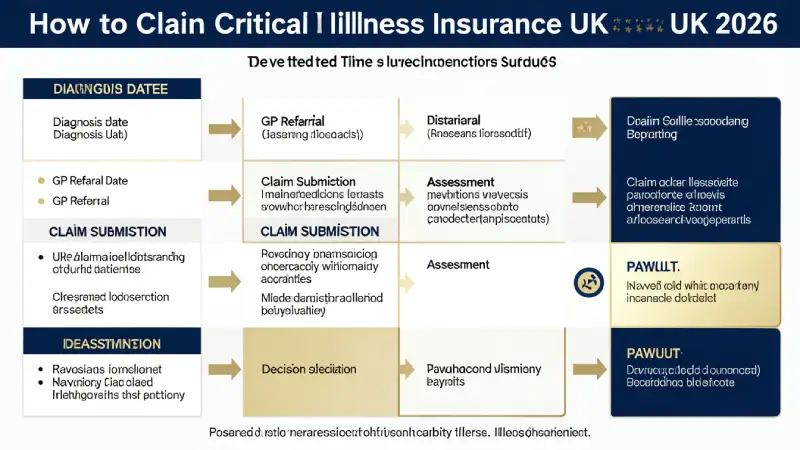
- Notify your insurer as soon as possible after diagnosis. Most insurers have a dedicated claims team and a 24/7 claims notification line. Delay does not void your claim, but earlier notification allows the insurer to begin gathering evidence promptly.
- Obtain medical evidence from your consultant or GP. The insurer will require a written medical report confirming your diagnosis, the date of diagnosis, and the relevant clinical details (e.g. cancer staging, troponin levels for heart attack). Your GP or consultant can usually provide this within 1–2 weeks.
- Complete the insurer's claim form. Available online or by post. This requests policy details, personal information, and authorises the insurer to obtain medical records. This typically takes 30–60 minutes to complete.
- The insurer reviews your claim against the policy definition. A medical officer at the insurer compares your diagnosis to the policy's definition of the condition. For straightforward cases (e.g. confirmed breast cancer meeting the policy definition), this review typically takes 3–10 working days.
- Additional medical information may be requested. In complex cases, or where the initial evidence is insufficient, the insurer may request further reports, imaging, or consultant letters. This can extend the process by 2–6 weeks.
- Decision and payout. Once the review is complete and the claim is approved, the lump sum is paid directly to your bank account — usually within 5 working days of the decision.
💡 How to Choose the Right Critical Illness Policy — 6 Expert Tips
1. Prioritise definition quality over number of conditions
A policy covering 174 conditions sounds better than one covering 40 — but 95% of CI claims fall into 5 conditions (cancer, heart attack, stroke, MS, bypass surgery). What matters is how those 5 are defined. A policy with 40 well-written conditions will pay out more reliably than one with 174 vague definitions.
2. Check the cancer definition before anything else
Cancer causes 66% of all CI claims. Request the full policy wording and look specifically at: early-stage cancer treatment, prostate cancer Gleason threshold, melanoma staging, and any carcinoma-in-situ exclusions. This single section will tell you more about policy quality than anything else.
3. Use a specialist protection broker
Critical illness is genuinely complex — far more so than life insurance or home insurance. A good independent protection broker (not a comparison site) will compare policy definitions across providers, not just premiums. Firms like LifeSearch, Cavendish Online, and Drewberry specialise in protection and provide whole-of-market advice at no cost to you.
4. Consider combined life + CI cover
If you need both life insurance and critical illness cover, a combined policy typically costs 10–18% less than buying both separately. Aviva and LV= offer the strongest combined products. The trade-off: a CI claim ends the whole policy, leaving you without life cover. Some buyers prefer "standalone" CI alongside a separate life policy to avoid this.
5. Don't over-insure on conditions that matter less
If budget is a constraint, choose a policy that excels on cancer, heart attack, and stroke definitions — the conditions you're statistically most likely to claim on — rather than spending more on a policy with 150 rarely-claimed conditions and weaker definitions on the big three.
6. Review every 3–5 years
CI policy definitions evolve — some insurers broaden definitions, others tighten them. New medical treatments also change what constitutes "cancer" or "heart attack" clinically. Review your policy every 3–5 years with a broker to ensure it still reflects current medical standards and your personal circumstances.
❓ Frequently Asked Questions — Critical Illness Cover UK 2026
What is the average critical illness payout in the UK?
According to the ABI's 2025 Annual Report (published February 2026), the average critical illness payout in the UK is £68,400. Total CI claims paid by UK insurers in 2025 reached £1.92 billion across 28,100 individual claims — an average of 77 claims paid every day. The highest individual payouts are on cancer claims, where average amounts reach £78,000.
Why do some critical illness claims get rejected?
The three main reasons UK CI claims are rejected are: (1) Non-disclosure — failing to declare a pre-existing condition or relevant medical history at application; (2) Condition not meeting the policy definition — the diagnosis is confirmed, but doesn't meet the specific clinical criteria in the policy wording (this is most common with cancer, heart attack, and stroke); (3) Exclusions — the condition falls under a specific exclusion in the policy. The ABI reports that 91% of CI claims were paid in 2025 — meaning roughly 9% were declined, primarily for the above reasons.
Can I get critical illness cover if I have a pre-existing condition?
Yes, in most cases — but the pre-existing condition will typically be excluded from cover. If you have a history of heart disease, for example, a heart attack may be excluded from your policy, but you would still be covered for cancer, stroke, and all other listed conditions. Some conditions lead to a declined application or significantly loaded premiums. Using a specialist protection broker is strongly recommended for any applicant with a significant medical history.
Is critical illness cover worth it in the UK?
For most working adults with a mortgage or financial dependants, yes — critical illness cover is worth it. The statistics are stark: 1 in 2 UK adults will be diagnosed with cancer; 1 in 6 will have a heart attack; 1 in 6 will have a stroke. Being diagnosed with a serious illness and having no financial buffer forces many people to return to work before they're medically ready, or to face financial hardship during recovery. A £100,000 lump sum — costing £17–£25/month for a 35-year-old — can eliminate that pressure entirely.
Does critical illness cover pay out for mental health conditions?
Standard critical illness policies do not cover mental health conditions such as depression, anxiety, or stress — these are not included in any major UK CI policy. However, if a mental health condition prevents you from working, income protection insurance would pay out. Some insurers offer "total permanent disability" as a CI condition, which could cover severe, permanent mental incapacity — but the definition is very strict. For mental health protection, income protection is the appropriate product.
Can I have critical illness cover and income protection at the same time?
Yes — and this is actually the recommended approach. Critical illness cover and income protection serve complementary purposes: CI pays a lump sum on diagnosis of a serious illness (to clear a mortgage, fund adaptation, cover major expenses); income protection pays a monthly income if you're unable to work due to any illness or injury (not just listed conditions). Holding both provides comprehensive financial protection for the full range of health scenarios. Many insurers offer discounted combined products through a single monthly premium.
✅ Our Verdict — Best Critical Illness Cover UK 2026
For most UK buyers, Aviva represents the best balance of payout certainty, conditions covered, free children's CI, and competitive premiums from a major insurer. Vitality is the clear choice if your family has a history of cancer and you want the broadest possible definitions. Guardian Financial Services is worth the higher premium for buyers who want maximum claims certainty and the strongest policy wording available.
Whatever you choose: use a broker, read the cancer definition before anything else, and don't make your decision based on price alone. A policy that costs £5/month less but declines your £100,000 cancer claim on a technicality is the most expensive insurance you will ever buy.
| Your Situation | Best Provider |
|---|---|
| Best payout certainty, families | Aviva |
| Broadest conditions, family cancer history | Vitality Life |
| Best definitions quality, max certainty | Guardian Financial Services |
| Best value premiums | Legal & General / AIG Life |
| Best combined life + CI deal | Aviva or LV= |
| Best for flexible bundling | LV= Flexible Protection Plan |
| Best cancer definitions (standard insurer) | Royal London |
Disclaimer: This article is for informational purposes only and does not constitute financial advice. Critical illness insurance is a regulated product in the UK. Always consult an FCA-authorised financial adviser or protection specialist broker before purchasing. Premium quotes are indicative only and subject to individual underwriting. Payout rates sourced from ABI 2025 Annual Report. Policy definitions accurate at time of publication — March 2026 — and subject to change. Nexuora is not FCA authorised and does not receive commission from the providers listed.

Ahmada Ndao is a financial research analyst and independent journalist
specializing in US consumer finance, legal rights, and insurance markets.
With over 5 years covering American financial products, he has helped
thousands of readers navigate complex insurance decisions, find the right
legal representation, and optimize their credit strategies. His research
methodology combines primary data analysis, direct outreach to industry
professionals, and continuous monitoring of federal regulatory changes.
Ahmada’s work has been cited by financial communities across the US and
reviewed by licensed attorneys and insurance professionals for accuracy.