
Best Medicare Supplement Plans USA 2026 — Medigap Plan G vs N vs F Ranked, Real Costs & Top Providers Compared
More than 14.5 million Americans have a Medicare Supplement (Medigap) plan — and in 2026, choosing between Plan G, Plan N, and Plan F has never had more financial consequence. Original Medicare covers approximately 80% of approved medical expenses, leaving the remaining 20% — plus hospital deductibles, skilled nursing facility coinsurance, and excess charges — as out-of-pocket exposure that can reach tens of thousands of dollars in a serious illness. A single hospitalization with the 2026 Part A deductible of $1,736 per benefit period can create multiple deductible events in a single year if multiple hospital stays occur. Plan G, which covers every Medicare gap except the $283 annual Part B deductible, costs an average of $180 per month in 2026 — but rates vary by over 50% between insurers for identical coverage. The difference between the cheapest Plan G and the most expensive Plan G in the same state can be over $1,200 per year, for literally identical benefits. This guide uses 16,954 Medigap quotes from Medicare.gov (MoneyGeek 2026 analysis) to rank the best Medicare Supplement plans and providers for 2026, break down Plan G vs N vs F with real numbers, and give every Medicare beneficiary the complete framework to stop overpaying for a standardized product.
Key Facts — Best Medicare Supplement Plans 2026 (Verified Data)
- Plan G is the best Medigap plan for most new enrollees — covers all Medicare gaps except the $283 Part B annual deductible. Average cost: $180/month for a 65-year-old. Rates rose 13% from 2025 to 2026 (+$21/month average).
- Plan N is the best budget option — $249/month average, covers most gaps but requires $20 copay for doctor visits and $50 for ER. Does NOT cover Part B excess charges — important if your doctors don't accept Medicare assignment.
- Plan F covers everything — $227/month average, but only available to those who became Medicare-eligible before January 1, 2020. Plan G is better value for new enrollees given the $47/month premium difference vs only $283/year extra coverage.
- AARP/UnitedHealthcare is the best overall provider — low rates, valuable extras through AARP membership, stable premiums, nationwide availability
- AFLAC has the cheapest Plan G, N, and F rates nationally — $203/month Plan G (vs $306 national average), saving up to $1,236/year on identical coverage
- Mutual of Omaha is best for Plan N and high-deductible Plan G — up to 12% household discount, strong customer service, fewer complaints than average
- High-Deductible Plan G costs only $52/month average but requires you to pay the first $2,950 in Medicare costs — best for very healthy seniors wanting catastrophic-only protection at minimum premium
- Open Enrollment Period: 6 months starting when you turn 65 AND are enrolled in Part B — guaranteed issue, no medical underwriting, cannot be denied or charged higher rates
- Pricing method matters: Community-rated plans charge everyone the same regardless of age — far better long-term than attained-age plans that increase every birthday
- Compare real rates for your ZIP code at Medicare.gov Medigap Plan Finder
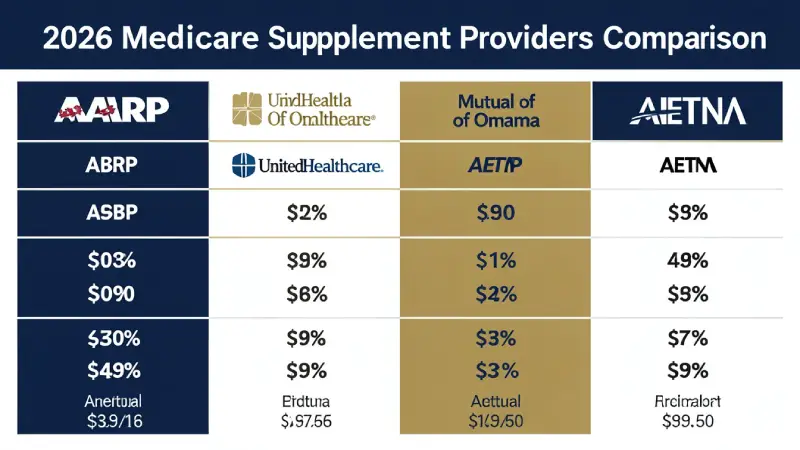
Plan G vs Plan N vs Plan F — The Complete 2026 Comparison
All Medicare Supplement plans are standardized by the federal government — Plan G from AFLAC covers exactly the same benefits as Plan G from UnitedHealthcare. The coverage is identical. Only the premium differs. This is why shopping between providers for the same plan letter is the single most financially impactful decision in Medigap — you are comparing prices for a commodity product.
| Coverage Gap | Plan G | Plan N | Plan F | No Supplement |
|---|---|---|---|---|
| Part A deductible ($1,736/benefit period) | ✅ Covered 100% | ✅ Covered 100% | ✅ Covered 100% | ❌ You pay $1,736 |
| Part A coinsurance (hospital days 61–90) | ✅ Covered | ✅ Covered | ✅ Covered | ❌ $371/day in 2026 |
| Part B coinsurance (20% of approved costs) | ✅ Covered 100% | ✅ Covered (with copays) | ✅ Covered 100% | ❌ 20% out-of-pocket |
| Part B deductible ($283/year) | ❌ NOT covered — you pay $283/yr | ❌ NOT covered | ✅ Covered (Plan F only) | ❌ You pay $283 |
| Part B excess charges | ✅ Covered | ❌ NOT covered | ✅ Covered | ❌ Up to 15% extra |
| Skilled nursing facility coinsurance | ✅ Covered | ✅ Covered | ✅ Covered | ❌ $209.50/day (days 21–100) |
| Foreign travel emergency (80%, after $250 deductible) | ✅ Covered ($50K lifetime) | ✅ Covered ($50K lifetime) | ✅ Covered ($50K lifetime) | ❌ Not covered |
| Doctor visit copay | $0 | $20 per visit | $0 | 20% of approved cost |
| Emergency room copay | $0 | $50 per visit | $0 | 20% of approved cost |
| Average Monthly Cost (65yo, 2026) | $180/month | $249/month avg (ValuePenguin) | $227/month (2026 avg) | $0 (premiums) — unlimited OOP |
| Who can buy it (2026) | All new Medicare enrollees ✅ | All new Medicare enrollees ✅ | Only pre-2020 eligibles ⚠️ | Anyone on Medicare |
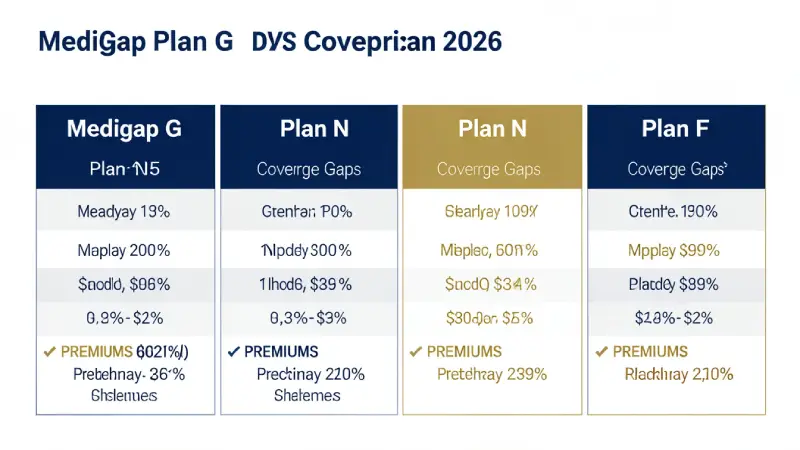
💡 The Plan G vs Plan F math that every eligible senior must see: Plan F covers everything — including the $283 annual Part B deductible. Plan G covers everything except that $283 deductible. Plan F costs an average of $227/month and Plan G $180/month — a $47/month ($564/year) difference. Since the only extra coverage Plan F provides is the $283 deductible, you would pay $564/year more in premiums to save $283 in deductibles — a net loss of $281 per year. Plan G is financially superior to Plan F for almost every eligible enrollee. The only exception: very high healthcare utilizers who meet their Part B deductible and more — but even then, the math rarely favors Plan F.
Best Medicare Supplement Plan Providers 2026 — Ranked
Strengths
- Best overall provider (ValuePenguin 2026) — low rates + stability
- Nationwide availability — all states where Medigap is sold
- Community rating in several states — age-stable premiums
- AARP membership extras: SilverSneakers, hearing discounts, wellness programs
- Largest Medigap insurer — scale + financial stability
Limitations
- Requires AARP membership ($16–$18/year)
- Not always the cheapest option in every state — compare locally
Strengths
- Cheapest Plan G nationally — $203/mo avg vs $306 national average
- Saves up to $1,236/year vs national average on identical coverage
- A+ AM Best — Superior financial strength rating
- Available across most states for Plans G, F, and N
Limitations
- Attained-age pricing — annual premium increases with age
- Long-term cost may exceed community-rated plans by age 75–80
- Mixed reviews on customer service compared to AARP/UHC
Strengths
- 12% household discount — best available for couples on Medicare
- NAIC complaint ratio below industry average — fewer disputes
- Best rates for Plan N and HD Plan G
- Strong customer service — consistently well-reviewed
- Available in most states (not New York)
Limitations
- Not available in New York — use AARP/UHC for NY residents
- Plan N leaves Part B excess charge risk — check your doctors' Medicare assignment status
Strengths
- Available in 48 states — broadest geographic reach
- 9 of 10 standard Medigap plans — maximum flexibility
- Multiple pricing methods — choose community, issue-age, or attained-age
- Plan L at $200/month — competitive for basic coverage
Limitations
- Not always the cheapest option in larger states
- Plan M not offered — reduces flexibility for that specific option
Strengths
- Most stable premium history — predictable long-term budgeting
- Plain-language policy materials — excellent for first-time enrollees
- Expanding to additional states in 2026
- Strong customer service ratings
Limitations
- Available in 38 states only — check local availability
- Not always cheapest current rates
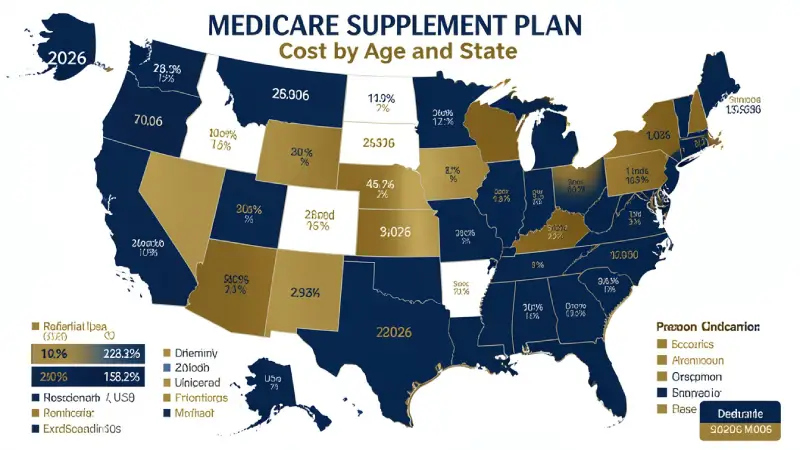
Medicare Supplement Costs by Age and State — 2026 Data
| State | Plan G Avg (age 65) | Plan G Avg (age 75) | Plan N Avg | Pricing Notes |
|---|---|---|---|---|
| New York | $354/mo | $354/mo | ~$290/mo | Community-rated — flat regardless of age |
| Florida | $170–$220/mo | $210–$280/mo | $140–$180/mo | Attained-age; Plan G most popular (930K+ members) |
| California | ~$200/mo | ~$260/mo | ~$165/mo | Attained-age in most counties |
| South Carolina / New Mexico | $160/mo | ~$200/mo | ~$125/mo | Lowest rates nationally for 65-year-olds |
| Texas | ~$180/mo | ~$230/mo | ~$150/mo | Competitive market — shop locally |
| National Average (age 65) | $180/mo | $238/mo | $249/mo | +13% increase from 2025 for Plan G |
| Massachusetts | Flat rate (state-regulated) | Same as 65 | N/A (MA uses different plan names) | Community-rated by state law |
| Washington | $259/mo avg | $259/mo | $200/mo avg | Flat regardless of age (state-regulated) |
Source: MoneyGeek Medigap cost analysis 2026 (16,954 quotes from Medicare.gov). Rates are averages — actual premiums vary by insurer, ZIP code, age, and pricing method.
The 3 Pricing Methods — This Decision Affects Your Costs More Than Which Plan You Choose
Medicare Supplement insurers use one of three premium pricing methods. This is the most important and most overlooked factor in selecting a Medigap plan — because the pricing method determines how your premium changes over your entire enrollment period.
- Community-rated (best for long-term): Everyone in the same geographic area pays the same premium regardless of age. A 65-year-old and an 80-year-old pay identical rates. Premiums can still increase due to inflation and medical costs, but NOT due to your personal aging. New York, Massachusetts, and Connecticut require community rating by law. AARP/UnitedHealthcare uses community rating in several other states. Best for: almost everyone who expects to be enrolled for many years.
- Issue-age-rated (middle ground): Premium is based on your age when you first enroll and stays relatively stable — but is not locked forever. A 65-year-old starting enrollment pays less than someone who starts at 70, but both pay the same from enrollment forward regardless of further aging. Best for: seniors who enroll at a relatively young age for Medicare.
- Attained-age-rated (avoid for long-term): Premium increases as you get older — every birthday typically triggers a rate increase. AFLAC primarily uses attained-age pricing. The initial rate appears cheap but compounds with age. A plan that saves $103/month at age 65 may cost $200+/month more than community-rated competitors by age 80. Best for: seniors who expect to comparison-shop every 1–3 years and switch to cheaper options.

When to Enroll — The 6-Month Open Enrollment Window You Cannot Afford to Miss
The Medigap Open Enrollment Period is the single most important timing decision in Medicare Supplement insurance. It begins on the first day of the month you turn 65 AND are enrolled in Medicare Part B — and lasts exactly 6 months.
During this window: Insurers must sell you any Medigap plan at standard rates — no medical underwriting, no health questions, cannot be denied, cannot be charged higher rates for pre-existing conditions. This is called guaranteed issue status.
After this window closes: Insurers can (and do) use medical underwriting to deny coverage, charge higher rates for health conditions, or exclude pre-existing conditions from coverage. Many seniors who develop health issues before enrolling in Medigap find themselves permanently locked out of Plan G and forced into Medicare Advantage or no supplemental coverage.
⚠️ The most expensive Medicare mistake seniors make: Delaying Medigap enrollment. Many new Medicare beneficiaries try Medicare Advantage first — attracted by lower premiums and dental/vision extras. If they later develop a serious health condition and want to switch to Medigap, they discover that guaranteed issue rights no longer apply. In most states, insurers can deny the application entirely based on the health condition. The 6-month Open Enrollment window does not reopen once it closes. Enroll in Medigap during your 6-month window — you can always downgrade later, but upgrading from Medicare Advantage to Medigap with health conditions is very difficult.
Medigap vs Medicare Advantage — Which Is Better in 2026?
This is the most consequential financial decision most Medicare beneficiaries make. Here is the honest comparison:
| Factor | Medigap + Part D | Medicare Advantage |
|---|---|---|
| Monthly Premium | $180–$306/mo (Plan G) + Part D ~$30–$50/mo | $0–$50/mo (many plans) |
| Provider Choice | Any Medicare-accepting provider nationwide — no network, no referrals | Network-restricted — HMO requires referrals; PPO has out-of-network costs |
| Out-of-Pocket Maximum | Very low with Plan G — only $283/year (Part B deductible) | Up to $8,850/year (2026 standard OOP maximum) |
| Predictability | Highly predictable — fixed premium, minimal out-of-pocket | Harder to predict — copays, coinsurance, network changes annually |
| Extras (dental, vision, hearing) | Not included — purchase separately | Often included — many plans include dental, vision, gym membership |
| Prior Authorization | None — see any specialist without approval | Common — specialist visits and procedures often require prior auth |
| Best For | Seniors with significant healthcare needs or who travel; value provider freedom | Healthy seniors wanting lower monthly premiums and extra benefits |
Medigap Plan Selection Checklist — 2026

Medicare Supplement Selection Checklist — 2026
- Enroll during your 6-month Open Enrollment Period (starts when you turn 65 AND enroll in Part B) — guaranteed issue rights only exist during this window
- Start with Plan G unless you were Medicare-eligible before Jan. 1, 2020 — Plan G is the most complete option for new enrollees and better value than Plan F in most cases
- Use Medicare.gov's Medigap Plan Finder for your exact ZIP code — rates vary enormously by county, and national averages may not reflect what you'll actually pay
- Check the pricing method before choosing based on current rates — community-rated plans are almost always better long-term than attained-age plans even if initially more expensive
- Get quotes from minimum 3 providers — AFLAC, AARP/UHC, and Mutual of Omaha are the starting comparison set in most states
- Consider Plan N if you rarely visit specialists — saves ~$70/month vs Plan G with $20 doctor visit and $50 ER copays. Verify your doctors accept Medicare assignment (no excess charges)
- For couples: Mutual of Omaha's 12% household discount makes it the most competitive option when both spouses need Medigap
- Add a standalone Part D (prescription drug) plan — Medigap does NOT cover prescriptions. Average Part D premium: $30–$50/month
- Review annually during your plan birthday window (some states allow switching to equal/lesser plans annually without medical underwriting)
- If you're considering Medicare Advantage: understand you may not be able to return to Medigap with health conditions — the decision is often permanent
- For your complete senior healthcare coverage plan, see our Medicare Advantage guide to understand the full alternative before committing to Medigap
FAQ — Best Medicare Supplement Plans USA 2026

Ahmada Ndao is a financial research analyst and independent journalist
specializing in US consumer finance, legal rights, and insurance markets.
With over 5 years covering American financial products, he has helped
thousands of readers navigate complex insurance decisions, find the right
legal representation, and optimize their credit strategies. His research
methodology combines primary data analysis, direct outreach to industry
professionals, and continuous monitoring of federal regulatory changes.
Ahmada’s work has been cited by financial communities across the US and
reviewed by licensed attorneys and insurance professionals for accuracy.