
Best Personal Injury Solicitors UK 2026 — Top Firms Ranked, No Win No Fee Explained & Maximum Compensation Guide
Every year, over 600,000 personal injury claims are made in England and Wales — yet studies consistently show that claimants who use specialist solicitors receive significantly more compensation than those who attempt to claim alone or through claims management companies. The UK personal injury landscape in 2026 is shaped by the Civil Liability Act 2018 reforms, the whiplash tariff system introduced in 2021 that fixed compensation for minor soft tissue injuries, and the May 2021 introduction of the Official Injury Claim portal for low-value RTA claims. Despite these reforms reducing some smaller payouts, serious injury claims — those involving broken bones, head injuries, spinal damage, and long-term disability — remain as significant as ever, with Irwin Mitchell alone recovering more than £1.5 billion in compensation for clients over the past two years. This guide ranks the best personal injury solicitors in the UK for 2026 using Chambers & Partners rankings, Legal 500 directory placement, Law Society accreditations, compensation amounts, and real client outcomes — giving every injured person in England, Scotland, and Wales the complete framework to maximise their claim.
Key Facts — Best Personal Injury Solicitors UK 2026
- Irwin Mitchell is the best overall UK personal injury firm — 21 offices nationwide, £1.5B+ recovered in 2 years, 5-star rated, Chambers & Partners recognised, full no win no fee coverage
- Slater and Gordon is the most accessible national firm — thousands of no win no fee claims annually, specialist teams for every injury type, freephone helpline, transparent process
- Fieldfisher is the top choice for serious and catastrophic injuries — Chambers Band 1 for clinical negligence, 30+ years specialist experience, free consultations
- Slee Blackwell is independently ranked top 10 in the UK by ReviewSolicitors — over 1,300 five-star client reviews, DASLS Solicitor of the Year 2024
- JMW Solicitors leads the North West — no win no fee including all disbursements covered by insurance, full personal injury range, no upfront costs of any kind
- No Win No Fee = CFA (Conditional Fee Agreement) — you pay nothing if you lose; if you win, your solicitor recovers most costs from the defendant plus a success fee capped at 25% of your compensation
- Time limit: 3 years from the date of the accident OR the date you first knew your injury was caused by someone else's negligence — contact a solicitor immediately
- Children's claims: The 3-year clock does not start until the child's 18th birthday — claims can be made any time before their 21st birthday
- Compensation includes: General damages (pain, suffering, loss of amenity) AND special damages (lost earnings, medical costs, travel, future care)
- Verify any solicitor's credentials at The Law Society's solicitor finder before instructing

Types of Personal Injury Claims in the UK — What You Can Claim For
UK personal injury law covers a broad range of incidents where someone else's negligence, breach of duty, or deliberate action caused your injury or illness. You are entitled to claim compensation if you can prove that another party owed you a duty of care, breached that duty, and that breach directly caused your injury.
| Claim Type | Common Examples | Typical Compensation | Time Limit |
|---|---|---|---|
| Road Traffic Accidents | Car crashes, cyclist injuries, pedestrian accidents, whiplash | £1,000–£500,000+ | 3 years |
| Accidents at Work | Falls, machinery injuries, manual handling, toxic exposure | £5,000–£250,000+ | 3 years |
| Slips, Trips & Falls | Wet floors, uneven pavements, defective steps, public places | £2,000–£100,000+ | 3 years |
| Medical Negligence | Surgical errors, misdiagnosis, delayed diagnosis, birth injuries | £10,000–£5M+ | 3 years from knowledge |
| Serious & Catastrophic Injury | Brain injury, spinal cord damage, amputation, fatal accidents | £250,000–£15M+ | 3 years |
| Industrial Disease | Asbestos/mesothelioma, industrial deafness, vibration white finger | £20,000–£500,000+ | 3 years from diagnosis |
| Product Liability | Defective products causing injury — cars, appliances, food | £5,000–£500,000+ | 3 years |
| Criminal Injuries | Assault, violent crime — claim through CICA (Criminal Injuries Compensation Authority) | £1,000–£500,000 (tariff scheme) | 2 years from incident |
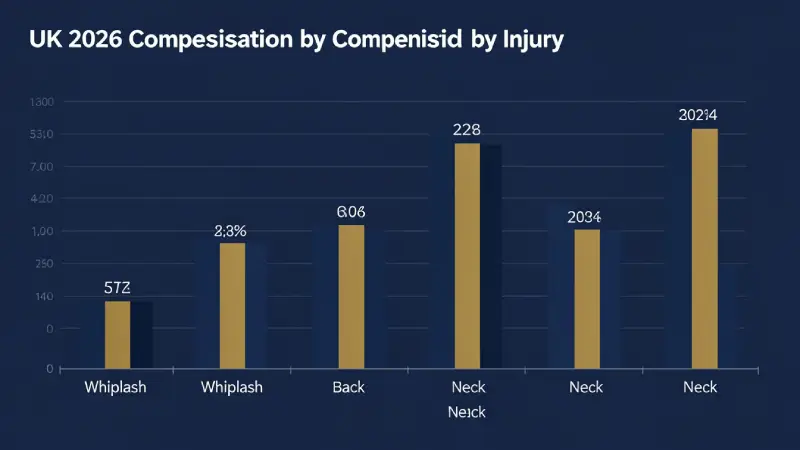
UK Personal Injury Compensation Amounts — Judicial College Guidelines 2026
Compensation amounts for personal injury in the UK are guided by the Judicial College Guidelines (JCG) — the official reference used by judges and solicitors to value general damages for pain, suffering, and loss of amenity. The 17th edition (2023) remains the current standard in 2026. These are the guideline ranges for the most common injury types:
| Injury Type & Severity | JCG Guideline Range | Additional Special Damages |
|---|---|---|
| Whiplash — minor (New Tariff, <2 years) | £240–£4,215 (fixed tariff) | Lost earnings, treatment, travel |
| Neck injury — moderate (disc damage) | £7,890–£38,490 | Lost earnings, physio, future treatment |
| Back injury — minor (full recovery) | £2,450–£11,730 | Lost earnings, treatment costs |
| Back injury — moderate (ongoing symptoms) | £27,760–£38,780 | Ongoing treatment, future care |
| Serious back injury (disc prolapse, surgery) | £38,780–£160,980 | Lost earnings, long-term care, adaptations |
| Knee — minor injury | £3,200–£12,900 | Physio, loss of amenity |
| Serious knee injury | £25,100–£96,250 | Surgery, rehabilitation, career impact |
| Arm — serious fracture | £36,770–£56,180 | Surgery, ongoing treatment, earnings |
| Traumatic Brain Injury — moderate | £150,110–£219,070 | Care costs, lost lifetime earnings, adaptations |
| TBI — severe (permanent disability) | £282,010–£403,990 | Lifetime care, case management, loss of earnings |
| Spinal cord injury (paraplegia) | £219,070–£322,060 | Lifetime care, wheelchair, home adaptations |
💡 General damages are only part of your claim. Special damages — which cover every financial loss caused by your injury — are often the largest component of significant claims. Lost earnings during recovery, private medical treatment, travel to appointments, home adaptations, future care costs, and the cost of help with household tasks you can no longer perform are all recoverable. A specialist solicitor identifies every recoverable head of damage. Claimants who represent themselves consistently under-claim on special damages, leaving thousands to tens of thousands of pounds unclaimed.
Best Personal Injury Solicitors UK 2026 — Top Firms Ranked
Strengths
- £1.5B+ recovered in 2 years — largest documented UK PI track record
- 21 UK offices including Scotland — genuinely national coverage
- Specialist teams for every claim type — not generalists
- ATE insurance arranged on your behalf — full financial protection
- Chambers & Partners recognised — peer-assessed excellence
Limitations
- Scale means cases are handled by teams, not always a single named solicitor throughout
- Better suited for moderate to serious claims — minor low-value claims may not receive partner-level attention
Strengths
- Chambers Band 1 — independently assessed as leading practice
- 30+ years specialist experience in serious and catastrophic cases
- Medical negligence, asbestos, and industrial disease expertise
- Legal 500 top tier recognition
- Free consultations — no initial cost to assess your claim
Limitations
- Primarily serious/high-value claims — minor injury cases unlikely to be accepted
- London-centric — fewer regional offices than Irwin Mitchell
Strengths
- National coverage — offices across England, Scotland and Wales
- Handles all PI claim types with dedicated specialist teams
- Freephone access — extremely accessible first contact
- Established national reputation and charity partnerships
- Strong process transparency from first call
Limitations
- Large firm volume means less boutique partner attention
- Mixed reviews on communication speed for lower-value claims
Strengths
- Top 10 UK independently ranked by ReviewSolicitors
- 1,300+ verified five-star client reviews — strongest review base in its tier
- DASLS Solicitor of the Year 2024 — peer recognition
- Exceptional individual solicitor-client relationship quality
- Free case assessment with no obligation
Limitations
- Southwest England primary base — less suited for Scotland or Northern England
- Smaller firm than Irwin Mitchell or Slater & Gordon
Strengths
- All disbursements covered — truly zero upfront cost of any kind
- ATE insurance arranged on behalf of clients
- Strong North West reputation — Manchester, Liverpool, Leeds reach
- Full PI spectrum including clinical negligence and serious injury
- Consistent client communication throughout the process
Limitations
- Primary strength is North West — less presence in South or Scotland
- Smaller national profile than Irwin Mitchell or Slater & Gordon

No Win No Fee UK 2026 — Exactly How It Works
No win no fee — formally known as a Conditional Fee Agreement (CFA) — is the funding model used by the vast majority of personal injury solicitors in England, Wales, and Scotland. Understanding precisely how it works prevents confusion about costs later in your claim.
How the CFA works step by step:
- You sign a CFA agreement with your solicitor at the start of the case. The agreement specifies the success fee percentage (capped at 25% of your compensation by LASPO 2012) and the circumstances under which it applies.
- Your solicitor takes out After the Event (ATE) insurance on your behalf. This policy protects you against paying the other side's legal costs if your claim is unsuccessful. You typically pay the ATE premium only if you win.
- You pay nothing throughout the claim — no upfront fees, no disbursements (at most firms), no ongoing payments. Your solicitor advances all costs and recovers them from the defendant if successful.
- If you WIN: The defendant pays your solicitor's base costs. Your solicitor deducts the success fee (max 25%) from your compensation, plus the ATE insurance premium. Everything else goes to you.
- If you LOSE: You pay nothing — your solicitor's fees are written off, and the ATE insurance covers the other side's costs. You have zero financial exposure.
⚠️ Beware Claims Management Companies (CMCs). CMCs are not solicitors — they are regulated by the Financial Conduct Authority, not the Solicitors Regulation Authority. They typically sell your claim to a solicitor firm, adding an extra layer of cost that reduces your net compensation. Always instruct a regulated solicitor directly. Verify any solicitor at the Law Society's Solicitor Finder or check SRA registration at sra.org.uk before signing any agreement.
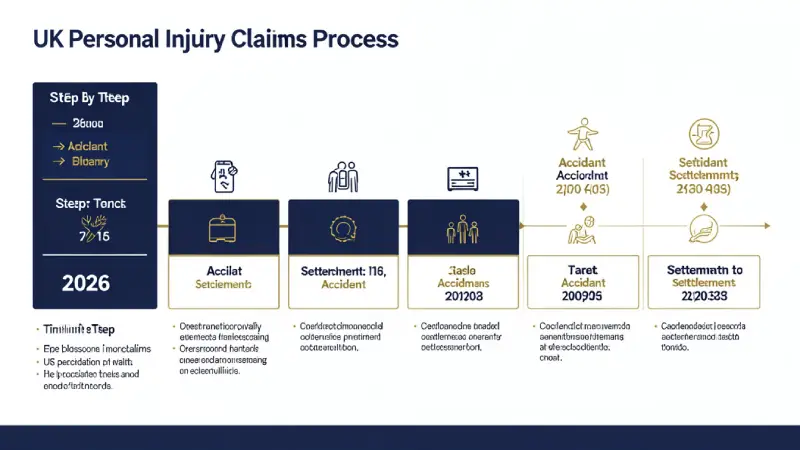
The UK Personal Injury Claims Process — Step by Step
- Step 1 — Initial consultation (free): Contact a personal injury solicitor for a free assessment. They evaluate liability, causation, and claim value. If they take your case on no win no fee, they believe it has sufficient prospects of success.
- Step 2 — Letter of claim: Your solicitor sends a formal letter to the defendant (or their insurer) setting out the claim. The defendant has 21 days to acknowledge and 3 months to investigate and respond for most claims.
- Step 3 — Medical evidence: An independent medical expert assesses your injuries and produces a report that forms the basis of your general damages valuation. You do not choose the expert — they must be independent.
- Step 4 — Schedule of loss: Your solicitor prepares a full schedule of special damages — lost earnings, medical costs, travel expenses, future care, home adaptations — with supporting documentation.
- Step 5 — Negotiation: Armed with medical evidence and a full schedule of loss, your solicitor negotiates with the defendant's insurer. The vast majority of claims settle at this stage without court proceedings.
- Step 6 — Settlement or court: If a fair settlement is reached, you receive your compensation (minus the success fee and ATE premium). If no agreement is reached, your solicitor issues court proceedings — which often prompts the defendant to settle rather than face a trial.

Personal Injury Claim Checklist — What to Do After an Accident in the UK
Personal Injury Claim Checklist — UK 2026
- Seek medical attention immediately — A&E, GP, or urgent care. Your medical records establish the injury and its connection to the accident. No medical records = no claim.
- Photograph everything at the scene: the hazard or vehicle that caused the accident, all injuries, road conditions, any signage, the wider scene
- Collect witness details immediately — full name, phone number, email. Witnesses leave and memories fade within hours
- Report the accident formally — to police (if RTA), your employer (if at work, via the Accident Book), or the property manager (if slip/trip). Written records protect your claim
- Keep all receipts and records of every cost: prescription charges, travel to appointments, private physiotherapy, parking, home help — all are recoverable as special damages
- Keep a pain diary — daily notes of how your injury affects your life, sleep, work, and activities. This evidence of impact directly affects general damages valuation
- Do NOT accept any settlement offer from an insurance company without a solicitor reviewing it — especially in the first days or weeks when the full extent of your injuries may not yet be clear
- Do NOT post about the accident, your injuries, or your recovery on social media — defence teams routinely monitor claimants' social media and use posts to challenge injury claims
- Contact a personal injury solicitor as early as possible — the 3-year time limit sounds generous but evidence is stronger when preserved early
- If the accident involved a vehicle, obtain the other driver's insurance details, registration number, and name — report to police within 24 hours if details are refused
- Verify your solicitor is SRA-registered before signing anything — check at sra.org.uk
- Children: claims can be made at any time before their 21st birthday — do not feel urgent pressure, but acting sooner preserves better evidence
FAQ — Best Personal Injury Solicitors UK 2026

Ahmada Ndao is a financial research analyst and independent journalist
specializing in US consumer finance, legal rights, and insurance markets.
With over 5 years covering American financial products, he has helped
thousands of readers navigate complex insurance decisions, find the right
legal representation, and optimize their credit strategies. His research
methodology combines primary data analysis, direct outreach to industry
professionals, and continuous monitoring of federal regulatory changes.
Ahmada’s work has been cited by financial communities across the US and
reviewed by licensed attorneys and insurance professionals for accuracy.