
Best Social Security Disability Lawyers USA 2026 — Top SSDI Attorneys, How to Win Your Claim & Maximize Back Pay
67% of Social Security disability applications are denied on the first attempt — yet 55% of claimants who appeal with attorney representation ultimately win their benefits. Without an attorney, that approval rate drops to 34% at the hearing level. Social Security disability law is a highly specialized field where the difference between winning and losing is not the strength of your medical condition — it is whether your attorney knows how to present your residual functional capacity, navigate the SSA's five-step evaluation, select the right medical evidence, and prepare you for the ALJ hearing. The SSA's own data confirms that represented claimants win at nearly twice the rate of unrepresented claimants. This guide identifies what makes a top SSDI attorney, explains the exact approval rates at each stage, reveals how back pay is calculated, and gives you the framework to find the right representation for your claim.
Key Facts — SSDI Lawyers USA 2026
- 67% of initial SSDI applications are denied — most valid claimants must appeal
- Represented claimants win at 55% at ALJ hearing vs 34% unrepresented — a 62% improvement
- Attorney fee is capped by law at 25% of back pay or $7,200 — whichever is less
- You pay nothing unless you win — SSDI attorneys work on contingency by federal regulation
- Average back pay award: $14,800 — meaning average attorney fee is $3,700
- Disability Onset Date (EOD) determines back pay — attorneys who establish the earliest possible onset date maximize your recovery
- Most critical stage: ALJ hearing — 70% of eventual approvals happen at this stage
- Biggest mistake: Waiting to hire an attorney until the ALJ hearing — representation at initial application improves odds at every subsequent stage
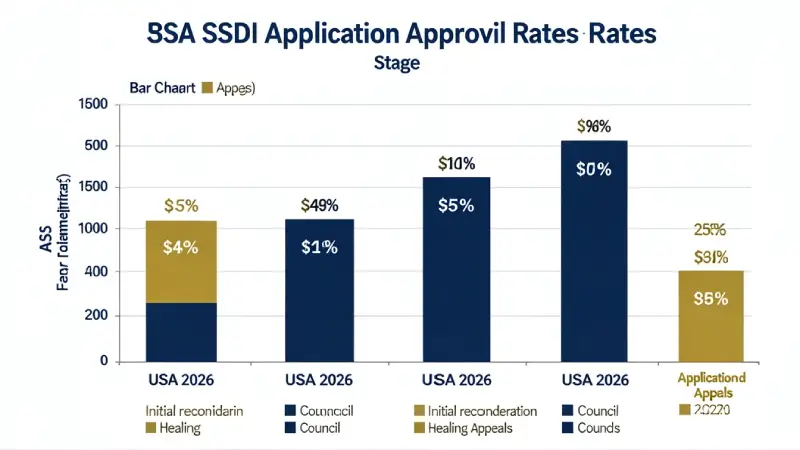
The 4 SSDI Appeal Stages — Approval Rates, Timelines & What Changes Each Time
Timeline: 3–6 months. Decision maker: State Disability Determination Services (DDS) examiner — not the SSA directly. What happens: DDS reviews your medical records and applies the SSA's five-step evaluation. 67% are denied — most for insufficient medical evidence, earnings above substantial gainful activity (SGA), or conditions not meeting SSA listing severity. Attorney impact at this stage: Attorneys who file the initial application ensure the correct onset date, gather supporting medical opinions from treating physicians, and structure the application to address the five-step criteria — increasing initial approval rates from 33% to approximately 42%.
Timeline: 3–5 months. Decision maker: Different DDS examiner reviews the same file. What happens: Reconsideration is widely regarded as the weakest stage — a different examiner reviews essentially the same evidence and reverses the initial denial in only 13% of cases. Most attorneys recommend: File the reconsideration appeal (required in most states to preserve your right to an ALJ hearing) but do not expect approval at this stage. The real battle is at the ALJ hearing. Exception: If new significant medical evidence has emerged since the initial application, reconsideration approval rates improve. Note: Alaska, Alabama, California (partial), Colorado, Louisiana, Michigan, Missouri, New Hampshire, New York, and Pennsylvania have eliminated the reconsideration step — these states go directly from initial denial to ALJ hearing.
Timeline: 12–24 months after request. Decision maker: Independent Administrative Law Judge — this is the most important decision point in the entire SSDI process. What changes: Unlike DDS paper reviews, the ALJ hearing is a live proceeding where you testify, your attorney cross-examines a vocational expert, and the judge evaluates your credibility and functional limitations in person. Why attorney representation matters most here: ALJ hearings are governed by procedural and evidentiary rules that require legal expertise. Attorneys who regularly appear before specific ALJs know their individual standards and approval tendencies — knowledge that directly improves outcomes.
Timeline: 12–36 months additional. Decision maker: SSA Appeals Council (review of legal errors), then U.S. District Court if further appeal needed. When this stage is used: If the ALJ denied due to a legal error, procedural violation, or failure to properly weigh medical evidence — not just a disagreement with the outcome. Federal court appeals require attorneys with federal litigation experience — this is where SSDI-specialized law firms that also have federal court capacity provide the most value. Most SSDI cases that reach federal court result in remand (sent back to ALJ with specific instructions) rather than direct approval.
Top SSDI Law Firms USA 2026 — What to Look for and Who Leads

Allsup handles SSDI claims from initial application through federal court appeals, in all 50 states. Their technology platform tracks individual ALJ approval rates and case outcomes to inform hearing strategy. For claimants seeking a national firm with proven scale and SSA expertise, Allsup is the benchmark. Contact at Allsup.com.
✓ Allsup Strengths
- 200,000+ cases won — largest track record
- Former SSA employees on staff
- All 50 states coverage
- ALJ approval rate database by hearing office
- Initial application through federal court
✗ Limitations
- Volume firm — less personal attention
- May assign advocates vs. attorneys on some cases
Binder & Binder handles both SSDI (Social Security Disability Insurance) and SSI (Supplemental Security Income) claims — important because many claimants qualify for both programs and the filing strategy differs. Their attorneys appear regularly before ALJs across all 50 states. Contact at BinderAndBinder.com.
✓ Binder Strengths
- 40+ years exclusive SSDI/SSI practice
- Handles both SSDI and SSI — maximizes recovery
- Deep ALJ relationship experience nationally
- Complex multi-impairment case expertise
✗ Limitations
- Large firm — case may be handled by associate
- Some state offices stronger than others
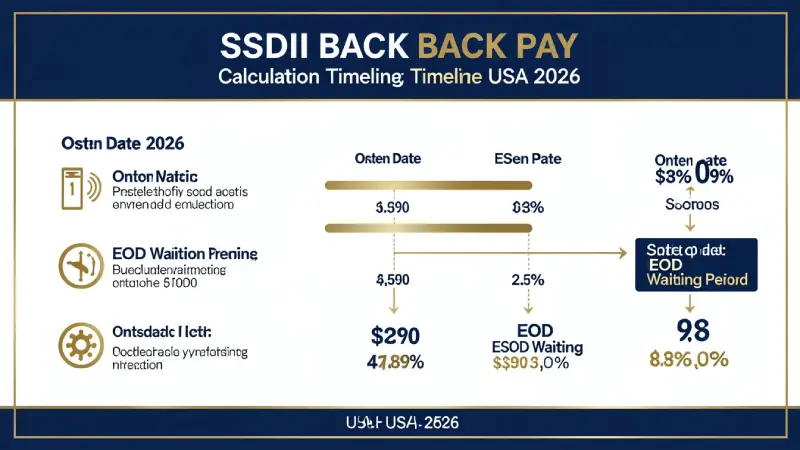
SSDI Back Pay — How It's Calculated and How Attorneys Maximize It
Back pay is the lump sum you receive for the months between your disability onset date and the date SSA approves your claim. It is often the largest single payment in an SSDI case — and the amount your attorney's fee is calculated against. Understanding back pay is essential to understanding what is at stake in your case.
| Element | Detail | Impact on Back Pay |
|---|---|---|
| Established Onset Date (EOD) | Date SSA determines your disability began | Earlier EOD = more back pay months |
| 5-Month Waiting Period | SSA does not pay for first 5 months of disability | Reduces back pay by 5 months of benefits |
| Application Date Limit | SSDI back pay limited to 12 months before application | File as early as possible — delays permanently reduce back pay |
| Monthly Benefit Amount (PIA) | Based on earnings record — avg. $1,537/mo in 2026 | Multiplied by back pay months |
| Example Calculation | EOD Jan 2023, approved Mar 2026, $1,537/mo PIA | 37 months − 5 = 32 × $1,537 = $49,184 back pay |
💡 The Onset Date Strategy: The most impactful thing an SSDI attorney does is establish the earliest defensible onset date — supported by medical evidence. Moving your established onset date back by 12 months on a $1,537 monthly benefit adds $18,444 to your back pay lump sum. Attorney fee on that $18,444 = $4,611. Your additional recovery = $13,833. This is why experienced SSDI attorneys spend significant time analyzing medical records to find the earliest supportable onset date.
SSDI Attorney Fees — The Federal Cap That Protects Every Claimant
Unlike most legal representation, SSDI attorney fees are federally regulated — meaning you cannot be overcharged regardless of the firm you hire. This makes the fee structure one of the most claimant-friendly in all of American law.
| Fee Rule | Detail |
|---|---|
| Contingency percentage | 25% of past-due (back pay) benefits only |
| Maximum fee | $7,200 (2026 cap — periodically adjusted by SSA) |
| You pay if you lose | Nothing — pure contingency |
| Ongoing monthly benefits | Attorney receives no percentage of ongoing monthly payments |
| Fee approval | SSA must approve the fee agreement before payment |
| Example | $14,800 back pay × 25% = $3,700 attorney fee. You receive $11,100 lump sum + ongoing $1,537/month. |
✅ The federal cap means: On large back pay awards, the 25% cap kicks in well below $7,200. On a $49,000 back pay award, 25% = $12,250 — but the cap limits the fee to $7,200. Your attorney receives $7,200; you receive $41,800. The fee cap is automatically enforced by SSA — you cannot be charged more regardless of what your fee agreement says.
What SSDI Attorneys Do That Unrepresented Claimants Can't
- Obtain and submit treating physician RFC forms — the single most important document in an SSDI case. Residual Functional Capacity forms from your treating doctors explain specifically how your condition limits your ability to work. SSA gives these forms significant weight when completed correctly. Most unrepresented claimants never submit them.
- Cross-examine the vocational expert at ALJ hearings — SSA vocational experts testify about what jobs exist in the national economy that a person with your limitations can perform. Skilled SSDI attorneys know how to question VEs on job numbers, exertional requirements, and DOT classifications to undercut testimony that your limitations are compatible with available work.
- Identify applicable SSA Listings — SSA maintains a "Listing of Impairments" (the Blue Book) — conditions that automatically qualify for disability if criteria are met. Attorneys who know the listing criteria ensure your medical records document the specific elements required. Many claimants who should qualify under a listing are denied because their records don't explicitly address listing criteria.
- Apply the Medical-Vocational Grid Rules — for claimants over 50, SSA's Grid Rules can result in approval based on age, education, and work history alone — even without meeting a listing. Attorneys who understand Grid Rule application can shift strategy to maximize approval probability based on your specific demographic profile.

The Medical Evidence That Wins SSDI Cases — What Your Attorney Needs
SSDI cases are decided on medical evidence. The quality, completeness, and framing of your medical record is more important than the severity of your condition. Here is what top SSDI attorneys assemble:
- Treating Physician RFC Forms. Residual Functional Capacity assessments completed by your primary care physician and treating specialists — documenting specifically how your condition limits sitting, standing, walking, lifting, concentrating, and attendance. These forms are the most heavily weighted evidence in SSDI cases. Attorneys draft these forms for physician completion to ensure they address SSA's specific functional criteria.
- Consistent Treatment Records Spanning the Alleged Onset Date. SSA requires documented medical treatment demonstrating your condition has persisted. Gaps in treatment — even due to inability to afford care — are used against claimants. Attorneys help document why gaps occurred and what functional impact persisted despite gaps.
- Specialist Records Aligned with SSA Listing Criteria. If your condition potentially meets a listed impairment, your attorney will obtain specialist records specifically addressing listing criteria — ensuring the record explicitly supports listing-level severity.
- Mental Health Records for Psychological Components. Many physical disability cases also involve secondary anxiety, depression, or cognitive impairment. Including mental health RFC documentation alongside physical RFC forms strengthens the overall functional limitation picture and can independently support approval under mental health listings.
- Work History and Vocational Documentation. Your past work history determines which vocational categories apply and whether Grid Rules are favorable to your case. Attorneys ensure work history is accurately characterized to maximize Grid Rule application.

SSDI Claim Checklist — 2026
- Hire an SSDI attorney before filing initial application — not just at hearing stage
- Document earliest possible onset date with medical records from that date
- Obtain RFC forms from treating physician and all treating specialists
- Gather treatment records covering entire period since onset date
- Request records from all hospitals, ERs, and specialist visits
- Include mental health records if anxiety, depression, or cognitive issues present
- Verify attorney handles both SSDI and SSI — you may qualify for both
- Confirm attorney tracks individual ALJ approval rates at your hearing office
- File reconsideration appeal within 60 days of initial denial
- Request ALJ hearing within 60 days of reconsideration denial
- Attend all SSA-scheduled consultative examinations (CE) — missing them causes denial
- Verify fee agreement: 25% of back pay, maximum $7,200, costs not deducted from your share
FAQ — Best Social Security Disability Lawyers USA 2026

Ahmada Ndao is a financial research analyst and independent journalist
specializing in US consumer finance, legal rights, and insurance markets.
With over 5 years covering American financial products, he has helped
thousands of readers navigate complex insurance decisions, find the right
legal representation, and optimize their credit strategies. His research
methodology combines primary data analysis, direct outreach to industry
professionals, and continuous monitoring of federal regulatory changes.
Ahmada’s work has been cited by financial communities across the US and
reviewed by licensed attorneys and insurance professionals for accuracy.