
Denied SSDI? Do This Immediately — The Complete 2026 Appeal Guide
67% of all initial SSDI applications are denied. If you just received a denial letter from the Social Security Administration, do not give up — the majority of people who appeal their denial and follow the right process ultimately receive benefits. But the next steps you take in the coming days are critical: deadlines are strict, evidence requirements are specific, and the appeals process has four distinct levels — each with different rules, timelines, and approval rates. This guide tells you exactly what to do, in what order, starting today.
📄 Step 1 — Read Your Denial Letter Carefully Right Now
Your denial letter (officially called a "Notice of Disapproved Claim") is not just bad news — it is a roadmap for your appeal. Before you do anything else, read it carefully and identify:
What to Look For in Your Denial Letter
- The specific reason(s) for denial — SSA is required to explain why they denied your claim. Common reasons include: "your condition is not severe enough," "you can perform other work," "insufficient medical evidence," or "you did not cooperate with our request for information." Each reason requires a different response strategy.
- The denial date — your 60-day appeal window begins from this date (plus 5 days for mail delivery). Write this date down immediately.
- Your appeal deadline — the letter should state the exact date by which you must file your appeal. This is your hard deadline.
- The appeal level being offered — if this is your first denial, the next level is Reconsideration. If you already filed Reconsideration and were denied again, the next level is an ALJ Hearing.
- Instructions for how to appeal — the letter provides the form number and instructions. For most appeals, this is Form SSA-561 (Reconsideration) or Form HA-501 (ALJ Hearing Request).
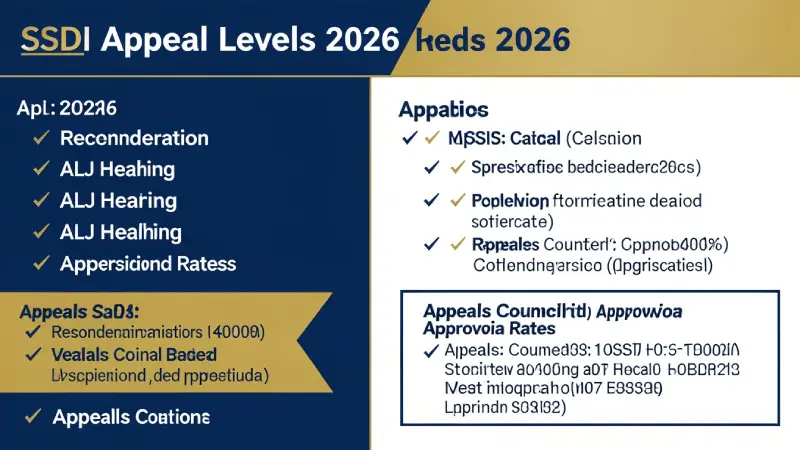
📊 The 4 Levels of SSDI Appeal — Overview
| Level | Name | Timeline to File | Decision Time | Approval Rate 2025 |
|---|---|---|---|---|
| 1 | Reconsideration | 60 days from denial | 3–5 months | 13% |
| 2 | ALJ Hearing | 60 days from recon denial | 12–24 months | 55% 🏆 |
| 3 | Appeals Council Review | 60 days from ALJ denial | 12–18 months | 17% |
| 4 | Federal District Court | 60 days from AC denial | 12–36 months | varies |
📋 Level 1 — Reconsideration (File Within 60 Days)
What Is Reconsideration?
Reconsideration is a complete review of your claim by a different SSA employee than the one who made the initial decision. They will review all evidence from your original application plus any new evidence you submit. The reconsideration decision is made without a hearing — it is a paper review.
The Honest Reality About Reconsideration
Reconsideration has a national approval rate of approximately 13% — meaning 87% of reconsideration requests are denied. This is not a reason to skip it — it is a mandatory step in the appeals process before you can request an ALJ Hearing. File it promptly, submit any new medical evidence you have, and begin preparing for the ALJ Hearing simultaneously.
How to File for Reconsideration
- Complete Form SSA-561 (Request for Reconsideration) — available at ssa.gov, your local SSA office, or from your disability attorney
- Complete Form SSA-827 (Authorization to Disclose Information) — allows SSA to obtain updated medical records from your providers
- Submit any new medical evidence — updated doctor's notes, new test results, specialist evaluations, or hospital records since your original application
- File online at ssa.gov/benefits/disability, by phone at 1-800-772-1213, or in person at your local SSA office
- Keep a copy of everything you submit and note the date filed
What New Evidence Helps Most at Reconsideration
- Updated treatment notes from your treating physician specifically addressing your functional limitations
- Results of any new diagnostic tests (MRI, CT scan, EMG, bloodwork) conducted since your original application
- Specialist evaluations you hadn't completed at the time of initial application
- A detailed letter from your primary treating physician explaining why your condition prevents substantial gainful activity
- Statements from employers, co-workers, or family members documenting how your condition affects daily activities
⚖️ Level 2 — ALJ Hearing (Your Best Chance)
What Is an ALJ Hearing?
An Administrative Law Judge (ALJ) Hearing is a formal, in-person (or video) hearing before an independent SSA judge. Unlike Reconsideration — which is a paper review by an SSA employee — the ALJ Hearing gives you the opportunity to present your case directly, testify about how your condition affects your life, have witnesses testify on your behalf, and cross-examine the vocational expert SSA uses to argue you can do "other work."
The ALJ Hearing is where 55% of appellants succeed — and where having legal representation makes the most dramatic difference in outcomes. Studies show that claimants with attorney representation at ALJ Hearings are 3× more likely to be approved than unrepresented claimants.
How to Request an ALJ Hearing
- Complete Form HA-501 (Request for Hearing by Administrative Law Judge) within 60 days of your Reconsideration denial
- File online at ssa.gov/appeals, by phone, or in person at your SSA hearing office
- You will be assigned to an ODAR (Office of Disability Adjudication and Review) hearing office and receive a Notice of Hearing typically 12–24 months later
- Use this waiting period to build your evidence, obtain a disability attorney if you haven't already, and gather supporting documentation
What Happens at the ALJ Hearing
The hearing typically lasts 30–60 minutes and includes:
- Your testimony — the ALJ will ask about your medical conditions, daily activities, work history, and why you cannot work. Be specific, honest, and detailed about your worst days — not your best.
- Medical expert testimony — the ALJ may call a medical expert to evaluate your conditions based on the records. Your attorney can cross-examine this expert.
- Vocational expert testimony — a vocational expert (VE) will testify about whether someone with your limitations can perform any jobs in the national economy. Your attorney can cross-examine the VE — this cross-examination is often the most critical part of the hearing.
- Witness testimony — you can bring witnesses (family members, caregivers) to testify about how your condition affects your daily life.
Critical Tips for Your ALJ Hearing
- Describe your worst days — SSA wants to understand your limitations on your hardest days, not your best days. Many claimants lose by describing what they can do when they feel okay.
- Be specific about time and duration — "I can walk" is useless. "I can walk no more than half a block before severe pain forces me to stop, and this happens every day" is powerful testimony.
- Don't minimise your symptoms — claimants sometimes understate their limitations because they don't want to seem like they're complaining. The ALJ needs the full picture to make a fair decision.
- Address every impairment — if you have multiple conditions (back pain, depression, diabetes), each one should be discussed. Combined impairments often qualify even when individual conditions don't.
- Have your attorney challenge the vocational expert — this is where many cases are won or lost. A skilled disability attorney knows how to expose limitations in VE testimony through targeted cross-examination.
📋 Level 3 — Appeals Council Review
If the ALJ denies your claim, you can request review by the Social Security Appeals Council within 60 days of the ALJ's written decision. The Appeals Council reviews ALJ decisions for legal errors — they do not conduct new hearings or take new testimony. They evaluate whether the ALJ followed proper procedures, correctly applied Social Security law, and whether the decision is supported by substantial evidence.
What the Appeals Council Can Do
- Deny review — if they find no basis for overturning the ALJ decision (most common outcome — approximately 75% of requests)
- Approve your claim — if they find the evidence clearly supports approval
- Remand the case back to the ALJ — with specific instructions to correct legal errors (most valuable outcome — this sends your case back for a new hearing with a corrected approach)
The Appeals Council approval rate is approximately 17% — but "approval" here includes remands, which often ultimately lead to approval at the subsequent ALJ hearing. Filing an Appeals Council request is generally worthwhile before proceeding to Federal Court, both because it preserves your appeal rights and because remands can successfully resolve the case without the expense and complexity of federal litigation.
🏛️ Level 4 — Federal District Court
If the Appeals Council denies your request or you disagree with their decision, you can file a civil action in the US District Court for your region within 60 days of the Appeals Council's decision. Federal Court review of SSDI cases evaluates whether the SSA's decision was supported by "substantial evidence" and whether SSA applied the law correctly — it is not a new factual hearing.
Federal Court SSDI cases are complex, expensive, and require an attorney experienced in Social Security federal litigation — not just administrative disability law. The good news: many disability attorneys who handle SSDI on contingency also handle Federal Court appeals, and the contingency fee structure (no win, no fee) remains the same.
When Federal Court Makes Sense
- Your case involves a clear legal error by the ALJ or Appeals Council that you can identify specifically
- You have a strong medical record and the denial appears to contradict the weight of the evidence
- Your attorney believes the ALJ's decision was not supported by substantial evidence under the correct legal standard
- The potential back pay value of your case justifies the time and complexity of federal litigation
📊 SSDI Approval Rates at Each Level — 2026 Data
| Stage | Approval Rate (2025) | With Attorney | Without Attorney | Avg Decision Time |
|---|---|---|---|---|
| Initial application | 33% | 45% | 28% | 3–6 months |
| Reconsideration | 13% | 18% | 10% | 3–5 months |
| ALJ Hearing | 55% 🏆 | 62% | 34% | 12–24 months |
| Appeals Council | 17% | 22% | 11% | 12–18 months |
| Federal Court | Varies | Required | Not recommended | 12–36 months |
🔍 Why SSDI Claims Are Denied — Top 8 Reasons & How to Fix Each
1. Insufficient Medical Evidence (Most Common)
Why it happens: SSA did not have enough medical documentation to establish your disability. Many claimants have conditions that are well-understood by their doctors but poorly documented in medical records.
How to fix it: Obtain detailed medical records from all treating physicians going back at least 12 months. Ask your primary care doctor and any specialists to write a Residual Functional Capacity (RFC) assessment — a detailed letter describing specifically what activities you cannot do (sitting, standing, walking, lifting, concentrating) due to your condition. This is the most powerful single piece of evidence in an SSDI appeal.
2. Your Condition Is "Not Severe Enough"
Why it happens: SSA determined your condition doesn't significantly limit your ability to do basic work activities. This often results from medical records that document diagnoses but not functional limitations.
How to fix it: The key is documenting functional impact, not just diagnosis. "Patient has degenerative disc disease" is a diagnosis. "Patient cannot sit for more than 20 minutes without severe pain, cannot lift more than 5 pounds, and requires rest periods of 30+ minutes after any physical activity" is a functional limitation that supports disability. Work with your doctor to document these specifics.
3. SSA Says You Can Do "Other Work"
Why it happens: Even if you can't do your past work, SSA's vocational expert testified that you could perform other jobs in the national economy given your age, education, and residual functional capacity.
How to fix it: This is where attorney representation is most critical. A disability attorney knows how to challenge the vocational expert's testimony — identifying jobs cited by the VE that actually require capacities you don't have, demonstrating that the number of jobs cited doesn't represent "significant numbers," or establishing additional limitations that eliminate the cited jobs. This cross-examination requires specific vocational and legal knowledge that unrepresented claimants rarely have.
4. You Earn Too Much (SGA Threshold)
Why it happens: In 2026, the Substantial Gainful Activity (SGA) limit is $1,550/month ($2,590 for blind individuals). If you are working and earning above this amount, you cannot receive SSDI regardless of your medical condition.
How to fix it: If your earnings exceeded SGA during the application period, your only option is to reduce work to below the SGA threshold. If your earnings were reported incorrectly, provide documentation of your actual income. Some earned income deductions (impairment-related work expenses) may reduce your countable earnings below SGA.
4. You Earn Too Much (SGA Threshold)
Why it happens: In 2026, the Substantial Gainful Activity (SGA) limit is $1,550/month ($2,590 for blind individuals). If you are working and earning above this amount, you cannot receive SSDI regardless of your medical condition.
How to fix it: If your earnings exceeded SGA during the application period, your only option is to reduce work to below the SGA threshold. If your earnings were reported incorrectly, provide documentation of your actual income. Some earned income deductions (impairment-related work expenses) may reduce your countable earnings below SGA.

5. Your Condition Isn't Expected to Last 12 Months
Why it happens: SSDI requires that your condition has lasted or is expected to last at least 12 continuous months (or result in death). SSA determined your condition is temporary or treatable within that timeframe.
How to fix it: Obtain medical opinions from your treating physicians addressing the expected duration and prognosis of your condition. For conditions that are difficult to predict, document the history of treatment attempts and their failure to restore function.
6. Failure to Follow Prescribed Treatment
Why it happens: SSA found that you refused or failed to follow prescribed medical treatment that could restore your ability to work, without good reason.
How to fix it: Document reasons for non-compliance — cost (inability to afford medication or treatment), side effects, religious beliefs, or medical advice from a treating physician. If you have not been following a treatment plan, work with your doctor to understand why and establish a current treatment record.
7. You Didn't Respond to SSA Requests
Why it happens: SSA sent requests for information, a consultative examination, or additional documentation that went unanswered.
How to fix it: Always respond to every SSA communication promptly. If you missed a request, explain the circumstances in your appeal and provide the requested information immediately. Going forward, ensure your address and phone number on file with SSA are current.
8. Your Condition Isn't in SSA's Records
Why it happens: SSA couldn't verify your condition because your medical providers didn't respond to their records requests, or your treatment was sparse.
How to fix it: Personally obtain your medical records from every provider and submit them directly with your appeal rather than relying on SSA to request them. Follow up with providers to ensure they respond to any outstanding SSA records requests.
⚖️ Should You Hire a Disability Lawyer? The Honest Answer.
The Case For Hiring an Attorney
- No upfront cost: SSDI disability attorneys work on a federally regulated contingency fee — you pay nothing unless you win, and the fee is capped at 25% of your back pay or $7,200 (whichever is less) in 2026. SSA pays the attorney directly from your back pay award.
- Dramatically higher approval rates: 62% approval at ALJ Hearings with an attorney vs 34% without — an 82% improvement in approval odds.
- RFC letter assistance: Experienced disability attorneys know exactly what a Residual Functional Capacity letter needs to say to be persuasive — and can help your doctor complete one effectively.
- Vocational expert cross-examination: This is the technical skill that wins or loses most ALJ Hearings. An attorney who has cross-examined hundreds of vocational experts is exponentially more effective than an unrepresented claimant.
- Appeals Council and Federal Court: These stages essentially require an attorney — the legal complexity is beyond what most claimants can navigate alone.
When You Might Not Need an Attorney
- Your condition clearly meets an SSA "Listing" (a specific list of conditions that automatically qualify) and your medical records clearly document it — some straightforward medical cases can succeed at Reconsideration without legal help
- You have a specific procedural error in your denial that you can identify and correct yourself
How to Find a Disability Attorney
- National Organization of Social Security Claimants' Representatives (NOSSCR) — nosscr.org — directory of disability specialists
- Allsup — large national disability representation firm
- Binder & Binder — national SSDI representation
- Local bar association referral — your state bar can refer disability specialists
- Legal aid — free disability representation for low-income applicants in most states
📁 What New Evidence to Gather Before Your Appeal
The single most common reason SSDI appeals succeed is the submission of new, stronger medical evidence. Here is exactly what to gather:
1. Residual Functional Capacity (RFC) Assessment — Most Critical
An RFC is a detailed assessment from your treating physician describing your functional limitations — what you can and cannot do physically and mentally. SSA produces their own RFC as part of the initial review, which often underestimates your limitations. A treating physician RFC that contradicts SSA's RFC is one of the most powerful tools in an SSDI appeal. Ask your doctor to complete SSA Form SSA-4734 or write a letter addressing specifically:
- How long you can sit, stand, and walk in an 8-hour workday
- Maximum weight you can lift and carry
- Whether you need to lie down or recline during the day
- How often you would need unscheduled breaks
- Number of days per month you would likely miss work due to your condition
- Ability to concentrate and maintain attention for extended periods
- Whether you experience pain that interferes with concentration
2. Updated Medical Records (Last 12 Months)
Obtain and submit all medical records from the past 12 months — doctor's notes, lab results, imaging studies, specialist reports, hospital records, and emergency room visits. Request records directly from your providers rather than relying on SSA to obtain them — this is faster and ensures nothing is missed.
3. Mental Health Documentation
If your disability includes any mental health component — depression, anxiety, PTSD, cognitive impairment — mental health records are critical and often underrepresented in initial applications. Obtain records from every mental health provider (psychiatrist, psychologist, therapist) and request a detailed functional capacity assessment addressing your ability to interact with others, respond to workplace stress, maintain concentration, and follow instructions.
4. Witness Statements
Written statements from people who observe your daily life — spouses, children, caregivers, neighbors, former employers — can be submitted as third-party evidence. These statements should describe specifically how your condition affects daily activities: getting dressed, cooking, shopping, driving, sleeping, managing pain, and social interactions.
5. Work History Documentation
Provide a detailed work history with the specific physical and cognitive demands of each job you have held. This helps establish why you cannot return to past work and why your skills don't transfer to other available employment.
💰 Understanding SSDI Back Pay
One of the most important reasons to appeal promptly — and to not start a new application if denied — is the preservation of your back pay accumulation date.
How SSDI Back Pay Works
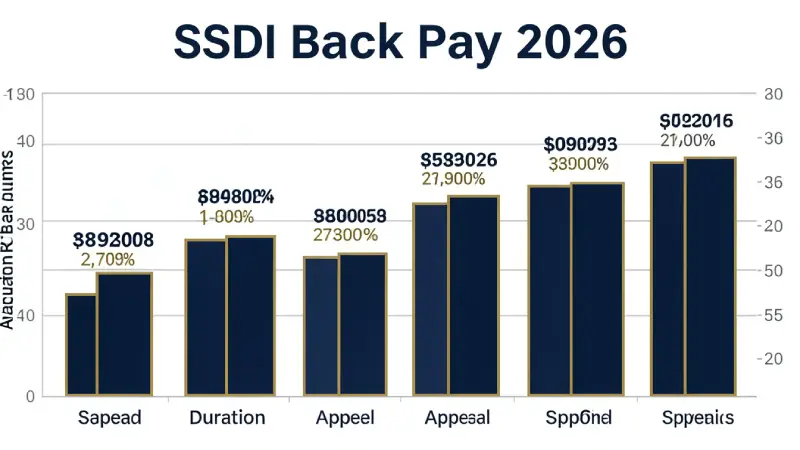
SSDI back pay is the accumulated monthly benefits from your "established onset date" (the date SSA determines your disability began) through the date of your approval. Because SSDI has a 5-month waiting period, back pay begins 5 months after your established onset date. The longer your appeal takes, the larger your potential back pay — provided you win.
| Scenario | Monthly Benefit (avg) | Appeal Duration | Potential Back Pay |
|---|---|---|---|
| Win at Reconsideration (3 months appeal) | $1,540 | 3 months | ~$4,620 |
| Win at ALJ Hearing (18 months appeal) | $1,540 | 18 months | ~$27,720 |
| Win at ALJ (24 months, onset 12 months prior) | $1,540 | 24 months + 12 prior | ~$55,440 |
Average SSDI Monthly Benefit 2026
The average SSDI monthly benefit in 2026 is $1,540/month — up from $1,483 in 2025 following the 2.5% COLA increase. Your individual benefit is based on your lifetime earnings record (AIME — Average Indexed Monthly Earnings). Higher lifetime earners receive higher benefits, up to the maximum of $3,822/month in 2026.
❓ Frequently Asked Questions — SSDI Denial & Appeals 2026
How long does the SSDI appeal process take?
The total SSDI appeal process from initial denial to ALJ Hearing decision typically takes 18–30 months. Reconsideration takes approximately 3–5 months. The ALJ Hearing wait time is currently 12–24 months from the date you request a hearing, due to backlog at ODAR hearing offices. Appeals Council review adds another 12–18 months if needed. The entire process from application to final decision can take 2–4 years in contested cases. This timeline makes preserving your appeal rights — rather than starting a new application — critically important, as your back pay accumulates throughout the appeal period.
Should I get a lawyer for my SSDI appeal?
Yes — for the ALJ Hearing and beyond, hiring a disability attorney is strongly recommended. SSA data shows claimants with attorney representation at ALJ Hearings are approved at 62% vs 34% for unrepresented claimants — nearly double the approval rate. The fee is federally regulated: no upfront cost, capped at 25% of back pay or $7,200 (whichever is less), paid directly from your award by SSA. You never pay out of pocket. Given this structure, there is no financial reason not to have legal representation at the ALJ Hearing level and beyond.
What is the most common reason SSDI is denied?
The most common reason for SSDI denial is insufficient medical evidence — SSA did not have enough documentation to establish the nature and severity of the disability and its impact on the claimant's functional capacity. The second most common reason is SSA's determination that the claimant can perform "other work" available in the national economy, based on the vocational expert's testimony. Both of these denial reasons are addressable on appeal — through stronger medical evidence (particularly a treating physician RFC assessment) and through attorney-led vocational expert cross-examination at the ALJ Hearing.
Can I work while my SSDI appeal is pending?
Yes, but carefully. You can work while your appeal is pending, but your earnings must stay below the Substantial Gainful Activity (SGA) threshold — $1,550/month in 2026 ($2,590 for blind individuals). Earning above this amount while your appeal is pending can result in denial based on your current work activity, regardless of your medical condition. If you need to work to survive financially during the appeal, keep careful records of your earnings and ensure they remain below SGA. Report any work activity to SSA. Some applicants qualify for an "unsuccessful work attempt" exception if they try to work but stop due to their disability — discuss this with your disability attorney.
What is the difference between SSDI and SSI?
SSDI (Social Security Disability Insurance) is based on your work history — you must have worked and paid Social Security taxes for a sufficient number of years (generally 5 of the last 10 years) to qualify. Benefits are calculated based on your lifetime earnings. SSI (Supplemental Security Income) is a needs-based programme for disabled individuals with limited income and resources — it does not require work history. A person can qualify for both programmes simultaneously if they meet both the disability and financial criteria. The medical definition of disability is the same for both programmes. If you don't have sufficient work history for SSDI, SSI may be an alternative path to explore.
How much SSDI back pay will I receive if I win my appeal?
Your SSDI back pay is calculated from your "established onset date" (when SSA determines your disability began) through the date of your approval, minus a 5-month waiting period. The average SSDI monthly benefit in 2026 is $1,540. If your onset date was 2 years ago and your appeal takes 18 months to resolve at the ALJ Hearing level, your back pay could be $36,000–$55,000 depending on your benefit amount and onset date. Your disability attorney's fee (capped at 25% or $7,200) is deducted from this back pay — you receive the remainder in a lump sum. Back pay is paid as a single lump-sum payment, and then monthly benefits begin going forward.
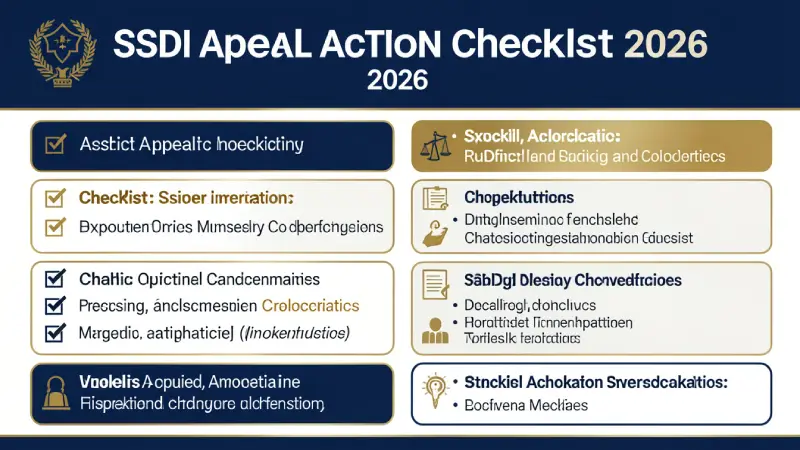
✅ Your Action Plan — What to Do Right Now
Today: Read your denial letter completely. Write down your appeal deadline (date on letter + 60 days + 5 days for mail). Do not miss this date under any circumstances.
This week: Contact a disability attorney — free consultation, no obligation, no upfront cost. File your Reconsideration request (Form SSA-561) even while you're consulting attorneys — you can add representation at any point.
Next 30 days: Gather updated medical records. Ask your treating physician for a detailed RFC assessment documenting your functional limitations specifically. Obtain any new test results or specialist evaluations.
Throughout the appeal: Continue all medical treatment. Keep your SSA address current. Respond to every SSA communication within the required timeframe. Do not earn above $1,550/month ($2,590 if blind).
At the ALJ Hearing: Have an attorney. Describe your worst days honestly and specifically. Let your attorney handle the vocational expert cross-examination.
| Action | Deadline | Priority |
|---|---|---|
| Read denial letter — identify reason & deadline | Today | 🔴 Urgent |
| Contact disability attorney | Within 48 hours | 🔴 Urgent |
| File Reconsideration (Form SSA-561) | Within 60 days of denial | 🔴 Urgent |
| Request RFC from treating physician | Within 2 weeks | 🟠 High |
| Gather all updated medical records | Within 30 days | 🟠 High |
| File ALJ Hearing request (if recon denied) | Within 60 days of recon denial | 🔴 Urgent when needed |
| Continue all medical treatment | Ongoing | 🟠 High |
| Keep earnings below SGA ($1,550/mo) | Ongoing | 🟠 High |
Disclaimer: This article is for informational purposes only and does not constitute legal advice. SSDI eligibility and appeal procedures are complex and subject to individual circumstances. Always consult a licensed disability attorney or accredited claims representative for advice specific to your case. Approval rates are based on SSA published data and administrative statistics for fiscal year 2025. Benefit amounts reflect 2026 SSA figures. Attorney fee caps and SGA thresholds accurate as of April 2026. Nexuora does not receive referral fees from any attorney or firm. Updated April 10, 2026.

Ahmada Ndao is a financial research analyst and independent journalist
specializing in US consumer finance, legal rights, and insurance markets.
With over 5 years covering American financial products, he has helped
thousands of readers navigate complex insurance decisions, find the right
legal representation, and optimize their credit strategies. His research
methodology combines primary data analysis, direct outreach to industry
professionals, and continuous monitoring of federal regulatory changes.
Ahmada’s work has been cited by financial communities across the US and
reviewed by licensed attorneys and insurance professionals for accuracy.