
Markets
Professional editorial finance photography of an American consumer building an emergency fund using a laptop and smartphone at a bright modern home office

Best High-Yield Savings Accounts of September 2026 — Highest APYs

The information in this article is for educational and informational purposes only and should not be considered personalized financial advice. Savings account APYs, fees, minimum balances, promotional offers, eligibility requirements and other account terms can change at any time. Always verify current terms directly with the financial institution before opening an account.

A high-yield savings account can help your cash earn substantially more interest than a traditional savings account while keeping your money relatively accessible.

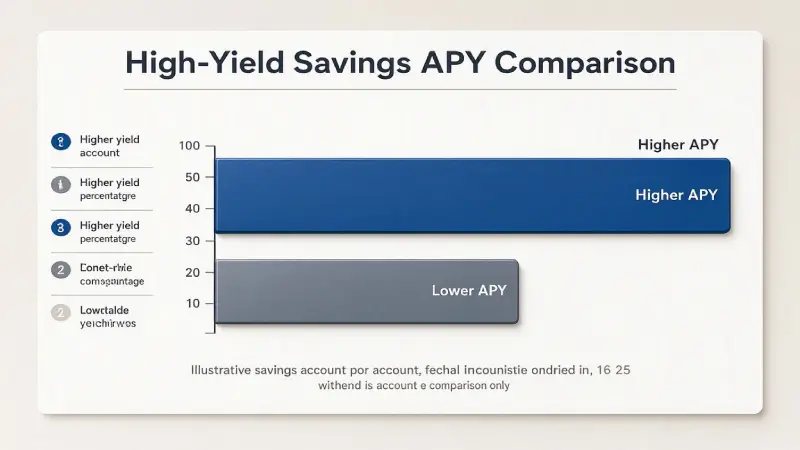
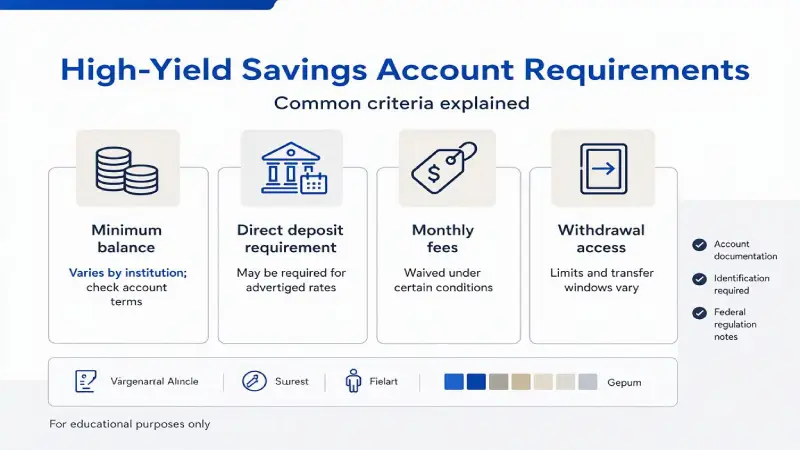
As of September 2026, some high-yield savings accounts are offering APYs around or above 4%, although the highest advertised rate may require specific conditions such as direct deposits, a linked checking account, a minimum balance or other qualifying activity.

That makes comparing savings accounts more complicated than simply searching for the highest APY.

The account with the highest advertised rate may not be the best fit if you cannot meet the requirements.

In this guide, we compare the factors that matter when choosing a high-yield savings account, including APY, fees, minimum deposits, access to your money, FDIC insurance, account requirements and rate stability.

We also explain how high-yield savings accounts compare with CDs, money market accounts and traditional savings accounts.

Best High-Yield Savings Accounts of September 2026

The high-yield savings market remains highly competitive in September 2026.

Current market research shows that some of the strongest accounts offer APYs around 4%, while certain accounts can offer more when customers meet specific requirements.

NerdWallet’s September 2026 research examined more than 110 savings accounts and currently lists Axos Bank among the accounts with the highest available APYs, at up to 4.21% under qualifying conditions.

Newtek Bank is currently listed at 4.20% APY with a $100 minimum opening deposit.

Climate First Bank and Peak Bank are currently listed around 4.01% APY.

However, these rates are not permanent. Savings APYs are generally variable, meaning the bank can change the rate.
High-Yield Savings Accounts at a Glance

Account TypeMain FeatureBest For
High-yield savingsCompetitive variable APYGeneral savings
Online savingsOften low fees and strong APYsDigital banking
Traditional savingsBranch accessIn-person banking
Money market accountSavings plus easier accessFlexible cash management
CDFixed APY for a set termMoney you can lock away

The best account depends on your priorities.

A consumer who needs an emergency fund may value easy access and no monthly fees more than an account offering a slightly higher APY with complicated requirements.

What Is a High-Yield Savings Account?

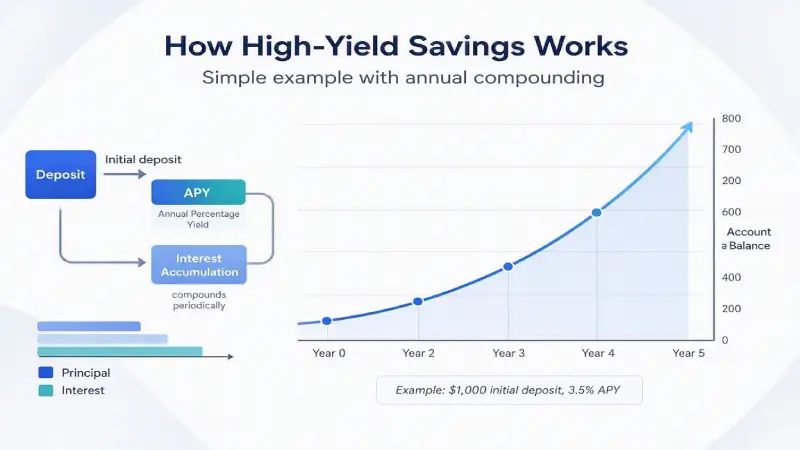
A high-yield savings account is a savings account that pays a higher interest rate than the typical traditional savings account.

These accounts are often offered by online banks and other financial institutions with lower operating costs than large branch-based banks.

The higher APY allows your savings to earn more interest over time.

For example, consider a hypothetical $10,000 balance.

At a 4% APY, the account could earn roughly $400 over one year if the rate remained unchanged and the balance stayed constant.

At a 1% APY, the same balance would earn roughly $100.

The difference becomes increasingly important as your balance grows and as you keep the money in the account for longer.

Actual earnings depend on the APY, balance, compounding method and changes in the account rate.
Why Are High-Yield Savings Rates Higher?

Online banks can sometimes offer higher deposit rates because they operate with fewer physical branches and lower overhead.

Banks also compete for deposits because customer deposits provide an important source of funding.

Interest-rate conditions also influence deposit rates.

When market rates are high, banks may increase the rates offered on savings accounts and CDs.

When rates decline, banks may reduce their APYs.

However, the relationship is not automatic.

Each financial institution sets its own deposit rates based on its business strategy, funding needs and competitive environment.

What Is APY?

APY stands for annual percentage yield.

It represents the amount of interest an account can earn over a year while accounting for compounding.

APY is generally more useful for comparing savings accounts than the stated interest rate alone.

For example, if two accounts have similar interest rates but different compounding structures, their APYs may differ.

When comparing accounts, focus on the current APY and the conditions required to earn it.
What Is the Highest High-Yield Savings Rate in September 2026?

There is no single permanent highest savings rate because APYs can change.

As of September 21, 2026, NerdWallet lists a high-yield savings APY of up to 4.21% through Axos Bank when certain requirements are met.

The same research lists:

  • Newtek Bank at 4.20%
  • Climate First Bank at 4.01%
  • Peak Bank at 4.01%
  • Vio Bank at 3.95%
  • TAB Bank at 3.95%
  • Valley Bank through Raisin at 3.96%

Other well-known savings products currently offer lower APYs but may provide different benefits such as branch access, integrated checking, strong digital tools or established banking relationships.

The highest APY should therefore be treated as one factor rather than the only selection criterion.

Best High-Yield Savings Account for High APY

If your priority is maximizing the interest earned on savings, look closely at the account’s advertised APY and the conditions attached to it.

For example, an account offering 4.21% APY may require a linked checking account and specific deposit or balance requirements.

That means the headline APY does not tell the entire story.

Before opening the account, ask:

  • What balance is required?
  • Is direct deposit required?
  • Must I open another account?
  • Is the APY promotional?
  • How long does the promotional rate last?
  • Can the bank change the APY?
  • Are there monthly fees?
  • Are there transaction restrictions?

A lower APY with fewer requirements can sometimes be more practical than a higher rate that is difficult to qualify for.

Best High-Yield Savings Account With No Minimum Deposit

Some high-yield savings accounts allow customers to open an account without depositing a large amount.

This can be useful for:

  • New savers
  • Students
  • Young adults
  • People building an emergency fund
  • Consumers moving money from a low-interest savings account

NerdWallet’s September 2026 list includes several accounts with no minimum opening deposit.

However, no minimum deposit does not necessarily mean no requirements.

Always check:

  • Minimum balance for the advertised APY
  • Monthly fees
  • Direct deposit requirements
  • Withdrawal rules
  • Account eligibility

High-Yield Savings Accounts vs Traditional Savings Accounts

The main difference is usually the interest rate.

FeatureHigh-Yield SavingsTraditional Savings
APYUsually higherUsually lower
Branch accessOften limitedOften available
FeesOften low or noneVaries
Online accessUsually strongVaries
RateVariableUsually variable
Emergency fundSuitableSuitable

Traditional savings accounts can still make sense for consumers who value local branches or already use a particular bank for checking and other services.

But consumers should regularly check their savings APY.

A large amount of cash sitting in a low-yield account can generate significantly less interest than it could in a competitive high-yield account.

High-Yield Savings Account vs CD

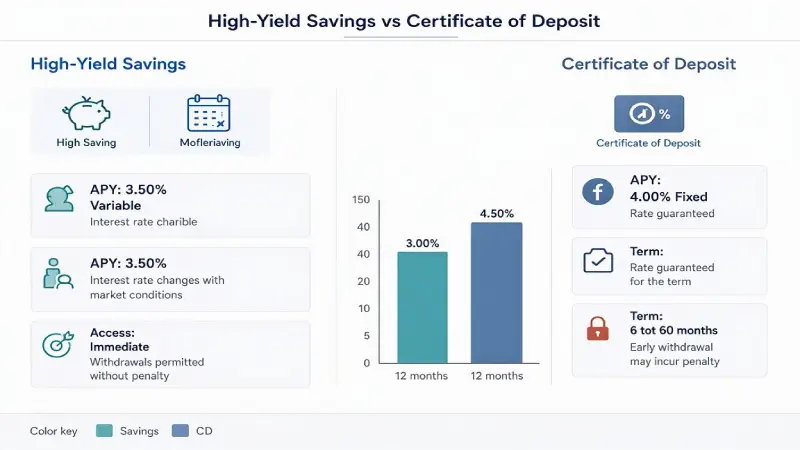
A CD can provide a fixed interest rate for a defined period.

A high-yield savings account generally provides a variable rate but easier access to the money.

FeatureHigh-Yield SavingsCD
RateUsually variableUsually fixed
AccessGenerally flexibleRestricted until maturity
Early withdrawal penaltyUsually noUsually yes
Maturity dateNoYes
Emergency fundOften suitableUsually less suitable
Rate protectionNoYes

A CD may be useful if you know you will not need the money for a specific period.

A high-yield savings account is generally more flexible for emergency savings.

High-Yield Savings vs Money Market Account

Money market accounts can provide a middle ground between savings and checking.

Depending on the institution, a money market account may provide features such as:

  • Debit card access
  • Check-writing capability
  • Competitive interest
  • Easier access to funds

However, account requirements vary.

Some money market accounts have minimum balances or monthly fees.

If your goal is simply to earn interest while maintaining easy access, compare both product types before deciding.

Are High-Yield Savings Accounts Safe?

High-yield savings accounts offered by FDIC-insured banks can provide federal deposit insurance within applicable limits.

The standard FDIC insurance coverage is generally $250,000 per depositor, per insured bank, for each ownership category.

Credit unions can instead provide NCUA insurance within applicable limits.

Consumers should verify that the financial institution is actually covered by the appropriate federal insurance program.

Do not assume that every financial product advertised as a “savings” product automatically has the same protection.

Deposit insurance also does not protect you from every possible financial loss.

It protects eligible deposits against certain losses resulting from the failure of an insured institution, subject to applicable rules and limits.

How Much Money Should You Keep in a High-Yield Savings Account?

he appropriate amount depends on your financial situation.

A high-yield savings account can be useful for:

  • Emergency savings
  • Upcoming expenses
  • Home down payments
  • Car purchases
  • Travel funds
  • Tax reserves
  • Business cash reserves
  • Short-term financial goals

Many financial professionals recommend maintaining an emergency fund covering several months of essential expenses, but the appropriate amount varies according to income stability, household expenses and personal circumstances.

The important point is liquidity.

Money you may need unexpectedly should generally be kept somewhere accessible.

How Much Interest Can $10,000 Earn?

Consider a hypothetical $10,000 balance earning 4% APY for one year.

If the APY remained unchanged and no money were withdrawn, the account could earn approximately $400 over the year.

At 3% APY, the same balance would earn approximately $300.

At 1% APY, it would earn approximately $100.

These are simplified illustrations rather than guaranteed returns.

Actual interest depends on the account’s APY, balance, compounding and rate changes.

How Much Can $50,000 Earn in a High-Yield Savings Account?

The same principle applies to larger balances.

At a hypothetical 4% APY, $50,000 could generate approximately $2,000 in interest over one year if the APY remained unchanged and the balance remained constant.

At 3%, the same balance would generate approximately $1,500.

That $500 difference illustrates why comparing savings rates becomes increasingly important as your cash balance grows.

However, consumers should also consider FDIC or NCUA insurance limits when keeping large amounts of cash in one institution.

High-Yield Savings and Inflation

A savings account can generate interest, but inflation can reduce the purchasing power of money over time.

A simplified way to think about the relationship is:

Real return ≈ savings rate − inflation rate

For example, a hypothetical 4% savings APY combined with 3% inflation would imply an approximate 1% nominal real-rate difference before considering taxes.

This is only a simplified illustration.

Taxes, changes in the APY and changes in inflation can alter the actual purchasing-power outcome.

NerdWallet’s recent rate-tracking research has specifically compared high-yield savings rates with inflation and notes that high-yield savings rates can sometimes fall below inflation.

This is one reason savers should distinguish between protecting cash, earning interest and building long-term wealth.

Should You Move Your Savings to a High-Yield Account?

Moving money can make sense when the new account provides materially better terms without creating unnecessary complications.

Before switching, compare:

  • APY
  • Fees
  • Insurance
  • Transfer limits
  • Mobile banking
  • Customer support
  • ATM access
  • Minimum balance
  • Direct deposit requirements
  • Account integration

You should also verify how quickly you can move money between the new account and your primary checking account.

An attractive APY is less useful if transferring money is difficult when you need it.

How to Choose the Best High-Yield Savings Account

1. Compare APYs

Look at the current APY rather than relying on an old advertised rate.

2. Check Requirements

Determine whether the advertised APY requires direct deposits, a linked checking account or a minimum balance.

3. Look for Monthly Fees

A monthly fee can offset the benefit of a higher interest rate.

4. Verify FDIC or NCUA Insurance

Confirm that your deposits have the appropriate federal insurance protection.

5. Check Withdrawal and Transfer Rules

Make sure you can access your money when needed.

6. Review Customer Service

Look at support hours, digital access and available communication channels.

7. Consider Mobile Banking

A strong app can make transfers and account management easier.

8. Check Rate History

A bank that consistently offers competitive rates may be more useful than one offering a temporary promotional APY.

9. Consider the Entire Banking Relationship

A slightly higher APY may not justify opening multiple accounts if you prefer simplicity.

Common High-Yield Savings Account Fees

Many competitive online savings accounts do not charge monthly maintenance fees, but consumers should still check the complete fee schedule.

Potential fees can include:

  • Excess transaction fees
  • Wire transfer fees
  • Out-of-network ATM fees
  • Returned payment fees
  • Paper statement fees
  • Account closure fees
  • Other service charges

Always read the account agreement before opening an account.

Are High-Yield Savings Rates Fixed?

Generally, no.

Most high-yield savings accounts have variable APYs.

The bank can increase or decrease the APY depending on market conditions and its own pricing decisions.

This is one of the biggest differences between a high-yield savings account and a fixed-rate CD.

A saver who wants to lock in a rate for a specific period may prefer a CD.

A saver who values liquidity may prefer a high-yield savings account.

What Happens When Savings Rates Fall?

If market rates decline, banks may reduce their savings APYs.

That means an account earning 4% today could pay less in the future.

This is normal for variable-rate savings accounts.

Rather than assuming the current APY will remain unchanged, review the account periodically.

If your bank significantly reduces its rate, compare current alternatives.


How Often Should You Check Your Savings APY?

There is no universal schedule, but checking periodically is useful.

A consumer could review the account:

  • When the Federal Reserve changes rates
  • When a promotional period ends
  • When the bank announces a rate change
  • When a competing account offers substantially more
  • During a broader financial review

The objective is not to constantly move money between banks.

The objective is to make sure your cash is still earning a competitive return without sacrificing convenience.


Can You Have More Than One High-Yield Savings Account?

Yes.

Some consumers use multiple savings accounts for different goals.

For example:

  • Emergency fund
  • Vacation fund
  • Home down payment
  • Tax savings
  • Business reserve

Separate accounts can make budgeting easier and help prevent money intended for one goal from being spent on another.

However, multiple accounts also create additional administration.

Choose the structure that is easiest for you to maintain.


High-Yield Savings Account Mistakes to Avoid

Chasing Every Rate Change

Constantly moving money can create unnecessary complexity.

Ignoring Account Requirements

A headline APY may require conditions you cannot meet.

Forgetting Promotional Rates

A promotional APY may expire.

Keeping Too Much Cash at One Institution

Large balances may exceed applicable federal deposit insurance limits.

Ignoring Inflation

A positive savings return does not automatically mean your purchasing power is increasing.

Using a Savings Account for Long-Term Investing

Savings accounts are designed primarily for cash savings and liquidity.

They are not a substitute for a diversified long-term investment strategy.

Best High-Yield Savings Account for an Emergency Fund

An emergency fund should prioritize:

  • Easy access
  • No or low monthly fees
  • Federal deposit insurance
  • Competitive APY
  • Reliable transfers
  • Strong online access

The highest APY should not be the only consideration.

If your emergency savings is difficult to access when your car breaks down or an unexpected bill arrives, the account may not be serving its purpose.

Best High-Yield Savings Account for Large Balances

Consumers with substantial cash balances should pay particular attention to:

  • FDIC or NCUA insurance
  • APY
  • Balance tiers
  • Minimum requirements
  • Transfer limits
  • Bank stability
  • Account ownership structure

For balances approaching or exceeding federal insurance limits, consumers may need to understand how deposit insurance applies across different institutions and ownership categories.

Best High-Yield Savings Account for Beginners

Beginners may benefit from an account that offers:

  • No monthly maintenance fee
  • Low or no minimum opening deposit
  • Simple online access
  • Clear account terms
  • Competitive APY
  • Easy transfers
  • FDIC or NCUA insurance

A simple account with a slightly lower APY may be easier to use than an account with complicated requirements.

Current High-Yield Savings Rate Environment

The savings-rate environment remains closely connected to broader interest-rate conditions.

In September 2026, the Federal Reserve’s target range is 3.75% to 4.00%.

However, the federal funds rate should not be confused with the APY paid directly to consumers.

Banks determine their own deposit rates.

That means two banks can offer very different savings APYs even when they operate in the same interest-rate environment.

Consumers should therefore compare actual account APYs rather than trying to estimate a savings rate from the Fed’s target alone.

Methodology

Nexuora evaluates high-yield savings accounts using several consumer-focused criteria.

These include:

  • Current APY
  • APY requirements
  • Minimum opening deposit
  • Minimum balance
  • Monthly fees
  • Deposit insurance
  • Account accessibility
  • Transfer convenience
  • Digital banking features
  • Customer support
  • Rate competitiveness
  • Suitability for different savings goals

Current rates are treated as time-sensitive information.

Where possible, important account terms should be verified directly with the financial institution before publication or immediately before a consumer applies.

Nexuora also reviews current market research from major personal-finance publishers to identify changes in rates, products and consumer questions.

Frequently Asked Questions

What is the highest high-yield savings account rate in September 2026?

Current September 2026 research shows that some high-yield savings accounts offer APYs above 4%, with the highest advertised rates sometimes requiring specific account conditions.

APYs can change, so verify the current rate directly with the bank.

Is 4% APY good for a savings account?

A 4% APY is competitive in the current September 2026 market, but consumers should compare the requirements, fees, insurance and rate stability before choosing an account.

Are high-yield savings accounts safe?

Savings accounts at FDIC-insured banks are generally protected within applicable FDIC limits. Eligible credit-union deposits may receive NCUA insurance.

Always verify the institution’s insurance status.

Can I lose money in a high-yield savings account?

The account balance itself generally does not fluctuate like a stock investment. However, fees, taxes and inflation can affect the effective value of your savings.

Can a high-yield savings APY go down?

Yes. Most savings APYs are variable and can increase or decrease.

Is a high-yield savings account better than a CD?

It depends on your need for liquidity. A HYSA generally provides easier access, while a CD can provide a fixed rate for a specific term.

How much money should I keep in a high-yield savings account?

The amount depends on your emergency fund and short-term savings needs. Many consumers use HYSAs for several months of essential expenses and other planned cash needs.

Do high-yield savings accounts have monthly fees?

Many competitive accounts do not charge monthly maintenance fees, but terms vary. Always check the current fee schedule.

Are online savings accounts safe?

Online savings accounts can be safe when offered by properly insured financial institutions. Verify FDIC or NCUA coverage before depositing money.

Can I have multiple savings accounts?

Yes. Multiple accounts can be useful for separating savings goals, although they also require more account management.

Final Takeaway

High-yield savings accounts can help consumers earn substantially more interest on cash without locking the money away for a fixed term.

But choosing an account should involve more than searching for the highest APY.

Before opening an account, compare the current APY, requirements, fees, minimum balance, transfer options, customer service and federal deposit insurance.

In September 2026, competitive savings accounts are offering rates around 4% or higher, but the best available rate can depend on specific eligibility requirements and can change at any time.

For an emergency fund or other money that needs to remain accessible, a competitive high-yield savings account can be an important part of a broader personal-finance strategy.