
Best Small Business Insurance USA 2026 — Top Providers, Coverage Types & Costs Compared
One lawsuit, one fire, one data breach — any of these can destroy a small business overnight without the right insurance. The U.S. Small Business Administration reports that 40% of small businesses that experience a major uninsured loss never reopen. Yet 44% of American small businesses operate without adequate coverage, mostly because owners find the insurance landscape confusing and expensive. This guide cuts through that complexity: we rank the best small business insurance providers in the USA for 2026, explain exactly what coverage every business needs, break down true costs by industry, and give you a proven framework to protect your business without overpaying.
Key Facts — Small Business Insurance USA 2026
- Best overall provider: Next Insurance — fastest quotes, fully digital, best for most small businesses
- Best for professional services: Hiscox — E&O specialist, trusted by 500,000+ businesses
- Best for contractors: The Hartford — general liability + tools & equipment coverage
- Average BOP cost: $57–$200/month depending on industry and revenue
- Most important policy: General Liability — required by most landlords, clients, and contracts
- 44% of small businesses are underinsured — average coverage gap of 35%
- Median lawsuit cost for small businesses: $54,000 — enough to bankrupt most without insurance
- Required by law: Workers' compensation in 49 states if you have employees
The 8 Best Small Business Insurance Companies USA — 2026
| Provider | Best For | BOP Starting | AM Best | Get Quote | Score |
|---|---|---|---|---|---|
| Next Insurance Editor's Pick | Most small businesses, digital-first | $25/mo | A- | Instant online | ⭐ 4.8/5 |
| Hiscox | Professional services, E&O | $30/mo | A | 10-min quote | ⭐ 4.7/5 |
| The Hartford | Contractors, established businesses | $50/mo | A+ | Agent or online | ⭐ 4.7/5 |
| Nationwide | Farms, restaurants, auto-related | $46/mo | A+ | Agent-based | ⭐ 4.5/5 |
| Chubb | High-value, large small businesses | $100/mo+ | A++ | Broker required | ⭐ 4.7/5 |
| Simply Business | Freelancers, self-employed | $20/mo | A (via partners) | Instant online | ⭐ 4.4/5 |
| Travelers | Full coverage, complex needs | $55/mo | A++ | Agent-based | ⭐ 4.6/5 |
| CNA | Healthcare, tech, financial services | $60/mo | A | Broker required | ⭐ 4.5/5 |
Next Insurance has revolutionized small business insurance with a fully digital platform that delivers instant quotes, same-day coverage, and certificate of insurance in minutes — no agents, no paperwork, no delays. They serve over 500,000 small businesses across 1,300+ professions, with industry-specific policies that cover exactly what your business needs and nothing it doesn't. Policies available: General Liability, Professional Liability (E&O), Commercial Auto, Workers' Comp, Tools & Equipment, and BOP. Their mobile app lets you manage policies, file claims, and share certificates of insurance directly from your phone. Apply at NextInsurance.com.
✓ Pros
- Instant quote and same-day coverage
- Lowest starting premiums for most industries
- 1,300+ profession-specific policies
- Certificate of insurance in minutes
- Fully mobile-managed
✗ Cons
- Newer company — less track record on large claims
- No human agent relationship
- A- rating vs A+ competitors
Hiscox is the industry benchmark for professional liability (Errors & Omissions) insurance — the coverage that protects consultants, accountants, lawyers, IT professionals, and any service business from client lawsuits alleging negligence or professional mistakes. With over a century of specialty insurance experience and a dedicated small business division, Hiscox offers coverage specifically calibrated for professional services firms. Their E&O policies start at $22.50/month for qualifying businesses. General liability, cyber liability, and BOP also available. Get a quote at Hiscox.com.
✓ Pros
- Best E&O/professional liability specialist
- 100+ years of specialty insurance experience
- Tailored for consultants, IT, finance professionals
- Strong claims handling reputation
✗ Cons
- Higher premiums than Next for general businesses
- Not ideal for contractors or physical businesses
The Hartford is the preferred insurer for contractors, tradespeople, and businesses that work on client properties — electricians, plumbers, roofers, landscapers, and general contractors. Their BOP for contractors includes general liability + commercial property + business interruption in a single package, with optional tools & equipment floaters that cover your gear wherever it goes. The Hartford's 200+ year track record means unmatched claims reliability — particularly important for contractors who need a certificate of insurance within hours to start a job. Get a quote at TheHartford.com.
✓ Pros
- A+ AM Best — outstanding financial strength
- Contractor-specific coverage packages
- Tools & equipment floater available
- 200+ years claims reliability
✗ Cons
- Higher premiums than digital-first competitors
- Agent-based process — less instant
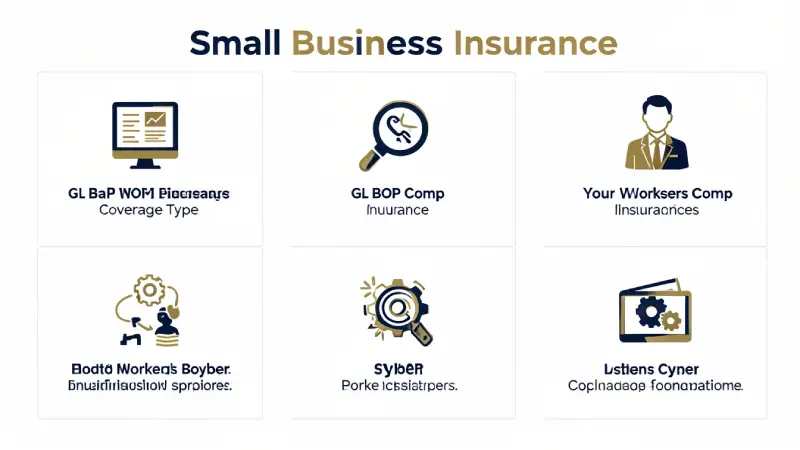
Essential Small Business Insurance Coverage Types — What Every Business Needs
General Liability Insurance Most Critical
Covers third-party bodily injury, property damage, and advertising injury claims. If a customer slips in your store, a contractor damages a client's property, or a competitor sues you for copyright infringement — general liability pays legal defense and damages. Required by virtually every commercial lease and client contract. Average cost: $42–$85/month. Every business needs this as the foundation of their coverage.
Business Owner's Policy (BOP) Best Value Bundle
A BOP bundles General Liability + Commercial Property + Business Interruption into one discounted package — typically 20–30% cheaper than buying each separately. Business interruption coverage (often overlooked) pays your ongoing expenses and lost income if a covered event forces you to temporarily close. Average cost: $57–$200/month. The best starting point for most small businesses with a physical location or significant equipment.
Professional Liability (E&O) Insurance
Errors & Omissions (E&O) insurance protects service businesses from client lawsuits claiming your work caused financial harm — a consultant's advice that led to losses, an accountant's error, an IT system that failed. Not included in a standard BOP — must be added separately. Essential for: consultants, accountants, IT professionals, real estate agents, financial advisors, lawyers, designers, and anyone paid for professional advice or services. Average cost: $30–$80/month.
Workers' Compensation Insurance Legally Required
Required by law in 49 states for businesses with employees. Covers medical expenses and lost wages for employees injured on the job, and protects you from lawsuits arising from workplace injuries. The cost of a single workplace injury without workers' comp can exceed $40,000. Average cost: $70–$150/month per employee depending on industry. High-risk industries (construction, manufacturing) pay significantly more. See our personal injury guide for context on workplace injury lawsuit values.
Commercial Auto Insurance
Your personal auto insurance does not cover vehicles used for business purposes. If you or an employee drive for business — deliveries, client visits, job sites — commercial auto insurance is required. Average cost: $150–$250/month per vehicle. Fleets and delivery businesses face higher premiums. See our auto insurance guide for general vehicle coverage context.
Cyber Liability Insurance Fastest Growing Need
Covers data breaches, ransomware attacks, and cybercrimes — including notification costs, credit monitoring for affected customers, legal defense, and regulatory fines. The average cost of a small business data breach is $108,000. With 43% of cyberattacks targeting small businesses, this coverage has moved from optional to essential. Average cost: $50–$150/month. Critical for any business storing customer data, processing payments, or operating online.
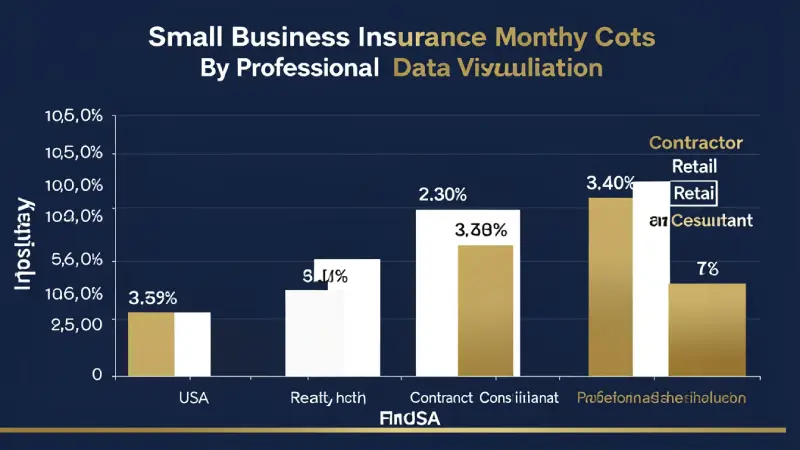
Small Business Insurance Cost by Industry — 2026
| Industry | General Liability/mo | BOP/mo | Workers' Comp/mo | Total Est./mo |
|---|---|---|---|---|
| Retail store | $50–$90 | $80–$150 | $80–$130 | $200–$350 |
| Contractor / Construction Highest Risk | $100–$250 | N/A (separate) | $200–$500 | $350–$800+ |
| Restaurant / Food service | $60–$120 | $100–$200 | $90–$150 | $250–$450 |
| IT / Technology | $30–$60 | $60–$100 | $40–$80 | $150–$300 |
| Consultant / Professional | $30–$55 | $50–$90 | $30–$60 | $100–$200 |
| Cleaning / Janitorial | $40–$80 | $65–$110 | $60–$100 | $150–$280 |
| Healthcare / Medical | $80–$150 | $120–$200 | $100–$180 | $300–$550 |
| Home-based / Freelance Lowest | $25–$50 | $35–$65 | N/A (no emp.) | $25–$100 |
💡 BOP Eligibility Note: Not all businesses qualify for a BOP. Generally, your business must have revenues under $5M, fewer than 100 employees, and operate in a low-to-moderate risk industry. High-risk businesses (construction, manufacturing, auto repair) typically need separate commercial policies rather than a BOP. Ask your insurer specifically about BOP eligibility based on your industry classification (NAICS code) and claims history.

How to Get Small Business Insurance — Step by Step
- Identify your mandatory coverages. If you have employees — workers' comp is legally required. If you have a commercial lease — general liability is required by contract. If you drive for business — commercial auto is required. Start with these before anything optional.
- Assess your risk profile. What could go wrong that would cause a financial loss too large to cover from cash reserves? Physical injury to customers? Damage to client property? Professional errors? Data breach? Each risk corresponds to a specific coverage type.
- Get quotes from at least 3 providers. Use Next Insurance for instant digital quotes, Hiscox for professional liability comparison, and The Hartford or Travelers for a traditional agent-based quote. Use CoverWallet.com to compare multiple carriers simultaneously.
- Compare total annual cost, not just monthly premium. Check deductibles, coverage limits, and exclusions. A $200/year cheaper policy with a $10,000 deductible may be more expensive when you need it.
- Purchase and obtain certificate of insurance immediately. Most clients and landlords need to be named as "additional insureds" on your certificate — confirm your policy allows this before purchasing.
- Review annually. As your business grows — more employees, new equipment, new services, new locations — your coverage needs change. An annual review prevents the most dangerous gap: being underinsured on a policy you took out when the business was smaller.
Small Business Insurance Requirements by State
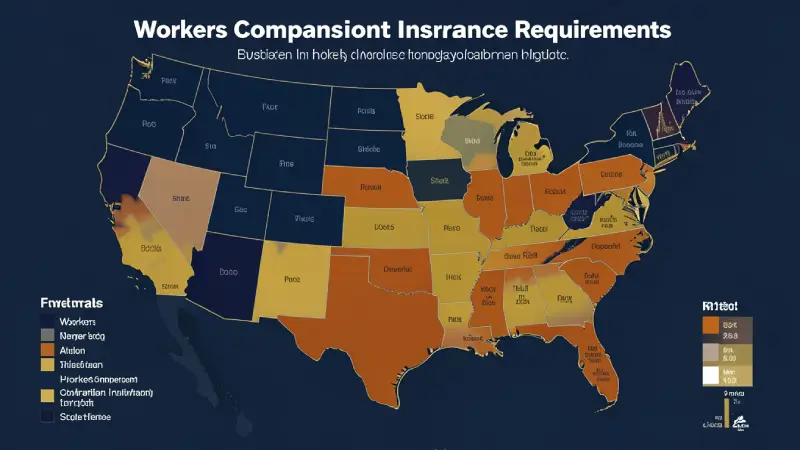
| State | Workers' Comp Threshold | Notable Requirement | Regulatory Body |
|---|---|---|---|
| California | 1+ employee | Strictest enforcement, high penalties | CA DIR |
| Texas Exception | Optional (only state) | Workers' comp not mandatory for most | TDI |
| New York | 1+ employee | Disability benefits also required | NY WCB |
| Florida | 4+ employees (construction: 1+) | Construction industry strictly enforced | FL DFS |
| Illinois | 1+ employee | Also requires occupational disease coverage | IL WCC |
| Georgia | 3+ employees | Lower threshold than many states | SBWC |
| Alabama | 5+ employees | Higher threshold | AWCC |
For a complete guide to your state's specific requirements, the U.S. Small Business Administration (SBA.gov) maintains updated state-by-state insurance requirement guides. The National Association of Insurance Commissioners (NAIC) provides complaint ratio data for every licensed insurer in your state — always check this before purchasing.
⚠️ Operating Without Required Insurance: Operating without mandatory workers' compensation is a criminal offense in most states — penalties include fines of $1,000–$10,000 per day, stop-work orders, and personal liability for all workplace injury costs. If an employee is injured and you have no workers' comp, you pay all medical bills, lost wages, and legal costs personally. This is one of the most common — and most devastating — financial mistakes small business owners make.
Small Business Insurance Audit Checklist 2026
- General liability — minimum $1M per occurrence, $2M aggregate
- BOP if you have a physical location or significant equipment
- Workers' comp if you have any employees (check your state threshold)
- Professional liability / E&O if you provide professional services or advice
- Commercial auto if any vehicle is used for business purposes
- Cyber liability if you store customer data or accept online payments
- Certificate of insurance naming key clients/landlords as additional insureds
- Umbrella policy if your liability exposure exceeds base limits
- Check AM Best rating — A- minimum for any insurer
- Review and update coverage annually as business grows
- Keep digital copies of all policies accessible from phone
FAQ — Best Small Business Insurance USA 2026

Ahmada Ndao is a financial research analyst and independent journalist
specializing in US consumer finance, legal rights, and insurance markets.
With over 5 years covering American financial products, he has helped
thousands of readers navigate complex insurance decisions, find the right
legal representation, and optimize their credit strategies. His research
methodology combines primary data analysis, direct outreach to industry
professionals, and continuous monitoring of federal regulatory changes.
Ahmada’s work has been cited by financial communities across the US and
reviewed by licensed attorneys and insurance professionals for accuracy.