
Best Umbrella Insurance Policy USA 2026 — Top 7 Providers, Real Costs & Exactly Who Needs $1M+ in Extra Coverage
A single serious car accident. A guest injured at your home. A defamation claim from a social media post. A dog bite lawsuit. Any of these can generate a judgment that exceeds your auto or homeowners liability limits — leaving your savings, investment accounts, real estate, and future earnings exposed to collection. Umbrella insurance adds $1M–$5M in liability coverage above your existing policies for approximately $150–$300/year — making it one of the highest-value insurance purchases available. Yet only 19% of American homeowners carry it, according to the Insurance Information Institute. This guide ranks the best umbrella insurance policies in the USA for 2026, explains exactly how umbrella coverage works as a layer above your existing policies, identifies who needs it most, reveals what it does and does not cover, and shows you how to buy $1M in protection for less than $13/month.
Key Facts — Best Umbrella Insurance USA 2026
- Best overall: Chubb — A++, broadest coverage, no underlying policy requirement, best for high-net-worth
- Best value: USAA — lowest premiums for eligible members, from $150/year for $1M coverage
- Best for bundlers: Allstate — strongest multi-policy discount, easy bundling with existing auto/home
- $1M umbrella policy costs $150–$300/year — roughly $0.41–$0.82/day for $1M extra protection
- Most auto/homeowners policies cap liability at $300K–$500K — umbrella fills the gap above that
- Umbrella does NOT cover: Your own injuries, business liability, intentional acts, or professional errors
- Who needs it most: Homeowners, dog owners, parents of teen drivers, landlords, high-income earners
- Most dangerous misconception: "My auto insurance covers everything" — a serious accident judgment routinely exceeds $500K
How Umbrella Insurance Works — The Coverage Layer Most Americans Are Missing
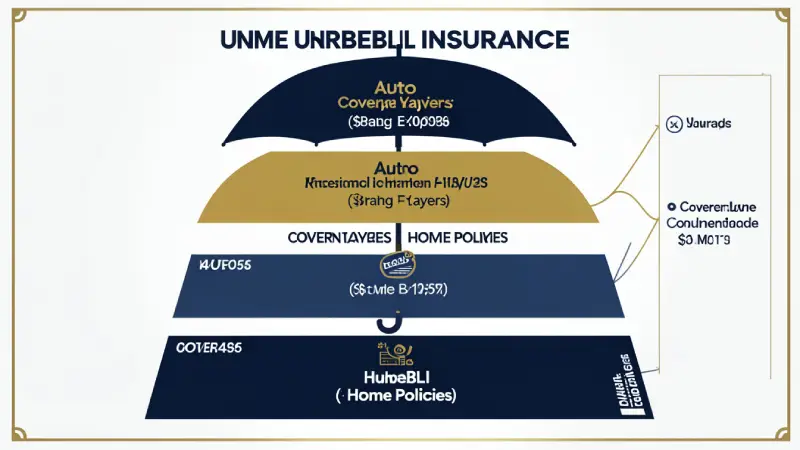
Umbrella insurance is not a standalone policy — it is an additional liability layer that activates when your underlying auto or homeowners policy limit is exhausted. Understanding this structure is essential to understanding both why you need it and how to buy it correctly.
Real scenario: You are at fault in a car accident. The other driver has $280,000 in medical bills, $190,000 in lost wages, and is awarded $90,000 in pain and suffering — a total judgment of $560,000. Your auto policy has a $300,000 bodily injury limit. Your insurer pays $300,000. The remaining $260,000 judgment is entirely your personal liability — enforceable against your savings, investment accounts, home equity, and future wages. A $1M umbrella policy costs $200/year and would have covered the entire $260,000 gap with $740,000 remaining.
Best Umbrella Insurance Companies USA 2026 — Full Rankings
| Rank | Provider | AM Best | $1M From | Max Coverage | Underlying Required | Score |
|---|---|---|---|---|---|---|
| #1 | Chubb Editor's Choice | A++ | $380/yr | $100M | Flexible | 4.9/5 |
| #2 | USAA | A++ | $150/yr | $5M | USAA auto+home | 4.9/5 |
| #3 | Allstate | A+ | $200/yr | $5M | Allstate auto+home | 4.7/5 |
| #4 | State Farm | A++ | $190/yr | $5M | SF auto+home | 4.6/5 |
| #5 | Nationwide | A+ | $200/yr | $5M | Nationwide auto+home | 4.6/5 |
| #6 | Liberty Mutual | A | $230/yr | $5M | LM auto+home | 4.4/5 |
| #7 | Travelers | A++ | $250/yr | $10M | Flexible | 4.4/5 |
Chubb's Personal Excess Liability (umbrella) policy provides coverage in layers above your existing auto and homeowners policies — but uniquely does not require those policies to be with Chubb. This flexibility means you can keep your existing auto and homeowners insurers while adding Chubb's superior umbrella protection. Coverage includes: bodily injury and property damage liability worldwide, personal injury (libel, slander, defamation, invasion of privacy), employment practices liability for household staff, and crisis management services for incidents requiring PR response. For clients with net worth above $1M, Chubb is the standard recommendation from independent financial advisors. Access via broker or at Chubb.com.
✓ Why Chubb Wins Umbrella
- A++ AM Best — maximum financial strength
- Coverage up to $100M — no other insurer matches
- No Chubb underlying policy required
- Worldwide coverage including international travel
- Unlimited defense cost coverage
- Employment practices for household staff included
- Social media defamation coverage standard
✗ Limitations
- Higher premiums than USAA or State Farm
- Broker required for most policies
- Minimum underlying liability requirements
USAA's umbrella policy bundles seamlessly with their auto and homeowners coverage — adding $1M–$5M in additional liability for as little as $150/year for eligible members. Their claims service for umbrella events is managed by the same high-rated team that handles all USAA claims, maintaining the satisfaction levels that have made them the benchmark for insurance customer experience. For military families with growing assets — particularly officers accumulating retirement savings, real estate equity, and investment portfolios — USAA umbrella protection at $150/year represents one of the highest-return insurance decisions available. Enroll at USAA.com.
✓ Why USAA Wins Value
- $1M coverage from $150/year — lowest available
- A++ AM Best — maximum financial strength
- Seamless bundle with USAA auto + home
- Top-rated claims service
✗ Limitations
- Military eligibility required
- Must carry USAA underlying auto + home
- Maximum $5M vs Chubb's $100M
Allstate's Personal Umbrella Policy adds $1M–$5M in liability coverage above their auto and homeowners policies. Their bundle discount reduces umbrella premiums by 10–15% for policyholders who already carry Allstate auto and home — making the effective annual cost as low as $170/year for $1M. Allstate's nationwide agent network (10,000+ agents) provides in-person policy review and coverage guidance that fully digital competitors cannot match. For families with existing Allstate relationships, adding umbrella coverage is often a 10-minute conversation. Get a quote at Allstate.com.
✓ Why Allstate Wins Bundlers
- 10–15% bundle discount with auto + home
- 10,000+ agents for in-person guidance
- A+ AM Best financial strength
- Simple add-on to existing Allstate policy
✗ Limitations
- Requires Allstate underlying auto + home
- Coverage breadth below Chubb
- Higher premiums without bundle discount
Who Needs Umbrella Insurance — The 9 Risk Profiles That Can't Afford to Skip It
Every financial advisor recommends umbrella insurance for anyone with assets worth protecting. But these specific risk profiles face the highest probability of a judgment that exceeds standard policy limits — and the highest financial consequences if they don't have it.
🚗 Parents of Teen Drivers
URGENT — Highest probability riskTeen drivers (16–19) are 3x more likely to be in a fatal crash than drivers 20+. A serious accident causing permanent injury to another driver can generate verdicts of $800,000–$3M. Standard auto policies cap at $300K–$500K. Parents are legally liable for their minor child's driving. A $1M umbrella policy costs $200/year and covers the most probable catastrophic liability event in most American families.
🏊 Pool, Trampoline, or Dog Owners
URGENT — "Attractive nuisance" doctrineSwimming pools, trampolines, and dogs create what courts call "attractive nuisances" — you can be held liable for injuries even if the injured party was trespassing. Dog bite claims alone averaged $64,555 per claim in 2025. A drowning death can generate multi-million dollar wrongful death suits. Homeowners liability typically caps at $100K–$300K. Umbrella fills the gap.
🏠 Landlords and Rental Property Owners
HIGH PRIORITY — Multiple liability exposuresRental property owners face liability from tenant injuries, visitor injuries, and property maintenance claims across multiple locations. Each property multiplies your exposure. Standard landlord policies cap liability at $100K–$300K per location. A tenant fall causing permanent disability can exceed those limits at a single property. Commercial umbrella or personal umbrella covering rental activities is essential.
💼 High-Income Earners and Business Owners
HIGH PRIORITY — Future earnings at riskLiability judgments can be enforced against future earnings, not just current assets. A 45-year-old earning $200,000/year has $4M+ in future earnings exposed to a judgment that exceeds insurance limits. Plaintiffs' attorneys routinely research defendants' income before structuring settlement demands. Higher income = larger judgment demands. The $200/year umbrella premium is the cheapest asset protection available.
🌐 Active Social Media Users
GROWING RISK — Defamation claims increasingDefamation, libel, and slander claims from social media posts have generated six-figure judgments against private individuals with no business activity. A negative business review, a comment about a neighbor, or a post about a former employer can trigger a lawsuit. Umbrella policies typically cover personal injury liability including defamation — for $0.41/day, this protection covers a risk that simply didn't exist 15 years ago.
Umbrella Insurance Costs — Exactly What $1M, $2M, and $5M Coverage Costs in 2026
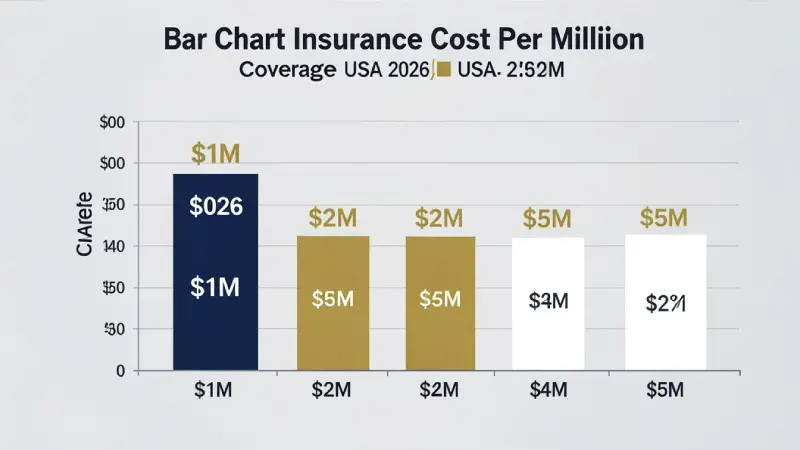
| Coverage Amount | Annual Premium Range | Monthly Cost | Per Day | Cost per $M Protection |
|---|---|---|---|---|
| $1,000,000 Most Popular | $150–$300/yr | $12.50–$25 | $0.41–$0.82 | $150–$300/M |
| $2,000,000 | $200–$375/yr | $16.67–$31 | $0.55–$1.03 | $100–$188/M |
| $3,000,000 | $250–$450/yr | $20.83–$37.50 | $0.68–$1.23 | $83–$150/M |
| $5,000,000 | $300–$550/yr | $25–$45.83 | $0.82–$1.51 | $60–$110/M |
💡 The cost efficiency of more coverage: The first $1M of umbrella coverage costs $150–$300/year. Each additional $1M typically adds only $50–$75/year. This means $5M of coverage costs only $100–$250/year more than $1M — yet provides 5x the protection. For anyone with assets or income exceeding $500K, $2M–$3M in umbrella coverage is almost always the better value decision.
What Umbrella Insurance Covers — And 6 Exclusions Most People Don't Know
Covered by most umbrella policies:
- Bodily injury liability above auto policy limits — car accidents, pedestrian injuries
- Property damage liability above auto policy limits
- Bodily injury on your property above homeowners limits — guest injuries, pool incidents
- Dog bite liability above homeowners limits
- Personal injury — libel, slander, defamation, invasion of privacy
- Worldwide liability coverage (most policies)
- Legal defense costs — in addition to coverage limits at most insurers
NOT covered — the 6 exclusions that surprise most buyers:
✗ Exclusion 1 — Your own injuries. Umbrella is a liability policy — it covers your legal obligation to others, not your own medical costs. Your health insurance and auto medical payments coverage handle your own injuries.
✗ Exclusion 2 — Business liability. Standard personal umbrella explicitly excludes claims arising from business activities. A home-based business that injures a client is typically not covered. Business owners need a separate commercial umbrella or commercial general liability policy. See our business insurance guide.
✗ Exclusion 3 — Professional errors and omissions. Advice you give professionally — as a doctor, lawyer, accountant, or consultant — that causes a client harm is excluded from personal umbrella. This requires a separate professional liability (E&O) policy.
✗ Exclusion 4 — Intentional acts. If you intentionally harm someone, umbrella does not cover the resulting judgment. Insurance covers accidental liability — not deliberate actions.
✗ Exclusion 5 — Damage to your own property. Umbrella covers your liability to others — not damage to your own home, car, or possessions. That is the function of your property coverage.
✗ Exclusion 6 — Underlying policy not in force. Umbrella requires your underlying auto and homeowners policies to be active and at specified minimum liability limits. If your auto policy lapses, your umbrella coverage may be suspended. Always maintain required underlying coverage minimums — typically $300K auto bodily injury and $300K homeowners liability.

How Much Umbrella Coverage Do You Need? — The Asset Protection Formula
The standard financial planning recommendation is to carry umbrella coverage equal to or greater than your total net worth. Here is the calculation:
- Calculate your total net worth: Home equity + savings + investment accounts + retirement accounts + vehicles. Subtract all debts.
- Add your future earnings exposure: Multiply your annual income by remaining working years. A 40-year-old earning $150,000/year with 25 working years has $3.75M in future earnings exposure.
- Subtract existing liability coverage: Your auto bodily injury limit + homeowners liability limit. Typical total: $400K–$800K.
- The result is your umbrella coverage minimum.
Example: Net worth $450,000 + future earnings $2,500,000 = $2,950,000 total exposure − $600,000 existing coverage = $2.35M umbrella coverage needed → buy $3M policy at $250–$450/year.
✅ The underwriting requirement: Before purchasing umbrella insurance, your insurer will require minimum liability limits on your underlying policies — typically $300,000 bodily injury per person / $300,000 per accident on auto, and $300,000 on homeowners. If your current limits are lower (e.g., $100K/$300K), you'll need to raise them first. The combined premium increase is usually $100–$200/year — still well below the protection gap you are closing.

Umbrella Insurance Checklist — 2026
- Calculate net worth + future earnings — set coverage at that level minimum
- Raise auto liability to $300K/$300K if currently below — required for umbrella
- Raise homeowners liability to $300K if currently below — required for umbrella
- Get quote from USAA first if military eligible — lowest premiums available
- Get Chubb quote via broker if net worth exceeds $1M — broadest coverage
- If existing Allstate/State Farm/Nationwide customer — add umbrella to bundle
- Verify dog breed is covered — some insurers exclude certain breeds
- Verify pool and trampoline are covered on underlying homeowners first
- Confirm worldwide coverage if you travel internationally
- Verify umbrella covers rental property if you own investment real estate
- AM Best minimum A- for any umbrella insurer
- Review coverage amount annually as net worth grows
FAQ — Best Umbrella Insurance Policy USA 2026

Ahmada Ndao is a financial research analyst and independent journalist
specializing in US consumer finance, legal rights, and insurance markets.
With over 5 years covering American financial products, he has helped
thousands of readers navigate complex insurance decisions, find the right
legal representation, and optimize their credit strategies. His research
methodology combines primary data analysis, direct outreach to industry
professionals, and continuous monitoring of federal regulatory changes.
Ahmada’s work has been cited by financial communities across the US and
reviewed by licensed attorneys and insurance professionals for accuracy.