
Best Medical Malpractice Lawyers USA 2026 — Top Firms, Average Settlements & How to Win Your Case
Medical errors are the third leading cause of death in the United States — yet fewer than 2% of medical malpractice victims ever file a claim, and of those who do, most hire the wrong attorney and leave hundreds of thousands of dollars on the table. Medical malpractice is the most complex and expensive area of personal injury law — requiring expert medical witnesses, specialized legal knowledge, and the financial resources to litigate against hospital systems and insurance companies with unlimited defense budgets. The difference between a skilled malpractice attorney and an average one is not marginal — it is the difference between a $280,000 settlement and a $2.4M verdict on the same case. This guide identifies what makes a top medical malpractice attorney, explains average settlements by case type, reveals the statute of limitations deadline that kills more cases than any defense strategy, and gives you a 12-point evaluation framework to find the right attorney for your specific case.
Key Facts — Medical Malpractice USA 2026
- Average malpractice settlement: $242,000 — but trial verdicts average $1.2M+ when plaintiff wins
- Only 7% of cases go to trial — 93% settle before verdict
- Contingency fees: 25–40% of recovery — you pay nothing unless you win
- Statute of limitations: 1–3 years depending on state — missing it permanently bars your claim
- Expert medical witnesses are required in virtually every malpractice case — attorneys who lack access to top experts lose cases they should win
- Most expensive case types: Birth injuries ($2M–$15M), surgical errors ($500K–$3M), anesthesia errors ($1M–$5M)
- The #1 mistake: Waiting too long to consult an attorney — evidence deteriorates and deadlines expire
- Caps on damages exist in 33 states — your state's cap directly limits your maximum recovery

What Makes a Top Medical Malpractice Attorney — The 7 Criteria That Separate Winners from the Rest
Medical malpractice is not like other personal injury cases. It requires a specialized combination of legal expertise, medical knowledge, and financial resources that most general personal injury attorneys simply don't have. Here is what separates top malpractice attorneys from average ones — and why the difference is measured in hundreds of thousands of dollars.
Expert witnesses charge $400–$800/hour for review and $5,000–$15,000/day for trial testimony. A complex malpractice case may require $80,000–$200,000 in expert costs. Attorneys who fund these costs themselves — on contingency — only do so when they believe in the case. This is why top malpractice firms that advance expert costs select cases more carefully and invest more heavily in winning them.
Medical Malpractice Average Settlements by Case Type — 2026 Data
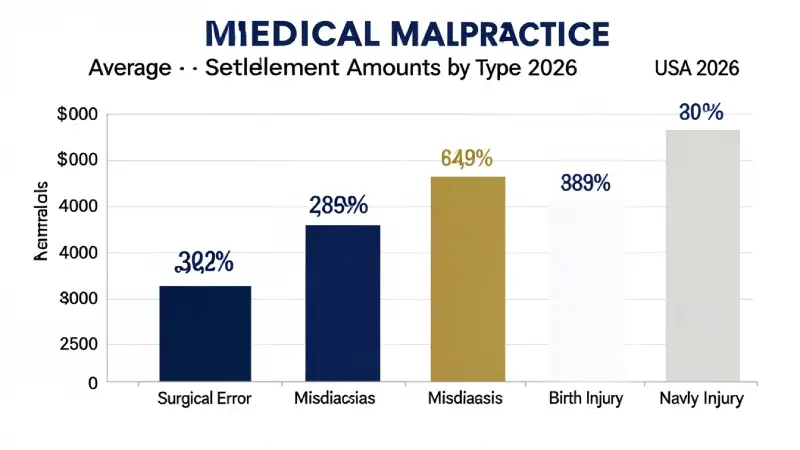
| Case Type | Avg. Settlement | Avg. Trial Verdict (Plaintiff Wins) | Time to Resolution |
|---|---|---|---|
| Birth Injury / Cerebral Palsy Highest | $1.5M–$3M | $5M–$15M | 3–7 years |
| Anesthesia Error | $800K–$2M | $2M–$8M | 2–5 years |
| Surgical Error | $400K–$1.2M | $1M–$4M | 2–4 years |
| Wrongful Death — Medical | $500K–$1.5M | $1M–$5M | 2–4 years |
| Delayed Diagnosis — Cancer | $300K–$900K | $800K–$3M | 2–3 years |
| Misdiagnosis | $150K–$400K | $400K–$1.5M | 1–3 years |
| Medication Error | $100K–$350K | $300K–$1.2M | 1–2 years |
| ER / Emergency Care Error | $200K–$600K | $500K–$2M | 2–3 years |
💡 Why settlements are lower than verdicts: Settlements average 20–40% of what a jury verdict would award for the same case. Defendants settle to avoid the uncertainty of trial and the risk of a larger verdict. Plaintiffs settle to avoid the time, stress, and uncertainty of trial. The decision to settle vs. trial is the most important strategic decision in your case — and the one where attorney quality matters most.
Malpractice Case Types — What You Need to Prove in Each
🏥 Surgical Error
AVG. SETTLEMENT $400K–$1.2MWhat qualifies: Wrong-site surgery, retained surgical instruments, nerve damage from improper technique, organ perforation, operating on wrong patient. What you must prove: (1) A doctor-patient relationship existed. (2) The surgeon deviated from the accepted standard of care. (3) That deviation directly caused your injury. (4) You suffered measurable damages. The standard of care is established by expert testimony comparing the defendant's actions to what a reasonably competent surgeon would have done in the same circumstances.
🧬 Misdiagnosis / Delayed Diagnosis
AVG. SETTLEMENT $150K–$900KWhat qualifies: Cancer diagnosed 6–18 months late allowing spread, heart attack misdiagnosed as indigestion, stroke symptoms dismissed, appendicitis missed resulting in rupture. The critical element: You must prove that a competent doctor in the same specialty would have reached the correct diagnosis earlier — AND that the delay in diagnosis changed your outcome. If the delay didn't worsen your prognosis, damages are limited. This "loss of chance" theory is the most legally complex element of misdiagnosis cases.
👶 Birth Injury
AVG. SETTLEMENT $1.5M–$3MWhat qualifies: Cerebral palsy from oxygen deprivation, brachial plexus injury from improper delivery technique, hypoxic ischemic encephalopathy (HIE), failure to perform timely C-section. Why these cases are highest value: Birth injury damages include a lifetime of medical care, therapy, special education, assisted living, and lost earning capacity — calculated over a 70–80 year life expectancy. A single birth injury case representing a child with severe cerebral palsy can have provable lifetime damages exceeding $15M.
💊 Medication Error
AVG. SETTLEMENT $100K–$350KWhat qualifies: Wrong drug prescribed, wrong dosage, dangerous drug interaction not identified, medication prescribed despite known allergy. Multiple potentially liable parties: Prescribing physician, pharmacist, hospital pharmacy, and in some cases the pharmaceutical manufacturer. Medication error cases often involve multiple defendants — which increases both complexity and potential recovery.

How Contingency Fees Work — What 33% Means on a $1.2M Settlement
Medical malpractice attorneys work on contingency — meaning you pay no attorney fees unless and until you receive a recovery. This makes malpractice representation accessible regardless of your financial situation. But the fee structure has several components that most clients don't fully understand until settlement.
| Fee Component | Typical Range | On $1.2M Settlement | Notes |
|---|---|---|---|
| Attorney contingency fee | 25–40% | $300K–$480K | Often higher if case goes to trial |
| Litigation costs advanced | $50K–$300K | $80K–$200K | Deducted from recovery before/after fee |
| Medical liens (if any) | Varies | $0–$150K | Health insurer, Medicare subrogation |
| Your net recovery | Varies | $400K–$820K | Depends on fee % and costs structure |
⚠️ Critical negotiation point: Whether litigation costs are deducted before or after the attorney fee is calculated dramatically changes your net recovery. Example: $1.2M settlement, $120K costs, 33% fee. Costs deducted first: 33% × ($1.2M − $120K) = $356K fee → you receive $724K. Costs deducted after fee: 33% × $1.2M = $396K fee, then − $120K costs → you receive $684K. The difference: $40,000 — purely a function of which calculation method your attorney uses. Negotiate costs-first deduction before signing.
Statute of Limitations — The Deadline That Kills More Cases Than Any Defense Strategy

The statute of limitations is the single most time-sensitive element of a malpractice claim. Missing it by one day permanently bars your case — regardless of how clear the negligence, how severe the injury, or how strong your evidence. Most states allow 2–3 years, but the nuances vary significantly.
🔴 1-Year States
Louisiana, Tennessee, Kentucky. The shortest deadlines in the country. If you suspect malpractice in these states, you must consult an attorney immediately — 12 months passes faster than most patients realize while dealing with medical recovery.
🟡 2-Year States
California, Texas, Florida, Illinois, Pennsylvania, Ohio, Michigan. The most common limit — covers most major states. Discovery rule may extend if injury was not immediately apparent.
🟢 3-Year States
New York, New Jersey, Massachusetts, Maryland, Washington. More time, but still not unlimited. The 3-year clock typically starts from the date of injury or date of discovery.
🟡 Discovery Rule
In most states, the clock starts when you discovered (or should have discovered) the injury — not necessarily the date of the medical procedure. Key for delayed diagnosis cases where harm wasn't immediately apparent.
🔴 Minor Children
Most states toll (pause) the statute of limitations for minors until age 18 or for a period after the injury. Birth injury cases may be filed years after the delivery. Verify your state's specific minor exception.
🔴 Damage Caps
33 states cap non-economic damages (pain and suffering) in malpractice cases — ranging from $250K (California) to $1.5M (Alaska). These caps do not limit economic damages (medical costs, lost wages) but directly limit your non-economic recovery regardless of jury verdict.
How to Find and Evaluate a Medical Malpractice Attorney — 12-Point Checklist

Medical Malpractice Attorney Evaluation Checklist — 2026
- Specializes specifically in medical malpractice — not general personal injury
- Has tried cases to verdict in your specific case type (surgical, birth injury, misdiagnosis)
- Can name the medical experts they would use for your case type
- Will advance all litigation costs on contingency — no upfront payment required
- Costs deducted from settlement before attorney fee is calculated
- Has handled cases against the specific hospital or physician group involved
- Member of American Association for Justice (AAJ) and state trial lawyers association
- Board certified in civil trial law (if available in your state)
- Verified the statute of limitations deadline for your state and case
- Obtains all medical records before giving an opinion on case merit
- Has a physician or registered nurse on staff or as consultant to review records
- Provides a written fee agreement specifying fee percentage and cost deduction order
🔍 How to find top malpractice attorneys in your state: Start with American Association for Justice (AAJ) member directory — members are vetted plaintiff's attorneys. Check Martindale-Hubbell for peer-reviewed AV Preeminent ratings. Review state bar disciplinary records. Search your state's court records for the attorney's trial verdicts — not just their website claims. The best malpractice attorneys' results are verifiable in public court records.
FAQ — Best Medical Malpractice Lawyers USA 2026

Ahmada Ndao is a financial research analyst and independent journalist
specializing in US consumer finance, legal rights, and insurance markets.
With over 5 years covering American financial products, he has helped
thousands of readers navigate complex insurance decisions, find the right
legal representation, and optimize their credit strategies. His research
methodology combines primary data analysis, direct outreach to industry
professionals, and continuous monitoring of federal regulatory changes.
Ahmada’s work has been cited by financial communities across the US and
reviewed by licensed attorneys and insurance professionals for accuracy.