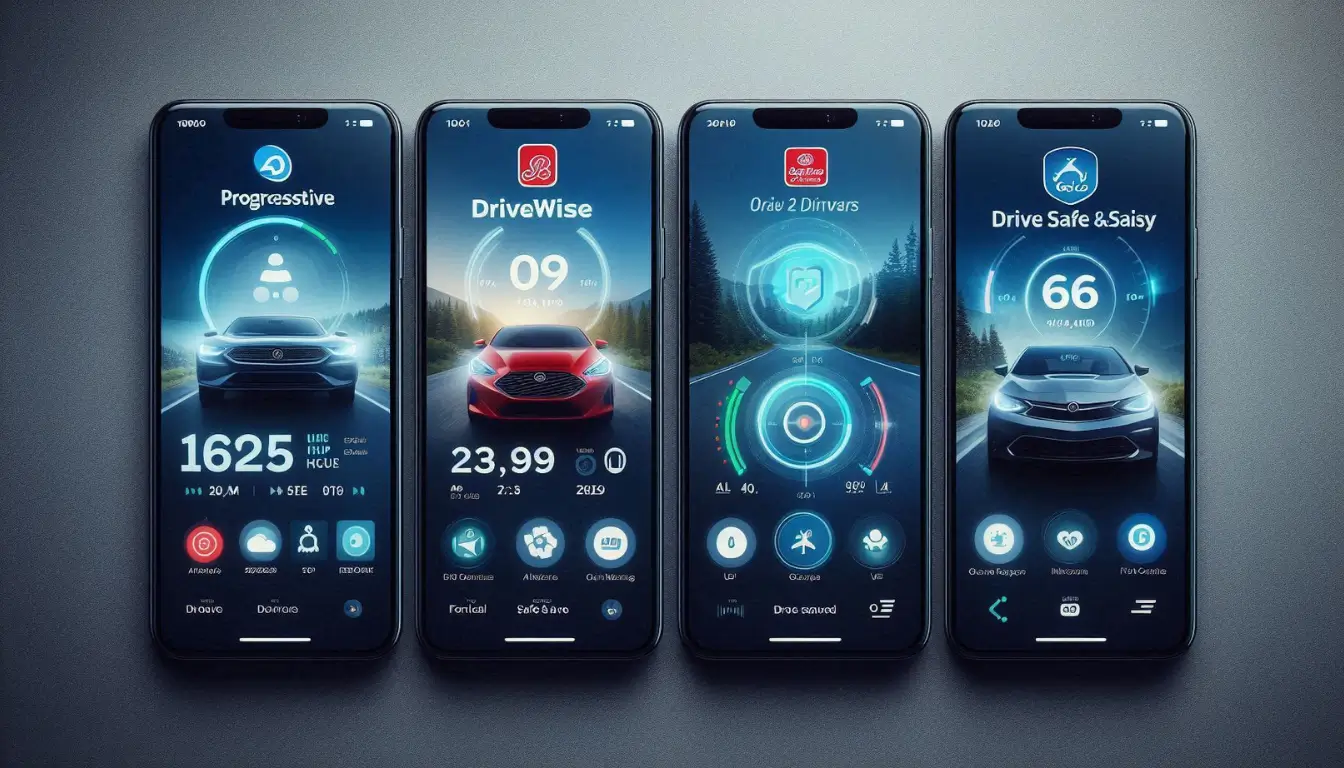
Progressive Snapshot vs Allstate Drivewise vs State Farm Drive Safe & Save vs Geico DriveEasy 2026 — Which Telematics App Saves You the Most?
Telematics car insurance — where your insurer tracks how you actually drive and rewards safe behaviour with discounts — is now the fastest-growing segment of the US auto insurance market. Over 19 million American drivers are currently enrolled in usage-based insurance (UBI) programmes, and the four major insurers each offer competing apps: Progressive's Snapshot, Allstate's Drivewise, State Farm's Drive Safe & Save, and Geico's DriveEasy. Each programme tracks different metrics, calculates discounts differently, and carries different privacy implications. A safe driver who chooses the wrong programme could leave $400+ per year on the table. We compared all four programmes across every dimension that actually matters — maximum discount, tracking factors, privacy risk, penalty risk, and the types of drivers who benefit most from each. This is the only guide that puts all four side by side.
⚡ Quick Comparison — All 4 Telematics Programmes at a Glance 2026
| Factor | Progressive Snapshot | Allstate Drivewise | State Farm Drive Safe | Geico DriveEasy |
|---|---|---|---|---|
| Max discount | Up to 30% | Up to 40% | Up to 30% | Up to 25% |
| Sign-up discount | ✅ Yes (~$26) | ✅ Yes (~10%) | ✅ Yes (~5%) | ✅ Yes (~$30) |
| Can rates INCREASE? | ⚠️ Yes — in some states | ⚠️ Yes | ❌ No penalty | ⚠️ Yes |
| Tracking method | App or plug-in device | App only | App + connected car | App only (AI-powered) |
| Tracks phone distraction | ❌ No | ✅ Yes | ❌ No | ✅ Yes (AI detection) |
| Tracks mileage | ✅ Yes | ❌ No | ✅ Yes | ❌ No |
| Open to non-customers | ❌ Customers only | ✅ Anyone | ❌ Customers only | ❌ Customers only |
| Cash back rewards | ❌ No | ✅ Yes | ❌ No | ❌ No |
| Avg real-world saving | $145–$220/yr | $120–$280/yr | $185–$320/yr | $100–$180/yr |
| J.D. Power UBI score | 628/1000 | 649/1000 🏆 | 654/1000 🏆 | N/A (new) |
| Best for | Low-mileage drivers | Phone-disciplined drivers | All-around safe drivers | Distraction-free drivers |
📱 What Is Telematics Car Insurance and How Does It Work?
Telematics car insurance — also called usage-based insurance (UBI) or pay-how-you-drive insurance — uses technology to track your actual driving behaviour and adjusts your premium based on how safely and how much you drive. Instead of pricing your policy based solely on demographic factors like age, gender, ZIP code, and credit score, telematics programmes add a behaviour component that rewards careful drivers with real discounts.
What Telematics Programmes Actually Track
Despite differences in branding and specific features, all four major telematics programmes collect data across five primary behavioural categories:
Hard braking — sudden, forceful braking events that suggest either following too closely, distracted driving, or aggressive driving patterns. This is the highest-weighted negative factor in most programmes. A hard braking event is typically defined as decelerating at more than 7–10 mph per second. Drivers who brake hard frequently score poorly across all four programmes.
Rapid acceleration — aggressive acceleration from stopped or slow-moving traffic. Like hard braking, rapid acceleration is associated with aggressive driving and higher accident risk. It is weighted less heavily than braking in most programmes but contributes negatively to your score.
Speeding — driving significantly above posted speed limits. Most programmes flag speeds above 80 mph consistently as a negative factor. The threshold and weighting vary: Drivewise specifically mentions 80 mph as a tracking threshold; Drive Safe & Save uses 80 mph as well; Snapshot tracks speed percentages above limits; DriveEasy uses AI to correlate speed with road type.
Time of day — driving between midnight and 4 AM is statistically associated with significantly higher accident risk and is negatively weighted in most programmes. Frequent late-night driving will reduce your discount regardless of how smoothly you drive during those hours.
Phone distraction — Allstate Drivewise and Geico DriveEasy now specifically track phone handling while driving. Drivewise uses motion sensors to detect when the phone is being manipulated during driving; DriveEasy uses Geico's 2026 AI update to distinguish between phone-as-navigation (acceptable) and phone-as-distraction (penalized). Progressive Snapshot and State Farm Drive Safe & Save do NOT directly track phone use.
How the Discount Calculation Works
Each programme converts your tracked driving data into a score, and that score determines your discount percentage at renewal. The specific scoring algorithms are proprietary and not publicly disclosed in full — but the general framework is consistent: you start with a participation discount when you enrol, your driving behaviour is tracked for a period (typically 6–12 months), and your renewal premium is adjusted based on your score. Most programmes recalculate at every 6-month policy renewal.
The crucial point that most drivers miss: the discount is applied to your new premium at renewal — not a rebate on what you've already paid. Your first renewal after enrolment reflects your tracked behaviour score. Subsequent renewals continue to reflect your ongoing behaviour. This means telematics is a long-term commitment, not a one-time setup.
For a broader understanding of how Progressive, Allstate, State Farm, and Geico compare across all factors beyond telematics, see our complete guide: Progressive vs Geico vs State Farm vs Allstate 2026 — Full Comparison. For understanding how much these discounts affect your overall premium, our Geico vs State Farm 2026 detailed comparison provides the full pricing context.
🔍 Progressive Snapshot — Full 2026 Review
How Snapshot Works in 2026
Progressive Snapshot is available exclusively to Progressive auto insurance customers. In 2026, Snapshot operates primarily through the Progressive mobile app (iOS and Android), with a Bluetooth plug-in device available as an option for drivers who prefer not to use their phone for tracking. The app must be active and running during all trips to collect data — drivers who frequently forget to activate it or drive without their phone will have gaps in tracking data.
Snapshot tracks four core factors: hard braking events (the highest-weighted negative factor), the time of day you drive (late-night driving is penalized), total mileage driven (lower mileage = higher discount — this is Snapshot's key differentiator), and speed relative to traffic flow. Snapshot does NOT track phone distraction or hand-held phone use — a significant advantage for drivers who use their phone hands-free for navigation.
Snapshot Discount Structure
Progressive offers an immediate sign-up discount of approximately $26 simply for enrolling in Snapshot before any data is collected. This is the only guaranteed discount — your renewal discount depends entirely on your scores. The maximum advertised discount is 30%, but Progressive's own data shows the average discount for drivers who complete the programme is approximately $145–$220 per year. Top-scoring low-mileage drivers report discounts up to $400+ per year.
| Factor | Weight in Scoring | Positive Impact | Negative Impact |
|---|---|---|---|
| Hard braking | High | Zero hard braking events | Frequent hard braking |
| Mileage | High | Low annual mileage (<7,500 mi) | High mileage (>15,000 mi) |
| Time of day | Medium | Daytime only driving | Regular midnight–4 AM driving |
| Speed | Medium | At or below speed limits | Consistent high-speed driving |
Snapshot Penalty Risk — The Important Warning
Progressive Snapshot can increase your premium in most states if your driving behaviour scores very poorly. Progressive states that they apply a surcharge only in cases of genuinely risky driving patterns — but the threshold for what triggers a surcharge is not publicly specified. If you have aggressive braking habits, regularly drive late at night, or drive high mileage, enrolling in Snapshot could cost you money rather than save it. If you are uncertain about your driving habits, Progressive allows you to preview your Snapshot score before your renewal is calculated — use this to assess your risk before committing to the programme long-term.
Snapshot — Who Should Use It
- ✅ Best for: Low-mileage drivers (under 8,000 miles/year) — mileage is Snapshot's highest-weighted positive factor
- ✅ Best for: Drivers who never drive between midnight and 4 AM
- ✅ Best for: Drivers who use their phone hands-free and worry about phone-tracking penalties
- ❌ Avoid if: You drive high annual mileage (commuters doing 20,000+ miles/year)
- ❌ Avoid if: You have aggressive braking habits you can't easily change
- ❌ Avoid if: You regularly work night shifts that require driving after midnight
🔍 Allstate Drivewise — Full 2026 Review
How Drivewise Works in 2026
Allstate Drivewise is unique among the four programmes in one critical way: it is open to anyone, not just Allstate customers. Non-Allstate customers can download the Drivewise app and use it to track their driving behaviour — a feature Allstate markets as a way to "try before you buy." Existing Allstate customers who enrol receive a 10% participation discount immediately upon signing up, before any driving data is collected.
Drivewise tracks four factors: speed (flagging consistent driving above 80 mph), hard braking, time of day (penalizing late-night driving between midnight and 5 AM), and — uniquely — phone use while driving. The phone tracking component is one of Drivewise's most distinctive features. The app uses the phone's motion sensors to detect when the phone is being handled while the vehicle is in motion. However, Allstate has stated that passive phone use (phone resting on a dock for navigation) is not penalized — only active handling is detected and counted negatively.
Drivewise Cash Back — A Unique Feature
Unlike the other three programmes, Drivewise offers cash back rewards in addition to premium discounts. Safe drivers receive 3% cash back on their premiums every 6 months. This cash back is separate from the renewal discount — you receive it regardless of when your policy renews, based on your 6-month driving score. For an Allstate customer paying $1,200/year in premiums, the 3% cash back equals $36/year with zero other driving changes required — simply for enrolment and reasonable driving behaviour.
Drivewise Maximum Discount — The 40% Claim
Allstate advertises a maximum Drivewise discount of 40% — the highest advertised maximum of any major telematics programme. However, this maximum requires sustained excellent driving across all tracked factors for multiple consecutive renewal periods. Most Drivewise users receive discounts in the 10–25% range. The critical factor: Drivewise's J.D. Power satisfaction score of 649/1000 — the highest of any major telematics programme in the 2025 study — suggests that most users find the programme delivers meaningful discounts and a positive experience.
Drivewise — Who Should Use It
- ✅ Best for: Drivers who never touch their phone while driving — the distraction-tracking component rewards this discipline directly
- ✅ Best for: Allstate customers who want immediate cash back in addition to potential renewal discounts
- ✅ Best for: Non-Allstate customers who want to test their driving score before switching
- ✅ Best for: Drivers who want to trial UBI without being a customer first
- ❌ Avoid if: You handle your phone frequently while driving (even at stops — Drivewise may detect this)
- ❌ Avoid if: You regularly drive after midnight — Drivewise's late-night window is midnight to 5 AM (wider than some competitors)
🔍 State Farm Drive Safe & Save — Full 2026 Review
How Drive Safe & Save Works in 2026
State Farm Drive Safe & Save is the most technologically integrated of the four programmes. In 2026, it supports three tracking methods: the State Farm mobile app (primary), Bluetooth beacon integration with your vehicle's OBD-II port, and — for compatible vehicles — direct integration with the car's connected vehicle system (OnStar for GM vehicles, Ford's FordPass, Subaru's STARLINK, and others). This direct vehicle integration provides more accurate, battery-efficient data collection without relying on the smartphone's accelerometer.
Drive Safe & Save tracks five factors: hard braking, rapid acceleration, speed, mileage, and time of day. Unlike Drivewise, it does not directly track phone use. Unlike Snapshot, the mileage component works alongside — rather than dominantly over — the other four factors. This makes Drive Safe & Save more suitable for moderate-mileage drivers who drive safely but aren't necessarily low-mileage.
The No-Penalty Advantage
State Farm Drive Safe & Save has a critical advantage that neither Progressive Snapshot nor Allstate Drivewise offers: your premium cannot increase due to Drive Safe & Save scores. The worst outcome for a State Farm Drive Safe & Save participant is receiving no discount — but your base rate will not be surcharged for poor behaviour tracked by the programme. This makes Drive Safe & Save the lowest-risk telematics enrolment of the four major programmes — particularly valuable for drivers who are uncertain about their driving behaviour patterns.
Drive Safe & Save Discount Structure
State Farm offers a 5% enrolment discount immediately upon joining Drive Safe & Save. Renewal discounts range from 1% to 30% based on your driving score. The average real-world discount reported by State Farm Drive Safe & Save users is approximately $185–$320 per year — the highest average of the four programmes. The combination of no penalty risk and strong average discounts makes Drive Safe & Save statistically the strongest programme for most drivers.
Drive Safe & Save — Who Should Use It
- ✅ Best for: Moderate-mileage drivers (8,000–15,000 miles/year) who drive safely overall
- ✅ Best for: Any driver uncertain about their telematics score — zero penalty risk makes this the safest enrolment
- ✅ Best for: Owners of connected vehicles (GM, Ford, Subaru) for seamless integration
- ✅ Best for: Drivers who want the highest average real-world discount
- ❌ Less ideal for: Very low-mileage drivers (Snapshot's mileage weighting may produce higher discounts)
- ❌ Note: Requires existing State Farm policy
🔍 Geico DriveEasy — Full 2026 Review
How DriveEasy Works in 2026
Geico DriveEasy underwent a significant update in January 2026 — adding AI-powered distracted driving detection that goes beyond simple phone handling to analyse driver attention patterns. The app now uses the phone's camera (with user consent) during trips to detect visual distraction patterns, combined with motion sensor data to identify phone manipulation. This AI update makes DriveEasy the most sophisticated — and potentially the most privacy-invasive — telematics programme of the four.
DriveEasy tracks hard braking, speed, time of day, and phone distraction. It does not track mileage — unlike Snapshot and Drive Safe & Save. This makes DriveEasy potentially less rewarding for low-mileage drivers who would benefit more from Snapshot's mileage weighting, but equally rewarding for high-mileage safe drivers since mileage doesn't count against them.
DriveEasy AI Distraction Detection — What It Actually Does
Geico's January 2026 AI update to DriveEasy introduced three new detection capabilities. First, phone manipulation detection — improved over the prior version to distinguish between active phone use and passive placement in a dock. Second, attention scoring — the AI analyses driving smoothness patterns to infer attention levels, even without direct phone detection. Third, trip-based feedback — after each trip, DriveEasy provides a detailed breakdown of your performance across all tracked factors, with specific improvement recommendations. This granular feedback is more detailed than any of the other three programmes and helps drivers understand exactly what behaviours are costing them discount points.
DriveEasy Penalty Risk and Privacy Concerns
Geico DriveEasy can increase your premium for consistently poor scores — and the 2026 AI update makes score penalties more sensitive. The camera-based distraction detection has generated privacy concerns among some users, though Geico states that camera data is processed on-device and not transmitted to Geico's servers. If privacy is a concern, Progressive Snapshot (no camera use, no phone tracking) or State Farm Drive Safe & Save (no camera, no phone tracking, no penalties) are more privacy-conservative alternatives.
DriveEasy — Who Should Use It
- ✅ Best for: Geico customers who genuinely never touch their phone while driving
- ✅ Best for: High-mileage safe drivers who don't want mileage to count against them
- ✅ Best for: Drivers who want the most detailed trip-by-trip feedback on their driving
- ❌ Avoid if: Privacy is a concern — camera-based detection is invasive
- ❌ Avoid if: You occasionally use your phone while driving — DriveEasy's AI detection is the most sensitive
- ❌ Avoid if: You want guaranteed no-penalty risk — DriveEasy can surcharge poor scorers
📊 Head-to-Head Comparison — All 4 Programmes by Key Criteria
Maximum Discount Comparison
| Programme | Advertised Max | Realistic Average | Top-Decile Drivers |
|---|---|---|---|
| Allstate Drivewise | 40% | 10–25% | $280–$400+/yr |
| State Farm Drive Safe | 30% | 15–25% | $320–$480+/yr |
| Progressive Snapshot | 30% | 10–20% | $145–$350+/yr |
| Geico DriveEasy | 25% | 8–18% | $100–$250+/yr |
Penalty Risk Comparison
| Programme | Can Premium Increase? | Penalty Threshold | Risk Level |
|---|---|---|---|
| State Farm Drive Safe | ❌ No — zero penalty risk | N/A | 🟢 Lowest |
| Progressive Snapshot | ⚠️ Yes — in most states | Very poor scores only | 🟡 Low-Medium |
| Allstate Drivewise | ⚠️ Yes | Poor score at renewal | 🟡 Medium |
| Geico DriveEasy | ⚠️ Yes | AI detects consistent issues | 🟠 Medium-High |
Tracking Factors Side by Side
| Factor Tracked | Snapshot | Drivewise | Drive Safe | DriveEasy |
|---|---|---|---|---|
| Hard braking | ✅ | ✅ | ✅ | ✅ |
| Rapid acceleration | ✅ | ✅ | ✅ | ✅ |
| Speeding | ✅ | ✅ (80mph+) | ✅ | ✅ |
| Late night driving | ✅ (12AM–4AM) | ✅ (12AM–5AM) | ✅ | ✅ |
| Total mileage | ✅ (high weight) | ❌ | ✅ | ❌ |
| Phone handling | ❌ | ✅ | ❌ | ✅ (AI) |
| Camera detection | ❌ | ❌ | ❌ | ✅ (opt-in) |
| Cornering | ✅ | ✅ | ✅ | ✅ |
🔒 Privacy Risks — What Data They Really Collect
Every telematics programme collects location data, driving behaviour data, and device data. Understanding exactly what each programme collects — and how it can be used — is essential before enrolment. Privacy concerns are legitimate and growing as these programmes become more sophisticated.
Location Data — All Four Programmes
All four programmes collect GPS location data for every trip. This data establishes your origin, destination, route, and stops. All four insurers state in their privacy policies that this location data can be shared with third parties including law enforcement when legally compelled — meaning your location history could theoretically be used in legal proceedings related to an accident or other incident. If location privacy is a concern, consider that insurance company privacy policies allow for this sharing.
Data Sharing Practices
| Data Use | Snapshot | Drivewise | Drive Safe | DriveEasy |
|---|---|---|---|---|
| Used in accident investigation | ⚠️ Possible | ⚠️ Possible | ⚠️ Possible | ⚠️ Possible |
| Shared with marketing partners | ⚠️ Some | ⚠️ Some | ❌ Limited | ⚠️ Some |
| Camera data transmitted | ❌ No camera | ❌ No camera | ❌ No camera | ✅ On-device processing (claimed) |
| Can cancel anytime | ✅ Yes | ✅ Yes | ✅ Yes | ✅ Yes |
| Delete data request | ✅ Available | ✅ Available | ✅ Available | ✅ Available |
Privacy Rankings — Most to Least Invasive
- Geico DriveEasy — Most invasive: AI camera detection, phone monitoring, advanced behavioral analysis
- Allstate Drivewise — Moderately invasive: phone handling detection adds behavioural layer beyond driving
- Progressive Snapshot — Standard: GPS, driving behaviour, no phone tracking
- State Farm Drive Safe — Least invasive: GPS and driving behaviour only, no phone tracking, vehicle integration avoids smartphone sensors entirely
🎯 Which Programme Is Best for Your Driver Profile?
| Your Driver Profile | Best Programme | Why |
|---|---|---|
| Low mileage (<8,000 mi/yr) | 🏆 Progressive Snapshot | Mileage is highest-weighted positive factor |
| Never touch phone while driving | 🏆 Allstate Drivewise | Phone discipline rewarded with cash back + high max discount |
| Uncertain about your habits | 🏆 State Farm Drive Safe | Zero penalty risk — worst case is no discount |
| High mileage safe driver | 🏆 Geico DriveEasy | No mileage penalty — scored purely on behaviour |
| Night shift worker | 🏆 Progressive Snapshot | Shortest late-night window (12AM–4AM vs competitors' wider windows) |
| Connected car owner (GM/Ford/Subaru) | 🏆 State Farm Drive Safe | Direct vehicle integration = most accurate tracking |
| Privacy-conscious driver | 🏆 State Farm Drive Safe | No phone tracking, no camera, vehicle integration only |
| Want to try before switching insurers | 🏆 Allstate Drivewise | Open to non-Allstate customers |
| Want detailed trip feedback | 🏆 Geico DriveEasy | Most granular per-trip analysis of all four programmes |
| Maximum discount potential | 🏆 State Farm Drive Safe | Highest average real-world discount ($185–$320/yr) |
💡 How to Maximize Your Telematics Discount — 8 Proven Strategies
1. Enrol immediately for the sign-up discount
All four programmes offer an enrolment discount before any driving data is collected. Allstate Drivewise offers approximately 10%, State Farm Drive Safe & Save offers 5%, and Progressive Snapshot and Geico DriveEasy offer fixed dollar amounts ($26 and $30 approximately). These enrolment discounts are guaranteed money — claim them immediately.
2. Drive smoothly for the first 90 days — they matter most
The initial tracking period establishes your baseline score and most heavily influences your first renewal discount. Give priority to smooth, calm driving during the first 90 days of your programme participation. The habits you establish in this period determine the bulk of your first-year saving.
3. Eliminate hard braking — it's the highest-weighted factor
Hard braking is the single most penalized behaviour in all four programmes. The practical fix: increase your following distance to at least 3–4 seconds behind the vehicle ahead. This one change eliminates the vast majority of hard braking events for most drivers — and is the single highest-value behaviour change available in any telematics programme.
4. Avoid driving between midnight and 4 AM
Late-night driving is penalized significantly across all four programmes. If you occasionally need to drive late, the programmes do not binary penalize you — they score based on frequency. Occasional late-night trips produce minimal scoring impact; regular late-night driving (multiple trips per week) produces significant negative scoring.
5. For Snapshot — drive less or consolidate trips
If you're using Progressive Snapshot, reducing your annual mileage — even by consolidating errands, carpooling occasionally, or using public transport for short trips — directly increases your discount. Snapshot's mileage tracking means every mile you don't drive translates to a higher score. Even reducing from 14,000 to 11,000 annual miles can meaningfully improve your Snapshot score.
6. For Drivewise — keep your phone in a dock during every trip
Allstate Drivewise detects phone handling during driving. The simplest fix: mount your phone in a dashboard dock before starting every trip. With the phone physically secured in a fixed position, the app's motion sensors cannot detect handling. This eliminates the phone-use penalty entirely without changing your driving behaviour.
7. Check your score regularly and adjust
All four apps provide trip-by-trip feedback and overall score visibility. Check your score weekly during the first three months of participation. If your score is poor, you have time to improve your driving habits before the renewal calculation. If your score is excellent, maintain your current habits and expect a meaningful discount at renewal.
8. Consider cancelling if your score is consistently poor
If after 60–90 days your telematics score is consistently in the lowest quartile and you are enrolled in a programme that can surcharge poor scores (Snapshot, Drivewise, or DriveEasy), consider unenrolling. For Snapshot, contact Progressive to understand whether your current score trajectory would result in a surcharge. For Drivewise and DriveEasy, the apps display your discount estimate — if it shows zero or you're receiving negative signals, unenrolling before your renewal protects you from a potential premium increase.
❓ Frequently Asked Questions — Telematics Car Insurance 2026
Which telematics programme saves the most money in 2026?
State Farm Drive Safe & Save delivers the highest average real-world discount for most drivers — approximately $185–$320 per year for drivers with good habits across all tracked factors. It also has zero penalty risk, meaning your premium cannot increase due to your telematics score. Allstate Drivewise has the highest advertised maximum (40%) and is the best choice for drivers who are consistently disciplined about phone use while driving. Progressive Snapshot produces the highest discounts for genuinely low-mileage drivers (under 8,000 miles/year) because of its heavy mileage weighting. Geico DriveEasy delivers lower average discounts than the other three but provides the most detailed per-trip feedback and does not penalize high mileage.
Can my car insurance rates increase because of a telematics programme?
Yes — for three of the four major programmes. Progressive Snapshot can surcharge premiums in most states for drivers with consistently poor scores. Allstate Drivewise can increase premiums at renewal for poor-scoring drivers. Geico DriveEasy can increase premiums for drivers with consistently poor behaviour detected by its AI system. State Farm Drive Safe & Save is the exception — the worst outcome is receiving no discount, but your base premium will not be increased due to your Drive Safe & Save score. If you are uncertain about your driving habits or have aggressive braking tendencies you can't easily change, State Farm Drive Safe & Save is the lowest-risk enrolment option.
Is Progressive Snapshot or Allstate Drivewise better?
The better programme depends entirely on your driving profile. Progressive Snapshot is better for low-mileage drivers — it heavily weights total annual mileage, meaning drivers who drive less than 8,000 miles per year receive disproportionately high discounts. Allstate Drivewise is better for drivers who primarily want to prove their phone discipline — its cash back rewards, higher J.D. Power satisfaction score (649 vs Snapshot's 628), and open access to non-Allstate customers make it the superior programme for most standard-mileage drivers. Drivewise also has the higher maximum discount (40% vs Snapshot's 30%), though both are rarely achieved by the average driver.
Does Geico DriveEasy use your phone camera?
Yes — Geico DriveEasy's January 2026 update added an optional camera-based distracted driving detection feature. Geico states that camera data is processed on-device and not transmitted to their servers, and that camera usage requires explicit user consent. Drivers who are uncomfortable with camera access can opt out of this specific feature, though opting out may reduce the discount available under the AI-enhanced programme. The camera feature is one of DriveEasy's most controversial aspects — drivers who value privacy should consider whether the potential discount increase justifies camera access, or whether State Farm Drive Safe & Save's camera-free approach is more appropriate.
Can I use Allstate Drivewise without being an Allstate customer?
Yes — Allstate Drivewise is the only major telematics programme that is open to non-customers. Anyone can download the Drivewise app and use it to track their driving behaviour. Non-customers can view their driving score and use it to evaluate whether telematics programmes would benefit them before switching insurers. However, the cash back rewards and premium discounts are only available to actual Allstate auto insurance policyholders. Non-customer access is purely for score tracking and programme evaluation. If your Drivewise score is excellent after 60–90 days of tracking, that data can be a powerful indicator that switching to Allstate and enrolling as a customer would produce meaningful discounts.
How much can I realistically save with telematics car insurance in 2026?
Realistic savings for a safe driver vary by programme and driving profile: State Farm Drive Safe & Save delivers an average of $185–$320 per year for safe drivers; Allstate Drivewise delivers $120–$280 per year; Progressive Snapshot delivers $145–$220 per year on average, with low-mileage drivers often reaching $350–$400+; Geico DriveEasy delivers $100–$180 per year on average. The highest reported savings come from extremely low-mileage Snapshot users who also drive smoothly, who occasionally report discounts over $500 per year. The enrolment discounts available at sign-up ($26–$30 for Snapshot and DriveEasy, ~10% for Drivewise, ~5% for Drive Safe) represent guaranteed immediate savings regardless of driving behaviour scores.
✅ Final Verdict — Which Telematics Programme Wins in 2026?
For most drivers: State Farm Drive Safe & Save. The combination of the highest real-world average discounts, zero penalty risk, and connected car integration makes it the strongest all-round telematics programme. If you're a State Farm customer and haven't enrolled, enrol today.
For low-mileage drivers: Progressive Snapshot. If you drive under 8,000 miles per year, Snapshot's heavy mileage weighting will produce discounts that other programmes simply can't match for your profile.
For phone-disciplined drivers: Allstate Drivewise. The cash back rewards, highest J.D. Power score, and open access make it the best programme for drivers who are genuinely disciplined about phone use behind the wheel.
For high-mileage drivers who want detailed feedback: Geico DriveEasy. No mileage penalty and the most granular trip-by-trip analysis make DriveEasy the right fit for high-mileage drivers who drive safely and want to understand their behaviour in detail.
For the complete comparison of all four insurers across price, claims, and coverage — not just telematics — see our full guide: Progressive vs Geico vs State Farm vs Allstate 2026. For understanding how Geico and State Farm specifically compare on price and claims without telematics, our Geico vs State Farm 2026 head-to-head provides the complete picture.
Disclaimer: Telematics discount amounts are averages and ranges based on insurer-published data and consumer reports — individual outcomes vary based on specific driving behaviour, state, policy type, and programme participation period. Programme features change frequently — always verify current terms directly with each insurer before enrolment. Nexuora does not receive referral fees from any insurer listed. Updated April 19, 2026.

Ahmada Ndao is a financial research analyst and independent journalist
specializing in US consumer finance, legal rights, and insurance markets.
With over 5 years covering American financial products, he has helped
thousands of readers navigate complex insurance decisions, find the right
legal representation, and optimize their credit strategies. His research
methodology combines primary data analysis, direct outreach to industry
professionals, and continuous monitoring of federal regulatory changes.
Ahmada’s work has been cited by financial communities across the US and
reviewed by licensed attorneys and insurance professionals for accuracy.