
Wrongful Death Lawyer Texas Payout 2026 — What Families Can Recover & How to Choose the Right Attorney
Losing a family member due to someone else's negligence is the most devastating experience a family can face. Beyond the emotional devastation, a wrongful death often leaves families facing profound financial loss — the sudden elimination of the deceased's income, the cost of medical care before death, funeral and burial expenses, and the incalculable loss of a parent, spouse, or child's guidance and companionship. Texas wrongful death law provides a legal pathway for surviving family members to hold the responsible party accountable and recover compensation for these losses. The Texas wrongful death statute — among the most detailed in the country — defines who can bring a claim, what damages are recoverable, and how the compensation is allocated among family members. Understanding what your family's wrongful death case may be worth, how Texas law works, and how to choose the right attorney is the foundation of getting the justice your loved one deserves.

⚖️ What Is a Wrongful Death Claim in Texas?
A wrongful death claim is a civil lawsuit brought by surviving family members to recover compensation when a person dies as a result of another party's negligence, recklessness, or intentional act. Unlike a criminal prosecution — which the state pursues to punish the wrongdoer — a wrongful death civil claim is pursued by the family to obtain financial compensation for the losses caused by the death. The two proceedings are independent: a person can be acquitted of manslaughter in criminal court and still be found civilly liable for wrongful death, because the burden of proof is lower in civil cases ("preponderance of evidence" rather than "beyond a reasonable doubt").
Texas wrongful death law is codified in the Texas Civil Practice and Remedies Code, Chapter 71. The statute provides that when a person's death is caused by the wrongful act, neglect, carelessness, unskillfulness, or default of another, the surviving spouse, children, and parents of the deceased are entitled to bring a wrongful death action for the damages they sustained. Texas wrongful death law is specifically designed to compensate surviving family members — not the deceased's estate — for their personal losses arising from the death.
The Standard of Liability in Texas Wrongful Death Cases
To succeed in a Texas wrongful death lawsuit, the plaintiff's attorney must establish that: (1) the defendant owed a duty of care to the deceased; (2) the defendant breached that duty through negligent, reckless, or intentional conduct; (3) the breach caused the deceased's death; and (4) the surviving family members suffered compensable damages as a result. The liability standard is the same as in any personal injury case — but the damages analysis and the statutory framework for who can recover and for what are specific to wrongful death law.
👨👩👧👦 Who Can File a Texas Wrongful Death Lawsuit?
Texas Civil Practice and Remedies Code § 71.004 specifically defines who has the right to bring a wrongful death claim — and the rules are more restrictive than many families expect.
Authorized Wrongful Death Claimants in Texas
Spouse: The surviving spouse of the deceased has a wrongful death claim for their personal losses arising from the death — loss of companionship, loss of the deceased's financial contributions to the household, mental anguish, and more. The spouse's claim is independent of any children's claims and is not diminished by the existence of other wrongful death claimants.
Children: The biological and legally adopted children of the deceased have wrongful death claims for their personal losses — loss of the parent's guidance and companionship, mental anguish, loss of inheritance (in survival actions), and the economic value of the parent's contributions to their upbringing and support. Stepchildren who were not legally adopted do not have wrongful death claims under the Texas statute unless they can establish a legally cognizable relationship through other legal theories.
Parents: The biological and adoptive parents of the deceased have wrongful death claims — particularly significant when the deceased was a young adult without children, where the parents' losses from the death are substantial. Grandparents, siblings, and other family members do NOT have independent Texas wrongful death claims under the statute unless they were legal adoptive parents.
The 3-Month Estate Activation Provision
Under Texas Civil Practice and Remedies Code § 71.004(b), if the statutory wrongful death claimants (spouse, children, parents) do not file a wrongful death action within 3 months of the death, the deceased's estate representative may file the action on behalf of the eligible family members. This provision ensures that delays by individual family members do not forever forfeit the family's right to pursue the claim — but does not extend the 2-year overall statute of limitations.
Who CANNOT File a Texas Wrongful Death Claim
Under the current Texas wrongful death statute, the following family members do not have independent wrongful death claims: siblings, grandparents, aunts and uncles, stepchildren (not legally adopted), stepparents (not legally adoptive), grandchildren (unless they were the dependent of the deceased), and domestic partners (in same-sex or unmarried relationships, unless marriage has occurred). Families in these situations may have alternative legal theories — particularly the survival action filed by the estate — but the wrongful death statute claims are limited to the enumerated categories.
💵 Texas Wrongful Death Payouts — Average Amounts by Case Type 2026

Texas wrongful death payouts are determined by the specific circumstances of the death, the nature and extent of the family's losses, the defendant's resources and insurance coverage, and the quality of legal representation. The ranges below reflect publicly reported settlements and verdicts from Texas wrongful death cases resolved in 2024–2026.
| Case Type | Texas Wrongful Death Payout Range 2026 | Key Value Drivers |
|---|---|---|
| Car accident — passenger vehicle | $500,000–$5M | Victim's age/income, number of survivors, liability clarity |
| 18-wheeler / commercial truck | $1M–$25M+ | FMCSA violations, multiple defendants, large commercial coverage |
| Workplace accident / industrial | $750,000–$15M+ | OSHA violations, employer liability, workers comp interaction |
| Medical malpractice | $500,000–$5M | MICRA cap on non-economic damages, expert-intensive |
| DUI/DWI fatality | $1M–$10M+ | Punitive damages available · Dram shop liability potential |
| Defective product | $1M–$20M+ | Corporate defendant · Strict liability · Punitive potential |
| Premises liability | $500,000–$8M | Property owner knowledge, safety violations |
| Nursing home / elder care negligence | $400,000–$5M | Texas Health & Safety Code violations, elder abuse |
What Drives Texas Wrongful Death Payout Amounts
The most important factors in determining the value of a Texas wrongful death case are: the age and income of the deceased (a 35-year-old with 30 years of future earnings carries a much larger economic value than a retired person), the number and age of surviving dependents (young children with decades of lost parental support increase the value substantially), the clarity and severity of the defendant's negligence (clear liability at full fault produces higher settlements than disputed liability), the available insurance coverage (the defendant's insurance policy limits cap the practical recovery in most cases), and the quality and aggressiveness of legal representation (attorneys who regularly try wrongful death cases to Texas juries command dramatically better settlements).
For context on how wrongful death payouts compare to other personal injury recoveries, see our guide on the best personal injury lawyers in Texas and what cases are worth. For understanding how insurance coverage limits affect wrongful death recovery, our umbrella insurance guide explains how commercial liability policies work.
💰 What Damages Are Recoverable in Texas Wrongful Death Cases
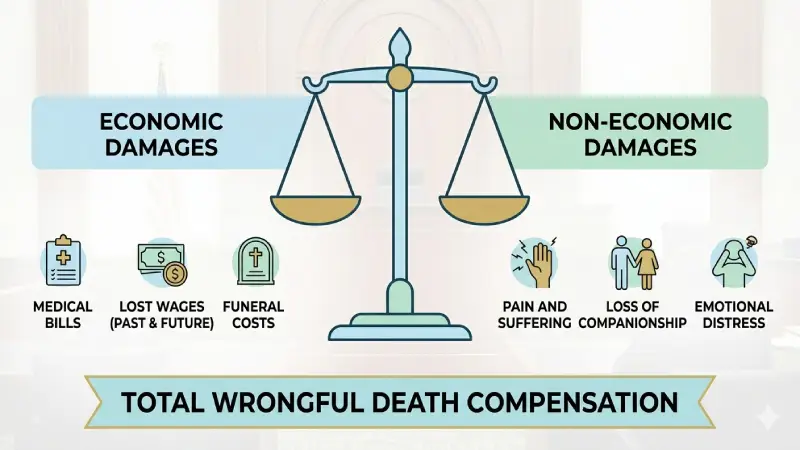
Texas wrongful death damages are divided between economic (pecuniary) damages — calculable financial losses — and non-economic damages — the personal, emotional, and relational losses of surviving family members. Understanding what is recoverable ensures your attorney builds the most comprehensive possible case.
Economic (Pecuniary) Damages for Surviving Family Members
Loss of financial support: The economic value of the income the deceased would have contributed to the family over their remaining working life — calculated by vocational economists and actuaries who project the deceased's future earnings trajectory, adjusted for mortality, discount rates, and the probability of continued employment. For a 40-year-old executive earning $180,000/year with 25 projected working years, the present value of lost earnings can exceed $3M. This is typically the largest single damage component in working-age wrongful death cases.
Loss of services: The value of household services, childcare, elder care, and other services the deceased provided to the family. For a non-working spouse who managed the household and provided primary childcare, the economic value of replacing these services with paid professionals — nannies, housekeepers, drivers, tutors — can be substantial and is routinely calculated by life economists. This damage category is frequently overlooked by unrepresented families and less experienced attorneys.
Loss of inheritance: The value of the estate the deceased would have accumulated and left to surviving family members is recoverable in a Texas survival action (which the estate files on behalf of the deceased). This includes retirement savings, investment growth, and business value that would have been inherited.
Funeral and burial expenses: All reasonable costs of funeral arrangements, burial or cremation, and associated services are recoverable as economic damages. Keep all receipts.
Medical expenses before death: If the deceased survived for any period after the injury before dying, all medical expenses incurred during that period are recoverable — either through the wrongful death claim or the survival action. For accident victims who lingered in critical care for days or weeks before dying, these costs can be substantial.
Non-Economic Damages — The Human Loss
Mental anguish: The psychological pain, suffering, and emotional distress experienced by surviving family members from the loss — grief, depression, anxiety, PTSD, and the ongoing psychological burden of the sudden and preventable loss of a loved one. Texas juries regularly award substantial mental anguish damages in wrongful death cases. The quality of evidence — surviving family members' testimony about the specific impact of the loss, mental health professional testimony about the diagnosis and prognosis, and the factual context of the death — determines the magnitude of mental anguish awards.
Loss of companionship and society: The loss of the deceased's love, companionship, comfort, advice, guidance, and support — for a spouse, the complete loss of a life partner; for children, the loss of a parent's involvement in their development, milestones, and daily life; for parents, the loss of their child's presence, communication, and relationship. This is one of the most significant non-economic damage categories in Texas wrongful death cases and is presented through the personal testimony of surviving family members about the specific qualities of their relationship with the deceased.
Loss of parental guidance (for children's claims): Minor children who lose a parent have a specific claim for the loss of that parent's guidance, education, and nurturing through their developmental years — a uniquely devastating loss that Texas juries respond to powerfully when presented effectively through the child's testimony and expert developmental psychology testimony.
Punitive Damages — When Conduct Was Egregious
Texas Civil Practice and Remedies Code § 41.003 allows punitive (exemplary) damages when the defendant's conduct was fraudulent, malicious, or — most relevant in wrongful death cases — grossly negligent. "Gross negligence" in Texas requires both an objective element (an act or omission that involves an extreme degree of risk) and a subjective element (the defendant's actual awareness of the risk, combined with conscious indifference to the rights of others). Texas caps punitive damages at the greater of $200,000 or two times the economic damages plus non-economic damages up to $750,000 — but in cases that qualify, punitive damages significantly increase total recovery and reflect the jury's condemnation of the defendant's conduct. Common Texas wrongful death scenarios that support punitive damages include: DUI/DWI fatalities, fatigue-driving trucking accidents where the company ignored Hours of Service violations, and products liability cases where the manufacturer knew of a defect and concealed it.
Texas-Specific Damage Limitation: No Cap on Wrongful Death
Unlike Texas medical malpractice cases, which are subject to a $250,000 cap on non-economic damages per defendant under Chapter 74, Texas wrongful death cases arising from other forms of negligence (car accidents, industrial accidents, premises liability, product defects) have no statutory cap on damages. Texas juries are free to award whatever economic and non-economic damages the evidence supports. This distinction makes the legal theory under which the death occurred — negligence vs. medical malpractice — legally and financially significant, and why some Texas wrongful death attorneys work hard to frame medical errors as general negligence rather than malpractice when possible.
🏆 Top 8 Texas Wrongful Death Law Firms 2026
| # | Firm | Google Rating | Location | Best For | Notable Result |
|---|---|---|---|---|---|
| 🥇 1 | Abraham, Watkins, Nichols, Agosto, Aziz & Stogner | 4.9 ⭐ (820+) | Houston | Industrial · Trucking · Catastrophic | $68M verdict — refinery explosion fatalities |
| 🥈 2 | Calhoun Meridith | 4.8 ⭐ (190+) | Houston | Wrongful death specialist | $22M — wrongful death industrial accident |
| 🥉 3 | Slack Davis Sanger | 4.8 ⭐ (480+) | Austin | Trucking · Aviation · Complex | $22M — Texas 18-wheeler wrongful death |
| 4 | Kherkher Garcia Appelbaum | 4.8 ⭐ (680+) | Houston | Industrial · Workplace fatalities | $55M — workplace explosion wrongful death |
| 5 | The Krist Law Firm | 4.8 ⭐ (540+) | Houston | Trucking fatalities · Commercial vehicle | $29M — 18-wheeler wrongful death Harris Co. |
| 6 | Fears Nachawati | 4.7 ⭐ (640+) | Dallas | Mass tort · Product defect fatalities | $18M — DFW area wrongful death product defect |
| 7 | Sutliff & Stout | 4.9 ⭐ (1,200+) | Houston | Car accident fatalities · DUI wrongful death | $12.5M — DUI wrongful death Houston |
| 8 | The Doan Law Firm | 4.7 ⭐ (950+) | Houston | Accessible · Spanish-speaking families | $8.9M — wrongful death multi-vehicle accident |
For broader Texas personal injury representation across all case types, our guide on the best personal injury lawyers in Houston and Texas provides comprehensive rankings. For cases involving commercial trucking fatalities, our Dallas truck accident lawyer cost guide addresses the specific legal complexity of 18-wheeler wrongful death cases.
🚗 Most Common Texas Wrongful Death Case Types
Motor Vehicle Accident Fatalities
Texas recorded over 4,200 traffic fatalities in 2025 — the second-highest total in the nation. Car, truck, and motorcycle accident fatalities are the most common source of Texas wrongful death claims. For car accident fatalities, the analysis follows the standard Texas personal injury framework — establishing the at-fault driver's negligence, available insurance coverage, and the family's compensable losses. See our related guide on car accident lawyers in Houston with free consultation for the foundational legal analysis that applies to vehicle fatality cases.
18-Wheeler and Commercial Truck Fatalities
Commercial truck accident fatalities produce the largest wrongful death payouts in Texas — for two reasons: the severity of injuries when an 80,000-pound truck strikes a passenger vehicle makes fatality a common outcome, and the commercial insurance policies carried by trucking companies ($1M–$5M+) and the additional FMCSA violation evidence available in trucking cases create substantially higher recovery potential. The specific legal dynamics of commercial truck wrongful death cases are addressed in detail in our guide on truck accident lawyers in Dallas and what they cost.
Workplace and Industrial Accident Fatalities
Texas's enormous oil and gas industry, petrochemical refinery concentration, construction sector, and agricultural operations produce significant workplace fatality rates — and Texas wrongful death cases from industrial accidents are among the largest in the country. The intersection of workers' compensation law and wrongful death civil litigation in Texas is complex: Texas is the only state where employers can legally opt out of the workers' compensation system, and non-subscribers face direct civil liability — including wrongful death claims — with no workers' comp exclusivity defense. Industrial wrongful death cases regularly involve OSHA violations, employer negligence in safety programme administration, and third-party contractor liability — all of which require specialized investigation expertise.
DUI/DWI Fatalities
Drunk or intoxicated driving fatalities are among the most actionable Texas wrongful death cases — both because liability is typically clear and documented by the criminal record, and because punitive damages are more accessible when the defendant's conduct was consciously reckless. Additionally, Texas Dram Shop liability under the Texas Alcoholic Beverage Code (TABC § 2.02) allows wrongful death claims against bars, restaurants, and social hosts who over-served an obviously intoxicated person who subsequently caused a fatal accident. The dram shop defendant — often a commercially licensed establishment with commercial liquor liability insurance — can dramatically expand the available insurance coverage beyond the drunk driver's personal auto policy.
Medical Malpractice Fatalities
Texas medical malpractice wrongful death cases are subject to specific procedural requirements and damage limitations. Pre-suit notice to all healthcare providers must be given at least 60 days before filing suit, along with an expert report from a qualified medical expert addressing the standard of care, breach, and causation. Non-economic damages are capped at $250,000 per defendant (physician) and $250,000 per healthcare institution — making the economic damages calculation (particularly loss of future earnings and loss of services) disproportionately important in medical wrongful death cases. These cases are expensive to litigate and require attorneys with specific medical malpractice expertise alongside wrongful death experience.
Product Defect Fatalities
Defective products that cause fatal injuries — defective vehicle components (airbag failures, brake defects, tire blowouts), dangerous consumer products, defective medical devices, and defective industrial equipment — generate product liability wrongful death claims against manufacturers under Texas strict liability law. Product liability wrongful death cases can involve national or international corporate defendants with significant insurance programs and the potential for class-wide punitive damages when the defect is systematic. These cases are among the most resource-intensive in Texas civil litigation.
📋 Survival Action vs Wrongful Death Claim — The Critical Texas Distinction

Texas law provides two distinct legal actions when a person dies due to another's negligence — and pursuing both simultaneously is critical to maximum recovery. Many families and even some attorneys miss this distinction, leaving significant compensation unclaimed.
The Wrongful Death Claim — The Family's Claim
The wrongful death claim under Texas Civil Practice and Remedies Code Chapter 71 is a claim by surviving family members (spouse, children, parents) for their personal losses arising from the death — loss of financial support, loss of services, loss of companionship, and mental anguish. This claim belongs to the surviving family members personally, not to the estate. The damages are the family members' own losses, not the deceased's losses. The family members' recovery is not subject to the deceased's creditors or estate debts.
The Survival Action — The Deceased's Claim
The survival action under Texas Civil Practice and Remedies Code § 71.021 is a claim by the deceased's estate — filed by the estate representative — for the damages the deceased would have been entitled to if they had survived. The survival action damages include: the deceased's physical pain and mental anguish between the injury and death (relevant when the victim survived for any period), the deceased's medical expenses during that period, the deceased's lost earning capacity between injury and death, and the deceased's disfigurement. The survival action recovery goes into the estate and is distributed according to the will or intestate succession laws — which may include creditors' claims before family members receive distributions.
Why Pursuing Both Is Essential
In cases where the deceased survived for a period after the injury — hours, days, or weeks in critical care — the survival action pain and suffering and medical expense damages can be substantial. The combined value of the wrongful death claim (family's losses) plus the survival action (deceased's pre-death losses) is consistently higher than pursuing only the wrongful death claim. An experienced Texas wrongful death attorney files both claims simultaneously — and most Texas courts allow them to proceed together in the same lawsuit.
📋 The Texas Wrongful Death Claim Process
Phase 1 — Immediate Evidence Preservation (Days 1–7)
The evidence that supports your wrongful death claim begins degrading immediately after the death. Skid marks are erased, surveillance footage is overwritten, electronic data from commercial vehicles is at risk of deletion, and witnesses' memories begin to fade. Your attorney must issue evidence preservation letters within days of the death — formally notifying all potential defendants of their obligation to preserve all relevant evidence. For trucking fatality cases, the driver's ELD data, black box data, and dashcam footage are urgently time-sensitive — your attorney should issue preservation demands within 24–48 hours of death. In workplace fatality cases, your attorney must preserve OSHA investigation documents, employer safety records, and equipment inspection histories before they are altered or destroyed.
Phase 2 — Identifying All Liable Parties and Coverage
Texas wrongful death cases often involve multiple potentially liable parties and multiple insurance policies. Your attorney will systematically investigate: the at-fault party's personal or commercial insurance coverage, any employer liability (if the at-fault party was acting in the course of employment), product manufacturer liability (if a defective product contributed), property owner liability (if premises were involved), dram shop liability (if alcohol was a factor), and government entity liability (if road design or maintenance was a contributing factor). Identifying every liable party and every available insurance policy is the most financially consequential investigation task in a wrongful death case.
Phase 3 — Economic Analysis and Expert Development
An economic expert — typically a forensic economist with expertise in life value analysis — calculates the present value of the deceased's lost future earnings, the value of lost household services, and the projected lost inheritance value. This analysis requires the deceased's employment records, tax returns, career trajectory, professional qualifications, and actuarial life expectancy data. For young victims with strong career trajectories, this analysis can produce economic damage calculations of $5M–$15M. For victims whose surviving minor children have extensive care and support needs ahead, the full economic analysis can be even larger. This phase takes 2–6 months to complete properly and is the foundation of your settlement demand.
Phase 4 — Presenting Family Member Losses
The non-economic damages in a Texas wrongful death case — mental anguish, loss of companionship, loss of parental guidance — are presented primarily through the personal testimony of surviving family members. Your attorney will work with you and other family members to prepare testimony that specifically and powerfully describes the relationship with the deceased, the unique qualities and contributions they brought to the family, and the specific ways in which the family's daily life has been irrevocably changed by the loss. This preparation is as important as any expert witness work — Texas juries respond to human testimony about real relationships, and the quality of this testimony significantly affects non-economic damage awards.
Phase 5 — Demand, Negotiation, and Resolution
Once the economic analysis is complete and the family's testimonial preparation is done, your attorney sends a comprehensive demand package to all defendants' insurers. Texas wrongful death cases regularly go through mediation — a structured settlement negotiation with a neutral mediator — before trial. The majority of Texas wrongful death cases settle at or before mediation, particularly when the liability evidence is strong and the economic analysis is thoroughly documented. Cases with disputed liability or with defendants who believe they can prevail on comparative fault arguments more frequently proceed to trial.
📈 How to Maximize Your Texas Wrongful Death Payout
1. File within the statute of limitations — but act immediately
Texas's 2-year wrongful death statute of limitations gives your family time — but waiting wastes the most valuable early-stage evidence preservation window. Evidence that was available in the first 72 hours may be gone at the 2-year mark. Contacting a wrongful death attorney within the first week of the death is the most important single step toward maximum recovery.
2. Hire the estate representative strategically
The person appointed as estate representative has the legal authority to file the survival action and to act on the estate's behalf in the wrongful death process. Selecting this person strategically — ideally in coordination with your wrongful death attorney — ensures that the estate's interests are fully aligned with the family's wrongful death claim and that the combined claim is pursued cohesively.
3. Document the relationship — don't wait for litigation
The non-economic damages in your wrongful death case are based on the quality and depth of the surviving family members' relationships with the deceased. Gather and preserve evidence of these relationships now: photographs and videos of family activities, written communications (texts, emails, letters) that demonstrate the relationship's depth, testimony from friends, coworkers, teachers, and others who observed the deceased's role in the family, and records of activities the deceased participated in with their children, spouse, and parents. This evidence deteriorates and becomes harder to reconstruct over time.
4. Obtain complete financial documentation of the deceased's earning trajectory
The economic damages calculation is heavily dependent on the deceased's documented earning history and projected trajectory. Gather: the last 5 years of tax returns, recent pay stubs and employment contracts, performance reviews and promotion records, professional certifications and educational credentials, and any evidence of planned career advancement (acceptance letters, scholarship documents, promotion discussions). For self-employed individuals and business owners, business financial statements, client contracts, and growth projections are essential. The more complete and well-organized this financial history, the stronger the foundation for a high economic damages calculation.
5. Identify all insurance coverage before accepting any offer
Defendants and their insurers do not voluntarily disclose all available coverage. Your attorney must investigate thoroughly to identify every potentially applicable policy: the defendant's personal liability coverage, their employer's commercial coverage (if applicable), any umbrella or excess liability policies, homeowners or renters liability coverage (if applicable), uninsured/underinsured motorist coverage from the deceased's or family's own policies, and any product liability or commercial general liability coverage. An early settlement offer based on the defendant's primary policy limits should never be accepted before confirming there are no additional coverage sources.
6. Evaluate dram shop and third-party liability
In DUI/DWI fatality cases, evaluate whether Texas Dram Shop liability (TABC § 2.02) applies — was the drunk driver over-served at a bar, restaurant, or social event before the fatal crash? A dram shop defendant adds a separately insured defendant with commercial liquor liability coverage — often $1M–$5M — to the claim. This dramatically expands recovery beyond the drunk driver's personal auto policy limits (which are frequently the Texas minimum of $30,000) and is available in every drunk driving fatality where the alcohol was purchased or served at a commercial establishment.
🎯 How to Choose the Right Texas Wrongful Death Lawyer

Wrongful Death Specialization Is Critical
Wrongful death cases differ fundamentally from standard personal injury cases — in the damages analysis, the claimant structure, the emotional dynamics, and the courtroom presentation. An attorney who primarily handles car accident fender-benders may have the technical ability to file a wrongful death lawsuit, but will lack the expert network, the economic analysis expertise, the family member testimony preparation skills, and the courtroom experience with wrongful death-specific jury presentations that an experienced specialist brings. Ask specifically: "What percentage of your personal injury caseload involves wrongful death cases, and how many Texas wrongful death cases have you taken to trial?"
Resource Depth for Large Cases
Texas wrongful death cases involving industrial accidents, commercial trucking, or product defects can require $200,000–$500,000 in expert investment to properly litigate — forensic economists, life care planners, industry safety experts, accident reconstruction specialists, and medical experts. Only well-resourced plaintiff firms with a demonstrated track record of funding complex litigation on contingency should handle these cases. Ask directly: "Has your firm fully funded comparable cases on contingency, and what were the results?"
Trial Record — Not Just Settlements
Texas wrongful death attorneys who have proven records of taking cases to trial — and achieving large verdicts — command dramatically better settlements from defendants and their insurers. The insurance defense industry tracks plaintiff attorneys' trial history meticulously. An attorney who has never tried a wrongful death case to verdict receives fundamentally lower settlement offers than one who has delivered multiple 8-figure verdicts. Ask: "What are your last three Texas wrongful death verdicts, and what were the amounts?"
Questions to Ask in Your Free Consultation
- "Are you familiar with the Texas wrongful death statute and the distinction between a wrongful death claim and a survival action?"
- "Do you have a forensic economist you work with regularly for life value calculations?"
- "How do you approach non-economic damages presentation — specifically the family members' testimony preparation?"
- "Have you handled wrongful death cases against this type of defendant before?"
- "Who will personally handle my case — you or a junior associate?"
- "What is your honest assessment of the value range for my family's claim, and what factors most affect where within that range we land?"
❓ Frequently Asked Questions — Wrongful Death Lawyer Texas Payout 2026
What is the average wrongful death payout in Texas in 2026?
Texas wrongful death payouts in 2026 range from approximately $500,000–$5M for car accident fatalities, to $1M–$25M+ for commercial truck fatalities involving FMCSA violations, to $1M–$10M+ for DUI/DWI fatalities with dram shop liability and punitive damages. The value is driven primarily by the deceased's age and income (determining lost future earnings), the number and age of surviving dependents, the strength of liability evidence, available insurance coverage, and the quality of legal representation. Texas has no cap on wrongful death damages outside of medical malpractice — juries are free to award whatever economic and non-economic damages the evidence supports, which makes Texas wrongful death cases among the highest-value in the country for appropriate cases.
Who can file a wrongful death lawsuit in Texas?
Under Texas Civil Practice and Remedies Code § 71.004, the following family members have the right to file a Texas wrongful death claim: the surviving spouse, the biological and legally adopted children, and the biological and adoptive parents of the deceased. Grandchildren, siblings, stepchildren (not legally adopted), grandparents, and domestic partners do not have independent wrongful death claims under the statute. If none of the eligible family members file a wrongful death claim within 3 months of the death, the deceased's estate representative may file on their behalf. The 2-year statute of limitations applies regardless of who files — the claim must be filed within 2 years of the date of death.
How long does a Texas wrongful death lawsuit take?
Texas wrongful death cases typically take 18 months to 4 years to resolve, depending on liability complexity and whether trial is required. Simple cases with clear liability and straightforward damages can settle in 12–18 months. Complex cases involving commercial trucking, industrial accidents, product defects, or disputed liability typically take 2–4 years through the full litigation process including discovery, expert development, mediation, and potentially trial. The economic damages analysis alone — projecting the deceased's lifetime lost earnings and family losses — typically takes 3–6 months to complete properly. Most cases settle at or before mediation, which in Texas district courts typically occurs 6–12 months before the scheduled trial date. Throughout this process, settlement negotiations are ongoing and cases frequently resolve earlier than the trial date when settlement pressure intensifies.
Are wrongful death settlements taxable in Texas?
Generally, wrongful death settlement proceeds are not subject to federal income tax under Internal Revenue Code Section 104(a)(2), which excludes from gross income "the amount of any damages (other than punitive damages) received... on account of personal physical injuries or physical sickness." Compensatory wrongful death damages — for lost financial support, loss of companionship, mental anguish, and medical and funeral expenses — are tax-exempt for the surviving family members who receive them. Punitive damages, however, are taxable as ordinary income and will generate a tax liability. Interest earned on settlement amounts held in escrow before distribution is also taxable. Texas has no state income tax, so only federal tax considerations apply for Texas wrongful death claimants. Always consult a tax attorney or CPA about the specific tax treatment of your family's settlement before accepting final payment.
What is the statute of limitations for wrongful death in Texas?
Under Texas Civil Practice and Remedies Code § 71.003, the statute of limitations for a Texas wrongful death claim is 2 years from the date of the death — not the date of the accident or injury that caused the death. This distinction matters when a victim survives an accident for days or weeks before dying. Claims against government entities (TxDOT, municipalities, school districts) require a formal notice of claim under the Texas Tort Claims Act within 6 months of the incident and carry specific procedural requirements that differ from private party claims. Medical malpractice wrongful death cases require pre-suit notice at least 60 days before filing and are subject to the 2-year statute of limitations from the date of death. Missing any applicable deadline permanently bars the wrongful death claim — contact a Texas wrongful death attorney immediately.
Can I get punitive damages in a Texas wrongful death case?
Yes — Texas Civil Practice and Remedies Code § 41.003 allows punitive (exemplary) damages in wrongful death cases when the defendant's conduct was grossly negligent, malicious, or fraudulent. Gross negligence requires both an objective element (an act or omission involving an extreme degree of risk) and a subjective element (the defendant's actual awareness of the risk combined with conscious indifference to the rights of others). Texas caps punitive damages at the greater of $200,000 or two times the economic damages plus non-economic damages up to $750,000 — so in a case with $2M in economic damages and $500,000 in non-economic damages, the punitive cap would be approximately $4.5M ($2M × 2 + $500,000). Common Texas wrongful death scenarios that support punitive damages include DUI/DWI fatalities, trucking accidents where the company knowingly violated Hours of Service rules, and product defect deaths where the manufacturer concealed a known defect.
✅ Final Thoughts — Wrongful Death Lawyer Texas Payout 2026
A Texas wrongful death lawsuit is one of the most complex and emotionally demanding legal proceedings a family can face — requiring both sophisticated legal expertise and genuine compassion for the human experience of devastating loss. The firms on our 2026 Texas ranking represent the highest level of wrongful death representation in the state — from Abraham Watkins' record industrial fatality verdicts to Sutliff & Stout's outstanding client experience in motor vehicle fatality cases.
Your family's wrongful death claim deserves the most experienced, well-resourced, and compassionate representation available — and the contingency fee model ensures that representation is accessible regardless of your family's financial situation. Contact a Texas wrongful death attorney within the first week of your loved one's death. The evidence that will win your family's case is available now and degrading every day. For related guides, see our articles on the best personal injury lawyers in Texas, truck accident lawyer costs in Dallas, and car accident lawyers in Houston with free consultation.
Disclaimer: This article is for informational purposes only and does not constitute legal advice. Texas wrongful death law is complex — always consult a licensed Texas attorney for advice specific to your family's situation. Settlement figures and payout ranges are based on publicly reported Texas wrongful death case data — individual outcomes vary significantly based on case-specific facts, liability evidence, insurance coverage, and representation quality. Nexuora does not receive referral fees from any law firm listed. Updated April 18, 2026.

Ahmada Ndao is a financial research analyst and independent journalist
specializing in US consumer finance, legal rights, and insurance markets.
With over 5 years covering American financial products, he has helped
thousands of readers navigate complex insurance decisions, find the right
legal representation, and optimize their credit strategies. His research
methodology combines primary data analysis, direct outreach to industry
professionals, and continuous monitoring of federal regulatory changes.
Ahmada’s work has been cited by financial communities across the US and
reviewed by licensed attorneys and insurance professionals for accuracy.