
Finding the right car insurance policy can be difficult, especially when premiums, coverage options, excess amounts, exclusions, and policy features vary significantly between providers.
For Australian drivers, insurance comparison platforms can make the process easier by allowing consumers to explore multiple options without contacting every insurer individually.
One of the better-known comparison services in Australia is iSelect.
But is iSelect actually a good way to compare car insurance in 2026?
The short answer is: iSelect can be useful for comparing available car insurance options, but it should be viewed as a comparison service rather than an insurer itself. The value of using iSelect depends on the insurers available through the platform, the information you provide, the coverage you need, and whether the final policy represents good value compared with quotes obtained directly from insurers.
This distinction is important.
A comparison website can help you discover insurance options, but the cheapest quote is not necessarily the best policy. A lower premium may come with a higher excess, fewer benefits, stricter exclusions, lower limits, or less flexibility when making a claim.
In this comprehensive iSelect car insurance review for 2026, we explain how the platform works, what types of car insurance Australian drivers can compare, what to consider before choosing a policy, and how iSelect compares with buying car insurance directly from an insurer.
We will also look at:
- How iSelect car insurance comparison works
- Whether iSelect is an insurer
- Types of car insurance available
- Comprehensive car insurance
- Third-party property damage insurance
- Third-party fire and theft insurance
- How car insurance quotes are calculated
- Factors that influence premiums
- Advantages and disadvantages of using iSelect
- How to compare car insurance properly
- What to check before purchasing a policy
- Whether iSelect is suitable for young drivers
- Whether it can help high-risk drivers
- How claims work
- How to potentially reduce insurance costs
- Alternatives to comparison websites
- Frequently asked questions
Editorial disclaimer: This article is for general informational purposes only and does not constitute financial, insurance, legal, or professional advice. Insurance products, prices, eligibility requirements, policy terms, and availability can change. Always read the Product Disclosure Statement (PDS), Target Market Determination (TMD), and other relevant policy documents before purchasing insurance. Consider obtaining independent advice if you are unsure which product is appropriate for your circumstances.
What Is iSelect?

iSelect is an Australian comparison service that allows consumers to compare certain financial and household products.
Depending on the product category and individual circumstances, comparison services such as iSelect can help consumers explore different options from participating providers.
For car insurance shoppers, the main attraction is convenience.
Instead of manually visiting numerous insurer websites, entering personal and vehicle information repeatedly, and comparing policy features one by one, consumers can potentially use a comparison platform to explore available insurance options in one place.
This can be particularly helpful for drivers who:
- Are buying car insurance for the first time
- Want to review their existing policy
- Are looking for a potentially cheaper premium
- Want to compare coverage options
- Are changing vehicles
- Have recently moved
- Want to review their insurance before renewal
- Prefer researching online
However, there is an important point to understand.
iSelect Is Not Your Car Insurer
When you use a comparison service, the platform itself may not be the company ultimately providing your insurance policy.
The insurer is responsible for the actual insurance contract.
That means the insurer determines:
- The policy terms
- Coverage
- Premium
- Excess
- Policy exclusions
- Claims process
- Repair arrangements
- Eligibility
- Policy limits
- Renewal terms
Therefore, consumers should always look beyond the comparison result.
The most important document is the actual policy documentation supplied by the insurer.
A comparison platform can help you discover and compare options, but the insurance contract is what ultimately determines what is and is not covered.
How Does iSelect Car Insurance Comparison Work?
The basic concept behind an insurance comparison platform is relatively straightforward.
A driver provides information about themselves, their vehicle, and their insurance requirements.
The platform then uses that information to identify relevant options or quotes available through its comparison process.
The exact process may vary depending on the product and provider, but consumers can generally expect to provide information such as:
- Name
- Address
- Age
- Driving history
- Vehicle make
- Vehicle model
- Vehicle year
- Vehicle usage
- Estimated annual kilometres
- Parking arrangements
- Previous insurance history
- Claims history
- Driver information
The more accurate the information, the more accurate the resulting quote is likely to be.
This is extremely important.
If you provide incorrect information when requesting a quote or purchasing a policy, the premium may not accurately reflect your circumstances.
In some situations, inaccurate or incomplete information could create problems during the claims process.
For example, a driver should not incorrectly state that their vehicle is used only for personal purposes if they regularly use it for business activities.
Similarly, information about who drives the vehicle should be accurate.
The goal should not simply be to obtain the lowest possible quote.
The goal should be to obtain an accurate quote for the coverage you actually need.
Is iSelect Good for Car Insurance?
Whether iSelect is “good” depends on what you expect from a comparison service.
For consumers who want convenience and an easier way to explore available options, iSelect can be useful.
For consumers who want to compare every possible insurer in the Australian market, however, a single comparison platform may not be sufficient.
Not every insurer necessarily participates in every comparison platform.
Some insurers sell policies directly to consumers rather than through comparison websites.
This means that a policy you find through iSelect may not necessarily be the cheapest policy available to you overall.
For this reason, a smart approach is to use comparison services as one part of your research process.
You can use iSelect to understand the market, identify potential options, and compare available policies.
You can then consider obtaining direct quotes from insurers that are not necessarily included in the comparison process.
This approach gives you a broader picture.
iSelect Car Insurance: Main Advantages

There are several reasons Australian drivers may consider using a comparison platform.
1. Convenience
One of the biggest benefits is convenience.
Researching car insurance manually can take considerable time.
A driver may otherwise need to:
- Find individual insurers.
- Visit each website.
- Complete multiple quote forms.
- Compare premiums.
- Review coverage.
- Compare excesses.
- Check exclusions.
- Review optional extras.
A comparison service can simplify the initial research process.
This can be particularly useful for consumers who do not have extensive experience with insurance products.
2. Easier Market Comparison
The insurance market can be difficult to navigate.
Different insurers may use different terminology and structure their products differently.
A comparison platform can make it easier to identify differences between options.
For example, you may be able to compare:
- Estimated premiums
- Coverage levels
- Excesses
- Policy features
- Optional benefits
However, consumers should still read the policy documents before making a final decision.
3. Potentially Faster Research
Drivers often postpone insurance research because they assume it will take too long.
A comparison service can reduce the time required to identify potential options.
This may be especially useful when:
- Your policy is approaching renewal
- You recently purchased a vehicle
- You are moving to a new location
- You are adding another driver
- Your current premium has increased
Instead of automatically renewing, you can use the opportunity to review your options.
4. Helps Consumers Become Better Informed
Even when you do not purchase a policy through the platform, comparison research can help you understand the market.
For example, you may discover that:
- Your current premium is relatively high
- Another insurer offers different coverage
- Your excess is higher than expected
- You are paying for optional benefits you do not need
- A different policy structure may suit your circumstances better
This information can be valuable when making an insurance decision.
Potential Disadvantages of Using iSelect
Comparison services are not perfect.
There are several limitations consumers should understand.
1. Not Every Insurer May Be Included
This is one of the most important limitations.
A comparison platform can only compare the products available through its network or comparison system.
If an insurer does not participate, its products may not appear.
Therefore, the results should not automatically be interpreted as a complete representation of the entire Australian car insurance market.
2. The Cheapest Quote May Not Be the Best
Price is important.
However, car insurance should not be evaluated based solely on the monthly or annual premium.
Two policies can have significantly different prices because they offer different levels of protection.
For example, one policy may include:
- A lower excess
- New-for-old replacement
- Rental car benefits
- Windscreen cover
- Personal property cover
Another may exclude some of these features.
The cheaper policy may therefore provide less value for your specific needs.
3. Quotes Depend on Personal Circumstances
Insurance is highly individualised.
A quote that is cheap for one driver may be expensive for another.
Factors such as age, location, vehicle type, driving history, and claims history can significantly influence premiums.
This means that online articles showing “average” prices should always be treated cautiously.
Your actual quote may be very different.
4. Comparison Results Can Change
Insurance prices are not permanent.
A quote is based on the information available at a specific point in time.
Premiums can change because of:
- Changes in underwriting
- Inflation
- Repair costs
- Vehicle theft rates
- Claims trends
- Natural disasters
- Changes in personal circumstances
Therefore, consumers should compare current quotes rather than relying on old prices.
Types of Car Insurance You May Compare
Australian drivers generally encounter several major categories of car insurance.
Understanding the difference between them is essential.
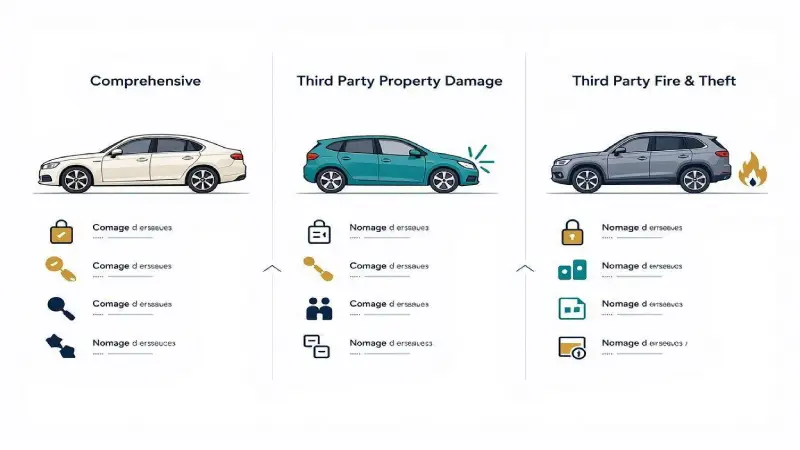
Comprehensive Car Insurance
Comprehensive insurance generally provides the broadest level of protection among standard car insurance options.
Depending on the policy, it may cover damage to your vehicle resulting from events such as:
- Accidents
- Theft
- Fire
- Storms
- Hail
- Malicious damage
- Other insured events
It may also provide cover for damage you cause to another person’s property.
The exact benefits depend entirely on the policy.
Comprehensive insurance is often considered by drivers who:
- Own a newer vehicle
- Have a valuable vehicle
- Rely heavily on their vehicle
- Want broader protection
- Have a car that would be expensive to replace
However, comprehensive insurance is typically more expensive than basic third-party coverage.
Third-Party Property Damage Insurance
Third-party property damage insurance is generally designed to cover your legal liability for damage you cause to another person’s property while using your vehicle.
For example, if you cause an accident and damage another person’s car, third-party property damage insurance may help cover the eligible costs according to the policy terms.
However, it generally does not provide the same level of protection for damage to your own vehicle.
This type of insurance may be considered by drivers who:
- Own an older vehicle
- Have a lower-value vehicle
- Want to meet legal or practical insurance needs at a lower cost
- Are willing to accept more financial risk regarding damage to their own car
Again, the exact terms vary between insurers.
Third-Party Fire and Theft Insurance
Third-party fire and theft insurance generally sits between comprehensive and basic third-party property damage insurance.
Depending on the policy, it may provide:
- Third-party property damage cover
- Protection if your vehicle is stolen
- Protection against certain fire-related events
However, accidental damage to your own vehicle may not be covered in the same way as under comprehensive insurance.
This option can potentially suit drivers who want more protection than basic third-party insurance without paying for full comprehensive cover.
How Much Does iSelect Car Insurance Cost?
There is no single price for iSelect car insurance.
This is because iSelect is a comparison service rather than the insurer setting a universal premium.
The cost of your car insurance depends on your individual profile and the policy you choose.
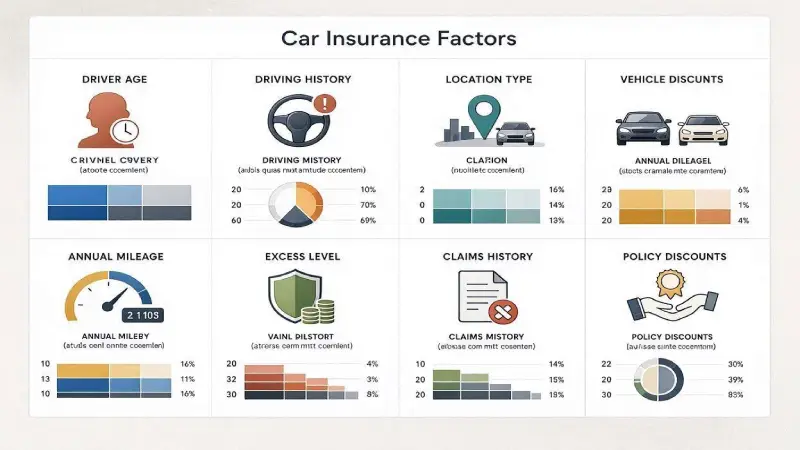
Common factors include:
Your Age
Younger drivers often pay higher premiums because insurers may consider them statistically higher risk.
Your Driving History
A history of accidents or driving offences can affect premiums.
Your Claims History
Previous insurance claims may influence how insurers assess risk.
Your Location
Where you live and where your vehicle is usually kept can affect insurance pricing.
Your Vehicle
The make, model, age, value, and repair costs of your car may influence the premium.
Your Vehicle Usage
A vehicle used frequently may be priced differently from one driven occasionally.
Your Parking Arrangements
Where your vehicle is parked overnight can affect risk assessment.
Your Chosen Excess
Choosing a higher excess may reduce the premium, but it also means you may pay more yourself when making an eligible claim.
Why Car Insurance Prices Can Vary So Much
Two drivers with identical vehicles can receive very different insurance quotes.
Consider two hypothetical drivers.
Driver A:
- 45 years old
- Clean driving history
- Lives in a low-risk area
- Drives fewer kilometres
- Has no recent claims
Driver B:
- 21 years old
- Recently licensed
- Lives in a high-risk area
- Drives frequently
- Has previous claims
Even if both drive the same vehicle, their premiums could be substantially different.
This explains why online comparisons should never be treated as a guarantee of what you personally will pay.
How to Get a Better iSelect Car Insurance Quote
There is no guaranteed way to obtain a cheap insurance premium.
However, several strategies may help you find better value.
Compare Multiple Options
Do not automatically accept the first quote.
Compare several policies where possible.
Review Your Excess
A higher excess may reduce your premium.
However, you should only choose an excess you could realistically afford if you needed to make a claim.
A low annual premium is not necessarily a good deal if the excess creates financial difficulty after an accident.
Avoid Unnecessary Extras
Optional benefits can increase the premium.
Review each additional feature and ask whether you actually need it.
Potential extras can include:
- Rental car cover
- Roadside assistance
- Windscreen protection
- Personal property cover
- Choice of repairer
- Additional vehicle benefits
The right choice depends on your circumstances.
Keep Your Information Accurate
Always provide accurate information.
Do not change details simply to obtain a cheaper quote.
Insurance providers use the information you provide to assess risk and determine eligibility.
Incorrect information can create serious problems later.
Review Your Policy at Renewal
Your circumstances may change over time.
For example:
- You may drive fewer kilometres.
- Your vehicle may lose value.
- You may move house.
- You may change jobs.
- Your driving history may improve.
- Your household may change.
Your insurance needs should evolve with your circumstances.
iSelect Car Insurance for Young Drivers
Young drivers often face higher insurance premiums.
This can make comparison shopping particularly important.
A young driver should consider:
- Comprehensive versus third-party cover
- Excess amounts
- Driver restrictions
- Usage restrictions
- Whether parents or other household members are listed drivers
- The impact of vehicle choice
- Available discounts
Young drivers should never misrepresent who primarily drives the vehicle.
If a parent is listed as the main driver when a younger person is actually the primary driver, this could create problems during a claim.
The cheapest strategy is not necessarily to manipulate the information.
The better approach is to provide accurate details and compare legitimate options.
iSelect Car Insurance for Older Drivers
Older drivers may have different insurance needs.
Factors worth considering include:
- Driving frequency
- Vehicle usage
- Roadside assistance
- Repair options
- Excess levels
- Policy flexibility
Drivers who use their vehicles less frequently may want to investigate whether lower annual mileage affects available premiums.
However, any mileage information provided should accurately reflect actual usage
iSelect Car Insurance for High-Risk Drivers
Drivers with previous claims, accidents, or driving offences may find insurance more difficult or expensive to obtain.
Comparison services can still be useful because they may help identify providers willing to consider different risk profiles.
However, high-risk drivers should pay close attention to:
- Eligibility
- Premiums
- Excess
- Exclusions
- Driver restrictions
- Claims conditions
It is especially important not to hide relevant information.
A policy that appears cheap but does not properly reflect your circumstances may not provide the protection you expect.
What Should You Check Before Buying Car Insurance?
Before purchasing any policy found through iSelect or another comparison platform, review the following.
1. Premium
Understand whether the quoted price is:
- Monthly
- Annual
- Estimated
- Subject to change
Check whether monthly payment arrangements involve additional costs.
2. Excess
Find out how much you may have to pay if you make a claim.
Some policies have multiple excess types.
3. Coverage
Understand exactly what is covered.
Do not assume that “comprehensive” means every possible event is automatically covered.
4. Exclusions
Read the exclusions carefully.
These can determine whether a claim is accepted or rejected.
5. Agreed Value vs Market Value
Depending on the policy, your vehicle may be insured based on:
- Agreed value
- Market value
These are not necessarily the same.
Understand how the insurer determines the value of your vehicle.
6. Repairer Choice
Some policies may allow you to choose your repairer.
Others may direct you to an approved repair network.
If this matters to you, check the policy terms.
7. Rental Car Benefits
If your vehicle is essential for work or family responsibilities, check whether rental car benefits are included or available as an optional extra.
How Does Making a Claim Work?
If you purchase insurance through a comparison platform, the insurer generally handles the actual claim.
This is another reason to understand who provides the policy.
In the event of an accident or insured event, you typically need to:
- Contact the insurer.
- Provide relevant information.
- Explain what happened.
- Provide supporting documentation if required.
- Follow the insurer’s claims process.
The comparison platform is generally not the party responsible for assessing the claim under your insurance contract.
The insurer’s claims team will determine whether the event is covered according to the policy.
iSelect vs Buying Car Insurance Directly
One of the biggest decisions for Australian drivers is whether to use a comparison service or go directly to an insurer.
Both approaches have advantages.
| Feature | iSelect Comparison | Direct Insurer |
|---|---|---|
| Compare multiple options | Potentially easier | Requires separate research |
| Convenience | High | Varies |
| Access to all insurers | Not guaranteed | Only one insurer at a time |
| Direct relationship with insurer | Depends on process | Yes |
| Policy documentation | Provided by insurer | Provided by insurer |
| Claims | Handled by insurer | Handled by insurer |
| Ability to compare | Useful for initial research | Requires multiple quotes |
| Best for | Comparing available options | Consumers who prefer direct contact |
There is no universally superior approach.
A comparison platform can save time, while direct research can help you explore insurers that may not appear on comparison websites.
For many consumers, using both methods may provide the broadest picture
Is iSelect Better Than Comparing Insurers Yourself?
The answer depends on your priorities.
If convenience is your priority, iSelect may be attractive.
If maximum market coverage is your priority, you may want to research insurers independently as well.
If you have a complex insurance situation, speaking directly with insurers may also be useful.
For example, drivers with:
- Multiple vehicles
- Business use
- Modified vehicles
- Special vehicle types
- Complex claims history
may need to look more carefully at policy-specific eligibility requirements.
How to Compare Car Insurance Like an Expert
| Factor | Policy A | Policy B | Policy C |
|---|---|---|---|
| Annual premium | |||
| Basic excess | |||
| Additional excess | |||
| Coverage level | |||
| Market/agreed value | |||
| Rental car | |||
| Windscreen cover | |||
| Roadside assistance | |||
| Choice of repairer | |||
| Key exclusions |
This makes it much easier to identify differences.
The best policy is usually the one that provides the right balance between:
Price + Coverage + Excess + Service + Financial protection
Is the Cheapest Car Insurance Always the Best?
No.
A cheap policy can be valuable if it provides adequate protection for your needs.
But a low premium should always be investigated.
Ask:
- Why is this policy cheaper?
- Is the excess higher?
- Does it have fewer benefits?
- Are there more exclusions?
- Is the coverage limit lower?
- Is the vehicle value calculated differently?
A policy that costs slightly more but provides substantially better protection may represent better overall value.
Common Mistakes When Comparing Car Insurance
Mistake 1: Looking Only at Price
Price is important, but it is not everything.
Mistake 2: Ignoring the Excess
A low premium with a very high excess may not be appropriate for everyone.
Mistake 3: Not Reading Exclusions
Exclusions can significantly affect your protection.
Mistake 4: Assuming All Comprehensive Policies Are Identical
They are not.
Coverage can vary significantly between insurers.
Mistake 5: Providing Inaccurate Information
Always provide accurate details.
Mistake 6: Automatically Renewing
Your renewal price may not be the best available option.
Mistake 7: Never Reviewing Your Coverage
Your insurance needs can change over time.
Is iSelect Car Insurance Worth It in 2026?
For many Australian drivers, iSelect can be worth using as a comparison and research tool.
Its main advantage is convenience.
It can help consumers understand the available market and potentially identify policies that may suit their needs.
However, consumers should not assume that the first or cheapest result is automatically the best choice.
The strongest strategy is to use comparison platforms intelligently.
Start with comparison.
Then investigate.
Then read the policy.
Then compare the final options.
Then make a decision based on the protection you actually need.
This approach can help prevent the common mistake of choosing insurance based solely on the lowest advertised price.
iSelect Car Insurance: Pros and Cons
Pros
- Convenient comparison process
- Can simplify insurance research
- Helps consumers discover potential options
- May save time
- Useful for reviewing insurance at renewal
- Can help consumers understand differences between policies
Cons
- May not include every Australian insurer
- Cheapest quote may not offer the best coverage
- Premiums depend heavily on individual circumstances
- Quotes can change
- Consumers still need to read policy documents
- Comparison services do not replace independent research
Who Should Consider Using iSelect?
iSelect may be particularly useful for:
First-Time Insurance Buyers
New drivers may find the comparison process easier than contacting insurers individually.
Busy Consumers
People who do not want to spend hours researching separate websites may appreciate the convenience.
Drivers Reviewing Their Renewal
If your premium has increased, comparing options can help you determine whether better value may be available.
Consumers Who Want to Understand the Market
Comparison platforms can provide a useful starting point.
Who Should Do Additional Research?
Some drivers may need to go beyond a comparison website.
This includes people with:
- Complex insurance requirements
- Modified vehicles
- Multiple vehicles
- Business use
- Unusual vehicle types
- Complicated driving histories
In these situations, direct conversations with insurers may provide additional clarity.
How Often Should You Compare Car Insurance?
There is no universal rule.
However, reviewing your insurance at least around renewal time can be a sensible habit.
You should also consider reviewing your coverage after major changes, such as:
- Buying a new vehicle
- Selling your vehicle
- Moving house
- Changing how you use your vehicle
- Adding or removing a regular driver
- Experiencing a major change in your driving habits
Regular comparison does not necessarily mean changing insurers every year.
Sometimes your current policy may still be the best option.
The goal is simply to make an informed decision rather than automatically renewing without checking.
Frequently Asked Questions
Is iSelect an insurance company?
No. iSelect is a comparison service. The actual insurance policy is provided by an insurer, which is responsible for the policy terms and claims process.
Is iSelect car insurance legitimate?
iSelect is an established Australian comparison service. However, consumers should always verify the insurer, policy documents, coverage, and terms before purchasing any insurance product.
Can I buy car insurance through iSelect?
Depending on the product and comparison process available at the time, consumers may be able to compare and proceed with eligible insurance options through the platform. The final policy is subject to the insurer’s terms and eligibility requirements.
Is iSelect car insurance cheaper?
It can help consumers find competitive options, but there is no guarantee that the cheapest policy available through a comparison platform is the cheapest policy in the entire market.
Does iSelect compare all car insurance companies?
Not necessarily. Comparison platforms typically have access to a defined range of participating providers. Consumers should consider checking insurers that sell directly as well.
What is the best car insurance in Australia?
There is no single best car insurance policy for every driver. The right choice depends on your vehicle, location, driving history, budget, coverage requirements, and risk tolerance.
Is comprehensive car insurance worth it?
For some drivers, comprehensive insurance can provide valuable protection, particularly when the vehicle is relatively new or expensive. However, the decision depends on the vehicle’s value and the driver’s financial circumstances.
Is third-party car insurance enough?
It can be appropriate for some drivers, particularly those with older or lower-value vehicles. However, it generally provides less protection for your own vehicle than comprehensive insurance.
Can young drivers use iSelect?
Young drivers may use comparison services to research available insurance options. However, premiums can be higher because insurers often consider age and driving experience when assessing risk.
Can I get car insurance after an accident?
Potentially, but eligibility and pricing depend on the insurer and your circumstances. A previous accident may affect your premium and available options.
Does car insurance cover mechanical problems?
Standard car insurance generally does not function as a general warranty for mechanical breakdowns. Coverage depends on the specific policy and insured event.
Does comprehensive insurance cover theft?
Many comprehensive policies provide coverage for theft, subject to the policy terms, exclusions, and applicable excess.
Can I change car insurers at renewal?
In many cases, yes. Consumers can generally compare alternatives before deciding whether to renew their current policy or switch to another insurer.
Should I compare car insurance every year?
Comparing at renewal can help you understand whether your current premium remains competitive. However, you should compare both price and coverage before switching.
Does getting a car insurance quote affect my credit score?
The impact depends on the insurer and the process used. Consumers should check the relevant terms and privacy information when requesting a quote.
Final Verdict: Is iSelect Good for Comparing Car Insurance Quotes?
Our verdict: iSelect can be a useful starting point for Australian drivers who want to compare car insurance options, but it should not be the only source used when choosing a policy.
The platform’s main strength is convenience.
It can simplify the process of exploring insurance options and help consumers avoid relying on a single quote.
However, the comparison process has limitations.
Not every insurer may be represented, and the cheapest available quote may not necessarily provide the strongest protection.
The best approach is to use iSelect as part of a broader insurance comparison strategy.
Start by identifying your needs.
Compare available options.
Check the premium.
Review the excess.
Read the exclusions.
Understand the coverage.
Check the insurer behind the policy.
Then compare the final option with direct quotes where appropriate.
For drivers looking for a quick and convenient way to begin researching car insurance, iSelect can be a useful tool.
For consumers with complex insurance needs or those determined to find the broadest range of options, additional research is recommended.
Ultimately, the right car insurance policy is not necessarily the one with the lowest price.
It is the policy that provides appropriate protection at a price you can afford, with terms and conditions you fully understand.
Editorial Disclaimer
This article was prepared for general educational and informational purposes and should not be considered financial, insurance, legal, or professional advice.
Insurance products and premiums vary according to individual circumstances. Prices, coverage options, eligibility criteria, provider availability, policy terms, and regulations may change over time.
Nexuora does not guarantee that any particular insurance product, provider, quote, or policy will be suitable for your individual circumstances.
Before purchasing car insurance, carefully review the insurer’s current Product Disclosure Statement (PDS), Target Market Determination (TMD), Financial Services Guide where applicable, and other relevant documentation.
Always provide accurate information when requesting an insurance quote or applying for coverage.

Ahmada Ndao is a financial research analyst and independent journalist
specializing in US consumer finance, legal rights, and insurance markets.
With over 5 years covering American financial products, he has helped
thousands of readers navigate complex insurance decisions, find the right
legal representation, and optimize their credit strategies. His research
methodology combines primary data analysis, direct outreach to industry
professionals, and continuous monitoring of federal regulatory changes.
Ahmada’s work has been cited by financial communities across the US and
reviewed by licensed attorneys and insurance professionals for accuracy.