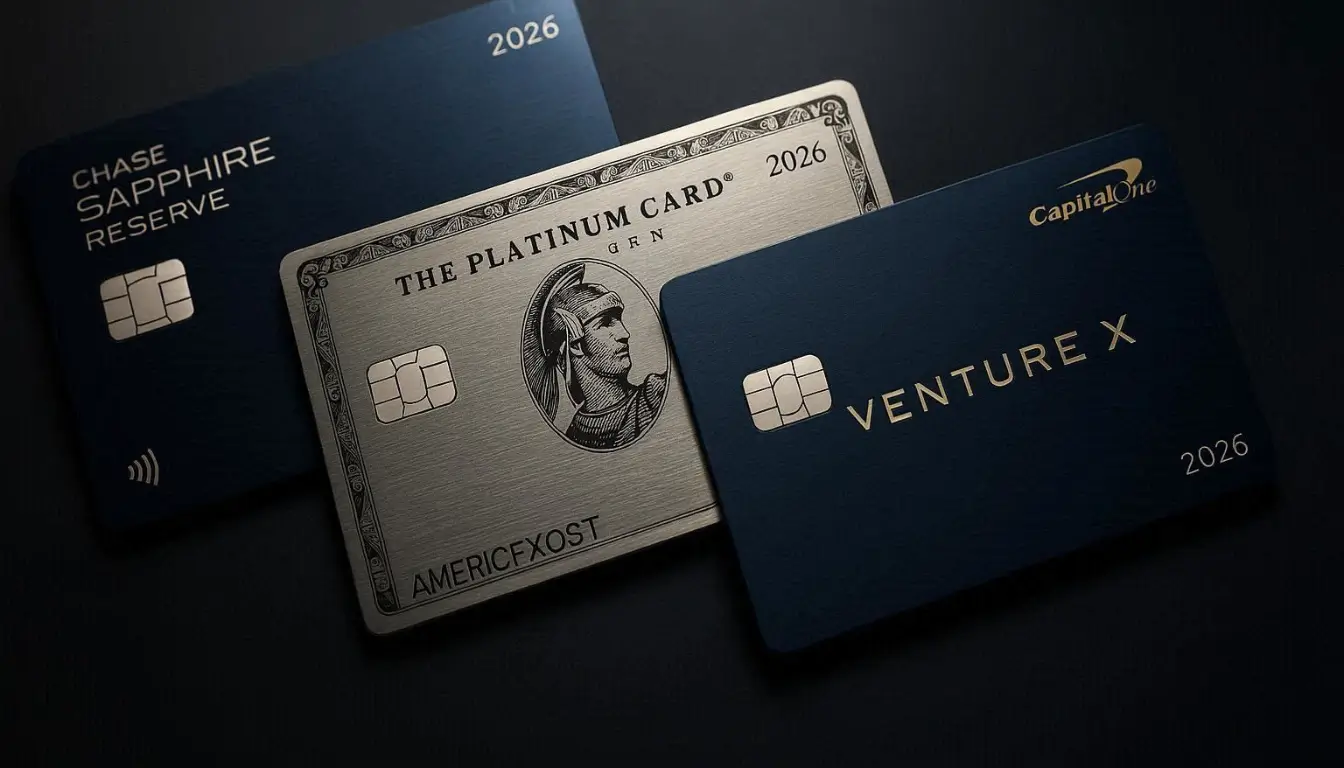
Best Travel Rewards Credit Cards 2026 — Top 8 Cards, Real Point Values & Who Earns the Most
The average American who optimises a travel rewards credit card earns $1,200–$2,400 in free travel value annually — from a card they were already going to use for everyday spending. Travel rewards credit cards have become the most effective legal arbitrage available to American consumers: banks pay you 2–5% of every purchase in travel currency, plus welcome bonuses worth $500–$1,500 in free flights or hotel stays. But the difference between the best and worst travel credit card for your specific spending profile can exceed $800 per year. This complete 2026 guide compares the 8 best travel rewards credit cards in America — with real point valuations, honest annual fee analysis, and a definitive ranking by traveler type.
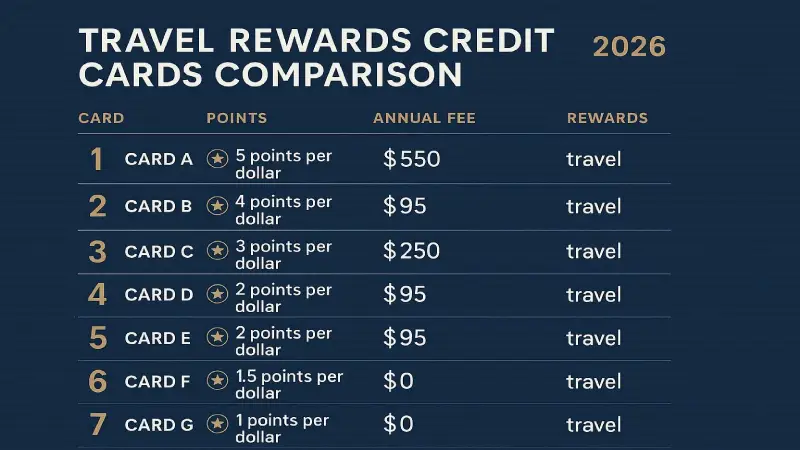
🏆 Top 8 Best Travel Rewards Credit Cards USA 2026 — Ranked
| # | Card | Annual Fee | Welcome Bonus | Best Earn Rate | Best For |
|---|---|---|---|---|---|
| 🥇 1 | Chase Sapphire Reserve | $550/yr | 60,000 UR pts (~$900) | 3× travel & dining everywhere | Best overall · Most flexible rewards |
| 🥈 2 | Amex Platinum Card | $745/yr | 80,000 MR pts (~$1,600) | 5× flights booked directly | Best lounge access · Luxury travel |
| 🥉 3 | Capital One Venture X | $395/yr | 75,000 miles (~$750) | 10× on hotels via C1 Travel | Best value premium card |
| 4 | Chase Sapphire Preferred | $95/yr | 60,000 UR pts (~$750) | 3× dining, 2× travel | Best mid-tier · Best first travel card |
| 5 | Amex Gold Card | $325/yr | 60,000 MR pts (~$1,200) | 4× US supermarkets & dining | Best for foodies · Grocery earners |
| 6 | Citi Strata Premier | $95/yr | 60,000 ThankYou pts (~$600) | 3× hotels, flights, dining, groceries | Best everyday earner · Broad 3× categories |
| 7 | Bank of America Premium Rewards | $95/yr | 60,000 pts ($600) | 2× on travel and dining | Best for BofA Preferred Rewards members |
| 8 | Wells Fargo Autograph Journey | $95/yr | 60,000 pts ($600) | 5× on hotels, 4× on airlines | Best hotel/airline earn at low annual fee |
💰 Real Point Values — What Travel Points Are Actually Worth in 2026

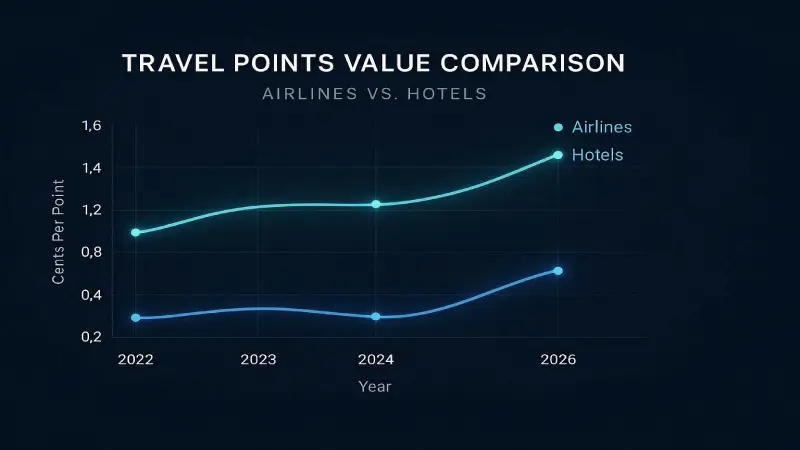
The advertised "earn rate" on a travel credit card is meaningless without knowing what each point is actually worth. A card earning "5× points" on a programme where points are worth 0.5¢ each earns 2.5¢ per dollar — less than a card earning "2× points" in a programme where points are worth 1.8¢ each (earning 3.6¢ per dollar). Understanding the real value of each point currency is the foundation of travel rewards optimisation.
| Point Currency | Conservative Value | Sweet Spot Value | Maximum Value | Best Redemption |
|---|---|---|---|---|
| Chase Ultimate Rewards | 1.0¢ | 1.5–2.0¢ | 2.3¢ | Transfer to Hyatt or United |
| Amex Membership Rewards | 0.6¢ | 1.5–2.0¢ | 2.5¢ | Transfer to ANA, Air Canada Aeroplan |
| Capital One Miles | 1.0¢ | 1.2–1.5¢ | 2.0¢ | Transfer to Turkish Airlines, Air Canada |
| Citi ThankYou Points | 1.0¢ | 1.5–1.8¢ | 2.2¢ | Transfer to Turkish Airlines Miles&Smiles |
| Bank of America Points | 1.0¢ | 1.0¢ | 1.5¢ (Preferred Rewards) | Cash back or travel portal — no transfer |
Why Transfer Partnerships Matter
The gap between a point's "cash back" value (typically 1.0¢) and its "transfer partner" value (typically 1.5–2.5¢) is where sophisticated travel rewards users capture most of their value. When you transfer Chase Ultimate Rewards to World of Hyatt and book a Category 4 hotel that retails for $350/night at 15,000 points per night, you're extracting 2.33¢ per point — 2.33× the value of redeeming for cash. The accumulation of this differential across thousands of points creates the $1,200–$2,400 annual free travel value that optimised travel credit card users routinely achieve.
🔍 Full Card Reviews — Top 5 Detailed 2026
1. Chase Sapphire Reserve — Best Overall Travel Card
The Chase Sapphire Reserve is the most consistently recommended premium travel credit card in America — and for good reason. Its combination of a flexible 3× earn rate on all travel and dining purchases worldwide, 1.5¢ minimum redemption value through Chase Travel portal (or 2¢+ through transfer partners), $300 automatic annual travel credit that reduces the effective annual fee to $250, and a suite of travel protections (trip cancellation/interruption, primary auto rental CDW, trip delay reimbursement, and lost luggage reimbursement) makes it the complete package for most frequent travelers.
The Sapphire Reserve's transfer programme — 14 airline and 3 hotel partners — is the broadest flexible points programme among US personal credit cards. United Airlines, Air Canada Aeroplan, British Airways, Southwest, Hyatt, and Marriott are among the partners, covering the major domestic and international airline alliances and the most valuable hotel loyalty programmes. The 60,000-point welcome bonus (spend $4,000 in first 3 months) is worth $900 at the 1.5¢ portal rate or $1,200–$1,380 transferred to Hyatt or United premium cabin awards.
The $550 annual fee, reduced to approximately $250 after the $300 travel credit, is the most visible barrier for new applicants. On a realistic spending profile — $2,000/month on travel and dining (earning 3× = 6,000 points), $2,000/month on other spending (earning 1× = 2,000 points) — the card earns approximately 96,000 Chase points annually worth $960–$1,920 at various redemption rates, easily justifying the $250 net fee.
- ✅ 3× on all travel and dining worldwide
- ✅ $300 annual travel credit — automatic, broad definition
- ✅ 14 airline + 3 hotel transfer partners
- ✅ Priority Pass Select lounge membership (unlimited + 2 guests)
- ✅ Best travel protections of any consumer card
- ✅ 1.5¢ portal redemption — 50% more than standard 1¢ cash back
- ❌ $550 annual fee — highest net cost of the group
- ❌ Cannot be combined with Sapphire Preferred (one Sapphire rule)
2. American Express Platinum Card — Best Lounge Access and Luxury Benefits
The Amex Platinum Card's $745 annual fee (2026) is the highest of any major US consumer card — but its benefit package is also the most extensive. The Centurion Lounge network (40+ locations globally), Delta SkyClub access when flying Delta, Priority Pass Select membership, and Escape Lounge access collectively give Platinum cardholders access to over 1,400 airport lounges worldwide — the largest lounge access programme of any consumer credit card. For frequent business travelers who value airport lounge comfort, the lounge access alone justifies significant annual fee premium over competitors.
The Amex Platinum's annual credits partially offset the $745 fee: $200 airline fee credit (incidental fees with one selected airline), $200 Uber Cash ($15/month + $20 December), $240 digital entertainment credit ($20/month at eligible services), $300 Equinox credit (fitness), and $200 Fine Hotels + Resorts credit (on qualifying bookings). Combined, these credits are worth $1,140 if fully utilised — though "fully utilised" requires significant lifestyle alignment with these specific credits. The 5× on flights booked directly with airlines or through Amex Travel is the highest airline earn rate of any consumer card.
- ✅ Best lounge access — 1,400+ worldwide including Centurion
- ✅ 5× on flights booked direct or via Amex Travel
- ✅ 80,000-point welcome bonus (~$1,600 in flight value)
- ✅ $1,140 in annual credits (if fully used)
- ✅ Global Entry/TSA PreCheck credit
- ✅ Hotel elite status (Hilton Gold, Marriott Gold)
- ❌ $745 annual fee — justified only if credits are used
- ❌ No bonus on dining or grocery spending
- ❌ Credits require active management to capture full value
3. Capital One Venture X — Best Value Premium Card
The Capital One Venture X is the most compelling value proposition in the premium travel credit card market in 2026. At $395/year — $155 less than Sapphire Reserve and $350 less than Amex Platinum — the Venture X provides: 10× miles on hotels and rental cars booked via Capital One Travel, 5× on flights via Capital One Travel, 2× on everything else, Priority Pass lounge access (unlimited), Capital One Lounge access (growing network), a $300 annual travel credit (applied automatically against Capital One Travel bookings), and a 10,000-mile anniversary bonus (~$100 in value) every year.
The $300 annual credit + 10,000 anniversary bonus effectively reduces the annual fee to approximately $95 in net cost — identical to the Sapphire Preferred. At that effective cost, the Venture X's 2× base earn rate (versus Preferred's 1×), Priority Pass access, and premium travel protections make it an exceptional value. Capital One's transfer partners — including Air Canada Aeroplan, Turkish Airlines, Avianca, and Singapore Airlines KrisFlyer — provide meaningful premium cabin award redemption opportunities for sophisticated users.
- ✅ Effective net fee ~$95 after credits and anniversary bonus
- ✅ 10× on hotels, 5× on flights via C1 Travel
- ✅ Priority Pass unlimited + Capital One Lounges
- ✅ 2× on all other spending
- ✅ 75,000-mile welcome bonus ($750)
- ❌ Best earn rates require booking through Capital One Travel portal
- ❌ Transfer partner list smaller than Chase or Amex
- ❌ Capital One Lounge network still limited (5 locations in 2026)
4. Chase Sapphire Preferred — Best First Travel Card
The Chase Sapphire Preferred is the most recommended first-step travel credit card in America — and has been for a decade. At $95/year, it provides access to Chase's complete Ultimate Rewards transfer ecosystem (the same 14 airline + 3 hotel partners as the Sapphire Reserve), a 60,000-point welcome bonus worth $750 at the 1.25¢ portal rate or $1,200+ transferred to Hyatt, and earn rates of 3× on dining, 3× on streaming, 2× on travel, and 5× on Chase Travel bookings. For travelers who are not yet ready to commit to a $500+ annual fee card, the Sapphire Preferred delivers 80% of the Sapphire Reserve's strategic value at 17% of the fee.
5. Amex Gold Card — Best for Dining and Grocery Spenders
The Amex Gold Card's 4× Membership Rewards points on US supermarkets (up to $25,000/year) and 4× on restaurants worldwide is the highest broad-category earn rate available for two of the largest household spending categories. For a household spending $800/month on groceries and $600/month on dining — earning 4× = 6,800 points/month × 12 = 81,600 points/year worth $1,224–$1,632 depending on redemption — the Gold Card's $325 annual fee (partially offset by $120 dining credit and $120 Uber Cash) is easily justified by the incremental earning versus lower-tier alternatives.
📊 Annual Fee Analysis — Are Premium Travel Cards Worth It?
| Card | Annual Fee | Annual Credits | Effective Net Fee | Worth It If You Spend $/yr on Travel+Dining |
|---|---|---|---|---|
| Amex Platinum | $745 | $1,140 (max value) | $0 (net positive if all used) | $8,000+ on flights |
| Chase Sapphire Reserve | $550 | $300 travel credit | ~$250 | $8,000+ on travel & dining |
| Capital One Venture X | $395 | $300 travel + 10K anniversary | ~$95 | $3,000+ on travel |
| Amex Gold Card | $325 | $240 dining/Uber | ~$85 | $12,000+ on dining & groceries |
| Chase Sapphire Preferred | $95 | $50 hotel credit | ~$45 | $2,000+ on travel & dining |
| Citi Strata Premier | $95 | $100 hotel credit (annual) | ~$0 (with hotel credit) | Any travel/dining spending |
🎯 Best Travel Rewards Card by Traveler Type 2026

| Traveler Profile | Best Card | Runner-Up | Why |
|---|---|---|---|
| Frequent flier, values lounge access | 🏆 Amex Platinum | Chase Sapphire Reserve | 1,400+ lounges including Centurion |
| Frequent traveler, wants flexibility | 🏆 Chase Sapphire Reserve | Capital One Venture X | 3× on all travel & dining · Best transfer partners |
| Value seeker — best net cost | 🏆 Capital One Venture X | Citi Strata Premier | ~$95 effective fee · Full premium benefits |
| First travel card — lower commitment | 🏆 Chase Sapphire Preferred | Citi Strata Premier | $95/yr · Same transfer partners as CSR |
| Big restaurant and grocery spender | 🏆 Amex Gold Card | Chase Sapphire Preferred | 4× supermarkets & dining |
| BofA Platinum Honors member | 🏆 BofA Premium Rewards | Chase Sapphire Preferred | 2.625% effective cash back with 75% bonus |
| Couple / family — maximise hotels | 🏆 Chase Sapphire Reserve | Capital One Venture X | Hyatt transfer — best hotel award value |
| Business frequent flier on one airline | 🏆 Airline co-branded card | Amex Platinum | Elite status qualification + companion tickets |
🎁 Welcome Bonuses — How to Maximise Your Sign-Up Value

Welcome bonuses are the single largest source of travel rewards value for most new cardholders. The bonuses available from the top 8 travel cards collectively represent $5,200+ in potential free travel value for a household that strategically applies for the right cards over 12–18 months. Here is how to maximise welcome bonus value:
Rule 1 — Only apply when you have organic spending to meet the requirement
Most welcome bonuses require $3,000–$6,000 in spending in the first 3 months. Meeting this requirement through manufactured spending (buying gift cards to resell, for example) violates card terms and can result in bonus denial or account closure. Apply for a new card when you have upcoming natural high-spend periods — a vacation, a home improvement project, a vehicle purchase, or a holiday season where organic spending will meet the requirement without stress.
Rule 2 — Check the "highest-ever" bonus history before applying
Card issuers periodically offer elevated welcome bonuses — sometimes 50–100% higher than the standard offer. Checking CardMatch (a NerdWallet/Bankrate tool), Amex's "check without applying" feature, or community resources like The Points Guy before applying can reveal whether you are eligible for a targeted higher bonus. Applying for the standard bonus when an elevated offer is available leaves significant value on the table.
Rule 3 — Understand the 5/24 and 1/30 rules
Chase's "5/24" rule means that if you have opened 5 or more credit cards from any issuer in the past 24 months, Chase will typically deny your application. If Chase cards are a priority (Sapphire, Freedom, Ink), apply for those first before diversifying to Amex and Capital One products. American Express's "once per lifetime" rule means you can generally only earn the welcome bonus for a specific Amex card once — though the card can be reopened after closure. American Express also has a "1/3 month" new card limit — typically no more than 1 new Amex card per 3 months.
Rule 4 — Transfer points at the right time
Transferring points to airline or hotel partners is irreversible — once transferred, they cannot be moved back to your flexible currency balance. Transfer only when you have a confirmed redemption in mind or when a transfer bonus (typically 30–40% extra miles for transferring to a specific partner during a promotional window) justifies the action. Keep most of your flexible points in your Ultimate Rewards, Membership Rewards, or Miles balance until you have a specific award redemption planned.
✈️ Transfer Partners — The Key to Maximum Value
| Programme | Chase UR | Amex MR | Capital One | Citi TY |
|---|---|---|---|---|
| United Airlines | ✅ 1:1 | ❌ | ❌ | ❌ |
| Air Canada Aeroplan | ✅ 1:1 | ✅ 1:1 | ✅ 1:1 | ✅ 1:1 |
| Turkish Airlines | ❌ | ❌ | ✅ 1:1 | ✅ 1:1 |
| Singapore Airlines | ❌ | ✅ 1:1 | ✅ 1:1 | ❌ |
| British Airways | ✅ 1:1 | ✅ 1:1 | ❌ | ❌ |
| Southwest | ✅ 1:1 | ❌ | ❌ | ❌ |
| World of Hyatt | ✅ 1:1 🏆 | ❌ | ❌ | ❌ |
| Marriott Bonvoy | ✅ 1:1 | ✅ 1:2 | ❌ | ❌ |
| Delta SkyMiles | ❌ | ✅ 1:1 | ❌ | ❌ |
| ANA Mileage Club | ❌ | ✅ 1:1 🏆 | ❌ | ❌ |
Chase Ultimate Rewards' exclusive Hyatt transfer partnership is the most valuable hotel transfer in the American market — World of Hyatt's award chart consistently provides 2–4¢ per point in value at high-category properties. Amex Membership Rewards' ANA transfer enables first-class roundtrip Japan tickets for 110,000 points — one of the highest-value premium cabin redemptions available for American travelers. Capital One's Turkish Airlines partnership unlocks Star Alliance premium cabin awards at the lowest point requirements of any Star Alliance partner programme.
🛋️ Airport Lounge Access Compared
| Card | Lounge Networks | Guest Policy | Best Benefit |
|---|---|---|---|
| Amex Platinum | Centurion + Priority Pass + Delta SkyClub + Escape | 2 guests at Centurion | Centurion Lounges — best US domestic lounges |
| Chase Sapphire Reserve | Priority Pass Select | Unlimited guests | Best guest policy — unlimited guests included |
| Capital One Venture X | Priority Pass + Capital One Lounges | 2 guests at C1 Lounges | Capital One Lounges — best food and service |
| Citi Strata Premier | ❌ No lounge access | — | No lounge — compensated by low fee |
| Chase Sapphire Preferred | ❌ No lounge access | — | No lounge — mid-tier card |
❓ Frequently Asked Questions — Travel Rewards Credit Cards 2026
What is the best travel rewards credit card in the USA in 2026?
The Chase Sapphire Reserve is the best overall travel rewards credit card in the USA for 2026 — offering 3× on all travel and dining worldwide, the most flexible transfer partner ecosystem (14 airlines, 3 hotels including Hyatt), $300 automatic travel credit, Priority Pass lounge access with unlimited guests, and the strongest consumer travel protection suite available. The effective net annual fee of approximately $250 (after the $300 travel credit) is justified for most travelers who spend $8,000+ annually on travel and dining. For those wanting lower upfront commitment, the Chase Sapphire Preferred provides access to the same transfer partners at $95/year. For maximum lounge access, the Amex Platinum's Centurion network is unmatched but requires active management of $745/year in credits to justify the fee.
How much are Chase Ultimate Rewards points worth?
Chase Ultimate Rewards points are worth a minimum of 1.0¢ each when redeemed for cash back, 1.25¢ each through the Chase Travel portal with the Sapphire Preferred, and 1.5¢ each through Chase Travel with the Sapphire Reserve. When transferred to World of Hyatt for hotel awards, experienced users extract 2.0–2.3¢ per point — the highest value available. When transferred to United Airlines or Air Canada Aeroplan for premium cabin international flights, values of 1.8–2.5¢ per point are achievable for business and first class redemptions. The average value for a typical user who mixes portal redemptions and some transfers is approximately 1.5–1.8¢ per point.
Is the Amex Platinum Card worth the $745 annual fee?
The Amex Platinum Card is worth the $745 annual fee for the right traveler — specifically, someone who flies at least 8–10 times per year (maximising the 5× earning and Centurion Lounge access), uses Uber regularly (capturing the $200 Uber Cash), subscribes to eligible streaming services ($240 credit), and values the hotel elite status benefits (Hilton Gold, Marriott Gold) and Fine Hotels + Resorts property access. If you can realistically capture $900+ of the $1,140 in annual credits while valuing the lounge access and 80,000-point welcome bonus, the Platinum is cost-effective. If you fly occasionally and cannot use the credits, the effective cost is the full $745 — making it a poor value compared to the Chase Sapphire Reserve or Capital One Venture X.
What is the best travel credit card with no annual fee?
The best no-annual-fee travel rewards cards in 2026 are the Chase Freedom Unlimited (1.5% cash back on everything, 3% on dining and drugstores, earns Ultimate Rewards convertible to travel if you also have a Sapphire card) and the Capital One VentureOne (1.25× miles on everything, no foreign transaction fees). However, no-fee travel cards earn significantly fewer points than fee cards and typically lack transfer partners and travel protections. The most cost-effective approach for most travelers is the Chase Sapphire Preferred at $95/year — providing access to the full Ultimate Rewards transfer ecosystem at very low net cost, particularly when the $50 hotel credit is factored in reducing the effective fee to $45/year.
Can I have both the Chase Sapphire Preferred and Chase Sapphire Reserve?
No — Chase's "one Sapphire" policy means you can only hold one Sapphire card (Preferred or Reserve) at a time. You also cannot earn the welcome bonus on the Sapphire Reserve if you have received a Sapphire welcome bonus in the past 48 months. Many advanced travel reward users start with the Sapphire Preferred, collect the welcome bonus, then product-change to the Sapphire Reserve after 12+ months to upgrade to the higher earn rates and $300 travel credit without a new application — allowing them to retain their existing Ultimate Rewards balance and card history without subjecting it to a new 5/24 inquiry.
How do travel rewards credit card transfer partners work?
Transfer partners are airline and hotel loyalty programmes where you can convert your flexible credit card points (Chase Ultimate Rewards, Amex Membership Rewards, Capital One Miles, Citi ThankYou Points) into loyalty currency at a typically 1:1 ratio. After transferring, you use the airline or hotel programme's award chart to book free flights or hotel nights. The value advantage: booking a business class flight with transferred points can deliver 2–4¢ per point in value versus 1.0–1.5¢ for portal or cash redemptions. The key mechanics: transfers are instant to most partners, transfers are one-way and irreversible (you cannot transfer back), minimum transfer amounts apply (typically 1,000 points), and you must have an active frequent flyer account with the partner before transferring. Always have a specific redemption in mind before initiating a transfer.
✅ Final Verdict — Best Travel Rewards Credit Cards 2026
Chase Sapphire Reserve is the best overall for flexibility, transfer partners, and travel protections. Amex Platinum is best for frequent fliers who value lounge access above all. Capital One Venture X is the best value at ~$95 effective annual cost with full premium benefits. Chase Sapphire Preferred is the best first travel card or low-commitment choice. Amex Gold is the best for heavy restaurant and grocery spenders. Most optimised households carry 2–3 complementary cards to maximise earn rates across all spending categories.
For financial protection that complements your travel rewards strategy — including travel insurance for covered trip costs — see our guide on Best Single Trip Travel Insurance USA 2026. For balance transfer options if you are carrying travel card debt, see our article on Best 0% APR Balance Transfer Credit Cards 2026.
Disclaimer: Credit card terms, welcome bonuses, and annual fees change frequently. All data reflects April 2026 public card offers. Point valuations are estimates based on independent analysis — actual values vary by redemption. Always review current terms at the card issuer's website before applying. Nexuora does not receive commission from any card issuer. Updated April 23, 2026.

Ahmada Ndao is a financial research analyst and independent journalist
specializing in US consumer finance, legal rights, and insurance markets.
With over 5 years covering American financial products, he has helped
thousands of readers navigate complex insurance decisions, find the right
legal representation, and optimize their credit strategies. His research
methodology combines primary data analysis, direct outreach to industry
professionals, and continuous monitoring of federal regulatory changes.
Ahmada’s work has been cited by financial communities across the US and
reviewed by licensed attorneys and insurance professionals for accuracy.