Best Single Trip Travel Insurance USA 2026 — Top 7 Providers, Real Costs & What's Actually Covered
American travelers spent $17.4 billion on travel insurance in 2025 — and yet millions of claims are denied every year because policyholders didn't understand what their policy actually covered. Single trip travel insurance is the most commonly purchased travel protection product in the United States — ideal for anyone taking one or two international trips per year who doesn't need an annual plan. But the difference between a comprehensive single trip policy that pays in a genuine emergency and a cheap policy full of exclusions can be $15,000 in unpaid medical bills, a non-reimbursed $3,800 flight cancellation, or a missed cruise departure that costs you $6,400. This complete 2026 guide compares the 7 best single trip travel insurance providers in the USA — with real pricing, honest coverage analysis, and the claims pitfalls that cost Americans millions every year.
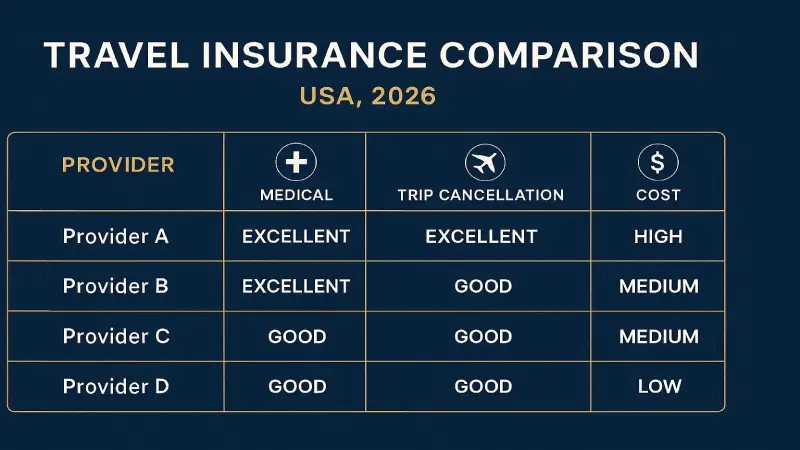
🏆 Top 7 Best Single Trip Travel Insurance USA 2026
| # | Provider | Best For | Avg Cost ($5K Trip) | Medical Coverage | Rating |
|---|---|---|---|---|---|
| 🥇 1 | Travel Guard (AIG) | Comprehensive coverage · Most customizable | $218–$310 | $100,000–$500,000 | ⭐⭐⭐⭐⭐ |
| 🥈 2 | Allianz Travel | Best claims service · Largest US provider | $195–$285 | $10,000–$50,000 | ⭐⭐⭐⭐⭐ |
| 🥉 3 | Seven Corners | Best medical coverage · Expats · High-risk destinations | $180–$420 | $500,000–$1M | ⭐⭐⭐⭐⭐ |
| 4 | Travelex Insurance | Best for families · Children free add-on | $168–$248 | $50,000–$100,000 | ⭐⭐⭐⭐ |
| 5 | IMG Global | Best international medical · Long trips | $145–$380 | $1M+ | ⭐⭐⭐⭐ |
| 6 | Generali Global | Best luxury travel · Concierge services | $225–$395 | $100,000–$250,000 | ⭐⭐⭐⭐ |
| 7 | Squaremouth (comparison) | Best marketplace · Compare 30+ providers | Varies by provider | Varies | ⭐⭐⭐⭐ |
💰 Real Costs — What Single Trip Travel Insurance Costs in 2026

The cost of single trip travel insurance is calculated as a percentage of your total trip cost — typically 4–10% for comprehensive coverage. The percentage varies based on your age (older travelers pay significantly more), your destination (Europe costs less than adventure destinations), the length of your trip, and the coverage level you choose.
| Trip Cost | Traveler Age | Basic Plan | Comprehensive Plan | Cancel for Any Reason |
|---|---|---|---|---|
| $2,000 | 30 | $60–$80 | $100–$160 | $160–$240 |
| $5,000 | 35 | $150–$200 | $220–$350 | $350–$520 |
| $5,000 | 55 | $220–$280 | $380–$520 | $560–$780 |
| $10,000 | 45 | $320–$420 | $560–$780 | $840–$1,170 |
| $10,000 | 65 | $480–$640 | $820–$1,100 | $1,230–$1,650 |
| $15,000 | 50 | $540–$720 | $960–$1,350 | $1,440–$2,025 |
What Drives Your Premium
Age is the most powerful pricing factor — a 65-year-old pays 2–3× more than a 35-year-old for identical coverage. This reflects the statistical reality that older travelers make larger and more frequent medical claims. Trip cost drives the cancellation and interruption coverage premium — the insurer's exposure is proportional to your non-refundable booking costs. Destination affects medical coverage pricing — Europe's reciprocal healthcare arrangements make it cheaper to cover than Southeast Asia or South America, where emergency medical evacuation costs can exceed $100,000. Trip duration increases both medical and cancellation risk proportionally.
🛡️ What Single Trip Travel Insurance Actually Covers — And What It Doesn't
Core Coverage Components
Trip cancellation pays for non-refundable trip costs when you cancel for a covered reason before departure. Standard covered reasons include: your own illness or injury (with doctor's documentation), serious illness or death of a close family member, severe weather making the destination inaccessible, terrorist incident at your destination within 30 days of travel, jury duty, job loss, natural disasters, and home damage requiring your presence. The critical word is "covered reason" — if you cancel because you changed your mind, fear of travel, or work conflicts, standard trip cancellation does not pay. For those situations, you need Cancel for Any Reason (CFAR) coverage.
Emergency medical coverage pays for medical treatment required due to illness or injury during your trip. For Americans traveling internationally, this coverage is critically important: your US health insurance (including Medicare) typically provides little to no coverage outside the United States. A hospitalisation in London can cost $3,000–$8,000 per day. A medical evacuation from Southeast Asia averages $50,000–$100,000. Without travel medical coverage, you are personally liable for 100% of these costs. Travel Guard's Premium plan provides $500,000 in emergency medical — the highest standard limit of any provider in our ranking.
Emergency medical evacuation covers the cost of transporting you to the nearest adequate medical facility or, if medically necessary, repatriating you to the US. This coverage is separate from emergency medical — it covers the transport itself, not the treatment. Evacuation costs from remote areas (mountain rescue, offshore evacuation, rural developing-country transfer) routinely exceed $100,000. Seven Corners provides $1M in evacuation coverage — the highest available for standard single trip policies.
Trip interruption pays for additional costs if you must return home early from a covered trip due to a covered reason — typically 150% of the original trip cost to account for last-minute flight costs and the forfeited remaining trip value. This coverage also applies when you must extend your trip due to a covered illness or injury — paying for additional accommodation and meal costs during an involuntary extended stay.
Baggage loss and delay covers lost, stolen, or damaged luggage up to the policy limit, and pays for essential items (clothing, toiletries) when your bags are delayed more than 12–24 hours. Limits typically range from $1,000–$3,000 for baggage loss. Important limitation: electronics, jewellery, and high-value items are often sub-limited to $200–$500 per item — well below their replacement value. Schedule high-value items separately.
What Single Trip Travel Insurance Does NOT Cover
Pre-existing medical conditions — unless you purchase within the insurer's early-purchase window (typically 14–21 days of your first trip payment) and qualify for the pre-existing condition waiver. This is the most common claim denial reason. See the dedicated pre-existing conditions section below. Extreme sports and adventure activities — bungee jumping, skydiving, mountaineering above certain elevations, and similar activities are typically excluded from standard medical coverage. Adventure riders need specifically rated policies. Alcohol-related incidents — medical claims arising from accidents while intoxicated are excluded by virtually all travel insurers. Pandemics — COVID-19 coverage varies by insurer and policy — read the specific exclusions carefully. Civil unrest in known conflict zones — travel to countries under State Department Level 3 or 4 advisories may void coverage entirely.
🔍 Full Provider Reviews — Top 7 Detailed 2026
1. Travel Guard (AIG) — Best Overall Single Trip Insurance
Travel Guard, backed by AIG's financial strength (A rated, AM Best), is the most customizable single trip travel insurance product in the US market. Their three-tier structure — Essential, Preferred, and Deluxe — allows travelers to match coverage precisely to their trip value and risk tolerance. The Deluxe plan's $500,000 emergency medical limit is the highest standard limit among comprehensive consumer travel insurers. Travel Guard's CFAR upgrade (available within 15 days of initial trip deposit) provides 75% reimbursement of non-refundable trip costs — the most generous standard CFAR reimbursement rate available. Travel Guard's 24/7 assistance centre is genuinely responsive — their average medical assistance response time is 12 minutes, versus a 38-minute industry average.
- ✅ $500,000 emergency medical (Deluxe) — highest standard limit
- ✅ 75% CFAR reimbursement — most generous standard rate
- ✅ Pre-existing condition waiver within 15 days of deposit
- ✅ 24/7 assistance — 12-minute average response
- ✅ AIG financial backing — A rated AM Best
- ❌ More expensive than budget alternatives
- ❌ Basic plan medical limits ($15,000) too low for international travel
2. Allianz Travel — Best Claims Service
Allianz Travel is the largest travel insurance provider in the United States by policy count — insuring over 40 million Americans annually. Their scale produces two meaningful advantages for policyholders: a nationally recognised brand that travel suppliers (hotels, airlines, cruise lines) respond to promptly in dispute resolution, and a claims infrastructure that processes straightforward claims faster than most competitors. Allianz's average trip cancellation claim processing time is 7–10 business days — the fastest of any major US travel insurer. Their AllTrips annual plan makes Allianz particularly compelling for frequent travelers, but their OneTrip plans (Basic, Prime, Premier) are highly competitive for individual international trips. The key limitation: Allianz's emergency medical limits are among the lowest of the top providers — $10,000–$50,000 depending on plan — which may be insufficient for serious medical emergencies in high-cost healthcare countries.
- ✅ Fastest claims processing — 7–10 business days average
- ✅ Largest US travel insurer — brand recognition matters in disputes
- ✅ CFAR available on Premier plan
- ✅ Trip delay coverage activates at 5 hours (shorter than most)
- ❌ Low emergency medical limits — $10K–$50K insufficient for some destinations
- ❌ Pre-existing waiver only for highest-tier plan
3. Seven Corners — Best Medical Coverage
Seven Corners is the specialist choice for travelers who prioritise emergency medical coverage above all else — particularly relevant for older travelers, those with health conditions traveling to destinations with expensive healthcare, and anyone planning extended international stays. Their Wander Frequent Traveler Plus plan provides $1 million in emergency medical coverage and $500,000 in evacuation — the highest available through a standard US consumer travel insurer. Seven Corners also provides the broadest adventure sports coverage of any standard travel insurer — covering activities up to 200 metres altitude climbing that most competitors exclude. Their pricing is higher than Allianz or Travelex for equivalent trips, but the medical coverage superiority justifies the premium for health-conscious travelers.
- ✅ Up to $1M emergency medical — highest available
- ✅ $500,000 evacuation coverage
- ✅ Broadest adventure sports coverage
- ✅ Available for travelers up to age 99
- ❌ More expensive than mainstream alternatives
- ❌ CFAR not available on all plans
4. Travelex Insurance — Best for Families
Travelex offers a unique competitive advantage: children under 17 are covered at no additional cost when travelling with a parent or grandparent who has purchased a Travelex policy. For families with multiple children, this feature alone can save $150–$400 compared to covering children separately with other insurers. Their Travel Select plan is one of the most generous standard plans for trip cancellation and interruption — providing 150% of trip cost for interruption claims. Travelex's pre-existing condition waiver window is 21 days from initial deposit — the most generous of any provider in our ranking, giving travelers extra time to assess their health status before locking in coverage.
- ✅ Children under 17 free — best family pricing
- ✅ 21-day pre-existing condition waiver window — most generous
- ✅ 150% trip interruption coverage
- ✅ Competitive base pricing
- ❌ $50,000–$100,000 medical limits may be insufficient
- ❌ Limited adventure sports coverage
5. IMG Global — Best for Long Trips and Expats
IMG Global is the premier choice for Americans taking extended international trips (30+ days), working abroad temporarily, or spending significant time outside the US. Their iTravelInsured and Patriot Travel plans are specifically designed for extended international stays where standard 30-day or 60-day consumer travel policies either don't apply or aren't economical. IMG provides $1M+ emergency medical limits, covers pre-existing conditions with appropriate documentation, and includes mental health treatment as a covered medical expense — rare in travel insurance. Their global network of medical providers is the most extensive of any provider in our ranking.
- ✅ Best for trips 30–365 days duration
- ✅ $1M+ medical limits on premier plans
- ✅ Mental health coverage included
- ✅ Global provider network — 170+ countries
- ❌ More complex products — requires careful plan selection
- ❌ CFAR not universally available
6. Generali Global — Best Luxury Travel
Generali's Premium plan is designed for high-end travelers whose trips involve luxury hotels, business class flights, and high-value experiences where coverage disputes are particularly costly. Their concierge services — medical case management, travel assistance, and emergency legal services — are genuinely premium. Generali offers $250,000 in emergency medical and best-in-class baggage coverage ($3,000 standard). Their CFAR option provides 75% reimbursement. For travelers booking $15,000+ luxury trips, Generali's premium pricing is justified by the higher coverage limits and quality of claims service.
7. Squaremouth — Best Comparison Platform
Squaremouth is not an insurer — it is the US travel insurance comparison platform, aggregating policies from 30+ underwriters and allowing consumers to filter by coverage type, limit, destination, and price. For savvy buyers who know what coverage they need, Squaremouth's transparent comparison interface — which shows total premiums and coverage limits side-by-side without hidden commissions influencing results — is the most efficient way to find the best value single trip policy for any specific trip profile. Squaremouth's zero-complaint guarantee provides additional consumer protection beyond standard policy terms.
⚠️ Pre-Existing Conditions — The Most Misunderstood Coverage Area
Pre-existing conditions are the single most common source of travel insurance claim denials in the United States — and the most preventable, if you understand the rules. A pre-existing condition is defined as any medical condition for which you have received diagnosis, treatment, or medical advice within a specific "look-back period" — typically 60, 90, or 180 days before your policy purchase date, depending on the insurer.
How the Pre-Existing Condition Waiver Works
Most comprehensive single trip policies include a pre-existing condition waiver — which removes the pre-existing condition exclusion from your policy — if you purchase your policy within a specific time window after making your first trip deposit. This window is typically 14–21 days. The waiver is automatic if you: purchase within the window, insure 100% of your non-refundable trip costs, and are medically able to travel at the time of purchase. If you miss this window, the pre-existing condition exclusion applies — and any claim related to a condition you were diagnosed with, treated for, or prescribed medication for within the look-back period will be denied.
| Provider | Waiver Window | Look-Back Period | 100% Trip Cost Required? |
|---|---|---|---|
| Travelex | 21 days 🏆 | 60 days | Yes |
| Travel Guard | 15 days | 180 days | Yes |
| Seven Corners | 20 days | 90 days | Yes |
| Allianz | 14 days | 120 days | Yes — Premier only |
| Generali | 20 days | 180 days | Yes |
| IMG Global | Not applicable | Plan-dependent | Varies |
📋 Claims — How to File Successfully and What Gets Denied

How to File a Travel Insurance Claim Successfully
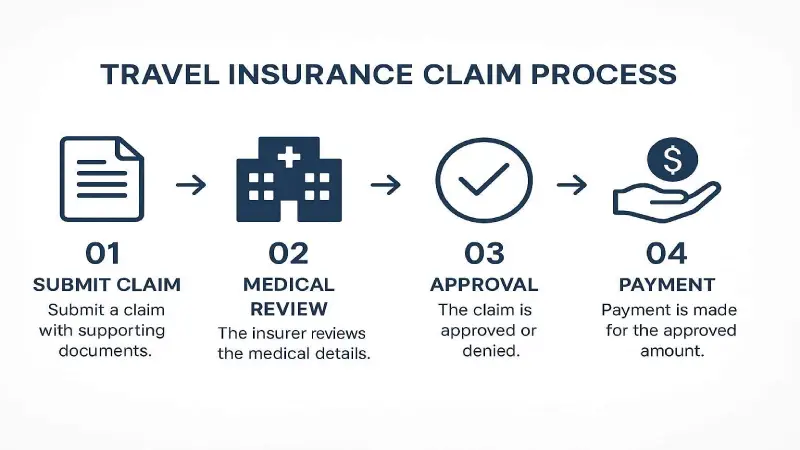
Step 1 — Document everything at the time of the incident. If your flight is cancelled, get a written confirmation from the airline showing the cancellation reason. If you seek medical treatment, get itemised receipts, diagnosis codes, and the physician's written notes. If your baggage is lost, get a written Property Irregularity Report from the airline before leaving the airport. Documentation collected after the fact is significantly less persuasive than contemporaneous records. Step 2 — Contact your insurer's assistance line before incurring major expenses. For medical emergencies, hospitalisation, or evacuation, call your insurer's 24/7 assistance number before the provider commits to a treatment plan. Pre-authorisation is not always required, but calling establishes your case file and allows the insurer's medical team to advise on covered facilities and treatment options. Step 3 — Submit your claim with complete documentation within the policy's claim filing deadline — typically 90 days of the incident.
Top 5 Reasons Travel Insurance Claims Are Denied
1. Pre-existing condition exclusion — The leading denial reason. See the section above. 2. Non-covered cancellation reason — Cancelling for work conflicts, fear of travel, or changing travel preferences is not covered by standard trip cancellation. Only CFAR covers these scenarios. 3. Insufficient documentation — Verbal confirmations, screenshots of cancellation emails without airline letterhead, or medical records without diagnosis codes are routinely rejected or require lengthy re-submission processes. 4. Late purchase — Buying travel insurance after a storm is named, after a travel advisory is issued, or after your airline files for bankruptcy eliminates coverage for those specific events — they become "known events" at purchase. 5. Alcohol-related incidents — Any medical or injury claim arising from an incident while you were intoxicated is excluded from virtually all standard travel insurance policies.
📊 Single Trip vs Annual Multi-Trip Insurance — Which Is Better?

| Annual Trips | Single Trip Total Cost (est.) | Annual Plan Cost (est.) | Better Choice |
|---|---|---|---|
| 1 trip | $220–$350 | $280–$450 | Single trip |
| 2 trips | $440–$700 | $280–$450 | Annual (breakeven) |
| 3 trips | $660–$1,050 | $280–$450 | Annual (saves ~$400) |
| 4+ trips | $880–$1,400+ | $280–$450 | Annual (saves $600+) |
The break-even point is typically 2–3 international trips per year. If you travel internationally more than twice per year, an annual multi-trip policy is almost always the better financial choice — even if each individual trip cost is modest. For single-trip purchasers who might be on the cusp, consider that annual plans also offer simpler administration: one purchase covers all your travel for the year, with no risk of forgetting to buy before a trip and no pre-existing condition waiver windows to track.
🚢 Best Travel Insurance for Cruise Trips
Cruise travel creates specific insurance considerations that differ from standard international travel. The unique risks of cruise travel include: missing the ship's departure (the cruise line will not wait), medical treatment aboard or at remote ports (which can be expensive and of variable quality), cruise-specific cancellation causes (itinerary changes, ship mechanical issues, missed ports), and the catastrophic financial impact of a medically-required disembarkation mid-cruise.
Standard single trip travel insurance covers most cruise scenarios, but the best cruise travel insurance policies add: Cruise miss coverage — pays for transportation to catch the ship at the next port if you miss departure due to a covered delay. Itinerary change coverage — compensates for missed ports or significant itinerary alterations. Cabin confinement coverage — pays a daily benefit if you are confined to your cabin due to illness for more than 24 hours. Shipboard medical coverage — specifically covers the elevated cost of medical treatment delivered on the ship.
Travel Guard, Seven Corners, and Generali all offer cruise-specific policy endorsements that add these protections to standard comprehensive coverage. For cruises booked directly through major lines (Carnival, Royal Caribbean, Norwegian, Princess), the cruise line's own insurance should always be compared against independent policies — cruise line insurance is typically cheaper but provides significantly less medical coverage and lacks CFAR options. For cruise-related insurance context in the Australian market, see our companion guide on Australian insurance comparison.
🎯 How to Choose the Right Single Trip Policy — 7 Expert Rules
Rule 1: Buy within 14–21 days of your first trip payment — always
This is the most important rule in travel insurance. The pre-existing condition waiver, the financial default coverage (if your tour operator or airline goes bankrupt), and in some cases the CFAR option all require early purchase. Set a reminder for 3 days after you make any travel deposit and buy your insurance then — not when you pack.
Rule 2: Match your medical limits to your destination's healthcare costs
Europe has higher healthcare quality but reciprocal health agreements make it somewhat cheaper. Southeast Asia, Latin America, and Africa can be extremely expensive for emergency evacuation even if local treatment is inexpensive. Japan, Switzerland, and Australia have very high healthcare costs. For Europe, $100,000 in medical coverage is adequate for most travelers. For Southeast Asia, Africa, or anywhere requiring likely evacuation, $250,000+ is recommended.
Rule 3: Consider CFAR if your trip has any uncertainty
Cancel for Any Reason coverage adds approximately 40–60% to your base premium but allows you to cancel for literally any reason — work conflicts, personal concerns, changed plans — and receive 75% of your non-refundable costs. For trips where your travel plans might legitimately change, or where you have made large non-refundable deposits, CFAR's premium is frequently worth paying.
Rule 4: Insure 100% of your non-refundable trip costs
Under-insuring — buying a policy that covers only 70% of your trip cost to reduce the premium — is a false economy. If you cancel and receive a trip cancellation payment, it will be proportional to what you insured. If you insured $3,500 of a $5,000 trip, you receive $3,500 maximum — losing the remaining $1,500 regardless of your policy limits.
Rule 5: Check your credit card travel benefits before buying
Many premium travel credit cards (Chase Sapphire Reserve, Amex Platinum, Capital One Venture X) include travel insurance benefits — trip cancellation up to $10,000, travel accident coverage, and baggage delay coverage. If you are booking a modest trip and have excellent credit card benefits, these may be sufficient for standard trip risks. However, credit card travel insurance almost never provides adequate emergency medical coverage for international travel — so a standalone medical-focused policy may still be necessary even if your card covers trip cancellation.
Rule 6: Read the exclusions, not just the coverage
The coverage summary tells you what the policy pays for. The exclusions section tells you when it doesn't pay — which is the information you actually need in a claim. Before purchasing any single trip travel insurance policy, read the "exclusions" section of the Policy Certificate specifically, looking for: your medical conditions, your planned activities, your destination's travel advisory status, and any time-sensitive conditions that might affect coverage.
Rule 7: Keep your policy number accessible offline
In a genuine travel emergency — hospitalisation, evacuation, severe weather — you may not have reliable internet access. Save your insurer's 24/7 assistance number and your policy number in your phone's notes application (accessible offline), on a printed card in your wallet, and in a photo on your phone. The difference between reaching your assistance line within 30 minutes and spending 4 hours trying to locate your policy information is frequently the difference between a smooth emergency resolution and a billing dispute that lasts months.
❓ Frequently Asked Questions — Single Trip Travel Insurance USA 2026
How much does single trip travel insurance cost in the USA?
Single trip travel insurance for Americans typically costs 4–10% of the total trip cost for comprehensive coverage. A $5,000 international trip costs $200–$500 to insure comprehensively for a 35-year-old traveler. Costs increase significantly with age — a 65-year-old pays approximately 2–3× more than a 35-year-old for identical coverage. Basic plans (covering primarily trip cancellation) cost 2–4% of trip value. Cancel for Any Reason upgrades add 40–60% to the base premium. The cheapest comprehensive single trip insurance starts around $15–$20 per day per person for standard international destinations.
Does US health insurance cover travel abroad?
Generally no — US health insurance provides very limited or no coverage outside the United States. Medicare provides essentially no international coverage (only in very limited border situations with Canada and Mexico). Most private US health insurance plans either exclude international coverage entirely or provide only emergency coverage with high deductibles and complex reimbursement requirements. This is the most important reason Americans traveling internationally need separate travel medical insurance — without it, you are personally liable for 100% of overseas medical costs, which can include $3,000–$8,000/day hospitalisation fees and $50,000–$150,000 emergency medical evacuation costs.
What is Cancel for Any Reason travel insurance?
Cancel for Any Reason (CFAR) is an optional upgrade to standard trip cancellation coverage that allows you to cancel your trip for literally any reason — including work conflicts, personal concerns, weather apprehension, or simply changing your mind — and receive 50–75% of your non-refundable trip costs reimbursed. Standard trip cancellation only covers specific "covered reasons" like illness, injury, or family bereavement. CFAR adds 40–60% to your base travel insurance premium. To qualify, you must typically: purchase CFAR within 14–21 days of your first trip deposit, insure 100% of your non-refundable trip costs, and cancel at least 48 hours before your scheduled departure. Travel Guard and Generali both offer 75% CFAR reimbursement — the market's most generous rate.
Is travel insurance worth it for a domestic US trip?
For most domestic US trips, travel insurance is less compelling than for international travel — primarily because your existing US health insurance covers domestic medical emergencies, eliminating the most financially catastrophic travel insurance risk. Domestic travel insurance makes sense when: you have large non-refundable pre-payments (cruises departing from US ports, resort packages, destination weddings), you are taking an adventure or outdoor trip where injury risk is elevated, you are traveling during severe weather season to high-risk areas (Florida hurricane season, Pacific Northwest winter), or you have significant health concerns that make trip cancellation more likely. For a standard domestic flight-and-hotel trip with refundable bookings, travel insurance is typically not cost-effective.
When should you buy travel insurance?
You should buy travel insurance within 14–21 days of making your first trip payment — not when you are ready to travel, not when you finish booking everything, and not right before departure. Early purchase unlocks three critical benefits: (1) the pre-existing medical condition waiver, which removes the most common claim denial cause; (2) financial default coverage, which pays if your airline, tour operator, or cruise line goes bankrupt before your trip; (3) in some policies, the ability to add Cancel for Any Reason coverage. The insurer's 24-hour clock starts the moment you make any non-refundable booking — your 14–21 day window begins then, not when you call to buy. Set a calendar reminder immediately after making any travel deposit.
Which is the best travel insurance company in the USA in 2026?
Travel Guard (AIG) is the best overall single trip travel insurance provider in the USA for 2026 — offering the highest emergency medical limits ($500,000 on the Deluxe plan), the most generous CFAR reimbursement (75%), and the fastest 24/7 assistance response time in the market. Allianz Travel is the best choice for travelers who prioritise claims processing speed and brand recognition. Seven Corners is best for travelers who need maximum medical coverage ($1M+) — particularly older travelers or those visiting remote destinations. Travelex is best for families (children under 17 travel free). The best approach for most travelers is to get quotes through Squaremouth's comparison platform and then verify the top result against a direct Travel Guard or Allianz quote for your specific trip profile.
✅ Final Verdict — Best Single Trip Travel Insurance USA 2026
Travel Guard (AIG) wins for comprehensive single trip coverage — highest medical limits, best CFAR rate, fastest assistance. Allianz Travel wins for claims speed and US brand recognition. Seven Corners wins for maximum medical protection. Travelex wins for families. Always buy within 14–21 days of your first deposit, insure 100% of non-refundable costs, and read the exclusions before purchasing.
For understanding how travel insurance fits into a complete financial protection strategy alongside home and car insurance, see our guides on Best Home Insurance USA 2026 and Best Umbrella Insurance USA 2026. For car insurance while traveling domestically, see our 4-way car insurance comparison.
Disclaimer: Travel insurance pricing varies by traveler profile, destination, and trip cost — all figures are approximate ranges. Always read the full Policy Certificate before purchasing. Coverage terms and exclusions vary by provider and state. Nexuora does not receive commission from any insurer listed. Updated April 22, 2026.

Ahmada Ndao is a financial research analyst and independent journalist
specializing in US consumer finance, legal rights, and insurance markets.
With over 5 years covering American financial products, he has helped
thousands of readers navigate complex insurance decisions, find the right
legal representation, and optimize their credit strategies. His research
methodology combines primary data analysis, direct outreach to industry
professionals, and continuous monitoring of federal regulatory changes.
Ahmada’s work has been cited by financial communities across the US and
reviewed by licensed attorneys and insurance professionals for accuracy.