Best Car Insurance Australia 2026 — Top 8 Providers, Cheapest Rates by State & Who Pays Claims Best
Australian drivers paid an average of AU$1,490 per year for comprehensive car insurance in 2026 — a 14% increase from 2024, driven by rising repair costs, severe weather events, and supply chain pressures on spare parts. But the range between the cheapest and most expensive comprehensive cover for an identical driver in the same state can exceed AU$800 per year. Choosing the wrong insurer — or the wrong coverage type — costs Australians hundreds of millions of dollars annually in unnecessary premiums. This complete 2026 guide ranks the 8 best car insurance providers in Australia by independent customer satisfaction data, average premium competitiveness, claims quality, and coverage breadth — covering everything from Budget Direct's rock-bottom pricing to NRMA's best-in-class claims service, and including Youi's pay-as-you-drive innovation that most comparison sites deliberately ignore.
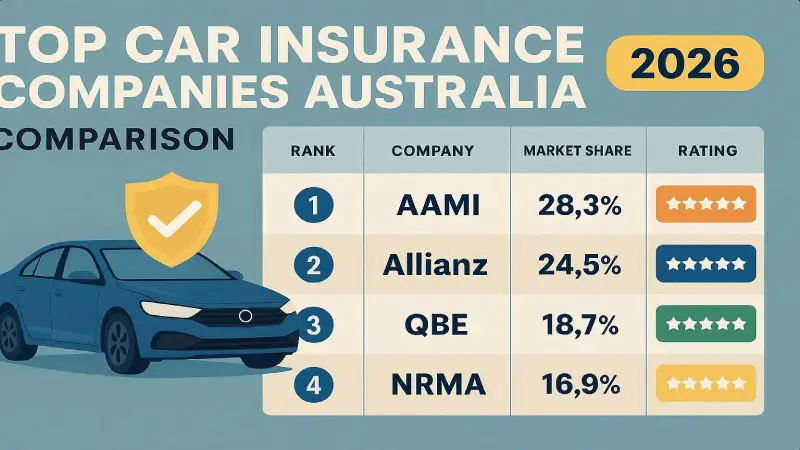
🏆 Top 8 Best Car Insurance Companies Australia 2026
| # | Provider | Avg Annual Premium | Claims Rating | Best For | On Comparison Sites? |
|---|---|---|---|---|---|
| 🥇 1 | Budget Direct | AU$1,020–$1,480 | ⭐⭐⭐⭐ | Best price — most profiles | ✅ Yes |
| 🥈 2 | Youi | AU$940–$1,380 | ⭐⭐⭐⭐⭐ | Low mileage · Young drivers · Pay-as-you-drive | ❌ Direct only |
| 🥉 3 | NRMA Insurance | AU$1,180–$1,720 | ⭐⭐⭐⭐⭐ | NSW/ACT/QLD · Best claims · New car replacement | ✅ Yes |
| 4 | AAMI | AU$1,080–$1,560 | ⭐⭐⭐⭐ | Loyalty · Multi-policy · Strong app | ✅ Yes |
| 5 | RACV / RAA / RAC / RACT | AU$1,120–$1,680 | ⭐⭐⭐⭐⭐ | State members · Best member benefits | ❌ Direct only |
| 6 | Allianz Australia | AU$1,240–$1,840 | ⭐⭐⭐⭐ | Agreed value · Premium cover · Rental car | ✅ Yes |
| 7 | Woolworths Insurance | AU$960–$1,420 | ⭐⭐⭐ | Everyday Rewards members · Value pricing | ❌ Direct only |
| 8 | Bingle | AU$680–$980 | ⭐⭐⭐ | Absolute cheapest · Basic comprehensive cover | ⚠️ Sometimes |
📋 Types of Car Insurance in Australia — Which Do You Need?

Compulsory Third Party (CTP) Insurance
CTP insurance — known as a "Green Slip" in NSW — is legally mandatory for all registered vehicles in Australia. It covers personal injury claims from people injured in accidents involving your vehicle. CTP is not purchased from general car insurers — in most states it is purchased from state-approved providers as part of vehicle registration. CTP does not cover damage to vehicles, property, or your own injuries. Every type of additional car insurance listed below is optional (though strongly recommended) and purchased separately from CTP.
Third Party Property Damage (TPPD)
TPPD is the most basic voluntary car insurance — it covers damage your vehicle causes to other people's property (vehicles, fences, buildings, etc.) but does not cover any damage to your own vehicle. TPPD is the right choice when: your vehicle has low market value and is not worth insuring for its own damage; you cannot afford comprehensive cover; and you primarily drive in low-risk conditions. Average annual cost: AU$280–$580 depending on driver profile and vehicle.
Third Party Fire and Theft
An upgrade on TPPD — adds coverage for damage to your own vehicle from fire or theft, in addition to the TPPD coverage. Still does not cover accident damage to your own vehicle. Average annual cost: AU$380–$720. Best for older vehicles in medium-value ranges where comprehensive cover is not cost-effective but theft and fire risk is a concern.
Comprehensive Car Insurance
Comprehensive cover is the most complete form of car insurance — covering damage to your vehicle from any cause (accidents, weather events, vandalism, theft), plus damage your vehicle causes to other people's property. All eight providers in our ranking offer comprehensive cover, which is what Australians typically mean when they say "car insurance." Average annual cost: AU$1,020–$1,840 for standard comprehensive, depending on insurer, state, vehicle, and driver profile.
Market Value vs Agreed Value
Within comprehensive cover, you typically choose between market value (insurer pays what your car was worth at the time of the claim, less depreciation) and agreed value (you and the insurer agree on a specific payout amount at policy inception, locked in regardless of depreciation). Agreed value costs 10–20% more but eliminates valuation disputes at claim time — particularly valuable for new or near-new vehicles where depreciation is steep in the first two years. NRMA, Allianz, and Youi offer the strongest agreed value options in our 2026 ranking.
🔍 Full Provider Reviews — Top 8 Detailed 2026
1. Budget Direct — Best Overall for Competitive Pricing
Budget Direct is consistently the most price-competitive major comprehensive car insurer in Australia for standard driver profiles — a position it has held continuously since 2019. Owned by Auto & General Holdings (backed by Goldman Sachs Private Equity), Budget Direct operates as a direct-to-consumer insurer with no agent commissions, keeping operational costs — and therefore premiums — below agent-based competitors like NRMA and AAMI. Budget Direct's comprehensive policies include: new-for-old vehicle replacement for vehicles under 2 years old, hire car cover after an accident or theft, emergency accommodation cover, and comprehensive Australia-wide coverage.
Budget Direct's pricing advantage is most pronounced for good-credit, clean-record drivers in standard metropolitan areas. In rural and regional areas, the price difference versus state motoring clubs narrows or reverses. Their claims process is fully digital but slower for complex claims than NRMA's — average straightforward claim settlement is 8–14 days. For drivers whose primary criterion is lowest premium, Budget Direct is the starting-point benchmark against which all other quotes should be measured.
- ✅ Consistently cheapest or near-cheapest for standard profiles
- ✅ Comprehensive cover with all standard features included
- ✅ Direct-to-consumer model keeps premiums low
- ❌ No physical offices — all digital and phone service
- ❌ Slower complex claims than NRMA
- ❌ Less competitive in rural and regional areas
2. Youi — Best for Low-Mileage and Usage-Based Pricing
Youi is the most innovative car insurer in Australia and the most frequently overlooked by comparison site users — because Youi does not appear on any major comparison platform. Youi's pricing model is fundamentally different from all other Australian car insurers: rather than using demographic proxies (age, gender, postcode) as the primary pricing factors, Youi asks detailed personal questions about your actual driving habits, daily routines, where you park overnight, how you use your vehicle, and your actual annual mileage. This hyper-personalised pricing model produces quotes that can be dramatically cheaper than competitors for low-risk profiles that standard demographic models overcharge — and more expensive for high-risk profiles that standard models undercharge.
Youi's KiloMeter product takes usage-based pricing further — it calculates your premium based on your actual annual mileage, reviewed annually. Drivers who cover under 10,000 km/year can save 25–40% versus standard comprehensive pricing. For urban professionals who work from home and drive fewer than 8,000 km/year, Youi's KiloMeter policy is frequently the cheapest comprehensive cover available in Australia — by a significant margin. You must call or visit youi.com.au directly to get a Youi quote.
- ✅ Best for low-mileage drivers — KiloMeter product saves 25–40%
- ✅ Hyper-personalised pricing rewards genuinely low-risk drivers
- ✅ 5-star claims satisfaction (FAIRER Finance 2025)
- ✅ Available nationwide
- ❌ Not on comparison sites — direct quote required
- ❌ May be expensive for high-mileage or high-risk profiles
- ❌ Quoting process is longer (more questions) than standard
3. NRMA Insurance — Best Claims Service in NSW/ACT/QLD
NRMA Insurance (National Roads and Motorists' Association Insurance, underwritten by IAG) is the market leader in NSW, ACT, and Queensland — not just by market share but by customer satisfaction. NRMA's claims service is the benchmark for the industry: their 24/7 emergency response, nationwide network of accredited repairers, and total loss settlement process consistently receive the highest customer satisfaction ratings of any Australian car insurer. Their new-for-old vehicle replacement (for vehicles under 2 years old that are written off) is available as standard — not just as an add-on. NRMA's premiums are above Budget Direct and Youi — but for drivers in NSW, ACT, and QLD who value claims quality and want a strong relationship with Australia's most trusted motoring brand, NRMA's premium is justified.
- ✅ Best claims service in NSW/ACT/QLD
- ✅ New-for-old replacement standard (under 2 years)
- ✅ 24/7 emergency assistance Australia-wide
- ✅ Largest accredited repairer network in eastern Australia
- ❌ Premiums above Budget Direct and Youi
- ❌ Primarily strong in NSW/ACT/QLD — less dominant elsewhere
4. AAMI — Best for Loyal Multi-Policy Holders
AAMI (Australian Associated Motor Insurers, underwritten by Suncorp) is one of Australia's most recognised car insurance brands. AAMI's multi-policy discount — available when you hold home and car insurance together — is among the most generous in the market, and their digital app for policy management and claims lodgement receives consistently positive reviews. AAMI's premiums are competitive in most states but not the cheapest for single-policy holders. The value proposition improves significantly when bundling — AAMI's combined home + car pricing is frequently competitive with Budget Direct's standalone car pricing for eligible homeowners.
- ✅ Strong multi-policy (home + car) bundle discount
- ✅ Good app and digital claims experience
- ✅ 24/7 claims lodgement available
- ✅ Australia-wide coverage and repairer network
- ❌ Not the cheapest for standalone car insurance
- ❌ Best pricing requires multi-policy bundle
5. State Motoring Clubs — Best for Members in Their States
Australia's state-based motoring clubs — RACV (Victoria), RAA (South Australia), RAC (Western Australia), NRMA (NSW/ACT), RACT (Tasmania), and AANT (Northern Territory) — collectively represent one of the best-value car insurance options available, particularly for existing members. Member discounts of 10–20% apply to insurance premiums, and the clubs' integration with roadside assistance creates a seamless emergency experience that standard insurers cannot replicate. For drivers who are already club members — or who find that joining a club plus purchasing their insurance produces a lower total cost than a commercial insurer — the motoring club option is frequently the most competitive available. None of the major comparison sites include motoring clubs in their results, meaning millions of Australians never see these quotes in their comparisons.
- ✅ Best member benefits (roadside assistance + insurance in one)
- ✅ Strong local claims networks in each state
- ✅ Competitive pricing with member discounts
- ✅ Best option in regional/rural areas of their states
- ❌ Geographic limitation — each club operates in its own state
- ❌ Not on comparison sites — direct quote required
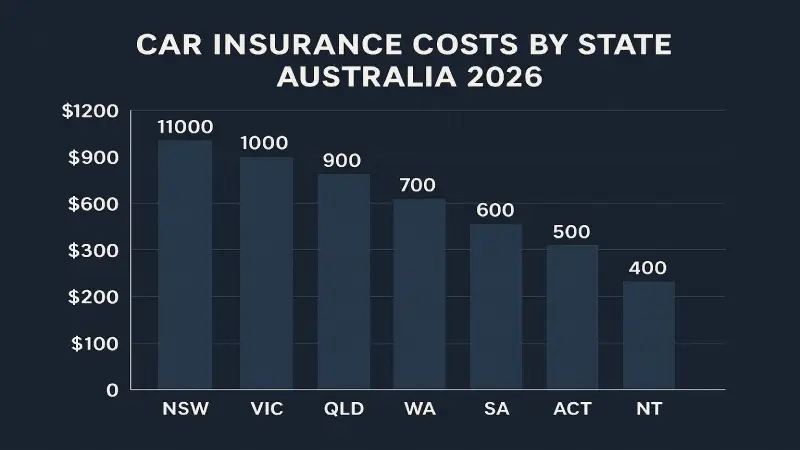
💰 Average Car Insurance Costs by State Australia 2026
| State | Avg Comprehensive 2026 | Change vs 2025 | Primary Risk Driver | Cheapest Insurer |
|---|---|---|---|---|
| NSW | AU$1,680/yr 🔴 | +12% | CTP structure · High repair costs · Theft | Budget Direct / Youi |
| QLD | AU$1,580/yr 🔴 | +16% | Hail · Cyclone · Flood risk | Budget Direct / Bingle |
| VIC | AU$1,420/yr | +11% | Dense urban · High repair costs | RACV / Budget Direct |
| WA | AU$1,380/yr | +10% | Long distances · Moderate risk | RAC / Budget Direct |
| SA | AU$1,240/yr | +9% | Lower density · Moderate risk | RAA / Budget Direct |
| ACT | AU$1,320/yr | +13% | High-value vehicles · Hailstorm risk | NRMA / Budget Direct |
| TAS | AU$1,080/yr 🟢 | +7% | Low density · Low severe weather risk | RACT / Budget Direct |
| NT | AU$1,820/yr 🔴 | +15% | Remote · Limited competition · Cyclone | AAMI / NRMA |
What Drives Your Individual Premium
Vehicle: Make, model, year, engine size, safety rating, and theft rate all directly affect your premium. Luxury vehicles, high-performance cars, and models with expensive spare parts cost significantly more to insure. A Toyota Camry in the same suburb as a BMW 3 Series will attract a premium 35–60% lower. Driver age and experience: Under-25 drivers pay 50–120% above average due to statistical claim rates. The premium reduces progressively with clean-record years of experience. Postcode: Your suburb's theft rate, traffic density, and weather exposure are reflected in suburb-level pricing adjustments that can differ by AU$200–$500 for identical profiles in adjacent suburbs. Annual mileage: Insurers are increasingly using self-declared or telematics-verified mileage as a pricing factor — particularly relevant for Youi's KiloMeter product. Claims history: Any at-fault claim in the past 5 years increases your premium, typically by 15–35% at the at-fault insurer and 10–25% when moving to a new insurer.
📋 Claims Satisfaction — Who Pays Fast and Fairly in Australia 2026

| Insurer | FAIRER Finance Rating 2025 | AFCA Complaints (relative) | Avg Straightforward Claim | Overall Claims |
|---|---|---|---|---|
| Youi | ⭐⭐⭐⭐⭐ (5/5) | Below average — very low | 6–10 days | 🏆 Best overall |
| NRMA | ⭐⭐⭐⭐⭐ (5/5) | Below average — low | 5–9 days | 🏆 Best in NSW/QLD |
| Budget Direct | ⭐⭐⭐⭐ (4/5) | Average | 8–14 days | Good for simple claims |
| AAMI | ⭐⭐⭐⭐ (4/5) | Average | 7–12 days | Good — strong repairer network |
| RACV/RAA/RAC | ⭐⭐⭐⭐⭐ (5/5) | Below average — low | 5–8 days | Best in their states |
| Allianz | ⭐⭐⭐⭐ (4/5) | Average | 9–15 days | Good — strongest for agreed value |
| Woolworths Insurance | ⭐⭐⭐ (3/5) | Above average ⚠️ | 10–18 days | Adequate — below industry average |
| Bingle | ⭐⭐⭐ (3/5) | Above average ⚠️ | 10–20 days | Basic — appropriate for basic cover |
Youi's 5-star FAIRER Finance rating for claims is the most important data point in this table. For a direct-to-consumer insurer that is cheaper than many mainstream competitors, achieving the highest claims satisfaction in the market is a remarkable combination. NRMA's 5-star rating confirms its market-leading position in claims quality for NSW, ACT, and Queensland. The motoring clubs consistently perform above average — reflecting their integration of insurance with roadside assistance and their local knowledge of repair networks in their states.
🚗 Best Car Insurance for Young Drivers Australia 2026
Young drivers under 25 face the highest car insurance premiums in Australia — often 50–120% above the rates paid by equivalent 35-year-olds with identical vehicles and postcodes. This premium reflects the statistical reality of elevated claim rates in the under-25 cohort. However, the price differential between the most expensive and cheapest insurer for a young driver can exceed AU$1,200/year for identical cover — making insurer selection even more financially consequential for young drivers than for older ones.
Best Options for Young Australian Drivers
Youi is consistently one of the most competitive insurers for young drivers — because its personalised questioning process allows genuinely low-risk young drivers (those who drive short distances, primarily daytime, in low-risk areas) to escape the demographic penalty that standard actuarial models impose. A 21-year-old who drives 6,000 km/year, parks in a secure garage, and works from home will receive a dramatically better Youi quote than from Budget Direct or NRMA, which price primarily on age demographics.
Adding to a parent's policy is frequently the cheapest option for young drivers who primarily use a shared family vehicle. Most Australian insurers allow young drivers to be listed as additional drivers on a parent's policy at significantly lower total cost than a separate young-driver policy. The trade-off: any claim the young driver makes affects the parent's no-claims discount.
Higher excess = lower premium — For young drivers on tight budgets, selecting a higher excess (the amount you pay toward any claim) dramatically reduces the annual premium. Moving from a AU$750 standard excess to a AU$2,500 voluntary excess can reduce a young driver's comprehensive premium by 20–35%. This strategy makes sense only if the young driver has savings to cover the excess in an emergency.
Third Party Property Damage — For young drivers with older, lower-value vehicles (under AU$8,000 market value), comprehensive cover may not be economically rational. The annual comprehensive premium for a high-risk young driver insuring an older vehicle can approach or exceed the vehicle's value within 2–3 years. TPPD protects other people's property — the young driver's legal obligation — without paying to insure their own lower-value vehicle.
🔋 Best for Low-Mileage Drivers — Youi's Pay-As-You-Drive

Youi's KiloMeter product is the most significant innovation in Australian car insurance in the past decade. The product works simply: you declare your expected annual mileage at policy inception, Youi sets a premium based on that mileage tier, and at renewal you report your actual mileage. If you drove less than declared, you receive a partial refund. If you drove more, a surcharge applies.
Youi KiloMeter Mileage Tiers and Approximate Savings (2026)
| Annual Mileage | KiloMeter Premium (approx) | Standard Comprehensive (approx) | Saving |
|---|---|---|---|
| Under 5,000 km | AU$620–$840 | AU$1,080–$1,480 | AU$300–$640 🔥 |
| 5,000–10,000 km | AU$780–$1,080 | AU$1,080–$1,480 | AU$200–$400 |
| 10,000–15,000 km | AU$980–$1,240 | AU$1,080–$1,480 | AU$100–$240 |
| 15,000–20,000 km | AU$1,120–$1,480 | AU$1,080–$1,480 | Minimal or no saving |
The KiloMeter advantage is most powerful for: remote workers and work-from-home professionals, retirees and semi-retired drivers, second-vehicle owners in multi-car households, and urban residents who rely primarily on public transport. For any driver covering under 10,000 km/year, a direct Youi quote should be obtained alongside any comparison site results — because Youi's KiloMeter pricing will almost always be lower than what comparison sites return for equivalent comprehensive cover.
💡 How to Save on Car Insurance Australia 2026 — 8 Proven Strategies
1. Never auto-renew — compare every year
Australian car insurers consistently offer their most competitive rates to new customers. ASIC data from 2025 found that policyholders who had not compared in the previous two years were paying an average of AU$280 more than comparable new customers at the same insurer. The loyalty penalty is real and institutionalised. Set a calendar reminder 6 weeks before your renewal date each year. Use it to run a full comparison before deciding to renew or switch.
2. Get a Youi direct quote every time
Youi does not appear on any comparison site. Every year, before finalising any insurance decision, visit youi.com.au directly for a quote. The 5–10 additional minutes of questioning that Youi's process requires consistently reveal potential savings that comparison sites completely miss — particularly for low-mileage, low-risk drivers.
3. Check your state motoring club
If you are not already a member of your state motoring club (RACV, RAA, RAC, NRMA, RACT, AANT), calculate whether membership cost plus the insured premium produces a lower total than your best comparison-site quote. Member discounts of 10–20% plus the roadside assistance benefits frequently make club membership an economically rational choice even purely on the insurance economics.
4. Choose market value cover for older vehicles
Agreed value cover costs 10–20% more than market value cover. For vehicles more than 5–7 years old, the agreed value premium differential typically exceeds the practical benefit of having a fixed, predictable payout. Review your vehicle's current market value annually — if your comprehensive premium represents more than 10–15% of your vehicle's current market value, consider whether comprehensive cover remains economically rational or whether TPPD is more appropriate.
5. Increase your excess to reduce your premium
Moving from a standard AU$750 excess to a AU$2,000–$2,500 voluntary excess can reduce premiums by 15–30%. For drivers with a clean claims history who are confident they can cover the excess in an emergency, this is straightforward expected-value mathematics: the annual premium savings typically exceed the excess increase within 2–4 claim-free years. Do not choose an excess you cannot realistically afford to pay — the purpose of the insurance is undermined if the excess renders you financially unable to make a legitimate claim.
6. Bundle home and car insurance
Most major Australian insurers offer 5–15% discounts when you insure both home and car together. AAMI, NRMA, Allianz, and Budget Direct all offer meaningful bundle pricing. For homeowners who purchase both policies from the same insurer, the bundle discount frequently makes a slightly more expensive insurer the most economical overall choice. Always request a bundled quote alongside individual policy quotes.
7. Pay annually, not monthly
Paying your premium monthly attracts an effective interest rate of 8–16% annually at most Australian insurers — because the total of 12 monthly payments typically exceeds the annual lump-sum premium by this percentage. If your cash flow permits, paying annually consistently reduces your effective premium cost. The savings are typically AU$60–$180 per year compared to monthly payment for a standard comprehensive policy.
8. Declare your accurate annual mileage
Most Australian insurers ask for your estimated annual mileage during quoting. Underestimating this figure to reduce your quoted premium creates a risk: if you claim and the insurer determines you were driving significantly more than declared, they may reduce your claim payout proportionally. Accurately declare your actual mileage — and if you drive less than 15,000 km/year, specifically investigate Youi's KiloMeter product, which can transform your mileage from a vague quoted figure into a genuine pricing advantage.
🎯 How to Compare Car Insurance in Australia — Expert Strategy 2026
The optimal comparison strategy for Australian car insurance requires checking more sources than most drivers realise — because the major comparison sites miss several of the most competitive providers. Here is the complete expert process:
Step 1 (5 min): Use ASIC Moneysmart to determine the right cover type for your vehicle value and financial situation — comprehensive, TPPF, or TPPD. This decision should be made objectively before any commercial quoting.
Step 2 (8 min): Run iSelect for your panel's quotes. Screenshot the top 3 results with premiums, excesses, and key features. For a detailed review of iSelect's strengths and limitations, see our guide: iSelect Car Insurance Review Australia 2026.
Step 3 (8 min): Run Compare the Market simultaneously. Note any providers that appear on Compare the Market but not iSelect — each platform covers slightly different panels.
Step 4 (10 min): Get a direct Youi quote at youi.com.au. This is the most important step that most Australian drivers skip entirely.
Step 5 (5 min): Get a direct quote from your state motoring club (RACV, RAA, RAC, NRMA, RACT, or AANT).
Step 6 (5 min): Compare all quotes on identical coverage terms (same excess level, same cover type, same optional extras). Select the insurer with the best combination of price and claims quality for your profile.
Step 7 (5 min): If your preferred option is a comparison site provider, visit the insurer's direct website and confirm whether a direct quote is identical to or lower than the comparison site result. Purchase directly if it reduces your cost.
❓ Frequently Asked Questions — Best Car Insurance Australia 2026
What is the best car insurance in Australia in 2026?
The best car insurance in Australia in 2026 depends on your driver profile. For most standard drivers, Budget Direct offers the most competitive comprehensive premiums and is the benchmark starting point for any comparison. Youi is best for low-mileage drivers (under 10,000 km/year) and often produces the cheapest quotes for personalised risk profiles — but requires a direct quote since Youi does not appear on comparison sites. NRMA is best for claims quality in NSW, ACT, and Queensland. State motoring clubs (RACV, RAA, RAC, RACT) are best for members in their respective states. The only way to identify the best option for your specific profile is to compare across at least four sources: two comparison platforms, Youi direct, and your state motoring club.
How much is car insurance in Australia per year in 2026?
Average comprehensive car insurance in Australia costs approximately AU$1,490 per year in 2026 — up 14% from 2024. State averages range from AU$1,080 (Tasmania) to AU$1,820 (Northern Territory). NSW and Queensland average AU$1,580–$1,680 due to CTP structure and severe weather exposure. Individual premiums vary significantly based on your vehicle, age, postcode, annual mileage, and claims history. The cheapest available comprehensive policy for a good-driver profile in most mainland states is AU$680–$1,020 with Bingle or Budget Direct. The most expensive mainstream comprehensive policy for the same profile is AU$1,680–$2,000+ with some regional or specialised insurers.
Is Youi a good car insurer in Australia?
Yes — Youi is one of the best car insurers in Australia in 2026, receiving a 5-star FAIRER Finance rating for claims (2025) and consistently ranking among the most competitive for low-mileage and low-risk driver profiles. Youi's personalised pricing model rewards genuinely low-risk drivers who are systematically overcharged by standard demographic-based pricing models. Its KiloMeter pay-as-you-drive product can save low-mileage drivers (under 10,000 km/year) AU$200–$640 per year versus standard comprehensive cover. The main limitation is that Youi does not appear on any major comparison site — you must visit youi.com.au directly. The longer quoting process (more personalised questions) is worth the additional 5–10 minutes.
Is comprehensive car insurance worth it in Australia?
For most Australian drivers with vehicles worth more than AU$8,000–$10,000, comprehensive car insurance is worth the premium. The key calculation: if your annual comprehensive premium is less than 10–15% of your vehicle's current market value, comprehensive cover represents reasonable economic value. If it exceeds this threshold — typically for older, lower-value vehicles — TPPD or TPPF may be more economically rational. Beyond the pure economics, comprehensive insurance provides important non-financial benefits: you do not need to fund your own vehicle repairs from savings after a non-fault accident (your insurer recovers from the at-fault party), and you are protected from theft, natural disasters, and vandalism. For drivers who cannot afford to replace their vehicle out-of-pocket without insurance proceeds, comprehensive cover is prudent regardless of the strict economic calculation.
How do I find the cheapest car insurance in Australia?
To find the cheapest car insurance in Australia, compare across at least four sources: (1) run iSelect for its panel of partners; (2) run Compare the Market for its panel; (3) get a direct quote from Youi at youi.com.au — Youi does not appear on any comparison site; and (4) check your state motoring club's direct rates. Additionally, consider increasing your excess to reduce premiums, choosing market value cover for older vehicles, paying annually rather than monthly, and declaring accurate low mileage if you drive under 15,000 km/year. The single biggest saving most Australian drivers can achieve is switching from auto-renewing with their current insurer to actively comparing every year — ASIC data shows the average loyalty penalty is AU$280/year for non-comparing policyholders.
What is the difference between market value and agreed value car insurance?
Market value car insurance pays you what your car was worth in the open market at the time of a total loss claim — taking into account age, condition, mileage, and depreciation. This can result in a payout lower than expected, particularly for vehicles that have depreciated significantly since purchase. Agreed value insurance sets a fixed payout amount agreed between you and the insurer at policy inception — you know exactly what you would receive if your car were written off, regardless of market depreciation. Agreed value costs approximately 10–20% more than market value cover. It is most valuable for new vehicles (where depreciation in the first 1–2 years is steep), classic or collectible vehicles (where market value may be disputed), and drivers who want certainty in their financial outcome. For vehicles more than 5 years old in standard condition, the agreed value premium premium is often not economically justified.
✅ Final Verdict — Best Car Insurance Australia 2026
Budget Direct is the best starting-point insurer for most Australian drivers — consistently cheapest for standard profiles, with solid coverage and adequate claims service. Youi is the most important non-comparison-site insurer — always get a direct quote, especially if you drive under 15,000 km/year or have a genuinely low-risk profile that standard demographics penalise. NRMA is the best claims service insurer in NSW, ACT, and Queensland. State motoring clubs are best for members in their respective states — particularly in regional and rural areas. Allianz is best for agreed value and premium features.
Whatever insurer you choose: compare every renewal, check Youi directly every time, and never auto-renew without getting at least three competing quotes. For understanding comparison site limitations in Australia, see our detailed guide on iSelect car insurance review Australia 2026. For international car insurance comparison, see our guides on best auto insurance USA 2026 and Allstate vs Geico vs Progressive vs State Farm 2026.
Disclaimer: This article is for informational purposes only and does not constitute financial advice. All premium ranges are approximate market averages based on publicly available data — individual quotes vary significantly by driver profile, vehicle, location, and insurer underwriting. FAIRER Finance ratings from 2025 report. Always read the PDS before purchasing. Nexuora is not affiliated with any insurer listed. Updated April 21, 2026.

Ahmada Ndao is a financial research analyst and independent journalist
specializing in US consumer finance, legal rights, and insurance markets.
With over 5 years covering American financial products, he has helped
thousands of readers navigate complex insurance decisions, find the right
legal representation, and optimize their credit strategies. His research
methodology combines primary data analysis, direct outreach to industry
professionals, and continuous monitoring of federal regulatory changes.
Ahmada’s work has been cited by financial communities across the US and
reviewed by licensed attorneys and insurance professionals for accuracy.