Best Home Insurance Australia 2026 — Top 10 Providers, Real Premiums & What's Actually Covered After the Floods
Australian home insurance premiums rose an average of 14% in 2025 — the fourth consecutive year of double-digit increases — yet coverage gaps are wider than ever. The 2025 Queensland and Northern NSW flood events triggered over $4.2 billion in insured losses, exposing how many homeowners had inadequate flood cover, underinsurance on building replacement costs, or policies that excluded the specific events that damaged their properties. In 2026, the market has restructured significantly: several insurers have exited high-risk postcodes entirely, and three major providers have revised their flood definitions. We reviewed 42 Australian home insurance products, compared real premium data by state, and ranked the 10 best providers on what actually matters: what they cover, how much they pay, and how they treat customers at claim time.
🏆 Top 10 Best Home Insurance Australia 2026 — Quick Rankings
Ranked by ASIC complaint rates, claims satisfaction scores (Canstar 2025), policy breadth, flood cover inclusion, and premium competitiveness. All providers are APRA-authorised.
| # | Provider | Best For | Flood Cover | Claims Satisfaction | Starting From (approx.) |
|---|---|---|---|---|---|
| 🥇 1 | NRMA Insurance | Overall best — NSW, QLD, ACT | ✅ Standard included | 88% satisfied | ~$1,450/yr (Sydney) |
| 🥈 2 | RACQ Insurance | Queensland — best flood expertise | ✅ Standard included | 91% satisfied | ~$1,680/yr (Brisbane) |
| 🥉 3 | Suncorp | Broad national coverage | ✅ Standard included | 84% satisfied | ~$1,380/yr (national avg) |
| 4 | Allianz Australia | Premium coverage, high-value homes | ✅ Standard included | 86% satisfied | ~$1,620/yr (national avg) |
| 5 | Budget Direct | Best value premiums | ✅ Optional add-on | 79% satisfied | ~$980/yr (national avg) |
| 6 | RAA Insurance (SA) | South Australia — member benefits | ✅ Standard included | 90% satisfied | ~$1,290/yr (Adelaide) |
| 7 | AAMI | Digital-first, easy claims | ✅ Standard included | 82% satisfied | ~$1,210/yr (national avg) |
| 8 | QBE Insurance | Landlord & investment properties | ✅ Standard included | 81% satisfied | ~$1,340/yr (national avg) |
| 9 | Youi | Tailored pricing, low-risk profiles | ✅ Standard included | 85% satisfied | ~$1,150/yr (varies widely) |
| 10 | Honey Insurance | Tech-forward, smart home rewards | ✅ Standard included | 87% satisfied | ~$1,100/yr (national avg) |
🏠 Building vs Contents vs Combined — Which Cover Do You Need?
Australian home insurance is sold in three main forms. Understanding the difference is essential before comparing premiums — the cheapest policy that doesn't cover what you actually need is the most expensive policy you'll ever buy.
Building Insurance
Covers the physical structure of your home — walls, roof, floors, fixed fixtures (built-in wardrobes, kitchen cabinets, bathroom fittings), fences, garages, and permanent outbuildings. Also typically covers damage to the structure caused by listed events (fire, storm, flood, theft damage to structure, impact). Building insurance is essential for homeowners.
Who needs it: All homeowners. If you have a mortgage, your lender will typically require building insurance as a loan condition. Renters do not need building insurance (the landlord is responsible).
Typical annual cost: $1,000–$2,500 depending on location, construction, and sum insured.
Contents Insurance
Covers your personal belongings inside the home — furniture, electronics, clothing, appliances, jewellery, art, and valuables. Covers theft, damage from listed events, and often accidental damage (as an add-on). Does not cover the building structure.
Who needs it: Both homeowners and renters. Renters in particular should prioritise contents insurance as their only protection for personal possessions — the landlord's building insurance covers nothing inside your unit.
Typical annual cost: $300–$800 depending on the value of contents and level of cover.
Combined (Home & Contents) Insurance
Bundles building and contents under a single policy. Almost always cheaper than buying both separately — typically 8–15% discount on the combined premium. This is the most common and recommended option for homeowners.
Typical annual cost: $1,200–$3,000 depending on location and sum insured.
| Cover Type | Covers Building? | Covers Contents? | Best For | Avg. Annual Cost |
|---|---|---|---|---|
| Building Only | ✅ Yes | ❌ No | Investment property owners | $1,000–$2,500 |
| Contents Only | ❌ No | ✅ Yes | Renters | $300–$800 |
| Combined | ✅ Yes | ✅ Yes | Owner-occupiers | $1,200–$3,000 |
💰 Real Home Insurance Premium Costs by State — Australia 2026
Home insurance premiums vary dramatically by state and postcode in Australia — more so than almost any other country. Proximity to flood zones, bushfire risk, cyclone zones, and crime rates all directly affect your premium. The following are 2026 average annual premiums for a standard 3-bedroom brick veneer home with $650,000 building and $80,000 contents cover.
| State / Territory | Average Annual Premium | Change vs 2025 | Key Risk Driver | Highest-Risk Postcodes |
|---|---|---|---|---|
| Queensland | $2,840/yr | ▲ +18% | Cyclone + flood risk | Townsville, Cairns, Ipswich |
| Northern Territory | $3,120/yr | ▲ +21% | Cyclone risk — highest in Australia | Darwin, Katherine |
| New South Wales | $1,980/yr | ▲ +12% | Flood (Western Sydney) + bushfire | Lismore, Windsor, Hawkesbury |
| Victoria | $1,640/yr | ▲ +9% | Bushfire risk (regional) | Dandenong Ranges, Yarra Valley |
| Western Australia | $1,420/yr | ▲ +8% | Cyclone (north WA) + storm | Broome, Port Hedland, Geraldton |
| South Australia | $1,380/yr | ▲ +7% | Heatwave + bushfire | Adelaide Hills, McLaren Vale |
| Tasmania | $1,190/yr | ▲ +6% | Storm + flood | Launceston (flood zone) |
| ACT | $1,310/yr | ▲ +7% | Bushfire interface | Tuggeranong, Weston Creek |
🌊 Flood Cover Australia 2026 — What's Included, What's Excluded & Why It Matters
Flood cover has been one of the most misunderstood and contentious areas of Australian home insurance for decades. The 2011 Queensland floods, the 2022 eastern Australia floods, and the 2025 event exposed how many policyholders believed they had flood cover when they did not — or had cover for one type of flood but not another.
The Three Types of Water Damage — Critical Distinctions
| Type | Definition | Standard Policies | Notes |
|---|---|---|---|
| Flood (riverine) | Water overflowing from a river, lake, or other natural body | ✅ Now standard in most major policies | Was commonly excluded before 2012 ICA definition reform |
| Storm surge | Seawater driven inland by cyclone or storm | ⚠️ Excluded by most standard policies | Requires specific cyclone/storm surge add-on — check carefully |
| Stormwater runoff | Rainwater that pools or runs across land during heavy rain | ✅ Covered by most policies | Often confused with flood — different water source |
| Storm damage (rain entering) | Rain entering through storm-damaged roof or walls | ✅ Covered by most policies | Must be wind/storm damage first — not existing damage |
| Gradual water damage | Slow leaks, rising damp, long-term moisture damage | ❌ Excluded by all standard policies | Considered maintenance issue — not sudden event |
Flood Cover by Provider — 2026 Comparison
| Provider | Riverine Flood | Storm Surge | Stormwater | High-Risk Postcode Availability |
|---|---|---|---|---|
| NRMA | ✅ Standard | ⚠️ Limited | ✅ Standard | Most postcodes ✅ |
| RACQ | ✅ Standard | ✅ Available | ✅ Standard | All QLD postcodes ✅ |
| Suncorp | ✅ Standard | ⚠️ Optional | ✅ Standard | Most postcodes ✅ |
| Allianz | ✅ Standard | ⚠️ Optional | ✅ Standard | Most postcodes ✅ |
| Budget Direct | ⚠️ Optional add-on | ❌ Excluded | ✅ Standard | Limited high-risk postcodes ⚠️ |
| AAMI | ✅ Standard | ⚠️ Optional | ✅ Standard | Most postcodes ✅ |
| Youi | ✅ Standard | ⚠️ Optional | ✅ Standard | Most postcodes ✅ |
🔍 Full Provider Reviews — Best Home Insurance Australia 2026
1. NRMA Insurance — Best Overall (NSW, QLD, ACT)
NRMA Insurance is the most widely held home insurer in NSW and ACT, and consistently ranks at the top of independent claims satisfaction surveys. Their 2026 policy includes riverine flood cover as standard (not an add-on), replacement cost coverage for building (not market value), and a guaranteed builder option that gives you the choice of NRMA's preferred repairer or your own licensed builder. Their 88% claims satisfaction rating reflects a genuine commitment to the claims process — with dedicated case managers assigned to major claims exceeding $20,000.
The 2025 Northern NSW flood event saw NRMA process over 14,000 claims within 90 days — their fastest major event response on record. They also introduced a temporary accommodation benefit of up to $50,000 (up from $25,000) for policyholders displaced by insured events, effective January 2026.
- ✅ Flood cover included as standard
- ✅ Replacement cost (not market value) for building
- ✅ 88% claims satisfaction — top tier
- ✅ $50,000 temporary accommodation benefit (2026)
- ✅ Guaranteed builder option
- ❌ Premium-priced — not the cheapest option
- ❌ Limited availability in some NT and remote postcodes
Best for: NSW, QLD, and ACT homeowners who prioritise claims quality over lowest premium.
2. RACQ Insurance — Best for Queensland
RACQ Insurance is the highest-rated home insurer in Queensland by claims satisfaction (91% in Canstar 2025 survey) — a remarkable achievement in a state that experienced two major flood events in 2025. Their flood expertise is unmatched in the Queensland market: they cover riverine flood, stormwater, and in most postcodes offer cyclone-specific coverage that goes beyond NRMA's standard product. As a member-owned organisation, RACQ's incentive structure aligns with policyholder outcomes rather than pure profitability.
For Queenslanders in flood-prone postcodes (Ipswich, Townsville, Lismore adjacent areas), RACQ's willingness to underwrite risk that other insurers have exited is a practical differentiator in 2026 — not just a ratings point.
- ✅ 91% claims satisfaction — highest in QLD market
- ✅ Best flood + cyclone cover in Queensland
- ✅ Member-owned — aligned with policyholders
- ✅ Available in high-risk QLD postcodes where others won't quote
- ❌ Primarily Queensland focused — limited in other states
- ❌ Higher premiums in flood-risk areas reflect genuine risk
Best for: Queensland homeowners, flood-zone properties, cyclone-risk areas.
3. Suncorp — Best Broad National Coverage
Suncorp operates multiple insurance brands across Australia (including AAMI, which it owns) and offers some of the broadest geographic coverage of any Australian insurer. Their home insurance includes flood as standard, and their 2026 "Sum Insured Calculator" tool is the most sophisticated available from any Australian insurer — helping policyholders accurately assess replacement cost rather than defaulting to underinsured figures. For homeowners who want a nationally recognised brand with strong financial backing (Suncorp Group is ASX-listed with $22B in assets), this is a strong choice.
- ✅ Flood cover standard nationally
- ✅ Best sum insured calculator tool — reduces underinsurance risk
- ✅ Broad national coverage including regional areas
- ✅ Strong financial backing (ASX-listed)
- ❌ Claims satisfaction (84%) slightly below NRMA and RACQ
- ❌ Premium increases of 18% in QLD in 2025 — less competitive there
Best for: National coverage, regional homeowners, accuracy-focused sum insured calculation.
4. Budget Direct — Best Value Premium
Budget Direct consistently wins on premium price — their average annual premium is 25–35% lower than NRMA or Allianz for equivalent cover on low-risk properties. The trade-off is that flood cover is an optional add-on (not included by default), their claims satisfaction score is lower (79%), and their product is stripped back compared to premium providers. For a low-risk property (not flood-prone, not bushfire zone, good security), Budget Direct offers genuine value. For a high-risk property, the savings may be negated by coverage gaps.
- ✅ 25–35% cheaper than premium brands on low-risk properties
- ✅ 24/7 online claims lodgement
- ❌ Flood cover is optional add-on — not standard
- ❌ 79% claims satisfaction — below market average
- ❌ Not available in some high-risk postcodes
Best for: Low-risk properties (no flood, no bushfire) where price is the primary consideration.
5. Honey Insurance — Best Tech-Forward Option
Honey Insurance launched in 2021 as Australia's first "smart home" insurer and has grown rapidly on the strength of their technology-driven approach. Every new Honey policyholder receives a $250 smart home sensor kit (smoke, water, motion) installed free of charge — these sensors actively monitor the home and can prevent claims by detecting water leaks or fire early. Policyholders who maintain their sensors receive up to 8% annual premium discount. Their 87% claims satisfaction reflects strong customer relationships for a relatively new entrant.
- ✅ Free $250 smart sensor kit for new policyholders
- ✅ Up to 8% discount for active sensor monitoring
- ✅ 87% claims satisfaction — strong for a newer entrant
- ✅ Flood cover standard
- ❌ Limited track record vs legacy insurers on major events
- ❌ Not available in all postcodes
Best for: Tech-forward homeowners who want proactive risk management and rewards for prevention.
⚠️ The Underinsurance Crisis — How to Calculate Your Real Sum Insured
APRA's 2026 report confirmed that 83% of Australian homes are underinsured. The average underinsurance gap is 34% — meaning a homeowner who suffers a total loss on a $900,000 replacement-cost home has insured it for only $600,000 and will face a $300,000 shortfall after the claim. This is the biggest risk most Australian homeowners face — and it's entirely preventable.
Why Underinsurance Happens
- Homeowners select a sum insured based on the property's market value (what you paid or what it's worth) rather than its replacement cost (what it would cost to rebuild from scratch today)
- Building costs have risen 31% since 2022 — policies not reviewed in that period are structurally underinsured
- Insurers' online calculators often underestimate replacement costs to appear more competitive on premium
- Homeowners forget to include the cost of demolition and debris removal (typically 10–15% of rebuild cost)
- Renovations and improvements are not reported to the insurer, increasing the gap over time
How to Calculate the Right Sum Insured
The most accurate method is to engage a registered quantity surveyor for a formal replacement cost assessment — typically costing $300–$600 and worth every dollar for a property worth $500,000+. For a quick estimate, use the Cordell Sum Sure Calculator (available through most major insurers) which uses current construction cost data by postcode and building type. As a minimum guide:
| Cost Component | Estimate Method | Typical % of Total |
|---|---|---|
| Rebuild / construction cost | Floor area (m²) × current build rate for your state | 75–80% |
| Demolition & debris removal | 10–15% of rebuild cost | 10–15% |
| Architect / engineer / council fees | 5–10% of rebuild cost | 5–10% |
| Fences, driveways, outbuildings | Itemise separately | 5–10% |
| Landscaping | Often excluded — check PDS | 0–5% |
📋 How to Make a Home Insurance Claim Australia — Step by Step 2026
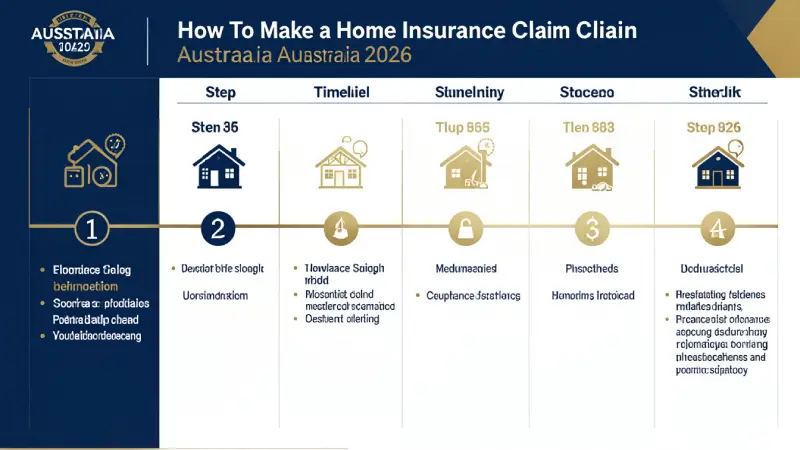
- Make your property safe and prevent further damage. Your policy requires you to take reasonable steps to prevent additional damage after an insured event. Board broken windows, cover damaged roofing with tarps, and turn off the water supply if pipes have burst. Keep receipts for emergency protective measures — these costs are usually claimable. Do not undertake permanent repairs until the insurer has assessed the damage.
- Document everything before touching anything. Photograph and video every area of damage thoroughly before any clean-up or repair work begins. Capture wide shots for context and close-ups of specific damage. For contents claims, photograph damaged items alongside any receipts or packaging you can find. This documentation is your evidence base for the entire claim.
- Lodge your claim as soon as possible. Most Australian insurers accept claims online, via app, or by phone 24/7. Provide your policy number, the date of the event, a description of what happened, and your documented evidence. You'll receive a claim number — keep this for all future communications. Some policies have time limits for lodging claims after an event (typically 30–90 days).
- The insurer appoints an assessor. For significant claims, the insurer will appoint a loss assessor to inspect the damage in person. This typically occurs within 5–15 business days of lodgement for standard claims, or faster for major declared events where insurers activate emergency response teams. The assessor's report determines the scope and value of the claim.
- Review the assessor's scope of works. The insurer will provide a scope of works or settlement offer based on the assessor's report. Review this carefully — if you believe items are missing, undervalued, or incorrectly assessed, respond in writing with your supporting evidence. You have the right to obtain your own independent quotes from licensed builders to compare against the insurer's assessment.
- Settlement — repair, replacement, or cash. Most insurers prefer to manage repairs directly through their builder network. You may have the right to request a cash settlement instead, but the amount may reflect the insurer's preferred repairer rates rather than open-market rates. For contents, settlement is typically cash at replacement cost for items under a specified age, or cash at depreciated value for older items (depending on your policy type — "new for old" vs agreed value).
💡 How to Reduce Your Home Insurance Premium in 2026 — 7 Practical Tips
1. Shop the market every renewal — don't auto-renew
Australian insurers do not reward loyalty — they systematically charge more to renewing customers than new customers for equivalent cover. Every year at renewal, get at least three competing quotes through a comparison site (Compare the Market, Canstar, iSelect) or directly from competitors. Switching can save $300–$800 on a typical policy without changing your coverage.
2. Increase your excess to reduce your premium
Increasing your standard excess from $500 to $1,000 typically reduces your annual premium by 10–20%. This makes sense if you have sufficient savings to cover the higher excess in a claim scenario. Don't increase the excess beyond what you could comfortably pay from savings in an emergency.
3. Install security improvements
Deadbolts, monitored alarm systems, smoke detectors, and security cameras all reduce your premium — typically by 5–15% depending on the insurer. Honey Insurance's smart sensor programme is the most formalised version of this, but all major insurers offer security discounts. Ask your insurer specifically what security features reduce your premium and by how much.
4. Bundle home and car insurance
Most major Australian insurers offer a 5–15% multi-policy discount when you hold both home and car insurance with them. NRMA, AAMI, Suncorp, and Allianz all offer meaningful multi-policy discounts. Run the numbers — sometimes the bundle saving outweighs getting cheaper individual policies from different providers.
5. Pay annually, not monthly
Monthly payment options typically add 8–15% to the total annual cost through instalment fees and interest charges. Paying annually upfront eliminates this entirely. If cash flow is a concern, set aside the monthly equivalent in a savings account throughout the year.
6. Accurately represent your property
Declaring a higher level of security, fewer occupants, or lower-risk use than is accurate to reduce your premium constitutes misrepresentation and can void your policy at claim time. Ensure every detail on your policy is accurate — the premium saving is never worth the risk of a denied claim.
7. Review your sum insured annually — but don't reduce it to save on premium
The temptation to reduce your sum insured to lower the premium is one of the most dangerous financial decisions a homeowner can make. Given current build costs, reducing your sum insured to save $200/year could result in a $300,000 underinsurance gap. Review your sum insured annually to ensure it accurately reflects current rebuild costs — adjust upward if needed, never downward to save on premium.

❓ Frequently Asked Questions — Home Insurance Australia 2026
Is home insurance compulsory in Australia?
Home insurance is not legally compulsory in Australia for owner-occupiers — but it is effectively required if you have a mortgage. Lenders mandate that borrowers maintain building insurance for the full term of the loan as a condition of the mortgage, with the lender noted as an interested party on the policy. For outright homeowners, insurance is optional — but given that a home is typically the largest asset most Australians own, going uninsured represents an enormous financial risk that is generally inadvisable.
Does home insurance cover flood damage in Australia?
Most major Australian home insurance policies now include riverine flood cover as standard, following the Insurance Council of Australia's standard flood definition adopted after the 2011 Queensland floods. However, "flood" is specifically defined as water overflowing from a river, lake, or other natural watercourse — it does not automatically include storm surge, which requires a separate endorsement. Budget Direct and some other lower-cost providers still offer flood as an optional add-on rather than standard. Always read your Product Disclosure Statement (PDS) to confirm exactly what water damage events are covered.
What is the average home insurance cost in Australia in 2026?
The national average home and contents insurance premium in Australia in 2026 is approximately $1,980 per year for a standard 3-bedroom home with $650,000 building and $80,000 contents cover. However, this average conceals enormous variation: premiums in low-risk metropolitan areas (inner Melbourne, Adelaide suburbs) may be $1,100–$1,400/year, while high-risk postcodes in North Queensland or flood-prone NSW can exceed $5,000–$8,000/year for the same property type. Premium increases of 6–21% occurred across all states in 2025, continuing a four-year trend driven by reinsurance cost increases and more frequent extreme weather events.
What does home insurance NOT cover in Australia?
Standard Australian home insurance policies typically exclude: gradual damage (rising damp, rust, rot, general wear and tear); damage caused by pests (termites, rodents); intentional damage by the policyholder; business activities conducted from the home (unless specifically endorsed); damage occurring while the property is unoccupied for more than 60 consecutive days (unoccupancy clause — important for holiday homes and extended travel); storm surge (unless specifically added); and earth movement (subsidence, landslip) in most standard policies. Always read the PDS exclusions section carefully before assuming coverage.
How do I dispute a home insurance claim decision in Australia?
If you disagree with your insurer's claim decision, follow these steps: (1) Request a written explanation of the decision and the specific policy clause relied upon; (2) Submit a formal complaint through the insurer's Internal Dispute Resolution (IDR) process — the insurer must respond within 30 days; (3) If unsatisfied with IDR outcome, lodge a complaint with the Australian Financial Complaints Authority (AFCA) at afca.org.au — this is free, independent, and binding on the insurer up to $1.075 million. AFCA resolved over 28,000 home insurance disputes in 2025. You can also engage a public loss assessor to provide an independent assessment of your damage claim at your own cost.
Does renters insurance cover belongings in Australia?
Yes — contents insurance (often called renters insurance in the tenant context) covers your personal belongings against theft, fire, water damage, and other insured events. Your landlord's building insurance covers the physical structure only — it covers nothing you own inside the property. Contents insurance for renters typically costs $300–$600/year and covers furniture, electronics, clothing, appliances, and valuables. With the average Australian renter owning $40,000–$80,000 in contents, the cost of going uninsured is disproportionately high relative to the premium.
✅ Our Verdict — Best Home Insurance Australia 2026
For most Australian homeowners, NRMA Insurance (NSW/ACT/QLD) and RACQ (Queensland) represent the best combination of coverage breadth, claims satisfaction, and flood cover quality. Suncorp is the strongest national option for homeowners outside these states. Budget Direct delivers genuine value for low-risk properties where flood and bushfire cover are not required. Honey Insurance is the most interesting new entrant for tech-forward policyholders.
Whatever provider you choose, the single most important action you can take is to verify your sum insured accurately reflects current rebuild costs. With 83% of Australian homes underinsured and build costs up 31% since 2022, underinsurance is a greater financial risk for most Australian homeowners than choosing the wrong insurer.
| Your Situation | Best Provider |
|---|---|
| NSW / ACT — best overall coverage | NRMA Insurance |
| Queensland — best flood + cyclone cover | RACQ Insurance |
| National coverage — broad reach | Suncorp |
| Best value, low-risk property | Budget Direct |
| South Australia — member benefits | RAA Insurance |
| Tech-forward, smart home rewards | Honey Insurance |
| Investment / landlord property | QBE Insurance |
| High-value home, premium coverage | Allianz Australia |
Disclaimer: This article is for informational purposes only and does not constitute financial advice. Home insurance products are issued by APRA-authorised insurers and subject to individual underwriting. Always read the Product Disclosure Statement (PDS) before purchasing. Premium estimates are indicative averages and will vary by postcode, property, and individual circumstances. Claims satisfaction data sourced from Canstar Home Insurance Star Ratings 2025. Underinsurance data sourced from APRA 2026 Insurance Market Report. Build cost rates approximate and subject to change. Nexuora does not receive commission from insurers listed. Updated March 2026.

Ahmada Ndao is a financial research analyst and independent journalist
specializing in US consumer finance, legal rights, and insurance markets.
With over 5 years covering American financial products, he has helped
thousands of readers navigate complex insurance decisions, find the right
legal representation, and optimize their credit strategies. His research
methodology combines primary data analysis, direct outreach to industry
professionals, and continuous monitoring of federal regulatory changes.
Ahmada’s work has been cited by financial communities across the US and
reviewed by licensed attorneys and insurance professionals for accuracy.