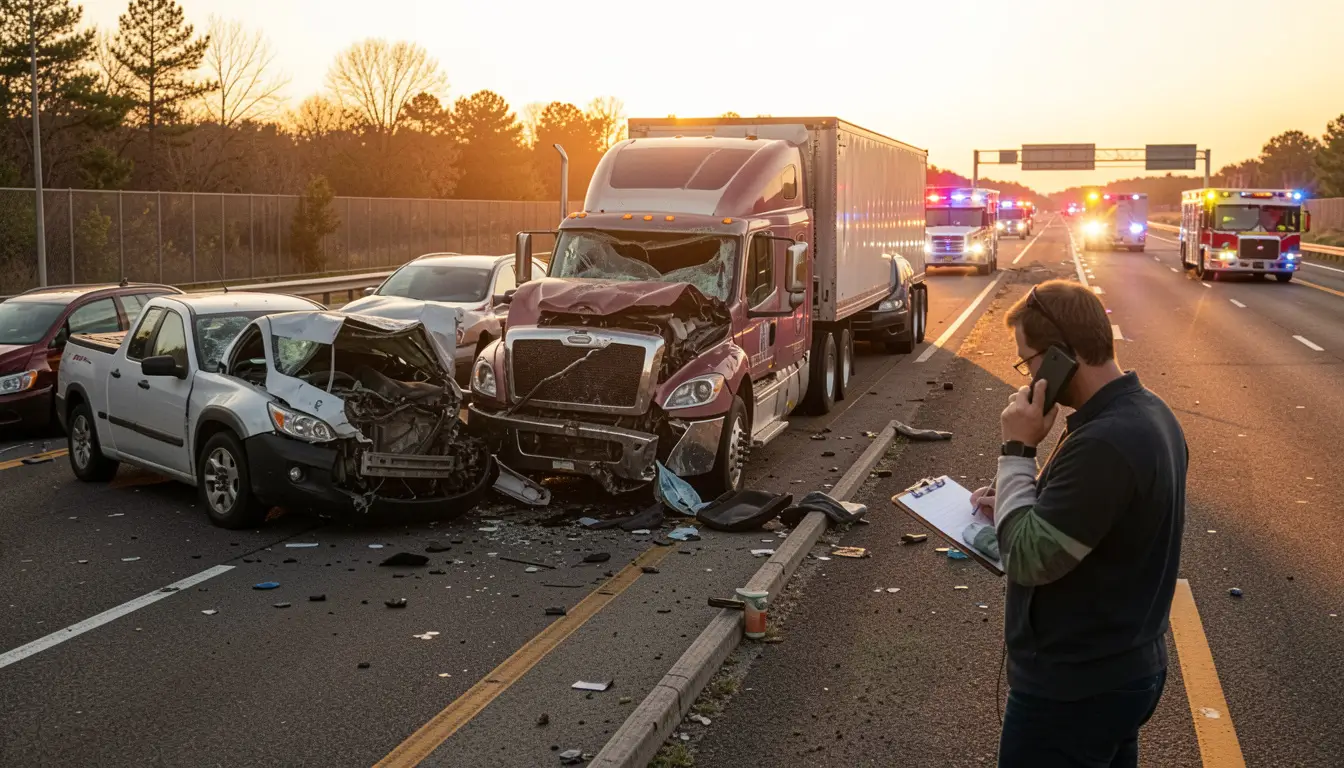
What to Do After a Truck Accident — The First 72 Hours (2026 Guide)
The 72 hours after a truck accident are the most legally critical of your entire case. Evidence disappears. Trucking companies deploy accident response teams within hours of a crash — before you've even left the hospital. Insurance adjusters call injured victims within 24 hours, trying to lock in low settlements before you understand the extent of your injuries. Electronic logging device (ELD) data, black box recordings, and dashcam footage can be overwritten or legally destroyed within days. If you were involved in a commercial truck accident in 2026 and you don't act strategically in the first 72 hours, you may permanently compromise a claim worth hundreds of thousands — or millions — of dollars. This guide tells you exactly what to do, hour by hour.
🚨 Hour 0–1: At the Scene — What to Do Immediately
✅ Step 1 — Call 911 Immediately
Call 911 regardless of how minor the accident seems. A police report is essential documentation for your legal claim — without it, the trucking company's insurer will dispute how the accident occurred. Request that an officer comes to the scene even if the truck driver tries to convince you it's unnecessary. Adrenaline often masks serious injuries — what feels like a minor impact can cause injuries that manifest hours or days later.
✅ Step 2 — Do Not Move Your Vehicle Unless You Are in Immediate Danger
Your vehicle's position relative to the truck documents the point of impact and direction of travel — critical for accident reconstruction. Only move vehicles if you are blocking traffic and law enforcement directs you to do so. If you must move, photograph the final resting positions of all vehicles first.
✅ Step 3 — Document Everything at the Scene
If you are physically able, use your smartphone to capture:
- The truck's license plate, DOT number (on the cab door), MC number, and company name
- The truck driver's license, CDL number, and insurance information
- The truck's VIN number and trailer identification number
- Damage to both vehicles from multiple angles
- Skid marks, road conditions, debris field, traffic signals, and signage
- Weather conditions and lighting
- Your injuries — photograph every visible injury at the scene
- Any dashcam footage from your vehicle before it loops and overwrites
✅ Step 4 — Get Witness Information
Get the full name, phone number, and email address of every witness at the scene — before they leave. Witnesses who see accidents firsthand are critical — but they disappear quickly and become almost impossible to find later. Don't assume the police will collect this information comprehensively.
✅ Step 5 — Limit What You Say to the Truck Driver
Exchange insurance and contact information, but do not discuss fault. Do not say "I'm sorry," "I didn't see you," or anything that could be interpreted as an admission of liability. The truck driver's company is monitoring the situation — anything you say may be reported and used against you.
✅ Step 6 — Seek Medical Attention — Even If You Feel Fine
Go to the emergency room or urgent care immediately after the accident — even if you feel no pain. Whiplash, traumatic brain injuries, internal bleeding, and soft tissue injuries frequently have delayed onset. More importantly: a gap between the accident and your first medical visit is the #1 argument trucking company insurers use to deny injury claims, arguing your injuries were caused by something else after the accident.
⏱ Hours 1–24: Medical, Documentation & Legal
✅ Step 7 — Get a Complete Medical Evaluation
At the hospital or urgent care, tell the treating physician about every symptom — no matter how minor. Neck stiffness, headache, back pain, dizziness, blurred vision, numbness, emotional distress — document all of it with the treating physician. Ask for a full written record of your examination and any imaging (X-ray, CT, MRI). Request copies of all records before you leave.
If you are discharged and symptoms worsen in the following 24–48 hours — which is common for whiplash and TBI — return for additional evaluation. Each medical visit creates a documented timeline of your injuries.
✅ Step 8 — Write Down Everything You Remember
Within the first few hours of leaving the scene — while your memory is sharpest — write a detailed account of exactly what happened. Include: what you were doing immediately before the accident, the direction and speed of both vehicles, the weather and road conditions, what you heard and felt, the exact sequence of events, and everything said at the scene. Memory degrades rapidly — this written account becomes a critical reference for your attorney and can be used to establish consistency in your account if the case goes to litigation.
✅ Step 9 — Notify Your Own Insurance Company
Report the accident to your own insurance company promptly — most policies require this within 24–72 hours. However, provide only the basic facts: date, location, vehicles involved, police report number. Do not give a recorded statement to your own insurer without consulting an attorney first — even your own insurer has interests that may not align with yours in a high-value truck accident claim.
✅ Step 10 — Do NOT Give a Recorded Statement to the Trucking Company's Insurer
Within hours of the accident, you may receive a call from the trucking company's insurance adjuster. They will be friendly and sympathetic — and they will ask for a recorded statement. Decline. Politely but firmly. You have no legal obligation to provide a recorded statement to a third-party insurer. These statements are used by claims adjusters to identify inconsistencies, admissions of partial fault, and minimise your claimed injuries. Say: "I have retained (or am in the process of retaining) legal representation and will be directing all communications through my attorney."
✅ Step 11 — Contact a Truck Accident Attorney
Contact a truck accident attorney within the first 24 hours. Most offer free consultations and work on contingency. The earlier your attorney is engaged, the faster they can send a legal hold letter demanding the trucking company preserve all evidence — a critical step that can prevent the destruction of black box data, ELD records, and maintenance logs. Evidence that is not legally preserved within the first 48–72 hours may be legally destroyed under the trucking company's routine data retention policies.
⏳ Hours 24–72: Evidence Preservation & Attorney Engagement
✅ Step 12 — Your Attorney Sends a Spoliation Letter Immediately
The first action your truck accident attorney takes is sending a spoliation letter (evidence preservation demand) to the trucking company, their insurance carrier, and any other potentially liable parties. This letter legally requires them to preserve:
- Electronic Logging Device (ELD) data — hours of service, driving time, rest breaks for the 7 days before the accident
- Event Data Recorder (EDR / "black box") data — speed, braking, steering, seatbelt status in the seconds before impact
- Dashcam and forward-facing camera footage from the truck
- Driver qualification file — CDL, medical certification, training records, drug test history
- Vehicle maintenance records — pre-trip inspection logs, maintenance history, any recent repairs
- Driver's trip log and dispatch records
- All communications between the driver and dispatch before and after the accident
- The driver's cell phone records
- Any internal accident investigation reports
Once a spoliation letter is received, the trucking company is legally prohibited from destroying this evidence. Without the letter, they can — and often do — allow this data to be overwritten under routine data retention policies within 30 days.
✅ Step 13 — Begin Your Medical Treatment Plan
Follow every medical recommendation from your treating physicians — without exception. Do not miss appointments. Do not stop treatment because you feel better or because you're busy. Insurance adjusters review medical records in detail: any gaps in treatment or non-compliance with medical advice is used to argue your injuries are less serious than claimed or that you failed to mitigate your damages.
✅ Step 14 — Document Your Damages Ongoing
From day one, keep a daily journal documenting: pain levels (1–10), activities you cannot perform, how your injuries are affecting your work and personal life, emotional impacts, and all out-of-pocket expenses. Keep every receipt — medical, transportation, medications, home assistance, lost income documentation. This contemporaneous record is powerful evidence of non-economic damages (pain and suffering, loss of enjoyment) that would otherwise be difficult to quantify.
✅ Step 15 — Identify All Potentially Liable Parties
Truck accident liability is frequently more complex than standard car accidents. Your attorney will investigate all potentially liable parties, which may include:
- The truck driver — individual negligence (speeding, distraction, fatigue, impairment)
- The trucking company — employer vicarious liability, negligent hiring, inadequate training, pressure to violate hours of service
- The cargo loading company — if improperly loaded or secured cargo contributed to the accident
- The truck manufacturer or parts manufacturer — if a mechanical defect (brake failure, tire blowout) caused or contributed to the accident
- The maintenance contractor — if negligent maintenance caused a mechanical failure
- A third-party driver — if another vehicle contributed to the crash
Identifying all liable parties is critical — each additional defendant may carry their own insurance policy and increase the total compensation available to you.
🚫 What NOT to Do After a Truck Accident
These mistakes are made by thousands of truck accident victims every year — and each one can cost tens of thousands of dollars in lost compensation:
- Don't accept a quick settlement from the trucking company's insurer. Early settlement offers — made before you know the full extent of your injuries — are almost always dramatically lower than the true value of your claim. Once you sign a release, you cannot reopen the claim even if your injuries prove more serious than initially apparent.
- Don't give a recorded statement to any insurance company without consulting your attorney first. Not the truck company's insurer. Not your own insurer. Not on the phone, not in writing.
- Don't post about the accident on social media. Insurance companies and defense attorneys actively monitor plaintiffs' social media for posts that contradict injury claims. A photo of you at a social event, a post saying you're "doing fine," or any activity inconsistent with your claimed injuries can devastate your case.
- Don't miss medical appointments or stop treatment early. Every gap in your medical treatment record is ammunition for the defense.
- Don't delay contacting an attorney. Every day of delay is a day the trucking company's legal team has more time to build their defense, preserve only the evidence that helps them, and exploit any procedural deadlines you might miss.
- Don't sign any document from the trucking company without legal review. This includes any "release of liability," "authorization to obtain medical records," or any other document. Medical authorizations in particular can be drafted so broadly that they give insurers access to your entire medical history — which they then use to find pre-existing conditions to blame for your injuries.
- Don't repair or sell your vehicle before it's inspected. Your vehicle is evidence. The damage pattern to your car is used by accident reconstruction experts to establish speed, angle of impact, and force — all critical to establishing the severity of the accident and the extent of your injuries.
🏢 What the Trucking Company Is Doing Right Now
Understanding what is happening on the other side of your claim in the first 72 hours is critical context for why immediate action is non-negotiable.
Within 1 Hour of the Accident
- The truck driver notifies their dispatcher, who immediately contacts the carrier's safety department and legal team
- The carrier's insurance company is notified and begins assigning a claims adjuster
- The carrier's "accident response" team — which may include their own investigators, attorneys, and accident reconstruction specialists — is often mobilised immediately
Within 6 Hours of the Accident
- The carrier's accident response team arrives at the scene (before police investigation is complete in many cases) to document conditions favourably for the defense
- The truck's black box data is downloaded and secured by the carrier's team — this data belongs to the carrier until a legal hold prevents its destruction
- The driver is coached by company representatives on what to say and what not to say
- The carrier's attorney is reviewing the driver's ELD and hours-of-service records for compliance — and identifying any violations they need to manage
Within 24 Hours
- The insurance adjuster calls you — appearing friendly and concerned, asking for a recorded statement and offering an initial settlement figure
- Social media monitoring for your profiles begins
- The carrier's investigators may approach witnesses before your attorney has an opportunity to
- The carrier's legal team begins building their defense narrative — contributory negligence, pre-existing conditions, alternative causation
🔬 Critical Evidence in Truck Accident Cases — What Exists & How Long It Lasts
| Evidence Type | What It Shows | Retention Period | How to Preserve |
|---|---|---|---|
| ELD (Electronic Logging Device) data | Hours driven, rest breaks, HOS violations | 6 months (FMCSA) — but overwritten sooner | Spoliation letter within 48 hours |
| Event Data Recorder (black box) | Speed, braking, steering, seconds before impact | 30 days — then overwritten | Spoliation letter + court order within 72 hours |
| Dashcam / forward-facing camera | What the driver saw before impact | 24–72 hours — looping overwrite | Immediate spoliation demand — most urgent |
| Driver cell phone records | Distracted driving — calls, texts at time of crash | 60–90 days (carrier) / 1 year (carrier) | Subpoena via attorney |
| Driver qualification file | CDL, medical cert, drug tests, driving history | 3 years (FMCSA regulation) | Discovery request after filing |
| Vehicle maintenance records | Brake condition, tire wear, inspection history | 1 year (FMCSA) but often longer | Discovery after filing |
| Scene evidence (skid marks, debris) | Speed, direction, point of impact | Days to weeks — weather dependent | Your photographs + attorney's investigator |
| Traffic / business CCTV | Third-party view of accident | 24–72 hours — looping overwrite | Immediate written request to business owners |
| Cargo / loading records | Weight, distribution, securement compliance | 1 year (FMCSA) | Discovery after filing |
💰 Truck Accident Settlement Amounts USA 2026
Truck accident cases settle for significantly higher amounts than standard car accident cases — reflecting the greater mass and destructive force of commercial trucks, the regulatory complexity of trucking law, and the typically larger insurance policies carried by commercial carriers.
| Injury Severity | Unrepresented (avg) | Represented (avg) | High-End Range |
|---|---|---|---|
| Minor (soft tissue, short recovery) | $18,000–$35,000 | $65,000–$150,000 | $200,000+ |
| Moderate (fractures, surgery required) | $45,000–$90,000 | $180,000–$450,000 | $600,000+ |
| Serious (back/spinal, TBI, multiple fractures) | $85,000–$180,000 | $500,000–$1,500,000 | $3,000,000+ |
| Catastrophic (paralysis, amputation, severe TBI) | $250,000–$500,000 | $1,500,000–$5,000,000 | $10,000,000–$50,000,000+ |
| Wrongful death | $350,000–$800,000 | $1,000,000–$5,000,000 | $10,000,000+ |
What Determines Your Settlement Amount
- Severity and permanence of injuries — the primary driver of settlement value
- Lost income and future earning capacity — past lost wages plus expert projection of future lost earnings
- Medical expenses — past and projected future treatment costs
- FMCSA violations — hours-of-service violations, maintenance failures, or CDL violations significantly increase value through punitive damages exposure
- Number of liable defendants — more defendants means more insurance policies and higher total available compensation
- Jurisdiction — venue matters significantly; some jurisdictions are more plaintiff-friendly than others
- Quality of legal representation — the attorney's willingness and ability to go to trial is the most powerful leverage in settlement negotiations
⚖️ How to Choose a Truck Accident Lawyer — 5 Non-Negotiable Criteria
1. Truck accident specialisation — not general personal injury
Truck accident litigation requires specific expertise in FMCSA regulations, hours-of-service rules, ELD data interpretation, black box analysis, and trucking company insurance structures. A general personal injury attorney who occasionally handles truck cases is not equivalent to a firm that does this exclusively. Ask: "What percentage of your cases involve commercial truck accidents?" The answer should be significant — not "some."
2. Willingness and ability to go to trial
The trucking company's insurer knows which plaintiff attorneys will settle for any amount and which will take cases to trial. Attorneys with genuine trial records receive higher settlement offers because defendants know there is real risk of a jury verdict. Ask for specific trial verdicts in truck accident cases — not settlements, verdicts.
3. Resources to handle litigation costs
Truck accident litigation is expensive — accident reconstruction experts, medical experts, FMCSA compliance experts, and depositions can cost $50,000–$150,000 before trial. A law firm with limited financial resources may pressure you to settle for less than your case is worth to avoid ongoing litigation costs. Ask: "Do you advance all case costs, and will you take this case to trial if a fair settlement is not offered?"
4. Track record with trucking company defendants specifically
Large trucking companies and their insurance carriers are represented by specialized defense firms who know every plaintiff attorney by reputation. An attorney who has successfully litigated against major carriers (Werner, J.B. Hunt, Swift, XPO) has specific relationship and reputation capital in that defense community that translates to better settlement positions.
5. Contingency fee structure and costs clarity
Standard contingency fees for truck accident cases are 33% pre-litigation and 40% if the case goes to trial. Get the exact fee structure in writing, understand how litigation costs are treated, and confirm the fee arrangement before signing. Some firms charge 40% from day one — this is above standard for pre-litigation resolution.
❓ Frequently Asked Questions — Truck Accidents USA 2026
How long do I have to file a truck accident lawsuit?
The statute of limitations for truck accident personal injury claims varies by state — typically 2–3 years from the date of the accident. However, the statute of limitations is not the most critical deadline in a truck accident case. The preservation of electronic evidence (ELD data, black box, dashcam footage) has a practical deadline of 24–72 hours. The practical deadline for engaging an attorney and sending a spoliation letter is within the first 48 hours. Missing the statute of limitations permanently bars your claim — but losing critical electronic evidence in the first 72 hours can fatally weaken a claim you file within the statute. Both deadlines matter; the 72-hour evidence window is the more urgent.
Who is liable in a truck accident — the driver or the trucking company?
Both can be liable — and in most truck accident cases, the trucking company is the primary defendant because they have significantly deeper insurance coverage than the individual driver. The trucking company is liable under: (1) respondeat superior — employers are legally responsible for negligent acts of employees performed within the scope of employment; (2) negligent hiring — if the company hired a driver with a disqualifying record; (3) negligent entrustment — if the company allowed a driver to operate a vehicle they knew was unsafe; (4) negligent maintenance — if inadequate maintenance contributed to a mechanical failure. Additionally, the cargo owner, loading company, truck manufacturer, and maintenance contractor may be independently liable. An experienced truck accident attorney investigates all potential defendants simultaneously.
What is an ELD and why does it matter for my truck accident case?
An Electronic Logging Device (ELD) is a federally mandated device (required for most commercial trucks since December 2019) that automatically records a truck driver's hours of service — total driving time, duty status, location, and engine activity. ELD data is critical evidence in truck accident cases because it proves whether the driver violated federal hours-of-service regulations (maximum 11 hours driving time, mandatory rest breaks) at the time of the accident. Driver fatigue from HOS violations is one of the most common causes of serious truck accidents and, when proven, can support punitive damages claims that significantly increase the total value of your case. ELD data is typically stored for 6 months under FMCSA regulations but can be overwritten sooner — a spoliation letter sent within 48 hours is the critical legal mechanism to prevent its destruction.
Should I accept the trucking company's first settlement offer?
No — almost never. First settlement offers from trucking company insurers are made early, before the full extent of your injuries is known, before all liability evidence has been gathered, and before expert analysis of your economic damages has been completed. These offers are designed to resolve the claim cheaply before you understand what it is worth. For comparison: the average first offer on a moderate truck accident injury case is $45,000–$90,000. The average represented settlement for the same injury type is $180,000–$450,000 — 3–4× higher. Never sign a release without a lawyer reviewing the full value of your claim. Once signed, you cannot reopen the claim regardless of how your injuries progress.
Can I sue a trucking company if the driver was an independent contractor?
Yes — in most cases. Trucking companies frequently attempt to classify drivers as independent contractors to avoid vicarious liability. However, under FMCSA regulations, a motor carrier that permits a driver to operate under its authority is responsible for that driver's actions regardless of the employment classification. Courts have consistently held that the "independent contractor" label does not insulate carriers from liability when they exercise control over the driver's work. Additionally, if the driver is operating a truck owned by or leased to the carrier, the carrier is typically liable under the "statutory employee" doctrine. An experienced truck accident attorney will investigate the true nature of the driver-carrier relationship and identify all applicable liability theories.
What if I was partly at fault for the truck accident?
You can still recover compensation in most states even if you were partially at fault for the accident. Most US states follow a comparative negligence system: your compensation is reduced proportionally to your percentage of fault. For example, if you are found 20% at fault and your damages total $500,000, you receive $400,000. In "modified comparative negligence" states (the majority), you can recover as long as you are less than 50% or 51% at fault (depending on the state). Only in the few remaining "contributory negligence" states (Alabama, Maryland, North Carolina, Virginia, DC) does any fault on your part bar recovery entirely. Do not assume you cannot recover because the truck driver's insurer is blaming you — let an attorney assess the actual liability picture.
✅ The 72-Hour Checklist — Everything in One Place
Hour 0–1 (at the scene): Call 911 · Document everything · Get witness info · Limit conversation · Seek medical attention immediately
Hours 1–24: Full medical evaluation · Write your account · Notify your insurer (facts only) · Decline recorded statement to truck insurer · Contact a truck accident attorney
Hours 24–72: Attorney sends spoliation letter · Begin and follow all medical treatment · Start damages journal · Keep all receipts · Do not post on social media · Do not repair your vehicle
| Action | Deadline | Why It Matters |
|---|---|---|
| Photograph scene & injuries | Immediately | Scene changes within hours |
| Seek medical evaluation | Same day | Treatment gap = insurer argument |
| Contact truck accident attorney | Within 24 hours | Evidence preservation requires immediate legal action |
| Attorney sends spoliation letter | Within 48 hours | Dashcam/black box overwritten in 24–72 hrs |
| Decline recorded statement to insurer | Immediately & ongoing | Statements used to minimise your claim |
| Begin damages journal | Within 24 hours | Real-time record of pain & impact |
| No social media posts | Immediately & ongoing | Insurers monitor actively |
Disclaimer: This article is for informational purposes only and does not constitute legal advice. Truck accident law varies by state and individual circumstances. Always consult a licensed personal injury attorney in your state immediately following a commercial truck accident. Settlement figures are representative averages based on published industry data and do not guarantee specific outcomes. FMCSA regulations cited are current as of March 2026. Nexuora does not receive referral fees from any law firm. Updated March 2026.

Ahmada Ndao is a financial research analyst and independent journalist
specializing in US consumer finance, legal rights, and insurance markets.
With over 5 years covering American financial products, he has helped
thousands of readers navigate complex insurance decisions, find the right
legal representation, and optimize their credit strategies. His research
methodology combines primary data analysis, direct outreach to industry
professionals, and continuous monitoring of federal regulatory changes.
Ahmada’s work has been cited by financial communities across the US and
reviewed by licensed attorneys and insurance professionals for accuracy.