State Farm and GEICO are the two largest auto insurers in the United States — and in 2026, the pricing gap between them has widened significantly. This guide gives you the real monthly rates by driver profile, state-by-state premium comparisons, discount breakdowns, and a definitive answer to which insurer wins for your specific situation.
The short answer: GEICO is cheaper than State Farm for most drivers with clean records — saving the average American approximately $290 per year for equivalent full coverage. But State Farm wins decisively for teen drivers, local agent access, and post-accident claims quality. The right answer depends entirely on your profile.
For the full market landscape including Travelers, Amica, and Progressive: Best Car Insurance Companies USA 2026. For the three-way comparison: Progressive vs GEICO vs State Farm 2026.
Table of Contents
- State Farm vs GEICO 2026 Overview
- Average Monthly Rates — Full Coverage vs Minimum
- Rates by Driver Profile — Who Wins Each Category
- State-by-State Premium Comparison
- Discounts Comparison — What Each Carrier Actually Offers
- Telematics Programs: DriveEasy vs Drive Safe & Save
- Coverage Options Deep-Dive
- Claims Satisfaction and Customer Service
- Financial Strength and Stability
- Best for Teen and Young Drivers
- Best for Senior Drivers
- Best for Drivers With Tickets or Accidents
- Home + Auto Bundling
- Digital Experience and Mobile Apps
- FAQ
- Conclusion — Who Should Choose Which
State Farm vs GEICO 2026 Overview
State Farm is the largest auto insurer in the United States by market share, covering more vehicles than any other single carrier. GEICO is the second largest — and in 2026, has aggressively expanded its pricing advantage after completing a major digital restructuring that involved closing hundreds of local offices and investing heavily in algorithm-driven pricing models.
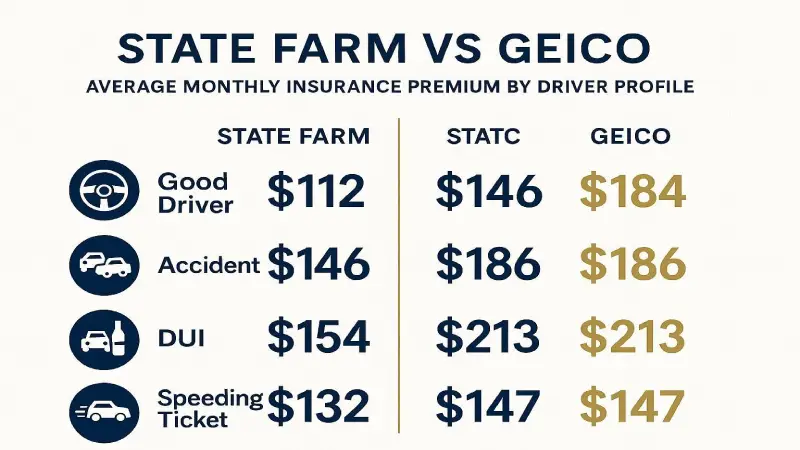
The competitive landscape in 2026 is materially different from 2024. State Farm raised rates in 22 states in 2025, pushing its national average full coverage premium to approximately $2,180 per year — a 9.4% increase from 2024. GEICO, meanwhile, has lowered its national average to approximately $1,890 per year following its restructuring. The gap between the two has widened to roughly $290 per year for the average driver on a comparable policy.
But averages are misleading. For specific driver profiles — teens, seniors, drivers with accidents, military members, rural drivers — the winner flips. Understanding which company wins for your specific situation is the entire point of this guide.
| Factor | State Farm | GEICO |
|---|---|---|
| Market Rank (US) | #1 by market share | #2 by market share |
| Avg Annual Full Coverage | ~$2,180/year | ~$1,890/year |
| Avg Monthly Full Coverage | ~$182/month | ~$158/month |
| Avg Annual Minimum Coverage | ~$636/year ($53/mo) | ~$960/year ($80/mo) |
| AM Best Financial Rating | A++ (Superior) | A++ (Superior) |
| J.D. Power Claims Score (2025) | 710/1,000 — #1 major carrier | 692/1,000 — Above average |
| Local Agent Network | 19,000+ agents nationwide | Limited — primarily digital |
| Telematics Program | Drive Safe & Save (up to 30%) | DriveEasy (up to 20%) |
| Number of Discounts | 12+ | 16+ |
| Best For | Teen drivers, claims quality, agents | Cheap rates, discounts, digital |
| Accident Forgiveness | No standalone option | Yes — available after 5 years |
| Rideshare Coverage | Available | Available |
| Rate Increase Post-DriveEasy | No — won’t raise rates | Yes — poor driving increases rates |
Critical 2026 update: GEICO’s DriveEasy telematics program can increase your rates if driving behavior is poor — unlike State Farm’s Drive Safe & Save, which never raises your premium above baseline. This asymmetry matters significantly for drivers who want telematics discounts without downside risk.
Average Monthly Rates — Full Coverage vs Minimum Coverage

The following figures represent national averages based on Q1–Q2 2026 quote data. Individual premiums vary by ZIP code, vehicle make and model, driving history, credit score (where applicable by state), and coverage selections.
Full Coverage Average Rates
| Driver Profile | State Farm | GEICO | Annual Difference |
|---|---|---|---|
| Good driver, good credit, age 35 | $115/mo | $152/mo | State Farm saves $444/yr |
| Good driver, good credit (national avg) | $182/mo | $158/mo | GEICO saves $288/yr |
| Driver with speeding ticket | $147/mo | $206/mo | State Farm saves $708/yr |
| Driver with DUI | $170/mo | $219/mo | State Farm saves $588/yr |
| Teen driver (age 16) | $237/mo | $269/mo | State Farm saves $384/yr |
| Senior driver (age 65+) | $47/mo (min) | $42/mo (min) | GEICO saves $60/yr |
| Driver with at-fault accident | ~$224/mo | ~$290/mo | State Farm saves $792/yr |
| Good driver, poor credit | ~$240/mo | ~$176/mo | GEICO saves $768/yr |
Minimum Coverage Average Rates
| Driver Profile | State Farm | GEICO | Cheaper Option |
|---|---|---|---|
| Good driver, age 35 | $53/mo | $80/mo | State Farm by $324/yr |
| Teen driver (age 16) | ~$128/mo | ~$108/mo | GEICO by $240/yr |
| Senior driver (age 65) | $47/mo | $42/mo | GEICO by $60/yr |
| Driver with DUI | $65/mo | $117/mo | State Farm by $624/yr |
| Driver with poor credit | ~$120/mo | ~$72/mo | GEICO by $576/yr |
Key insight: State Farm’s minimum coverage rates are dramatically lower than GEICO’s for clean-record drivers — $53 vs $80 per month. This reverses for high-risk drivers, where GEICO’s pricing is more favorable. The minimum coverage gap is one of the most underreported advantages State Farm holds in 2026.
For the most complete view of the market including Travelers — currently ranked #1 by NerdWallet in May 2026 — see our Best Car Insurance Companies USA 2026 ranking.
Rates by Driver Profile — Who Wins Each Category
Clean Record Drivers (35–55)
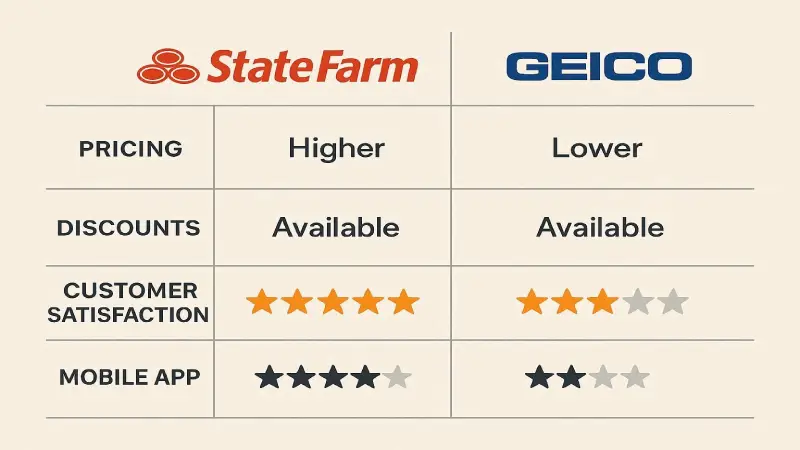
At the national average level, GEICO is cheaper for full coverage — saving approximately $288/year. However, the gap narrows or reverses in specific states and for specific vehicle types. Always get both quotes for your exact ZIP code.
Winner: GEICO (nationally, on average)
Teen Drivers (Age 16–19)
State Farm is significantly cheaper for teen drivers — $237/month versus GEICO’s $269/month for full coverage, a $384 annual difference. State Farm’s Steer Clear program specifically targets under-25 drivers with training modules and monitoring discounts that can further reduce this gap for completing drivers. GEICO offers no equivalent specialized young-driver program.
Winner: State Farm — clearly
Drivers With Speeding Tickets
State Farm is dramatically cheaper post-ticket: $147/month versus GEICO’s $206/month — a $708 annual difference. State Farm’s traditional underwriting is more lenient on moving violations than GEICO’s algorithmically-driven model, which weights violations heavily in its pricing formula.
Winner: State Farm — by a wide margin
Drivers With DUI/DWI
State Farm at $170/month versus GEICO at $219/month — a $588 annual difference. Both carriers insure DUI drivers, but State Farm’s more moderate post-DUI surcharge makes it the preferred choice for drivers working to rebuild their record. Note: some states require SR-22 filing, which both carriers handle.
Winner: State Farm
Drivers With At-Fault Accidents
State Farm maintains significantly lower premiums post-accident. GEICO’s algorithm aggressively prices accident history into premiums and does not offer accident forgiveness until drivers have been claim-free for 5 years. GEICO’s accident forgiveness program does exist but requires a long eligibility period to unlock.
Winner: State Farm
Drivers With Poor Credit
GEICO wins decisively for drivers with poor credit scores. State Farm’s credit score weighting can produce extremely high premiums for poor-credit drivers — sometimes doubling or tripling rates versus clean-credit equivalents. GEICO’s credit weighting, while present, is less extreme. Note: California, Hawaii, and Massachusetts prohibit credit-based pricing — in these states, this category is irrelevant.
Winner: GEICO — significantly
Senior Drivers (Age 60+)
Both carriers are competitive for senior drivers. GEICO edges State Farm slightly on minimum coverage at $42 vs $47/month. For full coverage, the gap is minimal. Senior drivers who prioritize local agent relationships for claims guidance favor State Farm; those who prefer digital management lean toward GEICO.
Winner: Tie (GEICO slight edge on price)
Military Members and Veterans
GEICO offers a military discount of up to 15% for active duty, reserve, and veteran status. State Farm offers no equivalent military-specific discount program. For military families who don’t qualify for USAA (which remains the cheapest option for qualifying members), GEICO is the stronger choice.
Winner: GEICO
Low-Mileage Drivers
State Farm’s Drive Safe & Save tracks mileage and rewards low-annual-mileage drivers with meaningful discounts. GEICO’s rates already account for mileage in the initial quote, and rates for drivers who drive under 7,500 miles are an average of 27% lower than for drivers at 15,000+ miles. Both carriers reward low mileage, but State Farm’s explicit Drive Safe & Save low-mileage component offers more transparent and predictable savings.
Winner: State Farm (slight edge for very low mileage)
| Driver Profile | Winner | Annual Savings |
|---|---|---|
| Clean record, good credit (national avg) | GEICO | ~$288/yr |
| Teen driver (age 16–19) | State Farm | ~$384/yr |
| Speeding ticket | State Farm | ~$708/yr |
| DUI/DWI | State Farm | ~$588/yr |
| At-fault accident | State Farm | ~$792/yr |
| Poor credit | GEICO | ~$768/yr |
| Senior driver (65+) | GEICO (slight) | ~$60/yr |
| Military/veteran | GEICO | Variable (15% discount) |
| Minimum coverage only | State Farm | ~$324/yr |
| High school/college student | State Farm (Steer Clear) | Variable |
State-by-State Premium Comparison

State-level insurance pricing reflects accident frequency, litigation environment, repair costs, weather risk, and local regulation. The national averages above mask significant state-level variation where the winner flips.
| State | State Farm | GEICO | Cheaper |
|---|---|---|---|
| California | $185 | $162 | GEICO by $276/yr |
| Texas | $198 | $178 | GEICO by $240/yr |
| Florida | $245 | $228 | GEICO by $204/yr |
| New York | $318 | $295 | GEICO by $276/yr |
| Illinois | $148 | $165 | State Farm by $204/yr |
| Georgia | $188 | $210 | State Farm by $264/yr |
| Ohio | $112 | $125 | State Farm by $156/yr |
| Michigan | $298 | $335 | State Farm by $444/yr |
| North Carolina | $108 | $118 | State Farm by $120/yr |
| Pennsylvania | $138 | $148 | State Farm by $120/yr |
| Washington | $162 | $145 | GEICO by $204/yr |
| Arizona | $178 | $162 | GEICO by $192/yr |
| Colorado | $192 | $178 | GEICO by $168/yr |
| Virginia | $118 | $128 | State Farm by $120/yr |
| Tennessee | $125 | $138 | State Farm by $156/yr |
The pattern: GEICO tends to win in coastal states and western states with higher average premiums (California, Texas, Florida, New York, Washington, Arizona). State Farm tends to win in Midwestern and Southern states where its large regional presence and lower overhead translate into better pricing (Illinois, Georgia, Ohio, Michigan, North Carolina, Virginia).
This geographic pattern reflects the fact that State Farm’s deep agent networks provide a genuine competitive advantage in markets where in-person service is valued and where State Farm has built decades of local market relationships. GEICO’s digital-first model performs better in high-density urban markets where digital-only insurance is normalized.
For California-specific pricing strategies and cheapest carriers in that market: Cheapest Car Insurance California 2026.
Discounts Comparison — What Each Carrier Actually Offers
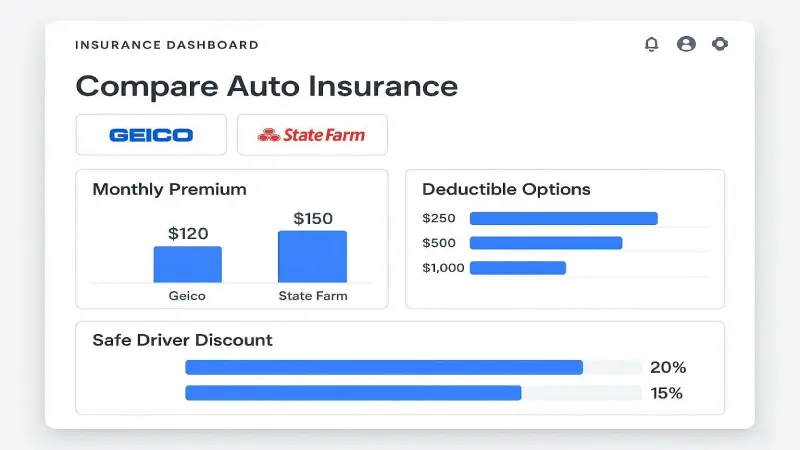
Both State Farm and GEICO offer substantial discount programs, but their structures differ in important ways that affect different driver profiles. GEICO technically offers more discount categories, but State Farm’s discounts can be larger in specific areas — particularly for young drivers and safe driving programs.
GEICO Discounts
| Discount | Potential Savings | Requirements |
|---|---|---|
| Good Driver (5-yr clean record) | Up to 22% | No accidents/violations for 5 years |
| Good Student | Up to 15% | Full-time student, GPA 3.0+ |
| Military / Federal Employee | Up to 15% | Active, reserve, veteran, or fed employee |
| Multi-Vehicle | Up to 25% | 2+ vehicles on same policy |
| Multi-Policy (bundle) | Up to 10% | Home, renters, or condo + auto |
| DriveEasy Telematics | Up to 20% | Safe driving via app (can raise rates) |
| Defensive Driving Course | Up to 5% | Approved course completion |
| Accident Forgiveness | Rate protection | 5+ years claim-free to unlock |
| Anti-Theft Device | Up to 25% | Qualifying theft-deterrent system |
| Air Bags / Safety Features | Up to 40% on medical | Factory-installed safety features |
| New Vehicle | Up to 15% | Vehicle 3 years old or newer |
| Seat Belt Usage | Up to 15% on medical | Regular seat belt use (tracked) |
| Emergency Deployment | Up to 25% | Military deployed to imminent danger area |
| Senior Defensive Driving | Variable | Approved course for drivers 50+ |
| Pay in Full | Up to 8% | 6-month or annual upfront payment |
| Paperless / Auto-Pay | Up to 2% | Digital billing enrollment |
State Farm Discounts
| Discount | Potential Savings | Requirements |
|---|---|---|
| Drive Safe & Save Telematics | Up to 30% | Safe driving via app — won’t raise rates |
| Steer Clear (under 25) | Up to 15% | Drivers under 25, complete training program |
| Good Student | Up to 25% | Full-time student, GPA 3.0+ |
| Good Driver (3-yr clean) | Up to 15% | No at-fault accidents for 3 years |
| Multi-Vehicle | Up to 20% | 2+ vehicles on same policy |
| Multi-Policy (bundle) | Up to 17% | Home, renters, or life + auto with State Farm |
| Passive Restraint (airbags) | Up to 40% on medical | Factory-installed airbags |
| Anti-Theft Device | Up to 15% | Qualifying anti-theft system installed |
| Student Away at School | Up to 25% | Student 100+ miles away without car |
| Accident-Free | Up to 15% | No accidents for defined period |
| Defensive Driving Course | Up to 5% | Approved course for drivers 55+ |
| Vehicle Safety Features | Up to 5% | Daytime running lights, other safety features |
Key comparison insights:
- State Farm’s good student discount (25%) is larger than GEICO’s (15%) — a meaningful advantage for families with student drivers
- State Farm’s Drive Safe & Save maximum (30%) exceeds GEICO’s DriveEasy maximum (20%)
- State Farm’s Drive Safe & Save cannot raise rates — GEICO’s DriveEasy can penalize poor driving. This is the most important telematics distinction.
- GEICO’s military discount is stronger and broader than State Farm’s discount structure for this demographic
- GEICO’s anti-theft discount (up to 25%) is higher than State Farm’s (up to 15%)
For strategies to maximize discounts across all major carriers: Best Car Insurance Companies USA 2026.
Telematics Programs: DriveEasy vs Drive Safe & Save
GEICO DriveEasy
DriveEasy is GEICO’s smartphone-based telematics program, tracking driving behavior through the app’s sensors. It monitors hard braking, phone usage while driving, cornering, speed, and time of day.
Key characteristics:
- Maximum discount: up to 20% for excellent driving behavior
- Monitoring: continuous — premium adjusts at each renewal based on rolling behavior data
- Can raise rates: if DriveEasy detects consistently risky driving (hard braking, phone use, late-night driving), your premium can increase above your original baseline
- Requires smartphone app — data collection via phone sensors, not vehicle telemetry
- Typical safe-driver savings: 5–15% in practice
Who should use DriveEasy: Drivers who are confident in their safe driving habits and comfortable with ongoing monitoring. Not recommended for drivers who occasionally brake hard in traffic or who frequently drive late at night — the downside risk of rate increases is real.
State Farm Drive Safe & Save
Drive Safe & Save uses either a smartphone app or OnStar integration to track driving behavior. It has a broader monitoring scope and a higher maximum discount than DriveEasy.
Key characteristics:
- Maximum discount: up to 30% for excellent driving behavior
- Monitoring: continuous — premium adjusts at each renewal
- Cannot raise rates: Drive Safe & Save can only reduce your premium — never increase it above your baseline rate. This is the most important difference.
- Works with OnStar (for compatible GM vehicles), smartphone app, or compatible vehicle connectivity
- Typical safe-driver savings: 10–25% in practice
Who should use Drive Safe & Save: Almost all State Farm customers — there is zero downside risk since it cannot raise rates. Even average drivers typically save 5–10% with minimal behavior modification.
| Factor | GEICO DriveEasy | State Farm Drive Safe & Save |
|---|---|---|
| Maximum Discount | Up to 20% | Up to 30% |
| Can Raise Rates | Yes | No |
| Tracks Phone Use | Yes | Yes |
| Tracks Hard Braking | Yes | Yes |
| Tracks Mileage | Yes | Yes |
| OnStar Integration | No | Yes (GM vehicles) |
| Sign-Up Discount | 5% initial | Immediate savings start |
| Risk for Average Driver | Moderate (rate increase possible) | None |
| Best For | Confident safe drivers only | All State Farm customers |
Verdict: State Farm Drive Safe & Save is the clearly superior telematics program — higher maximum discount, no downside risk, and broader vehicle compatibility. Drivers who are uncertain about their driving behavior score should especially avoid GEICO’s DriveEasy due to the rate-increase risk.
Coverage Options Deep-Dive
Both State Farm and GEICO offer the full suite of standard auto insurance coverages. Differences appear primarily in specialty coverage options and add-ons.
| Coverage Type | State Farm | GEICO |
|---|---|---|
| Liability (BI + PD) | Yes | Yes |
| Collision | Yes | Yes |
| Comprehensive | Yes | Yes |
| Uninsured/Underinsured Motorist | Yes | Yes |
| Medical Payments / PIP | Yes (state-dependent) | Yes (state-dependent) |
| Roadside Assistance | Yes — add-on | Yes — add-on |
| Rental Reimbursement | Yes — add-on | Yes — add-on |
| Gap Insurance | Yes | Yes |
| Rideshare Coverage | Yes | Yes |
| Accident Forgiveness | No standalone — included after Steer Clear | Yes — after 5 years claim-free |
| New Car Replacement | No | No |
| Mechanical Breakdown Insurance | No | Yes — strong MBI program |
| Travel Interruption Coverage | Included in roadside add-on | Limited |
| SR-22 Filing | Yes | Yes |
| Classic Car Insurance | Yes | Yes (via partner) |
GEICO’s coverage advantage: Mechanical Breakdown Insurance (MBI) — a unique GEICO product that covers repair costs for vehicles under 15 months old with under 15,000 miles, similar to an extended warranty. This is genuinely useful for new car buyers and is not available from State Farm. MBI typically costs $25–$35/month for qualified vehicles and can save significantly on covered repairs.
State Farm’s coverage advantage: Broader travel interruption coverage within its roadside add-on, and in-person agent assistance for claims navigation — particularly valuable for complex multi-party accidents
Claims Satisfaction and Customer Service
Premium savings are only meaningful if the company pays your claim fairly and efficiently when you need it. Claims handling is where State Farm and GEICO diverge most significantly in 2026.
J.D. Power Claims Satisfaction Scores (2025 Study)
| Metric | State Farm | GEICO | Industry Average |
|---|---|---|---|
| Overall Claims Satisfaction (J.D. Power) | 710/1,000 — #1 major carrier | 692/1,000 — Above avg | 679/1,000 |
| First Notice of Loss | Excellent | Good | Average |
| Service Interaction | Excellent (agent support) | Good (digital) | Average |
| Repair Process | Excellent | Good | Average |
| Rental Experience | Good | Good | Average |
| Settlement | Excellent | Good | Average |
State Farm’s J.D. Power claims score of 710/1,000 is the highest among all major carriers and significantly above the industry average of 679. This gap represents a real, measurable difference in customer experience during claims — the moment when insurance actually matters.
GEICO’s digital claims process: GEICO’s photo estimate tool allows minor damage claims to be processed entirely through the app without an adjuster visit. For simple fender-benders, this creates a faster resolution. For complex multi-vehicle accidents, structural damage, or disputed liability, GEICO’s limited agent network can slow resolution compared to State Farm’s in-person agent access.
State Farm’s agent network advantage: State Farm’s 19,000+ agent network provides an unmatched level of in-person claims support. For drivers who want a local advocate during a claim — someone who knows them, knows their policy, and can make calls on their behalf — State Farm’s agent model is genuinely differentiated. GEICO’s closure of hundreds of local offices in its restructuring has eliminated this option for GEICO customers.
NAIC Complaint Ratios 2025
The National Association of Insurance Commissioners complaint ratio measures the volume of complaints relative to market share (1.0 = average; below 1.0 = fewer complaints than average).
- State Farm: 0.71 — meaningfully fewer complaints than industry average
- GEICO: 0.84 — below average complaints (better than average)
Both carriers perform well on complaints, but State Farm’s lower complaint ratio reflects the advantage of in-person agent support that resolves issues before they escalate to formal complaints.
Financial Strength and Stability
Both State Farm and GEICO carry the highest possible AM Best financial strength rating — A++ (Superior) — meaning both have essentially zero meaningful risk of being unable to pay claims under any foreseeable scenario.
- State Farm: A++ (AM Best), Aa1 (Moody’s), AA (S&P). State Farm is a mutual company — owned by policyholders, not shareholders. This structure means long-term pricing stability takes priority over quarterly profit maximization.
- GEICO: A++ (AM Best), backed by Berkshire Hathaway — one of the strongest balance sheets in global finance. Warren Buffett’s holding company ownership provides essentially unlimited claims-paying capacity in catastrophic scenarios.
For most drivers, financial strength is a tie — both companies are among the most financially secure insurers in the world. The distinction matters more in catastrophic multi-billion-dollar events affecting hundreds of thousands of policyholders simultaneously.
Best for Teen and Young Drivers
Teen driver insurance is one of the most financially impactful decisions families make — rates for 16-year-olds can exceed $250–$500/month — and State Farm has a clear structural advantage in this category.
Why State Farm Wins for Teen Drivers
- Lower base rates: $237/month vs GEICO’s $269/month for full coverage at age 16 — a $384 annual difference that compounds over 7–8 years of young driver premiums
- Steer Clear program: State Farm’s under-25 training and monitoring program provides up to 15% additional discount upon completion — with no downside risk. GEICO has no equivalent program.
- Good student discount up to 25%: Larger than GEICO’s 15% maximum
- Student away at school discount: Up to 25% for students 100+ miles away without the car — directly applicable to college students leaving home
- Drive Safe & Save safety: Parents can add teen drivers to Drive Safe & Save with zero rate-increase risk — encouraging safe behavior without financial penalty for developing drivers
For young drivers specifically on a Tesla Model 3 or Model Y: Cheapest Tesla Insurance Under 25. For general young driver insurance: Cheapest Auto Insurance for Young Drivers USA 2026.
Best for Senior Drivers
Senior drivers (age 60+) generally represent lower-risk profiles for insurers and both State Farm and GEICO offer competitive rates for this demographic. The winner is essentially a tie on price, with the decision coming down to service preferences.
- GEICO minimum coverage at 65: ~$42/month (slightly cheaper)
- State Farm minimum coverage at 65: ~$47/month
- Both offer mature driver/defensive driving course discounts for drivers 55+
Senior drivers who value in-person agent support for policy questions, claims guidance, and coverage review benefit from State Farm’s local agent model. Senior drivers comfortable with digital-only management and motivated by the lowest possible premium will slightly prefer GEICO.
Best for Drivers With Tickets or Accidents
State Farm is the clear winner for most categories of imperfect driving records. The pricing differential is striking:
| Violation Type | State Farm | GEICO | Annual Savings (State Farm) |
|---|---|---|---|
| Speeding ticket (1) | $147/mo | $206/mo | $708/yr |
| DUI/DWI | $170/mo | $219/mo | $588/yr |
| At-fault accident | ~$224/mo | ~$290/mo | ~$792/yr |
| Multiple violations | Significantly higher | Even higher | State Farm still cheaper |
GEICO’s algorithmic underwriting penalizes violations more aggressively than State Farm’s traditional actuarial model. State Farm’s agent-based relationships also mean that long-term customers with established records have more pricing stability after incidents than GEICO’s purely algorithm-driven model offers.
For very high-risk drivers (multiple DUIs, SR-22 requirements, multiple at-fault accidents), Progressive may offer even more flexible underwriting than either State Farm or GEICO. See: Progressive vs GEICO vs State Farm 2026.
Home + Auto Bundling
Bundling home and auto insurance with the same carrier is one of the most reliably effective savings strategies available. Both State Farm and GEICO offer bundle discounts, but their home insurance products differ significantly.
State Farm Bundling
- Bundle discount: up to 17% on auto when combined with State Farm home insurance
- State Farm home insurance is available nationwide (with some state-specific limitations)
- The bundle creates one agent contact for both policies — simplified claims management
- State Farm also bundles with life insurance, renter’s insurance, and condo insurance
GEICO Bundling
- Bundle discount: up to 10% on auto
- GEICO partners with third-party home insurers rather than writing home policies directly — meaning claims for home and auto go to different companies despite being quoted together
- The indirect home insurance model can create friction when filing simultaneous home + auto claims (e.g., hail that damages both house and car)
Winner: State Farm for bundling — both the larger discount (17% vs 10%) and the genuinely integrated home + auto product (versus GEICO’s third-party home insurance arrangement) favor State Farm for homeowners who want true single-carrier bundling.
For the best home + auto bundle options across all major carriers: Best Home and Auto Insurance Bundle USA 2026.
Digital Experience and Mobile Apps
Both carriers have invested heavily in digital tools, but their digital experiences reflect their fundamentally different business models.
GEICO Digital Experience
- Highly rated mobile app on both iOS (4.8 stars) and Android (4.7 stars)
- Photo claims estimation — file claims entirely via smartphone for minor damage
- Digital-first policy management — all changes, payments, documents accessible online
- Virtual assistant for basic service requests
- DriveEasy fully integrated within main app
- Limitation: No local agent fallback — digital-only for most customers
State Farm Digital Experience
- Highly rated mobile app on iOS (4.8 stars) and Android (4.7 stars) — competitive with GEICO
- Digital claims filing with option to escalate to agent at any stage
- Drive Safe & Save fully integrated
- Steer Clear program accessible through app
- Full policy management available digitally
- Advantage: Agent backup available at any point — digital and in-person co-exist
Both apps are excellent and comparably rated. The distinction is the fallback option: State Farm customers can transition to in-person agent support when digital interactions don’t resolve their issue. GEICO customers must work through digital and phone channels only.
Frequently Asked Questions
Is State Farm or GEICO cheaper in 2026?
GEICO is cheaper at the national average level for full coverage — approximately $1,890/year vs State Farm’s $2,180/year. However, State Farm is cheaper for teen drivers, drivers with speeding tickets, DUIs, or at-fault accidents, and for minimum coverage. The correct answer depends entirely on your driver profile, state, and driving history. Always get quotes from both before deciding.
Why did State Farm raise rates in 2025?
State Farm raised rates in 22 states in 2025 due to elevated claims costs driven by rising repair costs (including tariff-related parts price increases), higher bodily injury settlement costs, and increased claim frequency. The national average full coverage premium reached approximately $2,180/year — a 9.4% increase from 2024. This widened the gap with GEICO for clean-record drivers but didn’t change State Farm’s relative advantage for high-risk driver profiles.
Can GEICO DriveEasy increase my rates?
Yes. GEICO DriveEasy tracks hard braking, phone usage, cornering, speed, and late-night driving through a smartphone app. If your driving behavior is consistently risky, DriveEasy can increase your rates above your baseline premium. This is different from State Farm’s Drive Safe & Save, which can only reduce rates — never increase them. Drivers who are uncertain about their driving habits should be cautious about enrolling in GEICO DriveEasy.
Which is better for teen drivers — State Farm or GEICO?
State Farm is significantly better for teen drivers. State Farm averages $237/month for a 16-year-old versus GEICO’s $269/month — a $384 annual difference. State Farm’s Steer Clear program provides additional discounts of up to 15% for completing driver training modules. State Farm’s good student discount reaches 25%, higher than GEICO’s 15%. And State Farm’s Drive Safe & Save adds teens to telematics with zero rate-increase risk.
Which insurer has better claims service in 2026?
State Farm has the highest J.D. Power claims satisfaction score among major carriers in 2025 — 710/1,000 versus GEICO’s 692. State Farm’s 19,000+ agent network provides in-person claims support that GEICO’s digital-only model cannot replicate after its recent office closures. For complex claims involving disputed liability, structural damage, or multi-party accidents, State Farm’s agent access is a meaningful advantage. For simple fender-benders, GEICO’s digital photo claims process can be faster.
Does State Farm offer accident forgiveness?
State Farm does not offer a standalone accident forgiveness program the way GEICO does. GEICO offers accident forgiveness to drivers who have been claim-free for 5 years. State Farm’s Steer Clear program includes some accident forgiveness elements for under-25 drivers who complete the program. For drivers specifically seeking accident forgiveness features, GEICO has a clearer program — though the 5-year qualifying period is substantial.
Is GEICO or State Farm better for bundling home and auto?
State Farm is better for home + auto bundling. State Farm offers a larger bundle discount (up to 17% vs GEICO’s 10%) and writes both policies directly — meaning one agent manages both policies and one company handles claims for both. GEICO partners with third-party home insurers rather than writing home policies directly, creating potential friction when filing simultaneous claims.
Which is better for military members — State Farm or GEICO?
GEICO is better for military members and veterans who don’t qualify for USAA. GEICO offers a military discount of up to 15% for active duty, reserve, and veteran status, plus an additional emergency deployment discount of up to 25% for vehicles stored during overseas deployment. State Farm offers no equivalent military-specific discount structure. Note: for military members who qualify, USAA consistently offers the lowest premiums of any major insurer.
Conclusion — Who Should Choose State Farm vs GEICO
Choose GEICO If:
- You have a clean driving record and good-to-excellent credit
- You are active military, reserve, or a veteran
- You live in California, Texas, Florida, New York, Washington, or Arizona (GEICO typically wins in these states)
- You want the lowest available minimum coverage rate for a driver with poor credit
- You prefer a fully digital experience with no agent relationship
- You want accident forgiveness to protect your rates post-first-incident
- You want Mechanical Breakdown Insurance for a new vehicle
- You are a safe, confident driver who wants to maximize telematics savings
Choose State Farm If:
- You have a teen driver on your policy
- You have a speeding ticket, DUI, or at-fault accident on your record
- You want the cheapest minimum coverage policy (clean record)
- You live in Illinois, Georgia, Ohio, Michigan, Virginia, Tennessee, or North Carolina
- You want a local agent for claims support and policy management
- You want Drive Safe & Save with zero rate-increase risk
- You want to bundle home + auto with a single carrier for maximum discount and seamless claims
- You have a student driver going away to college
- You prioritize the highest claims satisfaction score in the industry
The bottom line: GEICO wins on price for the average driver. State Farm wins on service quality and for every high-risk profile category. The right answer for most American drivers is to get a quote from both — plus at least one additional insurer — every year. The premium difference between the cheapest and most expensive quote for the same driver can exceed $500–$1,000 annually.
Related guides:
- Best Car Insurance Companies USA 2026
- Progressive vs GEICO vs State Farm 2026
- Cheapest Auto Insurance for Young Drivers USA 2026
- Best Home and Auto Insurance Bundle USA 2026
- Best Home Insurance Companies USA 2026
- How Tariffs Are Making Car Insurance More Expensive in 2026
- Tesla Insurance vs GEICO 2026 — Model Y Drivers
- Cheapest Car Insurance California 2026

Ahmada Ndao is a financial research analyst and independent journalist
specializing in US consumer finance, legal rights, and insurance markets.
With over 5 years covering American financial products, he has helped
thousands of readers navigate complex insurance decisions, find the right
legal representation, and optimize their credit strategies. His research
methodology combines primary data analysis, direct outreach to industry
professionals, and continuous monitoring of federal regulatory changes.
Ahmada’s work has been cited by financial communities across the US and
reviewed by licensed attorneys and insurance professionals for accuracy.