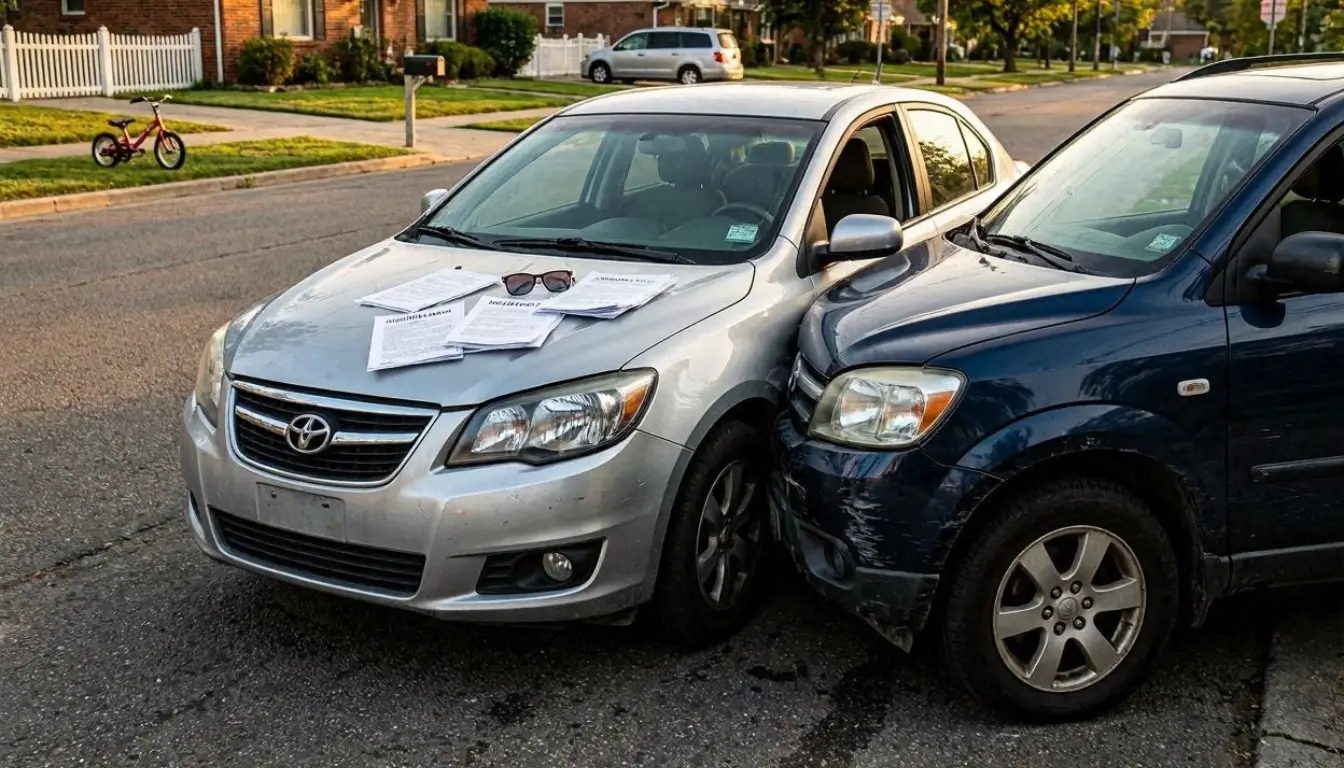
GEICO vs Allstate 2026 — Which Insurance Company Is Actually Cheaper After an Accident?
Your car insurance rate after an accident is the number that actually matters — and GEICO and Allstate behave very differently when you file a claim. At-fault accident? GEICO's average rate jumps to $3,341/year versus Allstate's $4,125/year — Allstate charges 23% more for the same driver profile post-accident. DUI? The math flips: Allstate ($3,875/year) is actually cheaper than GEICO ($4,584/year) after a DUI conviction. Speeding ticket? GEICO averages $2,493/year vs Allstate's $3,073/year — a $580 annual difference. This 2026 guide breaks down every scenario: what each insurer charges after an accident, a DUI, a speeding ticket, or multiple violations — and which accident forgiveness program actually delivers.

📊 Quick Comparison — GEICO vs Allstate 2026
| Driver Profile | GEICO Annual Avg | Allstate Annual Avg | Cheaper |
|---|---|---|---|
| Clean record | $1,800/yr | $1,776/yr | Allstate (slight) |
| After at-fault accident | $3,341/yr | $4,125/yr | GEICO saves $784/yr |
| After speeding ticket | $2,493/yr | $3,073/yr | GEICO saves $580/yr |
| After DUI | $4,584/yr | $3,875/yr | Allstate saves $709/yr |
| Poor credit | Competitive | Higher | GEICO generally cheaper |
| High coverage limits | Below avg ✅ | 65% above avg ⚠️ | GEICO significantly cheaper |
| Liability only | ~$727/yr | ~$1,158/yr | GEICO saves $431/yr |
| Full coverage | ~$1,800/yr | ~$1,776/yr | Roughly equal |
🚗 Rates After an At-Fault Accident — GEICO vs Allstate

An at-fault accident is the most common reason drivers see their insurance rates increase — and how much rates increase varies dramatically between insurers. GEICO and Allstate apply different surcharge formulas, producing a meaningful cost difference for the same driver.
| Scenario | GEICO Rate | Allstate Rate | Annual Difference |
|---|---|---|---|
| 1 at-fault accident (full coverage) | $3,341/yr | $4,125/yr | Allstate $784 more |
| Rate increase vs clean record | +$1,541/yr (+85%) | +$2,349/yr (+132%) | Allstate surcharges more aggressively |
| How long surcharge lasts | 3 years typically | 3–5 years | Allstate surcharge may last longer |
Why GEICO Surcharges Less After an Accident
GEICO's post-accident rate formula applies a lower surcharge multiplier than Allstate for most driver profiles. This reflects GEICO's broader risk pool — as the third-largest US insurer by market share, GEICO spreads post-accident risk across more policyholders, allowing for lower individual surcharges. Allstate's higher surcharge compensates partly through its accident forgiveness program — but only if you purchased or earned that coverage before the accident occurred.
The Accident Forgiveness Difference
Both GEICO and Allstate offer accident forgiveness — but the programs work differently. GEICO: Accident forgiveness can be earned automatically after 5 consecutive years with GEICO without an accident. It can also be purchased as an add-on. Once activated, your rate does not increase after your first at-fault accident. Allstate: Accident forgiveness must be purchased as an add-on — it is not earned through tenure. Once purchased, your first at-fault accident is forgiven and does not raise your premium. Allstate also offers a "Claim-Free Rewards" program that provides a bonus check (not a rate discount) for claim-free periods. If you already have accident forgiveness active on your Allstate policy, the $784 annual gap reverses — Allstate's forgiveness protection prevents any rate increase, while GEICO's rate still increases if your forgiveness wasn't yet activated.
🚨 Rates After a DUI — Where Allstate Wins
A DUI conviction is the scenario where the comparison flips completely. After a DUI, Allstate ($3,875/year) is $709/year cheaper than GEICO ($4,584/year) — a 15% cost advantage that makes Allstate the clear choice for drivers with a DUI on their record.
| DUI Scenario | GEICO | Allstate | Winner |
|---|---|---|---|
| Annual full coverage premium | $4,584/yr | $3,875/yr | Allstate saves $709/yr |
| Rate increase vs national avg | 22% above avg | 45% above avg (but lower absolute $) | Complex — check your state |
| Risk of mid-term cancellation | Yes (both insurers) | Yes (both insurers) | Equal risk |
| SR-22 filing | ✅ Provided | ✅ Provided | Equal |
🚦 Rates After a Speeding Ticket
A speeding ticket is the most common driving violation — and GEICO charges significantly less than Allstate for the same infraction.
| Speeding Violation | GEICO | Allstate | Difference |
|---|---|---|---|
| 1 speeding ticket (full coverage) | $2,493/yr | $3,073/yr | GEICO saves $580/yr |
| Rate increase vs clean | +$693/yr (+38%) | +$1,297/yr (+73%) | Allstate surcharges 92% more per ticket |
| How long on record | 3 years most states | 3 years most states | Equal |
Over a 3-year surcharge period, a single speeding ticket costs GEICO drivers $2,079 in total additional premiums versus Allstate drivers paying $3,891 extra — a $1,812 cumulative difference for the same violation. For drivers who receive occasional speeding tickets, GEICO's lower surcharge formula produces meaningful long-term savings.
🛡️ Accident Forgiveness — Who Actually Delivers?
| Factor | GEICO Accident Forgiveness | Allstate Accident Forgiveness |
|---|---|---|
| How to get it | Earn after 5 years claim-free OR purchase as add-on | Purchase as add-on only |
| Cost | ~$30–$80/year (add-on) or free if earned | ~$60–$120/year |
| Number of accidents forgiven | First at-fault accident only | First at-fault accident only |
| Rate increase if forgiveness active | $0 (no increase) | $0 (no increase) |
| Rate increase without forgiveness | +$1,541/yr average | +$2,349/yr average |
| Transferable if you switch? | ❌ No | ❌ No |
| Worth buying? | ✅ Yes for most drivers | ✅ Yes if staying with Allstate |
GEICO's Earned Forgiveness — The Hidden Advantage
GEICO's ability to earn accident forgiveness after 5 claim-free years — at zero additional cost — is a meaningful advantage over Allstate's purchase-only model. A GEICO customer who has been accident-free for 5 years gets automatic forgiveness protection without paying the add-on premium. An Allstate customer in the same situation pays $60–$120/year for equivalent coverage. Over 5 years, that's $300–$600 in additional premiums just for the forgiveness rider — before any accident occurs.
⚠️ Multiple Violations — Who Is More Forgiving?
For drivers with multiple violations on their record — a ticket plus an accident, or two at-fault accidents — the premium gaps between GEICO and Allstate widen further. Neither insurer is particularly forgiving of multiple violations, but GEICO's lower base surcharge per violation means the cumulative cost is lower.
| Violation Combination | GEICO Est. | Allstate Est. | Better Choice |
|---|---|---|---|
| 1 ticket + 1 accident | ~$3,800/yr | ~$4,900/yr | GEICO |
| 2 at-fault accidents | ~$4,400/yr | ~$5,600/yr | GEICO |
| DUI + 1 accident | ~$5,500+/yr | ~$5,000+/yr | Allstate |
| 3+ violations | May non-renew | May non-renew | Non-standard market |
Drivers with 3 or more violations within 3 years may face non-renewal from both GEICO and Allstate. At that point, non-standard carriers (The General, Bristol West, Dairyland, Gainsco) become the primary options — at significantly higher rates.
✅ Clean Record Comparison
For drivers with a clean record, GEICO and Allstate are nearly equal on full coverage — but GEICO is significantly cheaper on liability-only coverage.
| Coverage Type | GEICO (Clean) | Allstate (Clean) | Winner |
|---|---|---|---|
| Full coverage | ~$1,800/yr | ~$1,776/yr | Allstate (slight) |
| Liability only | ~$727/yr | ~$1,158/yr | GEICO saves $431/yr |
| High coverage limits | Below avg | 65% above avg | GEICO significantly cheaper |
| Bundle discount (home+auto) | Up to 25% | Up to 25% | Equal |
📊 Full Head-to-Head — GEICO vs Allstate 2026
| Factor | GEICO | Allstate | Edge |
|---|---|---|---|
| AM Best Rating | A++ ✅ | A+ | GEICO |
| J.D. Power Claims (2026) | Below avg | Above avg ✅ | Allstate |
| NAIC Complaint Index | Below avg ✅ | 1.24 ⚠️ | GEICO |
| After accident cost | $3,341/yr ✅ | $4,125/yr | GEICO |
| After DUI cost | $4,584/yr | $3,875/yr ✅ | Allstate |
| After speeding ticket | $2,493/yr ✅ | $3,073/yr | GEICO |
| Accident forgiveness (earned) | ✅ Yes (5yr) | ❌ Purchase only | GEICO |
| Mobile app rating | 4.7/5 ✅ | 4.6/5 | GEICO |
| Telematics discount | DriveEasy 25% | Drivewise 40% ✅ | Allstate |
| Bundle discount | Up to 25% | Up to 25% | Equal |
| Mexico coverage | ✅ Available | ✅ Available | Equal |
| Gap coverage | ❌ No | ✅ Yes | Allstate |
| National availability | All 50 states ✅ | All 50 states ✅ | Equal |
🎯 Who Should Choose GEICO vs Allstate?
Choose GEICO If:
You have an at-fault accident on your record — GEICO's surcharge is 23% lower than Allstate's for the same accident. You have a speeding ticket — GEICO charges $580/year less. You want the lowest liability-only premiums — GEICO averages $431/year less than Allstate. You've been claim-free for 5 years and want to earn accident forgiveness at no extra cost. You prioritize app experience and digital management — GEICO's app consistently outperforms Allstate's in user ratings.
Choose Allstate If:
You have a DUI on your record — Allstate is $709/year cheaper than GEICO post-DUI. You want J.D. Power claims satisfaction above the industry average. You need gap insurance for a financed vehicle — GEICO doesn't offer it. You're a heavy Drivewise telematics user — Allstate's 40% maximum discount exceeds GEICO's 25% DriveEasy maximum. You already have home insurance with Allstate and want the 25% bundle discount on both policies.
❓ Frequently Asked Questions — GEICO vs Allstate After Accident
Does GEICO raise rates after an accident?
Yes — GEICO raises rates after an at-fault accident. The national average increase is approximately $1,541/year (+85% above clean-record rates), bringing the average full-coverage premium to $3,341/year after one at-fault accident. However, if you have GEICO's accident forgiveness (earned after 5 claim-free years or purchased as an add-on), your rate does not increase after your first at-fault accident. Without accident forgiveness, GEICO's post-accident rate is still typically 23% lower than Allstate's equivalent rate.
Is GEICO or Allstate cheaper after an at-fault accident?
GEICO is cheaper after an at-fault accident. GEICO averages $3,341/year post-accident versus Allstate's $4,125/year — a $784 annual difference, or 23% less. This gap reflects GEICO's lower surcharge formula for at-fault accidents. The exception is if Allstate's accident forgiveness is active — in that case, Allstate would not raise your rate at all, making it cheaper than GEICO's surcharge. Without forgiveness active on either policy, GEICO is the cheaper post-accident insurer.
Which is cheaper after a DUI — GEICO or Allstate?
Allstate is cheaper after a DUI. Allstate averages $3,875/year after a DUI versus GEICO's $4,584/year — a $709 annual difference. This is the main exception to GEICO's generally lower rates. Both insurers are significantly above the national average after a DUI, and both may cancel mid-term or non-renew after a DUI conviction. GEICO's DUI surcharge percentage is lower than Allstate's in relative terms, but its absolute dollar cost is higher. Always get quotes from both standard and non-standard carriers after a DUI.
How long does an accident affect my GEICO or Allstate rate?
Both GEICO and Allstate typically surcharge rates for 3 years after an at-fault accident in most states. Some states allow insurers to consider accidents on your record for up to 5 years, and Allstate's surcharge in some markets may persist longer than GEICO's. After the surcharge period expires, your rate returns to the level appropriate for your current profile. Speeding tickets also typically affect rates for 3 years; DUI convictions may affect rates and insurability for 5–7 years depending on the state.
Should I switch from Allstate to GEICO after an accident?
Switching to GEICO after an at-fault accident can save $784/year on average — but check two things first. First, does your current Allstate policy have accident forgiveness? If yes, your Allstate rate won't increase and switching loses that protection. Second, will GEICO apply the accident to your new policy rate? Yes — the at-fault accident follows your driving record regardless of which insurer you choose. Get an actual GEICO quote with your accident disclosed before deciding. The savings are real on average, but your specific rate depends on your full profile.
✅ Final Verdict — GEICO vs Allstate After an Accident 2026
For most drivers with an accident, ticket, or violation on their record: GEICO is cheaper. The $784/year post-accident savings, $580/year post-ticket savings, and earned accident forgiveness program make GEICO the better choice for high-risk drivers in nearly every scenario except DUI. For DUI drivers: Allstate is cheaper by $709/year. For drivers with a clean record: both are nearly equal on full coverage, but GEICO is dramatically cheaper on liability-only. Before making any switch, get personalized quotes from both insurers — and check whether your current policy's accident forgiveness changes the calculation. For a complete 4-way comparison including Progressive and State Farm, see our GEICO vs Allstate vs Progressive vs State Farm 2026 guide.
Disclaimer: Rate data based on national averages from LendingTree, AutoInsurance.com, and Insurify as of May 2026. Individual premiums vary significantly by state, ZIP code, age, vehicle, credit score, and driving history. Always obtain personalized quotes. Nexuora is not affiliated with GEICO or Allstate. Updated May 30, 2026.

Ahmada Ndao is a financial research analyst and independent journalist
specializing in US consumer finance, legal rights, and insurance markets.
With over 5 years covering American financial products, he has helped
thousands of readers navigate complex insurance decisions, find the right
legal representation, and optimize their credit strategies. His research
methodology combines primary data analysis, direct outreach to industry
professionals, and continuous monitoring of federal regulatory changes.
Ahmada’s work has been cited by financial communities across the US and
reviewed by licensed attorneys and insurance professionals for accuracy.