Published: May 30, 2026 | Last updated: September 22, 2026 | by Ahmada Ndao | Finance, Insurance & Investing
Nexuora is reader-supported. This article is educational and general in nature — it is not individualized financial or insurance advice. Rates, discounts, fees, eligibility and program terms change and vary by state, insurer and driver profile. Always confirm current details directly with Progressive or State Farm, or with a licensed agent, before enrolling.
Usage-based insurance programs keep growing in popularity in 2026 as drivers look for ways to offset rising auto insurance costs. But while insurers advertise "save up to 30%" headlines, the real savings — and the real trade-offs — are more nuanced than the marketing suggests.
Two of the most searched telematics programs are:
- Progressive Snapshot
- State Farm Drive Safe & Save
Both track your driving through a smartphone app (Snapshot also offers a plug-in device), and both promise a more personalized rate based on actual driving behavior instead of demographics alone. But there's one difference that matters more than any advertised percentage: only one of these two programs can raise your rate for risky driving.
This guide compares what each program tracks, realistic savings, privacy trade-offs, state availability, and which type of driver each program actually suits.
If you're comparing more insurers, see our full GEICO vs. State Farm 2026 comparison.
Quick Verdict: Snapshot vs. Drive Safe & Save
| Feature | Progressive Snapshot | State Farm Drive Safe & Save |
|---|---|---|
| Advertised max discount | Progressive discloses average dollar savings rather than a flat maximum percentage | Up to 30% (may exceed 30% in some states; capped at 30% in NY) |
| Sign-up discount | Average sign-up discount historically reported between roughly $47–$169 | Up to 5% just for enrolling and completing setup |
| Can my rate increase for poor driving? | Yes — Progressive has said about 1 in 5 participants sees an increase | No — State Farm states Drive Safe & Save will not raise your premium for risky driving |
| Tracking method | Mobile app or plug-in OBD-II device | State Farm app + mailed Bluetooth beacon (no OBD-II device) |
| Tracks phone distraction | Yes | Yes |
| Tracks hard braking / acceleration / cornering | Yes | Yes |
| Not available in | California (program); Hawaii & New York (sign-up discount only) | California, Massachusetts, Rhode Island; may be unavailable in North Carolina depending on circumstances |
| Best for | Low-mileage, daytime, predictable drivers willing to accept some downside risk | Drivers who want upside-only telematics with no risk of a rate hike |
What Is Usage-Based Insurance?
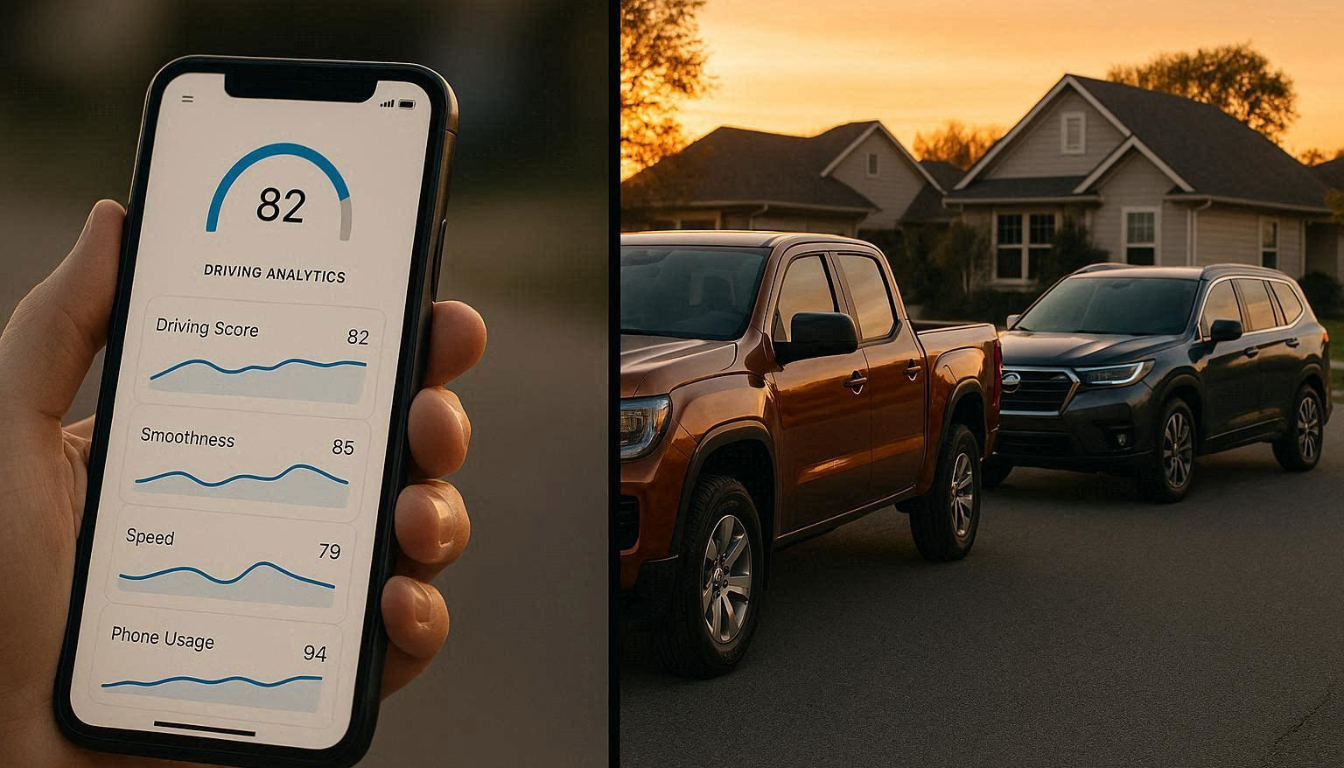
Usage-based insurance (UBI), also called telematics insurance, uses a smartphone app, plug-in device, or connected-vehicle beacon to monitor real driving behavior — typically mileage, hard braking, rapid acceleration, cornering, speed, and phone-handling — and factors that data into your premium instead of relying only on age, credit-based insurance score, or ZIP code.
You can also read our related guides on Best Electric Vehicle Insurance USA 2026 and Best Tesla Insurance Companies USA 2026.
External source: Insurance Information Institute — What Is Usage-Based Insurance
How Progressive Snapshot Works
Official page: progressive.com/auto/discounts/snapshot
Drivers can enroll through the Snapshot mobile app or a plug-in device. Snapshot evaluates:
- Hard braking and rapid acceleration
- Total mileage
- Time of day (especially driving between midnight and 4 a.m.)
- Phone handling while driving
Progressive doesn't advertise a single flat maximum percentage. Instead it discloses average dollar figures: reported sign-up discounts have ranged from roughly $47 to $169, and average renewal savings for safe drivers have been reported anywhere from about $150 to $322 a year, depending on the source and time period.[1][2] Progressive has also stated that about 1 in 5 Snapshot participants sees a rate increase rather than a discount, based on how their driving data comes back.[3]
Availability: Snapshot is offered in every state except California. The automatic sign-up discount specifically is not available in Hawaii or New York, though drivers in those states can still earn a discount based on driving results at renewal.[4]
How State Farm Drive Safe & Save Works
Official page: statefarm.com/insurance/auto/discounts/drive-safe-save
Drive Safe & Save now runs through the main State Farm app rather than a standalone app. In most states, State Farm mails you a small Bluetooth beacon that pairs with your phone to automatically record trips in your insured vehicle — you don't need to keep the app open while driving.[5] The program tracks:
- Acceleration
- Braking
- Cornering
- Phone distraction (when the vehicle is moving, the phone is moving inside it, and the screen is on)
- Speed (flagged when you exceed the posted limit by 8 mph or more)
- Annual mileage, on certain policies in certain states
State Farm states you can save up to 30% based on how you drive, with discounts that may exceed 30% in some states (capped at 30% in New York), plus up to 5% just for enrolling and completing setup.[6] Unlike Snapshot, State Farm has said Drive Safe & Save will not increase your premium for risky driving — the program only adds a discount, it doesn't apply a penalty.[7]
Availability: Not available in California, Massachusetts or Rhode Island. A discount may not be available in North Carolina depending on individual circumstances.[6]
Which Program Gives Bigger Discounts?
On paper, State Farm's stated "up to 30%" is a clearer number than Progressive's dollar-based disclosures. But headline numbers describe best-case outcomes for very safe, low-mileage drivers — most participants in either program land well below the maximum.
The more important difference is downside risk. Snapshot can lower your rate substantially for safe driving, but Progressive has been explicit that some participants see an increase. Drive Safe & Save is structured so the discount can only help you, not hurt you — which makes it a lower-risk way to try telematics, even if your eventual discount turns out modest.
Snapshot vs. Drive Safe & Save: Driver Profile Comparison
| Driver Type | Progressive Snapshot | State Farm Drive Safe & Save |
|---|---|---|
| Remote worker / low mileage | Strong fit | Strong fit |
| Daily daytime commuter | Good fit | Good fit |
| Frequent night driver | Weak fit — penalized heavily | Weaker fit for savings, but no downside risk |
| Occasional hard-braking events | Risk of a rate increase | No rate-increase risk, but lower discount |
| Risk-averse / wants guaranteed no-downside | Not ideal | Strong fit |
| Already a policyholder with either insurer | Good fit | Good fit |
How We Evaluated These Programs
This comparison was built from information published directly by Progressive and State Farm, supplemented by independent review coverage from Bankrate, NerdWallet, WalletHub, Insurify, ValuePenguin and AutoInsurance.com, plus consumer-protection guidance from the Insurance Information Institute (III) and the National Association of Insurance Commissioners (NAIC). We compared advertised discounts against independently reported real-world figures, tracking methods, rate-increase risk, state availability and privacy practices. Nexuora did not conduct proprietary surveys or first-hand telematics testing; figures above are drawn from insurer disclosures and third-party reporting, cited throughout.
The Privacy Trade-Off
Both programs collect more data than many drivers expect. Snapshot's app and plug-in device log routes, timing, and phone handling; Drive Safe & Save uses your phone's location, accelerometer, and Bluetooth beacon to reconstruct each trip, and requires "Always" location access to work correctly. State Farm states it does not sell your information but may share it with third parties in limited situations.[5] The National Association of Insurance Commissioners (NAIC) recommends reviewing any telematics program's privacy policy, including data retention and sharing practices, before enrolling.
Who Should Avoid Telematics Insurance?
Usage-based insurance isn't the right fit for every driver. You may want to think twice about either program if you:
- Drive frequently at night
- Work in delivery or rideshare
- Have a long, unavoidable highway commute
- Use your phone hands-on while driving
- Are uncomfortable with location and driving-behavior data collection
If your habits are on the riskier side, Drive Safe & Save's no-downside structure is the safer of the two to try, since it can't lower your rate below where you started.
Snapshot vs. Drive Safe & Save for Young Drivers
Young drivers typically pay the highest premiums of any age group, and telematics can help them earn a discount faster than waiting out age-based pricing alone. Because Snapshot can penalize risky patterns with a rate increase, parents adding a teen driver may prefer starting with Drive Safe & Save's no-downside model, then evaluating Snapshot separately once the young driver has an established safe-driving track record.
Alternatives to Telematics-Based Discounts
If you'd rather not be tracked, both insurers — and most major carriers — offer other ways to lower a premium, including multi-policy (bundling) discounts, good-student discounts, multi-car discounts, paid-in-full discounts, and defensive-driving-course discounts. Comparing quotes across insurers directly is often a bigger lever than any single telematics discount.
Common Mistakes Drivers Make With Telematics Programs
- Assuming the advertised maximum (30%, or Progressive's higher-end dollar figures) is typical rather than a best case
- Not checking availability in their state before enrolling
- Not completing setup (pairing the beacon, enabling "Always" location) — an incomplete setup can remove the sign-up discount
- Ignoring the phone-distraction trigger, which can flag a passenger using the recording phone, not just the driver
- Enrolling in Snapshot without understanding that a rate increase is possible in their state
Which Program Should You Choose?
Progressive Snapshot may be a better fit if you:
- Drive relatively few miles and rarely at night
- Want the option of a plug-in device instead of an app
- Are confident in your driving and want to maximize potential savings
- Are already a Progressive customer
State Farm Drive Safe & Save may be a better fit if you:
- Want a telematics discount with no risk of a rate increase
- Don't mind a mailed Bluetooth beacon and app-based setup
- Are already a State Farm customer
- Have moderately safe (not perfect) driving habits and want a lower-risk way to try telematics
For most drivers, Drive Safe & Save's guaranteed-no-penalty structure makes it the lower-risk choice, while Snapshot may offer a larger upside for consistently safe, low-mileage drivers willing to accept some downside risk. If you're evaluating more insurers, see our GEICO vs. State Farm 2026 comparison.
FAQ
Can Progressive Snapshot raise my insurance rate?
Yes. Progressive has said roughly 1 in 5 Snapshot participants sees a rate increase based on their driving data, particularly for frequent hard braking, speeding, or late-night driving.
Can State Farm Drive Safe & Save raise my rate?
No. State Farm states the program is designed only to add a discount — it will not increase your premium for risky driving, though a smaller discount (or none) is possible if your data doesn't qualify.
Does Drive Safe & Save require a separate device?
In most states, yes — State Farm mails a small Bluetooth beacon that pairs with the State Farm app and stays in your car. Progressive Snapshot offers a plug-in device as an alternative to its app.
Are these programs available in every state?
No. Snapshot is unavailable in California, and its sign-up discount doesn't apply in Hawaii or New York. Drive Safe & Save is unavailable in California, Massachusetts and Rhode Island, and may not be available in North Carolina depending on your situation. Always confirm current availability directly with the insurer.
Which program gives a bigger discount?
It depends on your driving profile and state. State Farm advertises a clearer maximum (up to 30%), while Progressive discloses average dollar savings rather than a flat percentage. Neither guarantees a specific outcome.
Can nighttime driving affect my discount?
Yes, for both programs. Late-night driving is weighted as higher-risk and can reduce the eventual discount on either program.
Is telematics insurance safe for privacy-conscious drivers?
Both programs collect detailed location and driving-behavior data. Privacy-conscious drivers should review each insurer's data policy — including retention and sharing practices — before enrolling, or consider a non-telematics discount instead.
Sources
- Progressive — Snapshot official program page and state availability list
- State Farm — Drive Safe & Save official program page and FAQ
- Insurance Information Institute (III) — usage-based insurance overview
- National Association of Insurance Commissioners (NAIC) — telematics privacy guidance
- Bankrate, NerdWallet, WalletHub, ValuePenguin, Insurify, AutoInsurance.com — independent program reviews (2026)
Data checked and article substantively updated September 22, 2026. Rates, discounts, fees, availability and program rules vary by state and change over time — verify current terms directly with Progressive or State Farm before enrolling.

Ahmada Ndao is a financial research analyst and independent journalist
specializing in US consumer finance, legal rights, and insurance markets.
With over 5 years covering American financial products, he has helped
thousands of readers navigate complex insurance decisions, find the right
legal representation, and optimize their credit strategies. His research
methodology combines primary data analysis, direct outreach to industry
professionals, and continuous monitoring of federal regulatory changes.
Ahmada’s work has been cited by financial communities across the US and
reviewed by licensed attorneys and insurance professionals for accuracy.