
Editorial Disclaimer: Our editorial team independently researches and evaluates insurance providers based on publicly available information, including financial strength ratings, policy features and industry reputation. We do not receive compensation from insurers to influence rankings. Coverage details, pricing and underwriting rules vary by state, insurer and individual applicant, so always confirm current terms directly with a licensed agent or the carrier before purchasing a policy.
Losing the ability to earn an income is one of the most financially disruptive events a household can face — often more disruptive than a house fire or even a premature death, because bills keep arriving while the paycheck stops. That is the risk disability insurance is designed to address. As we head deeper into 2026, with the cost of housing, healthcare and everyday goods still elevated across much of the country, more workers are recognizing that health insurance alone does not replace lost wages. Identifying the best disability insurance companies USA 2026 has to offer means comparing financial strength, policy flexibility, underwriting standards and real-world claims reputation — not just advertised premiums.
Disability insurance replaces a portion of your income if illness or injury keeps you from working. It matters for salaried employees whose employer coverage is thin, for self-employed professionals who have no employer safety net at all, and for anyone whose household budget depends on a single paycheck. Rising living costs make the gap between “some income” and “no income” wider than ever, which is why income protection has become a core part of a sound financial plan rather than an optional extra.
This guide walks through how disability insurance works, compares short-term and long-term policies, ranks several of the most established providers in the individual disability insurance market, and explains what actually drives your premium. Whether you are a physician evaluating own-occupation riders, a freelancer building coverage from scratch, or a parent trying to understand your employer’s group plan, this article is built to help you compare options with confidence.
Key Takeaways
- Disability insurance replaces a percentage of your income — typically 45% to 65% — if you cannot work due to illness or injury.
- Short-term disability policies cover a few months of lost income; long-term disability insurance can pay benefits for years or until retirement age.
- Financially strong, well-established insurers such as Guardian, MassMutual, Principal, The Standard, Mutual of Omaha, Northwestern Mutual and Illinois Mutual dominate the individual disability insurance market, each with distinct strengths.
- Premiums depend on your age, health, occupation class, income, state, and the benefit and elimination periods you choose — there is no single “average” price that applies to everyone.
- Self-employed workers and business owners typically need to buy individual coverage since they have no employer-sponsored safety net.
- Reading the fine print on own-occupation definitions, non-cancellable versus guaranteed renewable terms, and exclusions is just as important as comparing price.
What Is Disability Insurance?
Disability insurance, sometimes called disability income insurance, is a contract that pays you a monthly benefit if a covered illness or injury prevents you from performing your job. Instead of reimbursing medical bills the way health insurance does, it functions as wage replacement — a way to keep your household running when your paycheck stops.
A handful of core terms show up in virtually every policy:
- Monthly benefit: The dollar amount the policy pays you each month while you are disabled, usually capped as a percentage of your pre-disability income.
- Elimination period: The waiting period between the start of your disability and the date benefits begin, similar in concept to a deductible measured in time rather than dollars. Common elimination periods range from 7 to 90 days for short-term policies and 90 to 365 days for long-term policies.
- Benefit period: The maximum length of time the policy will continue paying benefits, ranging from a few months to several years, or all the way to age 65 or 67 on many long-term policies.
- Own-occupation vs. any-occupation definition: Own-occupation coverage pays benefits if you cannot perform the material duties of your specific occupation, even if you could physically do a different job. Any-occupation coverage only pays if you cannot work in any job reasonably suited to your education and experience — a much higher bar to meet.
Understanding these building blocks is the foundation for comparing policies later in this guide, because two policies with similar premiums can offer very different real-world protection depending on how these terms are defined.

How Disability Insurance Works
The mechanics of a disability insurance claim follow a fairly consistent sequence across insurers, even though the specific paperwork and timelines vary.
- You apply and get underwritten. The insurer reviews your health history, occupation, income and sometimes requires a medical exam or records review before issuing a policy and setting your premium.
- You pay premiums to keep the policy active. Premiums can be paid monthly, quarterly or annually, and are typically level for a set period depending on the policy type.
- A covered illness or injury occurs. This could be anything from a back injury to cancer to a mental health condition, depending on what the policy covers and excludes.
- You file a claim and satisfy the elimination period. You must be unable to work for the length of the elimination period before benefits start, and you generally need to provide medical documentation and sometimes ongoing proof of continued disability.
- Benefits begin. Once approved, the insurer pays your monthly benefit, often via direct deposit, for as long as you remain disabled up to the benefit period’s limit.
- The claim is periodically reviewed. Insurers may request updated medical information or ask you to participate in an independent medical exam to confirm ongoing eligibility.
- Benefits end. Payments stop when you recover and return to work, when the benefit period expires, or when you reach the policy’s maximum age limit — commonly 65 or 67 for long-term policies.
Group disability coverage through an employer often works similarly but with less customization, since the employer typically selects the plan design for the entire workforce. That is one reason many higher earners and professionals in specialized fields — like the readers who also research what health coverage costs in 2026 — choose to supplement employer disability benefits with an individual policy.
Short-Term vs Long-Term Disability Insurance
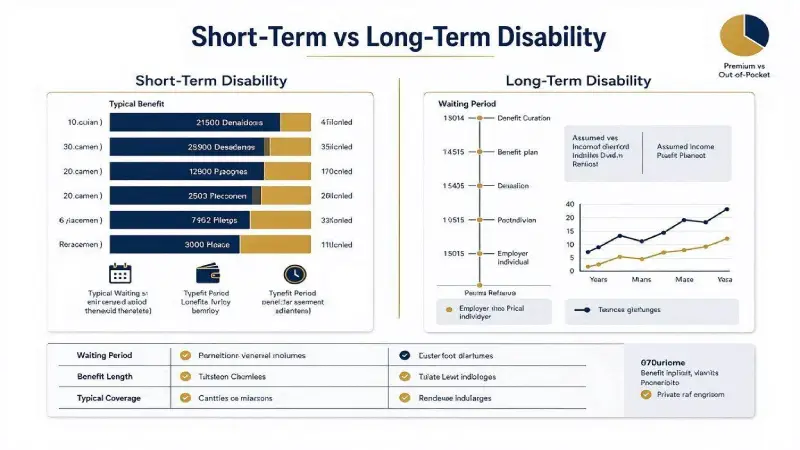
Short-term and long-term disability insurance solve different problems, and many financial planners recommend carrying both, whether through an employer, an individual policy, or a combination of the two.
| Feature | Short-Term Disability Insurance | Long-Term Disability Insurance |
|---|---|---|
| Typical elimination period | 0 to 14 days | 90 to 365 days |
| Typical benefit period | 9 weeks to 12 months | 2 years to age 65/67 |
| Common income replacement | 50% to 70% of income | 45% to 65% of income |
| Best suited for | Recovery from surgery, pregnancy, short illnesses, minor accidents | Serious injuries, chronic illness, cancer, long recoveries or permanent conditions |
| Where it’s commonly obtained | Often through employers; individual policies exist but are less common | Employer group plans and individual policies are both widely available |
| Premium cost relative to coverage | Lower absolute cost, shorter protection window | Higher absolute cost, protects long-term earning potential |
A useful way to think about it: short-term disability insurance bridges the gap while you recover from something temporary, while long-term disability insurance protects your career-long earning power against a serious or permanent setback.

Best Disability Insurance Companies Ranked
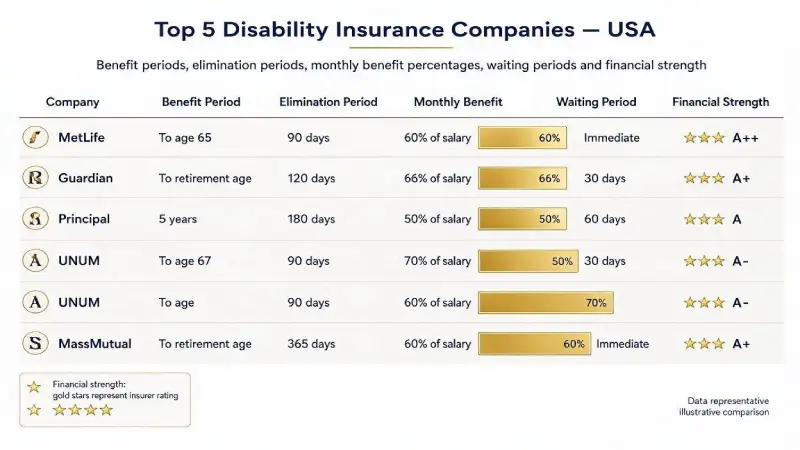
The individual disability insurance market is smaller and more specialized than markets like auto or homeowners insurance, and it is dominated by a handful of established mutual and stock insurers with decades of experience underwriting income protection. The table below compares seven of the most prominent providers in the individual and business disability insurance space based on publicly available financial strength ratings and policy structure.
| Company | Best For | Financial Strength (AM Best) | Waiting Period Options | Maximum Benefit Period | Online Quotes | Overall Rating |
|---|---|---|---|---|---|---|
| Guardian | True own-occupation coverage for high-income professionals | A++ (Superior) | 30, 60, 90, 180, 365 days | To age 65 or 67 | Through a licensed agent | 4.8 / 5 |
| MassMutual | Customizable riders and dividend-eligible policies | A++ (Superior) | 30, 60, 90, 180, 365 days | To age 65 or 67 | Through a licensed agent | 4.7 / 5 |
| Principal | Small business owners needing Business Overhead Expense coverage | A+ (Superior) | 30, 60, 90, 180 days | To age 65 or 67 | Through a licensed agent | 4.6 / 5 |
| The Standard | Group and voluntary workplace disability coverage | A (Excellent) | 30, 60, 90, 180, 365 days | To age 65 or 67 | Through employer or agent | 4.5 / 5 |
| Mutual of Omaha | Accessible entry-level coverage and simplified underwriting | A+ (Superior) | 30, 60, 90, 180, 365 days | To age 65 or 67 | Through a licensed agent | 4.5 / 5 |
| Northwestern Mutual | Mutual company dividends and long-term policyholder value | A++ (Superior) | 30, 60, 90, 180 days | To age 65 or 67 | Through a licensed agent | 4.6 / 5 |
| Illinois Mutual | Blue-collar and moderate-risk occupations underserved by larger carriers | A- (Excellent) | 30, 60, 90, 180 days | To age 65 or 67 | Through a licensed agent | 4.2 / 5 |
Overall ratings reflect a composite editorial assessment of financial strength, policy flexibility, occupation class breadth and market reputation. Ratings and product availability can change, and not every company offers coverage in every state or to every occupation class, so always verify current details directly with the insurer.
Guardian
Guardian, formally Guardian Life Insurance Company of America, is a policyholder-owned mutual insurer founded in 1860 and headquartered in New York City. It is one of the most respected names in individual disability insurance, particularly among physicians, dentists, attorneys and other high-income professionals who value a strong own-occupation definition.
Coverage Highlights: Guardian’s individual disability policies are known for offering a true own-occupation definition, meaning you can collect full benefits if you cannot perform your specific specialty even if you go on to work in a different field. The company also offers riders for future income increases, cost-of-living adjustments, and residual or partial disability benefits.
Pros:
- Superior A++ AM Best financial strength rating
- Strong true own-occupation definition, valuable for specialized professionals
- Extensive rider customization
- Long history as a mutual company owned by policyholders
Cons:
- Coverage must be purchased through a licensed agent rather than fully online
- Premiums tend to run higher than budget-oriented competitors
Best For: High-income professionals in specialized occupations who want the strongest possible own-occupation protection.
Why We Recommend It: Guardian consistently earns a place near the top of individual disability insurance comparisons because of its combination of financial strength and genuinely strong contract language — the details that matter most when you actually need to file a claim.
MassMutual
Massachusetts Mutual Life Insurance Company, commonly known as MassMutual, is another mutual insurer with a long track record in both life and disability insurance. Its Radius Choice disability income policy is frequently cited for its flexibility.
Coverage Highlights: MassMutual allows policyholders to customize benefit amounts, elimination periods and optional riders, including a residual disability rider and a future increase option that lets you raise coverage later without new medical underwriting.
Pros:
- Superior A++ AM Best financial strength rating
- Dividend-eligible policies through its mutual structure
- Strong rider flexibility for customizing coverage over time
Cons:
- Not available for instant online purchase — requires an agent
- Underwriting can be detailed for higher benefit amounts
Best For: Professionals who want a policy they can adjust and grow as their income and needs change over a career.
Why We Recommend It: MassMutual’s combination of financial strength and rider flexibility makes it a strong fit for people who expect their income — and therefore their coverage needs — to change significantly over time.
Principal
Principal Financial Group is a Des Moines-based insurer with a particularly strong presence in disability coverage for small business owners, thanks to its Business Overhead Expense (BOE) product line alongside personal disability income insurance.
Coverage Highlights: Principal’s individual disability policies typically define disability as an “own occupation, not working” standard in the base policy, with a true own-occupation rider available for an additional cost. Business Overhead Expense coverage can reimburse fixed business costs — rent, utilities, employee salaries — if the owner becomes disabled.
Pros:
- Superior A+ AM Best financial strength rating
- Strong option set for small business owners, including BOE coverage
- Established underwriting experience across many occupation classes
Cons:
- Base policy’s own-occupation definition is narrower than the true own-occupation rider, so read the rider details closely
- Requires agent involvement for quotes and applications
Best For: Small business owners who want to protect both personal income and business overhead in the event of a disability.
Why We Recommend It: Few carriers combine personal income protection and business expense coverage as seamlessly as Principal, making it a natural fit for entrepreneurs — a group that should also compare business liability insurance options as part of a complete risk management plan.
The Standard
Standard Insurance Company, known simply as The Standard, is headquartered in Portland, Oregon, and has been active in the group and voluntary workplace benefits market for more than a century. It is one of the largest providers of employer-sponsored group disability insurance in the country.
Coverage Highlights: The Standard is best known for group long-term and short-term disability plans offered through employers, along with voluntary worksite disability products. It also offers a Family Care Benefit that can extend coverage to policyholders who leave work temporarily to care for a family member.
Pros:
- Excellent A rating from AM Best with a long continuous ratings history
- Large-scale group disability experience covering millions of employees
- Distinctive Family Care Benefit not commonly offered elsewhere
Cons:
- Primarily accessed through an employer rather than as a direct individual purchase
- Individual policy customization is more limited than dedicated individual DI carriers
Best For: Employees evaluating or supplementing an employer-sponsored disability plan.
Why We Recommend It: If your employer offers coverage through The Standard, you are working with one of the most experienced group disability administrators in the industry, backed by a long-standing financial strength track record.
Mutual of Omaha
Mutual of Omaha, founded in 1909, is a well-known mutual insurer that has built a reputation for accessible, simplified disability income products aimed at a broad range of income levels and occupations.
Coverage Highlights: Mutual of Omaha’s disability income products include simplified or no-exam underwriting options for certain coverage amounts, along with riders such as a Residual Disability benefit for partial income loss and a True Regular Occupation rider.
Pros:
- Superior A+ AM Best financial strength rating
- Faster issuance and simplified underwriting relative to some competitors
- Household discount available when both spouses or partners apply
Cons:
- Uses a modified rather than true own-occupation definition on some products
- Some policies are guaranteed renewable rather than fully non-cancellable, meaning premiums can be adjusted at renewal
Best For: Budget-conscious buyers, younger workers, and those who want a faster underwriting process.
Why We Recommend It: Mutual of Omaha strikes a practical balance between affordability and financial strength, which makes it one of the more approachable entry points into individual disability coverage.
Northwestern Mutual
Northwestern Mutual, founded in 1857 and headquartered in Milwaukee, is one of the largest mutual insurers in the country and consistently earns some of the highest financial strength ratings in the industry.
Coverage Highlights: Northwestern Mutual offers disability income insurance with a range of riders tailored to occupation, income class and life stage, and as a mutual company, it distributes dividends to eligible policyholders based on the company’s financial performance.
Pros:
- Superior A++ AM Best financial strength rating
- Long dividend history as a mutual, policyholder-owned company
- Broad rider selection tailored to different occupations and income levels
Cons:
- Coverage is primarily distributed through Northwestern Mutual’s own financial representatives
- Standalone individual policy availability can be more limited compared to group offerings in some markets
Best For: Buyers who want a long-established mutual insurer with a strong dividend track record and broad rider customization.
Why We Recommend It: Northwestern Mutual’s financial strength and mutual ownership structure make it a dependable long-term choice for policyholders who plan to keep coverage in force for decades.
Illinois Mutual
Illinois Mutual, based in Peoria, Illinois and originally founded in 1910, is a smaller regional mutual insurer that has carved out a niche in disability income insurance for occupations that larger national carriers sometimes underserve, including blue-collar and moderate-risk professions.
Coverage Highlights: Illinois Mutual’s Paycheck Power series offers individual disability income coverage along with a Business Expense Power product for business owners, and the company offers a discount for business owners who purchase disability income and business expense coverage together.
Pros:
- Excellent A- AM Best financial strength rating
- Willingness to underwrite occupation classes that some larger carriers avoid
- Conservative, capital-strong balance sheet relative to its size
Cons:
- Smaller company with less national brand recognition
- Product and rider selection is narrower than larger national carriers
Best For: Self-employed and blue-collar workers in occupation classes that larger insurers may decline or price less competitively.
Why We Recommend It: Illinois Mutual fills an important gap in the market for moderate-risk occupations, backed by a financially conservative balance sheet despite its smaller size.

How Much Does Disability Insurance Cost?
There is no universal price for disability insurance because premiums are individually underwritten based on your personal risk profile. As a general guideline used across the industry, individual disability insurance often costs somewhere between 1% and 3% of your annual income per year, but your actual quote could fall outside that range depending on your circumstances.
The table below is illustrative only and is meant to show how cost can vary by broad income and occupation profile — it is not a quote and should not be used to estimate your own premium.
| Illustrative Profile | Approximate Annual Income | Illustrative Monthly Benefit | Illustrative Monthly Premium Range |
|---|---|---|---|
| Early-career office professional, low-risk occupation class | $50,000 | $2,000–$2,500 | $25–$60 |
| Mid-career professional, low-risk occupation class | $90,000 | $4,000–$4,500 | $60–$150 |
| Self-employed consultant, moderate-risk occupation class | $120,000 | $5,000–$6,000 | $100–$250 |
| Physician or specialist, own-occupation rider included | $250,000+ | $10,000–$15,000 | $300–$700+ |
These figures are illustrative approximations built from typical industry pricing patterns, not quotes from any single insurer. Your actual premium will depend heavily on the factors covered in the next section, and the only reliable way to know your cost is to request a formal quote.

Factors That Affect Premiums
Disability insurance underwriting weighs a combination of personal, occupational and policy-design factors. Understanding each one can help you make informed trade-offs when shopping for coverage.
- Age: Younger applicants typically pay less because they are statistically less likely to file a claim in the near term, and locking in coverage early can mean lower lifetime premiums.
- Occupation: Insurers assign occupation classes that reflect the physical and financial risk of your job. Desk-based professional occupations generally receive more favorable classes than physically demanding or hazardous occupations.
- Income: Your income determines the maximum benefit amount you can qualify for, since insurers cap coverage as a percentage of earnings to avoid over-insurance.
- Smoking status: Tobacco use is medically underwritten and typically increases premiums, similar to its effect on life insurance pricing.
- Health history: Pre-existing conditions, medications and overall health can affect both eligibility and pricing, and may result in exclusion riders for specific conditions.
- State of residence: Insurance is regulated at the state level, so product availability, rider options and pricing can vary from state to state.
- Benefit period: Longer benefit periods, such as coverage to age 65 or 67, cost more than shorter benefit periods of two or five years.
- Elimination period: A shorter elimination period means benefits start sooner but costs more; a longer elimination period lowers your premium in exchange for a longer unpaid waiting window.
- Monthly benefit amount: A higher monthly benefit naturally increases your premium, since the insurer is taking on a larger potential payout.
- Occupation class: Beyond the general occupation category, insurers assign specific class ratings that reflect claims experience for similar roles, which directly affects your rate.
Individual vs Employer Disability Insurance
Many workers have access to some level of disability coverage through their employer, but employer plans and individually purchased policies differ in important ways.
| Feature | Employer (Group) Disability Insurance | Individual Disability Insurance |
|---|---|---|
| Portability | Typically ends when you leave the job | Stays with you regardless of employer changes |
| Customization | Limited — set by the employer’s chosen plan | Highly customizable riders, benefit and elimination periods |
| Cost | Often subsidized or free to the employee | Fully paid by the individual, generally higher absolute cost |
| Benefit taxation | Taxable if employer paid premiums pre-tax | Typically tax-free if you paid premiums with after-tax dollars |
| Coverage amount | Often capped at a modest percentage of salary | Can be tailored to replace a higher share of income |
| Underwriting | Usually guaranteed issue up to a limit, no medical exam | Medically underwritten, may require exam or records |
Advantages of employer coverage: lower or no cost, simplified enrollment, and typically no medical underwriting for base amounts.
Disadvantages of employer coverage: coverage usually ends if you change jobs, benefit amounts may be modest, and benefits can be taxable depending on how premiums were paid.
Advantages of individual coverage: portability, customization and generally tax-free benefits when you pay premiums yourself.
Disadvantages of individual coverage: higher cost and a more involved underwriting process.
Who should choose each: Employees with strong group coverage and modest income needs may find employer disability insurance sufficient on its own. Self-employed workers, business owners and high earners whose income exceeds what a group plan replaces typically need an individual policy to fully protect their earning power — a consideration worth weighing alongside other coverage, including professional liability insurance for small businesses if you run your own practice.
How Much Disability Coverage Do You Need?
Most financial professionals recommend targeting a monthly benefit that replaces roughly 60% to 70% of your gross income, since disability benefits from individually purchased policies are often received tax-free and therefore don’t need to fully match your pre-tax paycheck to maintain your standard of living.
To estimate your own need, consider a few factors:
- Fixed monthly expenses: mortgage or rent, utilities, insurance premiums, debt payments and other obligations that continue regardless of your income status.
- Emergency savings: a fully funded emergency fund can help cover the elimination period before benefits begin, reducing how short an elimination period you need to select.
- Living expenses versus lifestyle expenses: distinguishing between what you must pay and what you could temporarily reduce helps you right-size your benefit amount instead of over-insuring.
- Self-employed considerations: without an employer safety net, self-employed workers often need to insure a higher share of income and may also want Business Overhead Expense coverage to keep a business running during a disability.
Running these numbers periodically — especially after a raise, a new mortgage, or a career change — helps ensure your coverage keeps pace with your actual financial obligations.
Common Policy Exclusions
Every disability insurance policy contains exclusions and limitations, and it’s essential to review them carefully since they vary meaningfully from insurer to insurer and state to state.
- Mental illness: Many policies cap benefits for mental health and nervous disorders at a limited benefit period, such as 24 months, rather than paying to the full benefit period.
- Pre-existing conditions: Conditions you were diagnosed with or treated for before the policy’s effective date are commonly excluded or subject to a waiting period before they are covered.
- Self-inflicted injuries: Disabilities resulting from intentionally self-inflicted harm are typically excluded from coverage.
- War: Disabilities resulting from war or acts of war are commonly excluded across the industry.
- Criminal acts: Injuries sustained while committing or attempting to commit a crime are generally excluded.
Because exclusions and limitations differ by insurer and by state insurance regulations, always request and read the full policy language — not just the marketing summary — before purchasing.
How to Choose the Best Disability Insurance Company
Use this checklist to evaluate providers side by side:
- Confirm the insurer’s financial strength rating from AM Best or another recognized rating agency.
- Compare the own-occupation definition closely — true own-occupation, modified own-occupation and any-occupation offer very different protection.
- Check whether the policy is non-cancellable, guaranteed renewable, or conditionally renewable, since this affects whether your premium can change over time.
- Review available riders, such as residual disability, future increase options, and cost-of-living adjustments.
- Ask about the elimination period and benefit period options and how each affects your premium.
- Understand how the insurer defines your occupation class and how that affects pricing.
- Research the insurer’s claims-paying reputation and customer service track record through independent reviews.
- Get multiple quotes so you can compare pricing and features across at least two or three carriers before deciding.
Pros and Cons of Disability Insurance
Pros:
- Replaces a meaningful portion of income if you cannot work due to illness or injury
- Individually purchased benefits are often received tax-free
- Riders allow you to tailor coverage to your career and life stage
- Protects long-term financial goals like retirement savings and homeownership from being derailed by a disability
Cons:
- Premiums can be a meaningful ongoing expense, especially for comprehensive own-occupation coverage
- Underwriting can be detailed, and pre-existing conditions may be excluded or increase cost
- Policy language and exclusions can be complex and require careful review
- Benefit periods and elimination periods create real gaps in coverage that must be planned around
Frequently Asked Questions
What is the best disability insurance company in the USA in 2026?
There isn’t a single “best” company for everyone, because the right choice depends on your occupation, income and priorities. Guardian and Northwestern Mutual are frequently favored by high-income professionals who want strong own-occupation protection, while Mutual of Omaha appeals to buyers prioritizing accessibility and faster underwriting. Principal stands out for small business owners needing Business Overhead Expense coverage, and Illinois Mutual serves occupation classes that larger carriers sometimes decline. Comparing financial strength ratings, own-occupation definitions and rider options across two or three insurers is the most reliable way to identify the best fit for your specific situation.
How much does disability insurance cost per month?
Individual disability insurance often costs roughly 1% to 3% of your annual income per year, though your actual premium depends on your age, health, occupation class, benefit amount, elimination period and benefit period. A young, healthy professional in a low-risk occupation might pay well under $100 a month for solid coverage, while a higher earner in a specialized field with a true own-occupation rider could pay several hundred dollars monthly. The only way to know your exact cost is to request quotes, since insurers individually underwrite every applicant.
What is the difference between short-term and long-term disability insurance?
Short-term disability insurance typically has a short elimination period and pays benefits for a matter of weeks or months, making it well suited to recovery from surgery, childbirth or a temporary illness. Long-term disability insurance has a longer elimination period but can pay benefits for years, sometimes until retirement age, protecting you against serious or permanent conditions. Many people carry both, either through an employer, an individual policy, or a combination of the two.
Can self-employed workers get disability insurance?
Yes. Self-employed individuals are a core market for individual disability insurance since they have no employer-sponsored safety net. Insurers typically use recent tax returns or business financial records to verify income during underwriting. Self-employed applicants may also want to consider Business Overhead Expense coverage, which reimburses fixed business costs like rent and payroll if the owner becomes disabled and cannot generate revenue.
What does “own occupation” mean in a disability policy?
An own-occupation definition means the insurer will pay your benefit if you cannot perform the material duties of your specific occupation, even if you are able to work in a different field. This is generally considered the strongest and most valuable definition, especially for specialized professionals like surgeons or attorneys, because it protects the value of your specific training and expertise rather than just your general ability to earn income in any job.
What is the elimination period in disability insurance?
The elimination period is the waiting period between the onset of your disability and the date your monthly benefits begin, functioning similarly to a deductible measured in time. Common elimination periods range from 7 to 90 days on short-term policies and 90 to 365 days on long-term policies. Choosing a longer elimination period generally lowers your premium, but it also means you need enough emergency savings to cover expenses during that unpaid window.
Does health insurance cover lost wages if I can’t work?
No. Health insurance pays for medical treatment — doctor visits, hospital stays, medications and procedures — but it does not replace the income you lose while you’re unable to work. That gap is exactly what disability insurance is designed to fill. If you’re also reviewing your medical coverage costs, it can help to compare what health insurance typically costs in 2026 alongside your disability insurance budget so you understand your full protection picture.
Is disability insurance worth it if I have savings?
Savings can cover a short-term setback, but most emergency funds are not designed to replace years of lost income from a serious injury or chronic illness. Disability insurance is generally worth considering for anyone who depends on their paycheck to cover ongoing expenses, since even a well-funded emergency account can be exhausted quickly if a disability lasts longer than expected. Savings and disability insurance work best together — savings cover the elimination period, and insurance covers the long haul.
What conditions are typically excluded from disability insurance?
Common exclusions include pre-existing conditions not disclosed or covered under the policy’s terms, self-inflicted injuries, disabilities resulting from war, and injuries sustained while committing a crime. Many policies also cap benefits for mental health and nervous disorders at a limited benefit period rather than the full policy term. Exact exclusions vary significantly by insurer and by state, so always review the specific policy language before purchasing.
Can I get disability insurance with a pre-existing condition?
It depends on the condition and the insurer. Some pre-existing conditions may result in an exclusion rider that excludes coverage for that specific condition, a rated (higher-cost) premium, or in some cases a decline. Other conditions that are well-managed and stable may be underwritten with standard terms. Working with an experienced agent who can shop your case across multiple carriers often improves your chances of finding favorable terms.
How is disability insurance different from workers’ compensation?
Workers’ compensation only covers injuries or illnesses that occur specifically because of your job, and it is provided by your employer’s insurer under state law. Disability insurance covers illnesses and injuries regardless of whether they are work-related, offering much broader protection. Someone who develops a disabling illness unrelated to their job, such as cancer or a car accident injury, would not be covered by workers’ compensation but could be covered by a disability insurance policy.
What is a non-cancellable disability insurance policy?
A non-cancellable policy guarantees that your premium and coverage terms cannot be changed by the insurer as long as you continue paying premiums, typically up to a specified age like 65. This offers the strongest long-term price protection. A guaranteed renewable policy, by contrast, guarantees the insurer cannot cancel your coverage, but it may adjust premiums for an entire class of policyholders at renewal. Non-cancellable policies generally cost more but offer greater long-term certainty.
How much disability insurance coverage should I buy?
Many financial professionals suggest targeting a monthly benefit that replaces roughly 60% to 70% of your gross income, since individually purchased benefits are often tax-free and don’t need to match your full pre-tax paycheck. Your ideal amount also depends on your fixed monthly expenses, existing emergency savings, and whether you have other income sources. Reassessing your coverage after major life changes, like a new mortgage or a significant raise, helps keep your protection aligned with your actual financial obligations.
Do disability insurance benefits get taxed?
Generally, disability insurance benefits are tax-free if you paid the premiums yourself with after-tax dollars. If your employer paid the premiums, or if you paid them with pre-tax dollars through a cafeteria plan, the benefits are typically taxable as income. This distinction is one reason many people choose to pay disability premiums personally even when coverage is offered through an employer, in order to preserve the tax-free benefit treatment.
What is residual or partial disability coverage?
Residual disability, sometimes called partial disability, is a rider that pays a percentage of your monthly benefit if you can still work but at reduced hours or capacity, resulting in a partial income loss. This is valuable because many disabilities don’t leave someone completely unable to work — they reduce earning capacity rather than eliminating it entirely. Without this rider, a policy might only pay if you are totally unable to work, leaving a gap for partial income loss situations.
Can I buy disability insurance if I work from home or freelance?
Yes, freelancers and remote workers can generally qualify for individual disability insurance, though insurers will evaluate your specific job duties and verified income, often using recent tax returns. Freelancers with variable income should be prepared to document an average income over a recent period, since insurers typically base your maximum benefit on documented, verifiable earnings rather than projected future income.
What happens to my disability insurance if I change jobs?
An individually purchased disability insurance policy stays with you regardless of employer changes, since you — not your employer — own the contract. This is one of the main advantages of individual coverage over group coverage. Employer-provided group disability insurance, on the other hand, typically ends when you leave that employer, which is why many professionals choose to supplement group coverage with a portable individual policy.
How do insurers determine my occupation class for disability insurance?
Insurers assign occupation classes based on factors like the physical demands of your job, the industry you work in, and historical claims experience for similar roles. Desk-based professional occupations with low physical risk typically receive more favorable occupation classes and lower premiums, while physically demanding or hazardous occupations are priced higher to reflect greater claims risk. Occupation class is one of the most significant factors in your premium, alongside age, health and the benefit and elimination periods you select.
Should business owners buy Business Overhead Expense insurance in addition to personal disability coverage?
Many business owners benefit from carrying both. Personal disability insurance replaces your individual income, while Business Overhead Expense (BOE) insurance reimburses fixed business costs — like rent, utilities and employee payroll — if you become disabled and cannot generate revenue. Without BOE coverage, a disabled owner might have enough personal income replacement but still watch the business fail from unpaid overhead. This is especially relevant for owners who are also weighing other protections, such as commercial auto insurance or cyber insurance for small businesses, as part of a comprehensive risk management strategy.
Final Verdict
There is no single insurer that qualifies as the best disability insurance company for every applicant, but the providers covered in this guide represent some of the most financially sound and well-established names in the individual and group disability insurance market. If you are searching for the best disability insurance companies USA 2026 has to offer, the right choice comes down to matching a carrier’s strengths to your own occupation, income level and coverage priorities — whether that means Guardian’s strong own-occupation protection for specialized professionals, Principal’s business overhead coverage for entrepreneurs, or Mutual of Omaha’s more accessible underwriting for budget-conscious buyers.
The most important step is simply not skipping this coverage altogether. Income is the asset that funds every other financial goal — your mortgage, your retirement savings, your children’s education — and protecting it with a well-chosen disability insurance policy is one of the more overlooked but consequential decisions in personal financial planning. Take the time to compare quotes, read the policy language closely, and work with a licensed agent who can walk you through the specific terms of each carrier before you commit.
How We Evaluated Disability Insurance Companies
Our editorial team evaluated disability insurance providers using a consistent set of criteria designed to reflect what actually matters to a policyholder over the life of a policy:
- Coverage: The breadth of policy types offered, including individual, group and business overhead expense products, along with available riders.
- Financial strength: Independent ratings from agencies such as AM Best, which assess an insurer’s ability to pay claims over the long term.
- Customer experience: Publicly available customer feedback, complaint indices and service reputation.
- Waiting periods: The range and flexibility of elimination period options available to policyholders.
- Benefit flexibility: How customizable benefit periods, monthly benefit amounts and optional riders are across each carrier’s product lineup.
- Policy options: The strength and clarity of own-occupation definitions and renewability terms, such as non-cancellable versus guaranteed renewable structures.
- Pricing transparency: How clearly each insurer communicates the factors that influence premiums, recognizing that individualized underwriting means final pricing always requires a personal quote.
- Claims reputation: Publicly available information regarding each carrier’s historical approach to claims handling and policyholder service.
Rankings reflect our editorial team’s independent analysis and are not paid placements. Insurance products, ratings and availability change over time, so always confirm current details directly with the carrier or a licensed insurance professional before making a purchasing decision.
This article is for informational purposes only and should not be considered insurance, financial or legal advice.

Ahmada Ndao is a financial research analyst and independent journalist
specializing in US consumer finance, legal rights, and insurance markets.
With over 5 years covering American financial products, he has helped
thousands of readers navigate complex insurance decisions, find the right
legal representation, and optimize their credit strategies. His research
methodology combines primary data analysis, direct outreach to industry
professionals, and continuous monitoring of federal regulatory changes.
Ahmada’s work has been cited by financial communities across the US and
reviewed by licensed attorneys and insurance professionals for accuracy.