
Markets
Professional editorial finance photography of an American saver reviewing certificate of deposit options on a laptop at a modern home office desk, smartphone showing a clean savings dashboard, printed financial documents and calculator nearby

Best CD Rates of September 2026 — Highest APYs & Best CD Accounts

Financial Disclaimer

The information in this article is for educational and informational purposes only and should not be considered personalized financial advice. CD rates, APYs, minimum deposits, early withdrawal penalties, account terms and availability can change at any time. Always verify the current terms directly with the financial institution before opening an account.

Certificate of deposit accounts can be an attractive option for savers who want a fixed interest rate and predictable returns without taking stock-market risk.

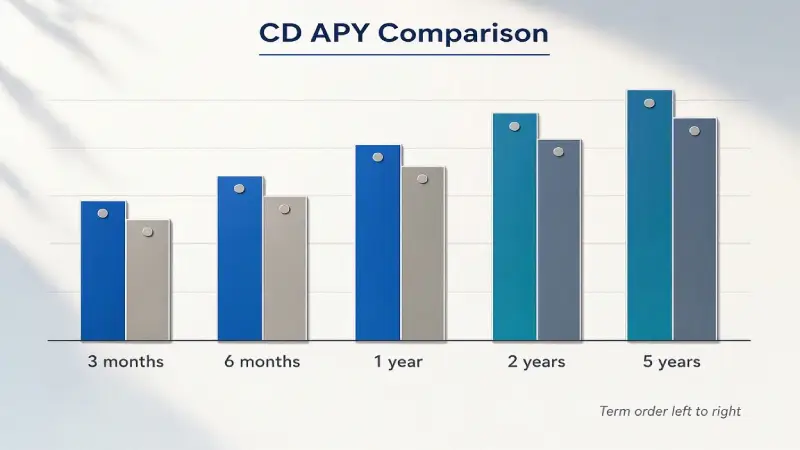
As of September 2026, competitive CD rates remain well above the national average for many traditional deposit accounts, with some nationally available products offering APYs around or above 4%. Current rates vary considerably by institution and term, so comparing the APY alone is not enough.

The best CD for you may depend on how long you can leave your money untouched, how much you have available to deposit, whether you need early access to your funds and whether the account is covered by federal deposit insurance.

In this guide, we compare the best CD options to consider in September 2026, explain current CD rates by term, show how CD penalties work, and explain how to choose between a CD, a high-yield savings account and other savings options.

Best CD Rates of September 2026

CD rates can change frequently, particularly when banks adjust their deposit pricing in response to changes in interest rates and competition for deposits.

Current market data shows that some of the highest CD APYs available nationally are around the mid-4% range, although the highest rate depends on the term, institution, minimum deposit and account requirements.

NerdWallet’s current September 2026 research shows that several one-year CDs offer APYs above 4%, including products around the 4.30% to 4.35% range.

For longer terms, NerdWallet currently lists Popular Direct among the providers offering some of the highest advertised CD APYs, including up to 4.50% for certain terms.

Forbes Advisor’s daily CD-rate tracking is also showing nationally available rates approaching 5% for certain products and terms.

Because these offers can change, consumers should treat published rates as a snapshot rather than a permanent guarantee.
CD Rates at a Glance

CD TermWhat to Look ForTypical Use
3 monthsCompetitive APY with low minimum depositVery short-term savings
6 monthsStrong APY and manageable lock-upShort-term goals
9 monthsCompetitive promotional ratesSavers between short and medium terms
1 yearStrong balance of yield and flexibilityGeneral savings goals
2 yearsFixed return for longer planningMedium-term goals
3 yearsLonger rate lockSavers comfortable committing funds
4 yearsLonger-term fixed returnLonger financial goals
5 yearsHigh long-term yield potentialMoney you will not need soon

The highest APY is not automatically the best option.

A 5-year CD paying slightly more than a 1-year CD may be less suitable if you expect to need the money sooner.

What Is a Certificate of Deposit?

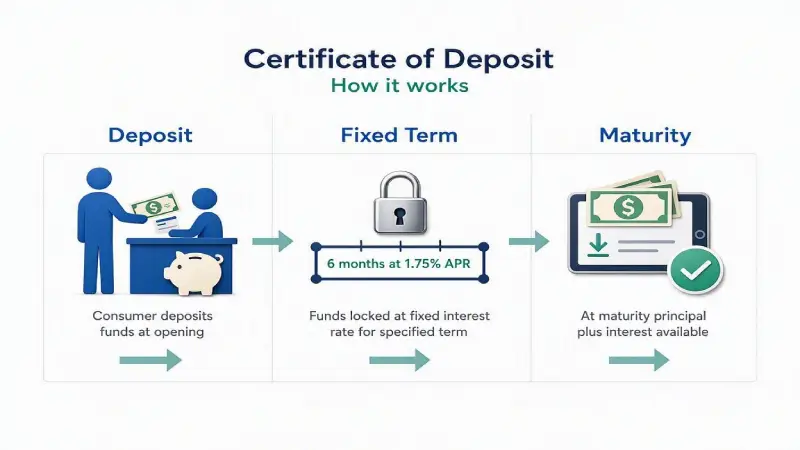
A certificate of deposit, commonly called a CD, is a type of time deposit account offered by banks and credit unions.

You deposit money for a specific period, known as the term. In exchange, the financial institution generally pays a fixed interest rate.

At maturity, you can typically withdraw your original deposit plus the interest earned or, depending on the account, renew the funds into another CD.

Unlike a standard savings account, a CD generally limits access to your money during the term.

That trade-off is one of the most important factors to understand before opening one.

How CD Interest Works

The interest rate on a CD is usually expressed as an annual percentage yield, or APY.

APY accounts for the effect of compounding and allows consumers to compare deposit products more easily.

For example, if you deposit $10,000 into a hypothetical CD paying 4.50% APY for one year and the account remains at that rate for the full term, the balance would grow by approximately $450 before taxes.

Actual interest earnings can vary depending on the institution’s compounding schedule, account terms and exact APY.
Best 1-Year CD Rates

One-year CDs remain one of the most important categories for consumers comparing fixed-rate savings.

NerdWallet’s September 2026 research currently lists several one-year CDs with APYs above 4%.

Examples appearing in its current research include:

  • CFG Bank CD
  • Live Oak Bank Personal CD
  • E*TRADE Certificate of Deposit
  • Newtek Bank CD
  • Popular Direct CD
  • NASA Federal Credit Union Share Certificate
  • Bask Bank CD
  • Sallie Mae Bank CD

The exact APYs and requirements can change, so consumers should verify the current offer before opening an account.

A one-year CD can make sense for someone who has a specific goal roughly 12 months away and does not need immediate access to the money.
Best Short-Term CD Rates

Short-term CDs generally include terms of less than one year.

Common options include:

  • 3-month CDs
  • 6-month CDs
  • 9-month CDs

These products can be useful for consumers who want a fixed return without committing their money for several years.

However, a shorter term is not automatically better.

If a 6-month CD pays significantly less than a 12-month CD, accepting the shorter maturity may result in lower earnings.

Consumers should compare both the APY and the maturity date.

Best Long-Term CD Rates

Long-term CDs commonly include:

  • 2-year CDs
  • 3-year CDs
  • 4-year CDs
  • 5-year CDs

The advantage of a long-term CD is that the interest rate is generally fixed for the entire term.

That can provide predictable returns and protect the account from falling rates during the CD term.

The disadvantage is reduced flexibility.

If rates rise after you open a long-term CD, your money remains locked into the original rate unless you withdraw early and accept the applicable penalty.

For this reason, long-term CDs require more careful planning.

Highest CD Rate vs. Best CD

These are not necessarily the same thing.

A CD advertising the highest APY may have:

  • A large minimum deposit
  • A very long term
  • A promotional rate
  • A limited availability period
  • Strict withdrawal rules
  • A requirement to maintain a specific balance

Another CD with a slightly lower APY may offer:

  • A smaller minimum deposit
  • A shorter term
  • More convenient access
  • Better renewal options
  • A more suitable maturity date

For many savers, the best CD is therefore the one that combines a competitive APY with terms that fit their financial plans.

What Is a Good CD Rate in September 2026?

There is no single number that defines a good CD rate because rates differ by term and account type.

However, current September 2026 market data shows that leading nationally available CDs can offer APYs in the 4% range, with some offers approaching 5% depending on the term and institution.

A consumer comparing a CD should ask:

  1. Is the APY competitive with other CDs of the same term?
  2. Is the deposit federally insured?
  3. What is the minimum opening deposit?
  4. What happens if I withdraw early?
  5. Does the CD automatically renew?
  6. What happens when the CD matures?
  7. Can I access the interest before maturity?
  8. Are there special requirements to receive the advertised APY?

Comparing the same term across several institutions provides a more useful comparison than simply searching for the highest advertised rate.

How CD Rates Are Determined

CD rates are influenced by several factors.

One of the most important is the federal funds rate and broader interest-rate conditions.

Banks also consider:

  • Competition for deposits
  • Their lending needs
  • Funding requirements
  • Expected future interest rates
  • Customer acquisition strategies
  • Internal pricing decisions

The relationship is not always immediate.

A change in the Federal Reserve’s policy does not necessarily cause every bank to change its CD rates on the same day.

In September 2026, the Federal Reserve’s target range moved to 3.75%-4.00%, adding another reason for consumers to pay attention to changing deposit rates.

CD vs. High-Yield Savings Account

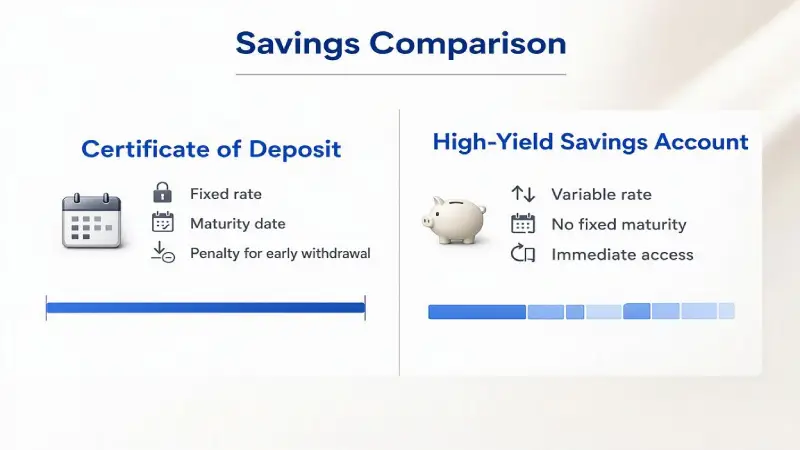
A high-yield savings account and a CD can both help consumers earn more interest on cash, but they serve different purposes.

FeatureCDHigh-Yield Savings Account
Interest rateUsually fixed for the termUsually variable
Access to moneyLimited during termGenerally easier
Early withdrawal penaltyUsually possibleGenerally none
Maturity dateYesNo
Rate changesUsually fixedCan change
Best forPlanned savingsFlexible savings

A CD may be useful when you know you will not need the money for a specific period.

A high-yield savings account may be more appropriate for an emergency fund or money that you may need to access unexpectedly.

CD vs. Money Market Account

Money market accounts can also compete with CDs and savings accounts.

A money market account generally offers easier access to funds than a CD, although account restrictions can apply.

The trade-off is that the interest rate is generally variable rather than locked for a fixed period.

Before choosing between a money market account and a CD, compare:

  • Current APY
  • Minimum balance
  • Monthly fees
  • Withdrawal rules
  • Rate stability
  • Deposit insurance

What Is a CD Ladder?

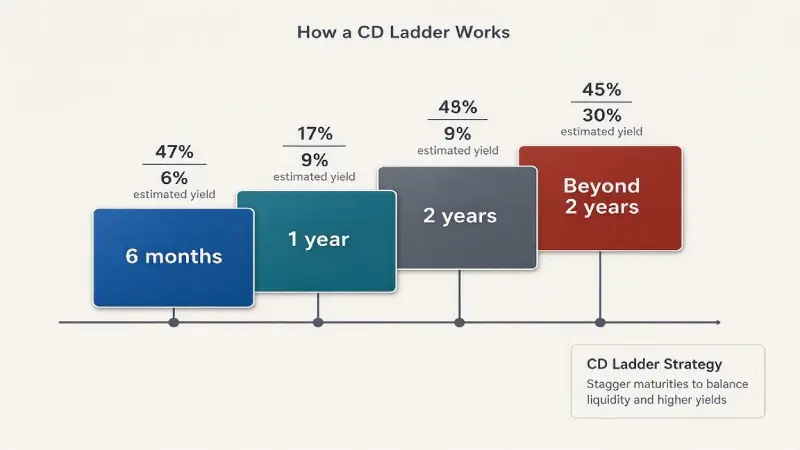
A CD ladder is a strategy that spreads money across multiple CDs with different maturity dates.

For example, instead of putting $20,000 into one five-year CD, a saver could divide the money among several CDs with different terms.

One possible structure could include:

  • $4,000 in a 1-year CD
  • $4,000 in a 2-year CD
  • $4,000 in a 3-year CD
  • $4,000 in a 4-year CD
  • $4,000 in a 5-year CD

When the first CD matures, the saver can decide whether to withdraw the money or reinvest it into a new longer-term CD.

This can provide more frequent access to funds while maintaining exposure to fixed CD rates.

The exact ladder should depend on the saver’s cash needs, goals and expectations.

CD Early Withdrawal Penalties

One of the biggest disadvantages of CDs is the potential penalty for withdrawing money before maturity.

The penalty depends on the financial institution and the specific CD.

It may be based on a certain number of months of interest or another formula disclosed in the account agreement.

Before opening a CD, read the early withdrawal policy carefully.

If there is a reasonable possibility that you will need the money before maturity, a high-yield savings account may provide greater flexibility.

What Happens When a CD Matures?

When a CD reaches maturity, the bank generally gives you a limited period during which you can decide what to do with the money.

Depending on the institution, you may be able to:

  • Withdraw the principal
  • Withdraw the interest
  • Renew the CD
  • Move the money into another account

Some CDs automatically renew if you do nothing.

This is why maturity dates are important.

Put a reminder on your calendar before the CD matures so you have time to review current rates and decide whether renewing still makes sense.

What Is an Automatic CD Renewal?

Automatic renewal means the financial institution may place your money into another CD after the original CD matures if you do not provide different instructions.

The new CD may have a different APY and term from the original account.

For example, a CD opened when rates were high could mature during a period when available rates are lower.

Always check the renewal terms before the maturity date.

Are CDs FDIC Insured?

CDs issued by FDIC-insured banks are generally covered by FDIC deposit insurance within applicable limits.

The standard FDIC insurance amount is generally $250,000 per depositor, per insured bank, for each ownership category.

Credit union share certificates may instead be insured by the National Credit Union Administration, or NCUA, within applicable limits.

Consumers should verify the insurance status of the institution before depositing money.

Deposit insurance is different from investment protection.

It is designed to protect eligible deposits if an insured bank or credit union fails, subject to applicable rules and limits.

How Much Money Should You Put in a CD?

There is no universal amount that every saver should place in a CD.

Before locking money into a CD, consider keeping enough liquid cash for:

  • Emergency expenses
  • Rent or mortgage payments
  • Insurance bills
  • Medical costs
  • Unexpected repairs
  • Near-term purchases

An emergency fund generally needs to remain accessible.

Putting your entire emergency reserve into a CD could create a problem if you suddenly need cash and have to pay an early withdrawal penalty.

Are CDs Taxable?

Interest earned from a CD is generally taxable income for federal tax purposes when it is credited or otherwise becomes taxable under applicable rules, even if you do not withdraw the interest.

The exact tax treatment can depend on the account structure and your circumstances.

Consumers should review the tax documents provided by the financial institution and consult a qualified tax professional for personal tax questions.

Who Should Consider a CD?

CDs may be worth considering for savers who:

  • Want predictable returns
  • Prefer fixed interest rates
  • Have money they will not need immediately
  • Want to avoid stock-market volatility for a specific savings goal
  • Are comfortable keeping money deposited until maturity

A CD may be less appropriate for someone who needs frequent access to their savings.

Who Should Avoid Locking Money Into a CD?

A CD may not be appropriate if:

  • You have no emergency savings
  • You expect to need the money soon
  • Your income is unstable
  • You have high-interest debt that should be addressed first
  • You may need the money before maturity
  • You are uncomfortable with fixed terms

The key issue is liquidity.

A high APY does not compensate for a product that does not fit your cash-flow needs.

How to Choose the Best CD

Use this checklist before opening a CD.

1. Compare APYs

Compare CDs with the same term rather than comparing unrelated maturities.

2. Check the Minimum Deposit

Some CDs can be opened with a relatively small amount, while others require substantially more.

3. Review the Early Withdrawal Penalty

Understand exactly how much you could lose if you need the money early.

4. Verify Deposit Insurance

Confirm whether the bank is FDIC insured or the credit union is NCUA insured.

5. Check the Maturity Date

Make sure the maturity date matches your financial plans.

6. Review Automatic Renewal

Know what happens if you do nothing when the CD matures.

7. Check Special Requirements

Some advertised rates may require specific balances, account relationships or other conditions.

8. Consider the Opportunity Cost

Ask whether the money could be used more effectively elsewhere.

Common CD Mistakes to Avoid

Chasing the Highest APY

A slightly higher rate is not necessarily worth a much longer term or larger minimum deposit.

Locking Up Emergency Savings

Emergency money should generally remain accessible.

Ignoring Early Withdrawal Penalties

Always read the penalty before opening the account.

Forgetting the Maturity Date

Automatic renewal can result in your money being placed into a less competitive CD.

Comparing Different Terms

A 5-year CD and a 6-month CD cannot be compared solely by APY.

Ignoring Deposit Insurance

Verify that your financial institution provides the appropriate federal deposit insurance.

September 2026 CD Rate Outlook

CD rates can change as banks respond to monetary policy, competition and expectations about future interest rates.

Recent September 2026 developments are particularly relevant because the Federal Reserve has moved its federal funds target range higher.

That does not mean CD rates will automatically rise by the same amount.

Banks set their own deposit rates, and different institutions can respond differently.

Consumers should therefore focus on current available offers rather than trying to predict exactly where rates will be several months from now.

Frequently Asked Questions

What is the highest CD rate in September 2026?

Current September 2026 market data shows that some nationally available CDs offer APYs approaching 5%, although the highest rate depends on the institution and term.

Rates can change at any time, so verify the current APY directly with the bank before opening an account.

Are CD rates expected to rise in 2026?

CD rates can respond to changes in the federal funds rate and other market conditions, but individual banks do not necessarily adjust rates immediately or by the same amount.

Is a 4% CD rate good?

A 4% APY can be competitive in the September 2026 market, but the answer depends on the CD term, minimum deposit, insurance coverage and available alternatives.

Are CDs safer than stocks?

CDs at federally insured banks provide deposit protection within applicable limits, while stocks are investments whose values can rise or fall.

The two products serve different purposes and should not be evaluated solely on their potential returns.

Can I lose money in a CD?

A federally insured CD generally protects eligible deposits against bank failure within applicable insurance limits. However, withdrawing money early can result in an early withdrawal penalty, and inflation can reduce the purchasing power of your returns.

What CD term should I choose?

Choose a term based on when you expect to need the money. If you need the funds within six months, a five-year CD may not be appropriate even if it offers a higher APY.

Are online banks good for CDs?

Online banks often compete aggressively on deposit rates because they generally operate with lower physical branch costs. However, consumers should still verify FDIC insurance, account requirements, customer support and withdrawal policies.

Can I open multiple CDs?

Yes. Opening multiple CDs can help you diversify maturity dates and build a CD ladder.

What happens if CD rates rise after I open one?

If your CD has a fixed rate, your APY generally remains fixed for the agreed term. You typically cannot simply increase the rate without opening another CD or accepting the applicable early withdrawal consequences.

Should I choose a CD or high-yield savings account?

Choose based on liquidity. CDs can provide a fixed rate for a defined period, while high-yield savings accounts generally provide easier access but variable rates.

Methodology

Nexuora evaluates CD accounts using consumer-focused criteria rather than looking only at the highest advertised APY.

Factors considered include:

  • Current APY
  • CD term
  • Minimum opening deposit
  • Early withdrawal policy
  • Deposit insurance
  • Account accessibility
  • Renewal conditions
  • Rate competitiveness
  • Overall usefulness for different savings goals

Because CD rates change frequently, this article should be treated as a current-market guide rather than a permanent ranking.

We also review current industry research from major personal-finance publishers and verify important product details against financial institutions and authoritative sources whenever possible.

Final Takeaway

The best CD rate is not necessarily the highest number you see in a comparison table.

The right choice depends on your savings goal, the amount you want to deposit, the length of time you can leave the money untouched and how much flexibility you need.

In September 2026, competitive CD rates remain available in the 4% range, with some products approaching 5% depending on the institution and term.

Before opening a CD, compare several offers with the same maturity period, verify the current APY, review the early withdrawal penalty and confirm federal deposit insurance.

For savers who want predictable returns and can leave their money untouched for a defined period, a CD can be a useful part of a broader savings strategy.