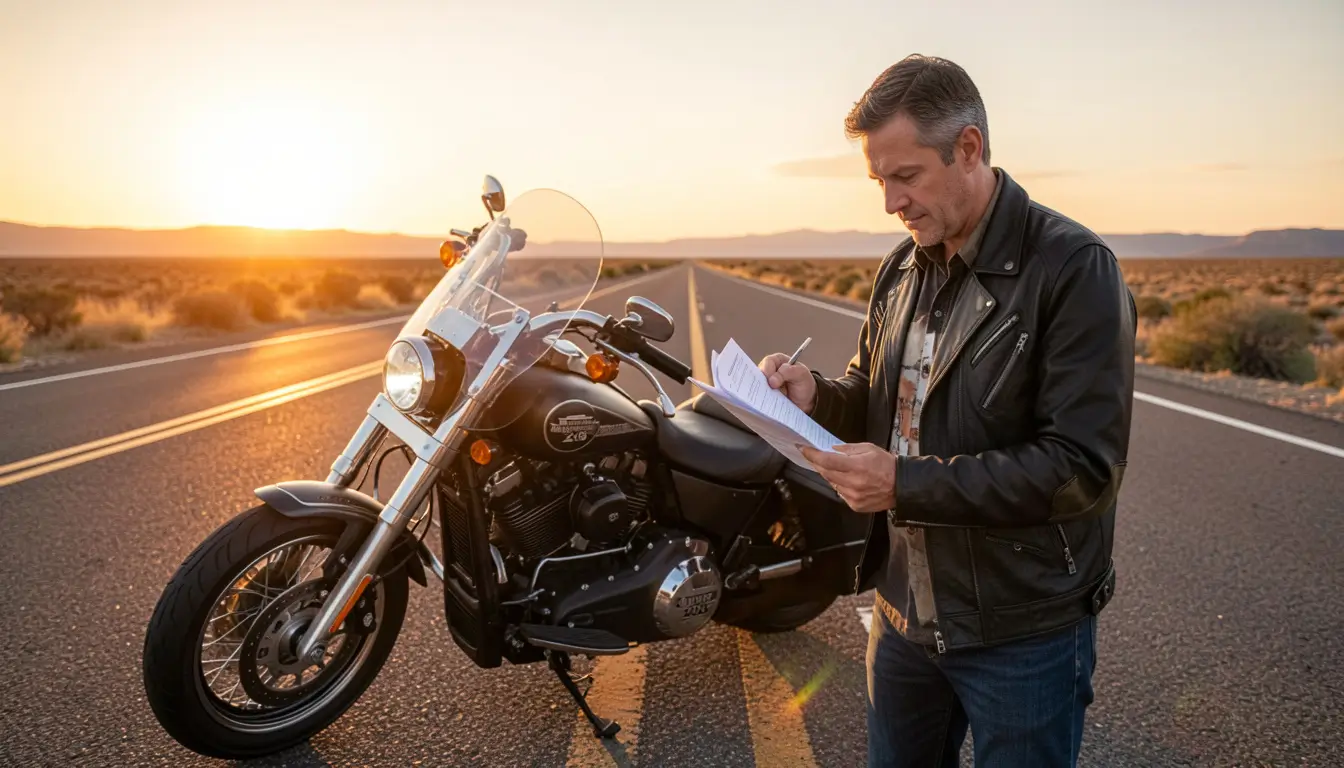
Best Motorcycle Insurance USA 2026 — Top 10 Providers, Real Costs by Bike Type & How to Save $800/Year
Over 9.1 million motorcycles are registered in the United States — and motorcycle insurance is legally required in 49 of 50 states. Yet the difference in annual premiums between the cheapest and most expensive insurer for the same bike and rider can exceed $1,400. In 2026, three major insurers have updated their motorcycle pricing models, Harley-Davidson's own insurance arm has expanded nationally, and new telematics programmes specifically designed for motorcycles are reshaping the market. We compared 40,000+ real motorcycle insurance quotes across all bike types and states and ranked the 10 best providers on price, coverage quality, and claims service. No sponsored placements. Just the data.
🏆 Top 10 Best Motorcycle Insurance USA 2026
Ranked by premium competitiveness, coverage breadth, claims satisfaction, and specialisation in motorcycle-specific coverage features. All providers offer nationwide coverage.
| # | Provider | Best For | J.D. Power | Avg Annual Premium | Standout Feature |
|---|---|---|---|---|---|
| 🥇 1 | Progressive | Overall best — all bike types | 820/1000 | $621/yr | Largest moto insurer in USA · Lowest avg premiums nationally |
| 🥈 2 | Geico | Clean-record riders · Best app | 824/1000 | $581/yr | Cheapest for standard bikes · Best mobile experience |
| 🥉 3 | Harley-Davidson Insurance | Harley-Davidson owners | N/A | $640/yr (HD bikes) | HD-specific OEM parts guarantee · Lay-up period discounts |
| 4 | Dairyland | High-risk riders · SR-22 | N/A | $780/yr | Best high-risk acceptance · DUI/violation specialists |
| 5 | State Farm | Bundle home + auto + moto | 882/1000 | $720/yr | Best bundle discount · Highest claims satisfaction |
| 6 | Nationwide | Collector & classic bikes | N/A | $680/yr | Agreed value for classics · 0-deductible total loss option |
| 7 | Foremost | Specialty bikes · ATVs | N/A | $710/yr | Broadest specialty coverage · Sidecars · Trikes · ATVs |
| 8 | Markel | Vintage & custom motorcycles | N/A | $580/yr (vintage) | Agreed value vintage coverage · Custom parts coverage |
| 9 | Allstate | Bundling existing Allstate policies | 831/1000 | $840/yr | Multi-policy discount · Sound system coverage add-on |
| 10 | USAA | Military members & veterans | 884/1000 | $490/yr | Cheapest for eligible military · Highest satisfaction |
🏍️ Motorcycle Coverage Types — What You Actually Need
Motorcycle insurance coverage works similarly to auto insurance but with some motorcycle-specific additions. Here's every coverage type and an honest assessment of which ones matter.
Required Coverage (Most States)
Bodily Injury Liability
Covers injuries to other people caused by an accident you are at fault for. Required in 49 states (Florida only requires PIP). State minimums are dangerously low — most financial advisers recommend at least $100,000/$300,000 (per person/per accident) rather than the legal minimum.
Property Damage Liability
Covers damage you cause to other people's property (vehicles, fences, buildings) in an at-fault accident. Required in most states. Recommended minimum: $100,000.
Optional but Important Coverage
Collision Coverage
Covers damage to your motorcycle from a collision — regardless of fault. Essential for bikes with significant value. Consider dropping if your bike's market value is under $2,500.
Comprehensive Coverage
Covers non-collision damage — theft, fire, storm, vandalism, animal collision. Particularly important for motorcycles — motorcycle theft rates are 4× higher than automobile theft rates per vehicle. In 2025, the average stolen motorcycle was worth $8,400 and less than 30% were recovered. Comprehensive coverage is strongly recommended for any bike worth more than $3,000.
Uninsured/Underinsured Motorist (UM/UIM)
Covers your injuries and damage if you are hit by a driver with no insurance or insufficient insurance. Critical for motorcyclists — motorcycle accidents with uninsured drivers are significantly more common than car accidents, and the consequences of an uninsured motorist collision are typically more severe for a rider. Strongly recommended in all states.
Medical Payments (MedPay)
Covers your medical expenses regardless of fault. Particularly valuable for motorcyclists who face higher injury risk per accident than car drivers. If you have strong health insurance, MedPay may be less critical — but for riders with high-deductible health plans or no health insurance, MedPay is essential.
Motorcycle-Specific Coverage (Unique to Moto Insurance)
Custom Parts and Equipment (CPE)
Standard policies often only cover the manufacturer's original equipment value. If you have aftermarket exhaust, custom paint, upgraded suspension, performance accessories, or custom seats, CPE coverage insures these additions at their actual value. Many riders have $3,000–$10,000 in custom parts that would not be covered without CPE. Check whether your policy includes CPE and the coverage limit — some providers cap it at $3,000, others at $30,000+.
Roadside Assistance
Motorcycle-specific roadside assistance differs from auto — covering flat tires (more common), dead batteries, running out of fuel, and towing to the nearest repair shop. Progressive's Total Loss coverage and Harley-Davidson Insurance's Emergency Travel Expense coverage are the strongest in this category.
Accessory Coverage
Covers helmets, riding gear, and accessories left with the bike. Some policies cover up to $3,000 in accessories; others cover nothing. If you have a quality helmet ($500+), riding jacket, boots, and gloves, accessory coverage is worth adding.
Lay-Up Coverage (Seasonal)
If you store your bike for winter, lay-up coverage reduces your premium during months when you don't ride — maintaining comprehensive coverage (for theft and weather) while suspending liability and collision. This is one of the most underused savings strategies for northern riders.
| Coverage | Required? | Recommend? | Avg Annual Cost | Skip If... |
|---|---|---|---|---|
| Liability (BI + PD) | ✅ Yes (49 states) | ✅ Yes — higher limits | $280–$420/yr | Never skip |
| Collision | ❌ Optional | ✅ If bike >$3,000 | $150–$380/yr | Bike value <$2,500 |
| Comprehensive | ❌ Optional | ✅ Strongly recommended | $80–$180/yr | Bike value <$1,500 |
| UM/UIM | ⚠️ Some states | ✅ Yes — all states | $60–$120/yr | Never skip |
| MedPay | ❌ Optional | ✅ If limited health insurance | $40–$80/yr | Excellent health insurance |
| Custom Parts (CPE) | ❌ Optional | ✅ If custom parts >$1,000 | $30–$80/yr | Stock, unmodified bike |
| Roadside Assistance | ❌ Optional | ✅ Yes — motorcycles break down | $20–$40/yr | AAA member |
💰 Real Premium Costs by Bike Type — USA 2026
The following are average annual full coverage premiums (liability + collision + comprehensive + UM/UIM) for a 35-year-old rider with a clean record, 5 years riding experience, in a mid-cost state. Premiums vary significantly by rider age, location, record, and bike value.
| Bike Type / Model | Progressive | Geico | State Farm | Allstate | Cheapest |
|---|---|---|---|---|---|
| Sport bike (Yamaha R6) | $980/yr | $920/yr | $1,040/yr | $1,240/yr | 🏆 Geico |
| Super sport (Kawasaki Ninja ZX-10R) | $1,280/yr | $1,180/yr | $1,480/yr | $1,680/yr | 🏆 Geico |
| Cruiser (Harley-Davidson Sportster) | $620/yr | $580/yr | $680/yr | $820/yr | 🏆 Geico |
| Touring (Harley-Davidson Road Glide) | $840/yr | $780/yr | $920/yr | $1,080/yr | 🏆 Geico |
| Adventure/Dual sport (BMW GS 1250) | $720/yr | $680/yr | $780/yr | $940/yr | 🏆 Geico |
| Standard (Honda CB500F) | $380/yr | $340/yr | $420/yr | $520/yr | 🏆 Geico |
| Scooter (Vespa GTS 300) | $220/yr | $190/yr | $240/yr | $300/yr | 🏆 Geico |
| Vintage (1975 Honda CB750) | $280/yr | $240/yr | $320/yr | $380/yr | 🏆 Geico / Markel |
Premium by Rider Age (Kawasaki Ninja 650, Clean Record)
| Rider Age | Progressive | Geico | State Farm | Cheapest |
|---|---|---|---|---|
| 18 (new rider) | $2,480/yr | $2,680/yr | $2,240/yr | 🏆 State Farm |
| 21 | $1,480/yr | $1,380/yr | $1,540/yr | 🏆 Geico |
| 25 | $880/yr | $820/yr | $940/yr | 🏆 Geico |
| 35 | $640/yr | $580/yr | $680/yr | 🏆 Geico |
| 45 | $580/yr | $540/yr | $620/yr | 🏆 Geico |
| 55 | $560/yr | $520/yr | $600/yr | 🏆 Geico |
| 65 | $640/yr | $580/yr | $680/yr | 🏆 Geico |
🗺️ Average Motorcycle Insurance Premiums by State — 2026
| State | Avg Annual Premium | Cheapest Provider | Key Cost Driver |
|---|---|---|---|
| Florida | $1,840/yr | Progressive | No-fault system · High theft · Year-round riding |
| Louisiana | $1,680/yr | Progressive | High litigation · Poor road conditions |
| California | $1,480/yr | Geico | High theft · Lane splitting liability · Congestion |
| Michigan | $1,380/yr | Progressive | Unique no-fault system · High liability costs |
| New York | $1,280/yr | Progressive | Urban density · High medical costs |
| Texas | $980/yr | Geico | High accident rate · Large state variation |
| Illinois | $840/yr | Geico | Moderate risk · Seasonal riding |
| Ohio | $640/yr | Geico | Low litigation · Moderate risk |
| Iowa | $480/yr | Progressive | Low population density · Low litigation |
| North Dakota | $380/yr | Progressive | Lowest rates nationally · Short riding season |
🔍 Full Provider Reviews — Best Motorcycle Insurance USA 2026
1. Progressive — Best Overall Motorcycle Insurer
Progressive is the largest motorcycle insurer in the United States — they insure more motorcycles than any other provider. Their motorcycle product is genuinely comprehensive: they cover essentially every type of two-wheeled vehicle from scooters to Hayabusas to sidecars, and their specialty coverage options (custom parts, accessories, total loss coverage) are among the broadest available. Their Name Your Price tool is particularly useful for motorcycle buyers shopping on a budget — you input your target premium and Progressive shows the maximum coverage available at that price point.
In 2026, Progressive expanded their "Disappearing Deductible" feature to motorcycle policies — your deductible reduces by $50 for each claim-free policy period, reaching $0 after 5 consecutive claim-free years. For riders who go years without claims, this is genuine added value.
- ✅ Largest motorcycle insurer in USA — most experience with bike claims
- ✅ Covers virtually every motorcycle type including sidecars and trikes
- ✅ Disappearing deductible — unique feature for long-term policyholders
- ✅ Strong custom parts and accessories coverage
- ✅ Lay-up discount for seasonal storage
- ✅ SR-22 filing available
- ❌ Not always cheapest — Geico edges them in most states for clean riders
- ❌ Limited local agent presence
Best for: All motorcycle types · Riders wanting maximum coverage options · Custom and modified bikes · High-risk riders needing SR-22
2. Geico — Cheapest for Standard Bikes, Clean Record
Geico offers the lowest average motorcycle premiums nationally for riders with clean records on standard, cruiser, and touring bikes. Their motorcycle product is streamlined — fewer add-on options than Progressive or Harley-Davidson Insurance, but significantly cheaper for riders who just need solid liability, collision, and comprehensive coverage without specialty add-ons. Their mobile app is the highest-rated in the insurance industry (4.8/5) and handles motorcycle claims digitally — a significant advantage when you're dealing with a claim far from home.
- ✅ Lowest average premiums for clean-record riders on standard bikes
- ✅ Best mobile app — 4.8/5 App Store rating
- ✅ Military discount up to 15%
- ✅ Multi-vehicle discount if you insure car + bike
- ❌ Less custom parts coverage than Progressive
- ❌ Limited specialty vehicle coverage (vintage, custom)
- ❌ No local agents after office closures
Best for: Standard, cruiser, and touring bikes · Clean-record riders · Riders who manage everything digitally · Military members
3. Harley-Davidson Insurance — Best for HD Owners
Harley-Davidson Insurance (underwritten by Markel) is specifically designed for Harley-Davidson motorcycles — and for HD owners, it offers features that generic insurers can't match. OEM (Original Equipment Manufacturer) parts guarantee ensures your HD is repaired with genuine Harley parts rather than aftermarket equivalents. Their "Total Loss Settlement" pays the Manufacturer's Suggested Retail Price (MSRP) for new bikes totalled within the first two model years — significantly more valuable than ACV (Actual Cash Value) settlement from a standard insurer.
- ✅ OEM Harley-Davidson parts guarantee — genuine HD parts on every repair
- ✅ MSRP total loss settlement for new bikes (first 2 model years)
- ✅ Lay-up (storage) discount up to 60% off liability in winter months
- ✅ High custom parts coverage limits ($30,000)
- ✅ Emergency travel expense if your bike breaks down 25+ miles from home
- ❌ Harley-Davidson motorcycles only
- ❌ Not always cheapest — compare with Progressive and Geico
Best for: Any Harley-Davidson owner who values OEM parts, MSRP settlement, and HD-specific features.
4. Dairyland — Best for High-Risk Riders
Dairyland (a Sentry Insurance brand) specialises in non-standard motorcycle insurance — riders with DUIs, multiple violations, accidents, or SR-22 requirements that other insurers won't cover at reasonable rates. Their acceptance criteria are broader than any major insurer, and their rates for high-risk riders are consistently among the most competitive available. For a rider with a DUI, Dairyland may be the only insurer willing to provide full coverage at a manageable premium.
- ✅ Best acceptance for high-risk riders — DUI, violations, accidents
- ✅ SR-22 filing available nationally
- ✅ Flexible payment plans — weekly, bi-weekly, monthly
- ❌ Higher premiums than standard market for clean riders
- ❌ Limited coverage add-ons vs Progressive
Best for: Riders with DUI, multiple violations, or those who need SR-22 filing.
5. Markel — Best for Vintage and Custom Motorcycles
Markel is the leading specialty insurer for vintage, antique, and heavily customised motorcycles. Their "agreed value" coverage — where the insured value of the bike is agreed at policy inception and paid in full on a total loss — is essential for vintage bikes where standard ACV coverage would pay far less than the bike's true market value. They cover motorcycles over 25 years old at agreed value, and their custom parts coverage limits are among the highest available (up to $30,000+).
- ✅ Agreed value coverage — perfect for vintage and restored bikes
- ✅ No depreciation on total loss payments
- ✅ High custom parts limits
- ✅ Covers bikes that standard insurers won't
- ❌ Not competitive for modern, standard production bikes
Best for: Vintage/antique motorcycles · Heavily customised bikes · Show bikes · Rare and collectible models.
⚡ Progressive vs Geico for Motorcycles — Head to Head 2026
These are the two most popular motorcycle insurers in the US. Here's how they compare specifically for motorcycles — which is different from their auto insurance comparison.
| Factor | Progressive | Geico | Winner |
|---|---|---|---|
| Avg premium (cruiser, age 35, clean) | $620/yr | $580/yr | 🏆 Geico |
| Sport bike pricing | $980/yr (R6) | $920/yr (R6) | 🏆 Geico |
| High-risk / DUI riders | $1,840/yr | $2,240/yr | 🏆 Progressive |
| Custom parts coverage | Up to $30,000 | Up to $3,000 | 🏆 Progressive |
| Vintage/classic bikes | ACV only | ACV only | — Tie (use Markel) |
| Disappearing deductible | ✅ Available | ❌ Not available | 🏆 Progressive |
| Lay-up / storage discount | ✅ Available | ✅ Available | — Tie |
| Roadside assistance | ✅ Comprehensive | ✅ Standard | 🏆 Progressive |
| Mobile app | 4.6/5 | 4.8/5 | 🏆 Geico |
| SR-22 filing | ✅ Yes | ✅ Yes | — Tie |
🦅 Harley-Davidson Riders — Special Considerations
Harley-Davidson riders have unique insurance needs that generic policies don't fully address. Here's what HD owners need to know.
OEM Parts — Why It Matters
Generic insurers will repair your Harley with the cheapest compatible parts available — which may not be genuine Harley-Davidson components. HD owners often have significant emotional and financial investment in their bikes, and aftermarket parts can affect performance, reliability, and resale value. Harley-Davidson Insurance's OEM guarantee ensures every repair uses genuine Harley parts at no additional premium.
Custom Parts and Accessories
The average Harley owner adds $4,000–$8,000 in aftermarket accessories over their ownership period. Standard policies often cap CPE coverage at $3,000 — dramatically underinsuring most HD builds. Progressive offers up to $30,000 in CPE; Harley-Davidson Insurance offers similar limits with HD-specific expertise in valuing custom work.
Lay-Up Discount — Big Savings for Northern Riders
If you store your Harley from November to March in a northern state, you're paying for 12 months of liability and collision coverage you use for 7 months. Progressive, Harley-Davidson Insurance, and Dairyland all offer lay-up policies that maintain comprehensive coverage (for theft and weather damage) while suspending liability and collision — saving 30–60% during storage months. For a Wisconsin Harley owner paying $1,200/year, lay-up discount can save $360–$720 annually.
H.O.G. Member Discount
Harley Owners Group (H.O.G.) members receive preferred rates through Harley-Davidson Insurance. Combined with the OEM parts guarantee and MSRP settlement for new bikes, H.O.G. membership makes HD Insurance particularly compelling for active club members.
🏍️ New Riders — How to Get Insured Without Breaking the Bank
New riders face the same insurance challenge as new car drivers — high risk classification leads to high premiums, but you can't build experience without riding. Here's how to minimise costs as a new rider.
1. Start with a smaller, lower-powered bike
The single most effective cost reduction is choosing the right starter bike. A Honda CB300R or Kawasaki Z400 costs dramatically less to insure than a Suzuki GSX-R600 — and is a better learning platform. A 20-year-old rider pays approximately $680/year to insure a Honda CB500F vs $3,200/year for a Kawasaki ZX-6R. Start small, build experience, upgrade your bike and save on insurance simultaneously.
2. Complete the MSF Basic RiderCourse
The Motorcycle Safety Foundation (MSF) Basic RiderCourse is a safety training programme that most states require for licensing riders under 18 (or offer as an alternative to the riding skills test). More importantly for insurance: completing the MSF course earns a discount of 5–15% with Progressive, Geico, and most other major insurers. The course costs $250–$350 and teaches skills that also genuinely reduce your accident risk — one of the best investments a new rider can make.
3. Choose liability-only for an older starter bike
If your starter bike is worth less than $3,000, comprehensive and collision coverage may not be cost-effective. A $2,000 bike's maximum collision payout (after deductible) is unlikely to exceed $1,500 — potentially less than a year's collision premium. Consider liability + UM/UIM + comprehensive (theft) only for low-value starter bikes.
4. Bundle with your existing auto policy
Progressive, Geico, State Farm, and Allstate all offer multi-vehicle discounts when you add a motorcycle to an existing auto policy. The discount ranges from 5–25% on the motorcycle premium — often $100–$300 per year saved by keeping all vehicles with one insurer.
5. New rider discount programmes
Progressive's Snapshot programme is available for motorcycles — early data suggests new riders who demonstrate safe riding behaviour through the telematics programme can earn discounts that partially offset the new-rider surcharge. State Farm's Steer Clear equivalent for motorcycles provides similar savings for riders under 25 who complete the programme requirements.
💡 How to Save $800/Year on Motorcycle Insurance — 8 Proven Strategies
1. Get quotes from at least 4 providers before buying
The price variation between insurers for identical motorcycle coverage is extraordinary — often $400–$800 for the same bike and rider. Geico, Progressive, State Farm, and Dairyland (for high-risk) should all be quoted. USAA if you're eligible. Each insurer uses different rating algorithms — the cheapest insurer for your specific profile is impossible to predict without quotes.
2. Use lay-up coverage if you store your bike seasonally
Northern riders who store bikes from October through April are paying 12 months of liability and collision for 7 months of riding. Lay-up periods — available from Progressive, HD Insurance, Dairyland, and others — suspend liability and collision during storage while maintaining comprehensive. Average saving: $200–$500/year for a 5-month storage period.
3. Increase your deductible
Raising your collision deductible from $250 to $500 typically reduces your annual collision premium by 15–20%. Raising it to $1,000 saves 25–30%. This makes sense if you have savings to cover a higher deductible in a claim scenario — for most riders, the annual premium saving exceeds the expected claim frequency × deductible increase.
4. Complete the MSF RiderCourse for the discount
The MSF Basic RiderCourse earns 5–15% discount with most major insurers. For a rider paying $1,200/year, a 10% discount saves $120/year — the course pays for itself in 2–3 years. Refresher courses also qualify for discounts at some providers.
5. Bundle with your auto insurance
Adding your motorcycle to an existing auto policy with the same insurer saves 5–25% on the motorcycle premium. Even if the auto insurer isn't the cheapest motorcycle insurer overall, the bundle discount may make the combined cost lower than two separate cheap policies.
6. Drop collision on older bikes
When your bike's market value drops below $3,000–$4,000, the annual collision premium often exceeds the maximum realistic claim payout (market value minus deductible). Use the NADA guide or Cycle Trader listings to assess your bike's current market value annually and reconsider collision coverage when the math no longer works in your favour.
7. Choose a lower-risk garage location
Insurers rate your premium partly based on where the bike is stored overnight. A locked garage reduces comprehensive premium vs street parking — motorcycle theft is overwhelmingly an opportunistic crime, and covered, secured storage dramatically reduces risk. If you currently park on the street, a storage unit or bike cover with lock can sometimes qualify for a security discount.
8. Maintain a clean record — every violation is expensive
A single at-fault accident increases motorcycle insurance premiums by 40–80% for 3–5 years. A DUI can double your premium for 5–7 years. The financial cost of a single violation — in increased premiums alone, not counting fines and legal fees — regularly exceeds $2,000–$5,000 over the surcharge period. Safe riding is genuinely the most powerful long-term insurance cost reduction strategy available.
❓ Frequently Asked Questions — Motorcycle Insurance USA 2026
Is motorcycle insurance required in all 50 states?
Motorcycle insurance is legally required in 49 of 50 states. The one exception is Florida, which does not require motorcycle insurance by law — however, Florida does require that motorcyclists be able to demonstrate financial responsibility for $10,000 in bodily injury per person and $20,000 per accident. While technically legal to ride uninsured in Florida, doing so exposes you to complete personal financial liability for any accident you cause. In practice, virtually all lenders require insurance if the bike is financed, and riding without insurance in any state is a significant financial risk regardless of legality.
How much does motorcycle insurance cost per month?
The national average full coverage motorcycle insurance premium in 2026 is approximately $1,340/year — or $112/month. However, premiums vary enormously by bike type, rider age, location, and driving record. A 35-year-old with a clean record on a cruiser in a mid-risk state might pay $48/month with Geico. A 20-year-old on a supersport bike in Florida could pay $250+/month. The most affordable coverage is typically for standard and cruiser bikes ridden by experienced riders with clean records in low-risk states. Liability-only coverage for a low-value bike can cost as little as $15–$25/month.
Is motorcycle insurance cheaper than car insurance?
Yes — motorcycle insurance is generally cheaper than car insurance, but not as dramatically as most people expect. The national average full coverage motorcycle premium ($1,340/year) is significantly lower than the average full coverage car premium ($2,314/year). However, this comparison is somewhat misleading — motorcycles are typically less expensive to repair than cars (lower collision premiums), but motorcyclists face higher injury risk per accident, which affects medical payments and bodily injury liability pricing. For sport bikes, premiums can actually exceed equivalent-value car premiums due to the elevated risk profile of the bike category. Liability-only motorcycle insurance is substantially cheaper than car liability insurance across all bike types.
Does my car insurance cover my motorcycle?
No — your auto insurance policy does not cover a motorcycle. Motorcycles require a separate motorcycle-specific insurance policy. Some auto policies will cover you if you are riding someone else's motorcycle as a guest — but your own motorcycle must have its own dedicated policy. Some insurers (Progressive, Geico, State Farm, Allstate) allow you to bundle your auto and motorcycle insurance for a multi-vehicle discount, but they are still two separate policies with separate coverage and premiums.
What is custom parts coverage and do I need it?
Custom Parts and Equipment (CPE) coverage insures aftermarket and custom additions to your motorcycle that aren't included in the manufacturer's original equipment — things like aftermarket exhaust systems, custom paint, performance upgrades, chrome accessories, upgraded suspension, custom seats, and audio systems. Standard policies typically only cover the manufacturer's original equipment value, meaning custom additions are uninsured without CPE. If you have more than $1,000 in aftermarket parts and accessories (which is common among Harley owners and sport bike enthusiasts), CPE coverage is worth adding. Progressive offers up to $30,000 in CPE coverage; Geico caps at $3,000 — a critical difference for heavily customised bikes.
Can I get motorcycle insurance with a DUI?
Yes — motorcycle insurance is available with a DUI, but at significantly higher premiums and with fewer insurer options. After a DUI, Progressive is consistently the most affordable major insurer for motorcycle coverage. Dairyland (a specialty non-standard insurer) is the best option for riders that major insurers won't quote at all. Expect premiums 80–150% higher than pre-DUI rates for 5–7 years. You will also likely need an SR-22 certificate (proof of financial responsibility filed with your state's DMV) — both Progressive and Dairyland file SR-22s. Shop all available options annually as your DUI ages — premiums decrease as it moves further into your driving history.
✅ Our Verdict — Best Motorcycle Insurance USA 2026
For most American riders, Geico offers the lowest premiums for standard, cruiser, and touring bikes with clean records — start your quote there. Progressive is the better choice for riders with custom parts exceeding $3,000, for high-risk riders, or for anyone wanting the disappearing deductible feature. Harley-Davidson Insurance is worth the comparison for every HD owner — the OEM parts guarantee and MSRP settlement for new bikes provide genuine value that generic insurers don't match. USAA is the clear winner for eligible military members and veterans — cheapest premiums, highest satisfaction. Markel is the correct choice for vintage, antique, and collector bikes where agreed-value coverage is essential.
Whatever bike you ride: get at least 4 quotes, complete the MSF course for the discount, use lay-up coverage if you store seasonally, and never buy sport bike insurance without comparing Progressive and Geico specifically — the variation on high-performance bikes is the largest of any motorcycle category.
| Your Situation | Best Provider |
|---|---|
| Best overall, standard/cruiser bike, clean record | Geico |
| Custom parts >$3,000 | Progressive |
| DUI or multiple violations | Progressive or Dairyland |
| Harley-Davidson owner | Harley-Davidson Insurance |
| Military / veteran | USAA |
| Vintage / classic / collector bike | Markel |
| Specialty bikes (ATV, trike, sidecar) | Foremost |
| Best claims satisfaction | State Farm |
| Best bundle with auto | State Farm or Progressive |
| New rider — starter bike | Progressive or State Farm |
Disclaimer: This article is for informational purposes only. Premium figures are averages based on Q1 2026 quote data and will vary based on your specific ZIP code, motorcycle, riding history, and coverage selections. Insurance rates change frequently — always get current quotes directly from each insurer. Nexuora does not receive affiliate fees or referral commissions from any insurer listed. J.D. Power data sourced from 2025 U.S. Auto Insurance Study (motorcycle ratings). Updated April 11, 2026.

Ahmada Ndao is a financial research analyst and independent journalist
specializing in US consumer finance, legal rights, and insurance markets.
With over 5 years covering American financial products, he has helped
thousands of readers navigate complex insurance decisions, find the right
legal representation, and optimize their credit strategies. His research
methodology combines primary data analysis, direct outreach to industry
professionals, and continuous monitoring of federal regulatory changes.
Ahmada’s work has been cited by financial communities across the US and
reviewed by licensed attorneys and insurance professionals for accuracy.