
Truck Accident Lawyer Dallas Cost 2026 — Fees, Settlements & How to Choose the Right Attorney
Dallas sits at the intersection of I-35, I-20, I-30, and I-45 — making it one of the most heavily trafficked commercial trucking corridors in North America. Texas recorded 672 fatalities involving commercial trucks in 2025 — the highest of any state in the nation. When an 18-wheeler, semi-truck, or other commercial vehicle collides with a passenger car, the consequences are almost always catastrophic. The legal complexity is also dramatically greater than a standard car accident: federal trucking regulations, multiple liable parties, commercial insurance coverage of $1M–$5M+, and corporate defendants with experienced defense teams. Understanding what a Dallas truck accident lawyer costs — and how that cost compares to what they can recover for you — is the first step in making an informed decision about your legal options. This complete 2026 guide covers every aspect of truck accident lawyer fees in Dallas, from contingency percentages to case expenses to net settlement calculations.
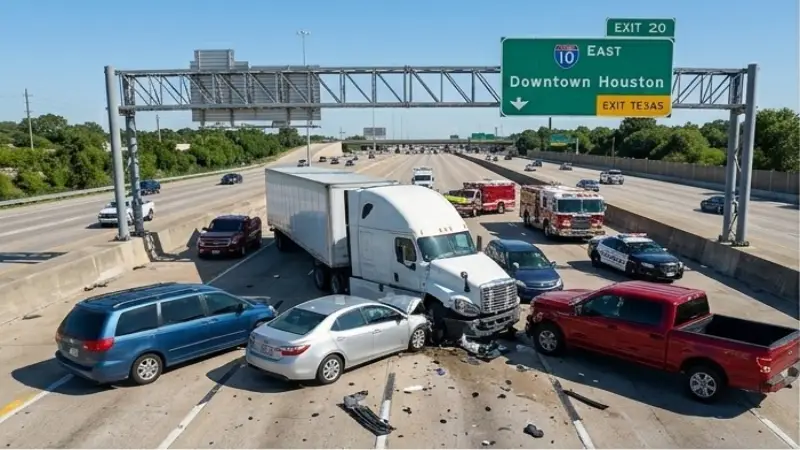
💰 How Much Does a Truck Accident Lawyer in Dallas Cost?
The most important thing to understand about Dallas truck accident lawyer costs is this: you almost certainly pay nothing upfront. The personal injury legal market in Texas — including for trucking cases — operates almost exclusively on contingency fee arrangements. You pay your attorney a percentage of your recovery, only when and if they win your case. If they don't recover anything, you owe nothing in attorney fees.
This is not simply a marketing claim — it is the fundamental economic model of plaintiff-side personal injury law. Truck accident cases are expensive to litigate. A complex 18-wheeler case can require $80,000–$200,000 in expert witness fees, investigation costs, accident reconstruction specialists, and medical experts before trial. Dallas truck accident firms fund these costs because they believe in the case's value and their ability to recover a settlement or verdict that covers those costs and generates their fee.
The Real Cost Question: What Percentage of Your Settlement Do You Pay?
The contingency fee percentage for Dallas truck accident cases is typically higher than standard car accident cases — and for good reason. Truck accident cases are more complex, require more expert resources, take longer to resolve, and carry higher litigation risk. The additional fee percentage reflects the additional work, time, and investment your attorney makes in your case.
| Case Resolution Stage | Typical Fee % | $1,000,000 Settlement Example | Your Net Recovery* |
|---|---|---|---|
| Pre-lawsuit settlement | 33–35% | Attorney: $330,000–$350,000 | ~$600,000–$620,000 |
| Post-lawsuit settlement | 40% | Attorney: $400,000 | ~$540,000–$560,000 |
| Trial verdict | 40–45% | Attorney: $400,000–$450,000 | ~$490,000–$540,000 |
| If no recovery | 0% | No attorney fee owed | — |
*Net recovery after attorney fee and before case expenses (typically $30,000–$150,000 for complex truck accident cases).
The Net Calculation — What You Actually Receive
To calculate what you actually receive from a truck accident settlement, you need to account for three deductions: the attorney's contingency fee percentage, case expenses advanced by the firm and reimbursed from the settlement, and any medical liens (bills paid by health insurance, Medicare, or Medicaid that must be repaid from the settlement). On a $1,000,000 truck accident settlement:
- Attorney fee (40% post-litigation): $400,000
- Case expenses (expert witnesses, investigation, depositions): $75,000–$120,000
- Medical liens (if applicable): $30,000–$100,000
- Your net recovery: approximately $380,000–$495,000
Even after all deductions, your $495,000 net recovery from a represented claim dramatically outperforms the $85,000–$150,000 that unrepresented truck accident claimants typically accept from commercial insurers — who know exactly how to exploit victims without legal counsel.
📋 Contingency Fees for Dallas Truck Accident Cases — Complete Breakdown

The contingency fee model has specific mechanics that significantly affect your net recovery. Understanding these mechanics before you sign a retainer agreement ensures you know exactly what you're agreeing to and can negotiate effectively.
Gross vs Net Contingency Fee Calculation
There are two ways attorneys calculate their fee relative to case expenses — and the method used makes a meaningful financial difference to you.
Method 1 — Fee calculated on gross settlement (expenses deducted after): If your settlement is $500,000 and the attorney charges 40%: Attorney fee = $200,000. Then expenses of $60,000 are deducted. You receive: $240,000.
Method 2 — Fee calculated on net settlement (expenses deducted first): $500,000 minus $60,000 expenses = $440,000 net. Attorney fee = $440,000 × 40% = $176,000. You receive: $264,000.
The difference in this example is $24,000 — real money that comes directly from your recovery. Always ask any Dallas truck accident attorney: "Do you calculate your fee on the gross settlement or the net after expenses?" The answer should be part of your evaluation. Most Texas contingency fee agreements calculate on the gross settlement (Method 1), but some plaintiff-friendly firms use Method 2. Knowing which applies to your agreement is essential.
What Case Expenses Look Like for a Dallas Truck Accident
Truck accident cases require significantly higher expert investment than standard car accident cases. Here are the typical expense categories and cost ranges you'll see deducted from your settlement:
| Expense Category | Typical Cost | Why It's Needed |
|---|---|---|
| Accident reconstruction specialist | $8,000–$25,000 | Establishes speed, braking, fault with engineering evidence |
| Medical expert witness | $5,000–$20,000 | Causation testimony linking crash to injuries |
| Life care planning expert | $8,000–$20,000 | Projects future medical costs for catastrophic injuries |
| Vocational rehabilitation expert | $5,000–$15,000 | Quantifies lost earning capacity for permanent injuries |
| Investigation (ELD data, black box) | $3,000–$10,000 | Preserves and analyses electronic evidence |
| Depositions and court reporters | $5,000–$20,000 | Formal testimony of all parties and witnesses |
| Court filing fees | $500–$2,000 | Mandatory for filing and trial |
| Trucking industry expert | $10,000–$30,000 | FMCSA compliance violations, industry standards |
⚖️ Why Truck Accident Cases Cost More Than Car Accident Cases
Dallas truck accident cases are legally, factually, and financially more complex than standard car accident cases — and this complexity explains both the higher contingency percentages and the dramatically higher potential settlements.
Multiple Liable Parties
In a standard car accident, one driver is typically at fault and their auto insurance provides coverage. In a truck accident, liability may be distributed across the truck driver, the trucking company (vicarious liability for their driver's conduct), the cargo loading company (if improper loading contributed to the accident), the truck manufacturer (if a defective component caused the crash), and the truck's maintenance provider (if deferred maintenance was a contributing factor). Identifying, naming, and pursuing all liable parties requires extensive investigation and specific legal expertise in commercial trucking law.
Federal Regulations Create Additional Claims
The Federal Motor Carrier Safety Administration (FMCSA) imposes extensive regulations on commercial trucking operations — Hours of Service limits preventing fatigued driving, mandatory pre-trip vehicle inspections, drug and alcohol testing requirements, weight and load restrictions, and electronic logging device requirements. Violations of these regulations are powerful evidence of negligence — and identifying them requires an attorney with specific FMCSA expertise and access to the trucking company's records through litigation discovery.
Commercial Insurance Policies Are Much Larger — And Harder to Collect
Federal law requires interstate commercial trucks to carry minimum liability insurance of $750,000. Most large trucking operations carry $1M–$5M in coverage, with umbrella policies extending to $10M+. These large policy limits represent substantial potential recovery — and the insurance companies defending these claims deploy specialized trucking defense teams with extensive resources. Your attorney must have equivalent expertise and resources to match them.
Corporate Defendants Use Aggressive Defense Tactics
Trucking companies deploy rapid response teams to accident scenes within hours — their primary goal is evidence preservation that favors the defense and statements from witnesses that minimize the truck driver's liability. They know that many victims don't hire attorneys immediately, and they exploit this window aggressively. Only an attorney with trucking accident experience who is retained quickly can effectively counter these tactics.
🏆 Top 8 Dallas Truck Accident Law Firms 2026
| # | Firm | Google Rating | Specialisation | Top Truck Result |
|---|---|---|---|---|
| 🥇 1 | Law Offices of Frank L. Branson | 4.9 ⭐ (310+) | 18-wheelers · Catastrophic trucking | $30M+ — multiple trucking verdicts |
| 🥈 2 | Slack Davis Sanger | 4.8 ⭐ (480+) | Commercial trucking · Aviation | $22M — Texas 18-wheeler fatality |
| 🥉 3 | Cowen | Rodriguez | Peacock | 4.8 ⭐ (290+) | Trucking · Offshore injury | $18.5M — commercial truck accident Dallas |
| 4 | Fears Nachawati | 4.7 ⭐ (640+) | Mass tort · Trucking · Product liability | $15M — 18-wheeler DFW area |
| 5 | The Carlson Law Firm | 4.8 ⭐ (820+) | Auto + commercial trucking statewide | $12M — North Texas truck accident |
| 6 | Witherite Law Group | 4.9 ⭐ (1,100+) | Car + truck accidents — high volume | $9.8M — Dallas commercial vehicle |
| 7 | Anderson Injury Lawyers | 4.8 ⭐ (380+) | 18-wheelers · Wrongful death | $8.4M — wrongful death truck accident |
| 8 | Montgomery Law | 4.9 ⭐ (220+) | Truck + car accidents · Fast response | $6.2M — I-35 commercial truck crash |
For broader personal injury case types in Texas, see our companion guide: Best Personal Injury Lawyers in Texas 2026. For understanding how insurance coverage limits affect trucking accident recoveries, our umbrella insurance guide explains how commercial liability policies work.
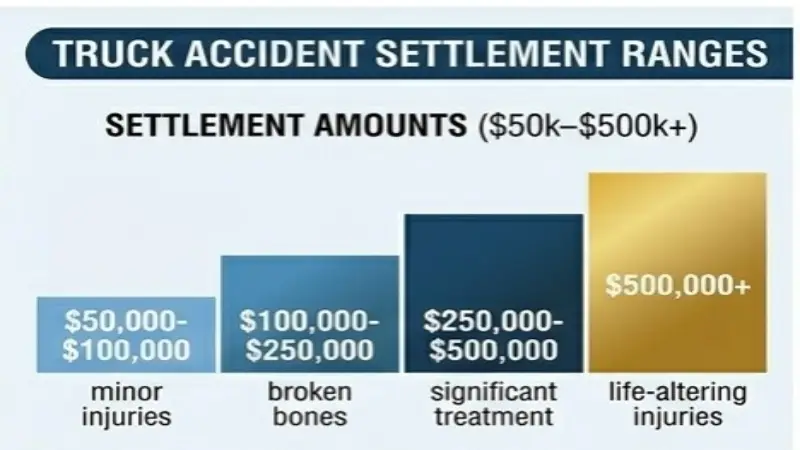
💵 18-Wheeler and Truck Accident Settlement Amounts in Dallas 2026
Truck accident settlements in Dallas are consistently among the largest personal injury recoveries in Texas — reflecting the severity of injuries, the size of commercial insurance policies, and the legal complexity that favors experienced plaintiff attorneys.
| Case Type / Injury | Dallas Settlement Range 2026 | Key Factors |
|---|---|---|
| Soft tissue / minor injury | $50,000–$150,000 | Commercial policy minimums change floor |
| Fractures / moderate injury | $150,000–$500,000 | Surgery, recovery time, lost wages |
| Spinal cord / disc injury | $300,000–$2M | Surgical intervention, chronic pain permanence |
| Traumatic brain injury | $500,000–$5M+ | Cognitive impairment, long-term care |
| Catastrophic / paralysis | $2M–$15M+ | Lifetime care costs, defendant resources |
| Wrongful death — 18-wheeler | $1M–$25M+ | FMCSA violations, multiple defendants |
| Multiple fatalities — mass casualty | $5M–$50M+ | Punitive damages possible, corporate defendant |
Why Truck Accident Settlements Are Higher Than Car Accident Settlements
Three factors explain the dramatically higher settlement values in truck accident cases compared to standard car accidents. First, the severity of injuries is typically much greater — the mass and momentum of a fully loaded 18-wheeler (up to 80,000 lbs) compared to a passenger vehicle (3,000–5,000 lbs) makes catastrophic injuries the norm rather than the exception. Second, commercial insurance policies carry minimum limits of $750,000 (interstate trucks) and often $1M–$5M in actual coverage, compared to the Texas minimum of $30,000 for passenger vehicles. Third, FMCSA regulation violations — Hours of Service violations, drug test failures, maintenance record falsification, improper cargo loading — create additional grounds for punitive damages that are not available in standard car accident cases.
⚖️ Who Is Liable in a Dallas Truck Accident?
One of the most important advantages of hiring an experienced Dallas truck accident attorney is their ability to identify all liable parties — not just the truck driver. Multiple defendants mean multiple insurance policies and dramatically larger potential recovery.
The Truck Driver
The driver is typically the most directly liable party — for acts of negligence including distracted driving, fatigued driving in violation of Hours of Service limits, impaired driving, speeding, unsafe lane changes, and failure to properly secure cargo. The driver is also the primary defendant for purposes of establishing liability through deposition testimony and driving record analysis.
The Trucking Company (Employer)
Under the doctrine of respondeat superior, employers are vicariously liable for the negligent acts of their employees committed in the course of employment. For truck drivers operating under the trucking company's authority, the company is liable for all driver negligence. Beyond vicarious liability, the trucking company may be directly liable for negligent hiring (hiring a driver with a prior DUI or license revocation), negligent supervision (failing to enforce Hours of Service compliance), negligent retention (continuing to employ a driver after known violations), and negligent maintenance (failing to properly service the vehicle).
The Cargo Loading Company
Improper cargo loading is a significant cause of Texas truck accidents — particularly rollovers and jackknife accidents caused by shifted, unsecured, or overweight cargo. If the company that loaded the truck (which may be separate from the trucking company) failed to secure cargo properly, failed to ensure the load was within weight limits, or loaded cargo that made the vehicle unstable, they are directly liable for accidents caused by those failures.
The Truck Manufacturer
If a defective vehicle component — brake failure, tire blowout, steering defect, or electronic stability control malfunction — contributed to the accident, the vehicle's manufacturer may be liable under product liability theories. This opens an entirely separate defendant with its own insurance coverage and potentially much larger resources than the trucking company alone.
Third-Party Maintenance Providers
Commercial trucks require extensive, frequent maintenance. If a contracted maintenance provider serviced the truck and performed inadequate work — missing a brake defect, failing to torque wheel fasteners correctly, or improperly maintaining safety systems — they may share liability for accidents attributable to those maintenance failures.
📋 Federal Trucking Regulations and How They Affect Your Dallas Case
The Federal Motor Carrier Safety Administration (FMCSA) imposes comprehensive regulations on commercial trucking operations. Violations of these regulations are not just regulatory infractions — they are evidence of negligence that your attorney can use to establish liability and pursue punitive damages.
Hours of Service Regulations
FMCSA Hours of Service rules limit how long commercial truck drivers can operate without rest. The current limits: truck drivers may drive a maximum of 11 hours after 10 consecutive hours off duty; cannot drive after being on duty for 14 consecutive hours; must take a 30-minute break after 8 cumulative hours of driving; and are subject to a 60/70 hour on-duty limit over 7/8 consecutive days. Violations of these rules — which produce fatigued driving — are among the most common FMCSA citations and among the most powerful evidence in truck accident litigation.
Electronic Logging Devices (ELDs), mandated for most commercial trucks since December 2017, automatically record driving time. Your attorney can subpoena ELD data to determine whether the driver violated Hours of Service in the period leading up to your accident. This data is time-sensitive — evidence preservation letters must be sent within hours of the accident.
Drug and Alcohol Testing Requirements
FMCSA requires pre-employment, random, post-accident, reasonable suspicion, and return-to-duty drug and alcohol testing for all commercial vehicle drivers. Post-accident testing must be completed within 32 hours (alcohol) and 8 hours (controlled substances) of a serious accident. If the trucking company failed to conduct required testing or allowed a driver with a prior positive test to operate, this creates significant liability exposure. Your attorney can subpoena the driver's full testing history through the FMCSA Drug and Alcohol Clearinghouse.
Vehicle Inspection and Maintenance Requirements
Commercial trucks must undergo annual FMCSA inspection and pass the Federal Motor Vehicle Safety Standards. Drivers must complete pre-trip and post-trip inspections and report all defects. Trucking companies must address reported defects before the vehicle returns to service. Maintenance records are discoverable through litigation and frequently reveal that known defects were deferred for economic reasons — a powerful indicator of corporate negligence.
Weight and Load Requirements
Federal regulations cap commercial truck weight at 80,000 lbs gross vehicle weight on interstate highways, with axle weight limits that vary by configuration. Texas permits some overweight loads with special permits — but loads exceeding permit limits or transported without required permits create strict liability. Overloaded trucks have dramatically increased stopping distances and reduced maneuverability — contributing directly to accident severity.
🔍 Critical Evidence in Dallas Truck Accident Cases

Truck accident cases involve a category of evidence that doesn't exist in standard car accident cases — electronic data generated by the truck itself and by the trucking company's records systems. This data is the foundation of the strongest truck accident cases in Dallas, and it is available only for a limited time after the accident.
Electronic Logging Device (ELD) Data
ELDs record the truck's speed, driving time, location, and engine activity continuously. This data can prove Hours of Service violations (the driver was too tired to be driving), speeding (the driver was operating above posted limits), and location history (the truck's exact route and timeline leading to the accident). ELD data must be formally preserved through a legal hold notice immediately after the accident — your attorney should issue this notice within hours of being retained.
Black Box / Event Data Recorder
Most modern commercial trucks are equipped with an Event Data Recorder (EDR) — the equivalent of an aircraft's black box. This device records vehicle speed, brake applications, acceleration, and other operational data in the seconds leading up to a collision. This data provides engineering-level evidence of driver behavior immediately before impact. Black box data can be overwritten after approximately 30–90 days, making early evidence preservation critical.
Driver's Logs and Records
Beyond ELD data, your attorney will subpoena: the driver's complete employment file with the trucking company, their prior safety violations and disciplinary history, their drug and alcohol testing history (through the FMCSA Clearinghouse), their medical examiner's certificate confirming fitness to drive, and all prior accident or incident reports. This paper trail frequently reveals patterns of negligence that the trucking company has ignored or concealed.
Trucking Company Safety Records
The FMCSA maintains a public database of motor carrier safety records — including safety audits, inspection histories, violation records, and crash histories. A trucking company with a history of Hours of Service violations, vehicle out-of-service orders, or prior accidents is a defendant with documented negligence patterns — a powerful foundation for punitive damages arguments.
Dashcam and Surveillance Footage
Many commercial trucks carry forward-facing, rear-facing, and cab-interior cameras. Footage capturing the moments before, during, and after the accident is the most compelling available evidence — and the most urgently time-sensitive to preserve. Your attorney's evidence preservation letter should specifically demand preservation of all dashcam footage, which trucking companies may otherwise routinely overwrite as part of their normal data management cycle.
📋 The Dallas Truck Accident Lawsuit Process
The typical timeline and process for a Dallas truck accident case differs from a standard car accident claim due to the additional investigation requirements, multiple defendants, and federal regulatory complexity.
Phase 1 — Emergency Evidence Preservation (Hours 1–72)
Your attorney issues legal hold letters to the trucking company, their insurer, and any maintenance or cargo companies — demanding preservation of all ELD data, black box data, maintenance records, driver logs, dashcam footage, drug test records, and communications relating to the driver and vehicle. This is the most time-critical phase of any truck accident case. Evidence that is not formally preserved can be lost — and the party that should have preserved it may face sanctions for spoliation of evidence, which can itself be used against them at trial.
Phase 2 — Investigation and Defendant Identification (Weeks 1–8)
Your attorney's team investigates to identify all potentially liable parties, obtain and analyse all available evidence, and develop an initial assessment of liability and damages. This phase includes engaging an accident reconstruction specialist, reviewing available ELD and black box data, obtaining police reports and witness statements, and issuing public records requests for traffic camera footage from TxDOT and Dallas city systems.
Phase 3 — Medical Documentation and Expert Development (Months 1–12)
Parallel to the legal investigation, your attorney coordinates with your medical team to ensure your injuries are fully documented for legal purposes — not just for treatment. They engage life care planners, vocational experts, and economic experts to calculate your total damages including future costs. For catastrophic injuries, this expert development phase may extend 12–18 months as your medical condition evolves toward Maximum Medical Improvement.
Phase 4 — Pre-Suit Demand and Negotiation (Months 6–18)
When your medical condition has stabilized, your attorney sends a comprehensive demand package to all defendants' insurers. For truck accident cases, this package typically includes accident reconstruction reports, medical expert opinions, economic loss analysis, vocational expert reports, and a complete damages summary with supporting documentation. Negotiation occurs directly with the commercial insurers and, frequently, through mediation — a structured settlement negotiation process where a neutral mediator facilitates agreement between the parties.
Phase 5 — Litigation (If Required)
If the insurers' best offer remains inadequate, your attorney files suit in Dallas County District Court (or federal court, if the defendants are in different states). Discovery — depositions of all parties, document requests, expert disclosures, and written interrogatories — typically takes 12–24 months. Settlement discussions continue throughout discovery and often intensify as trial approaches. Most truck accident cases resolve in settlement before the scheduled trial date, but your attorney's genuine trial capability is the leverage that produces those settlements.
🎯 How to Choose the Right Dallas Truck Accident Lawyer
Choosing the right Dallas truck accident attorney is the single most impactful decision in your case — more so than in a standard car accident case, because the legal complexity, federal regulatory knowledge requirements, and resource demands of truck accident litigation are significantly higher.
Must-Have Experience Criteria
Federal trucking regulation expertise: Ask specifically: "Do you have lawyers on staff who focus primarily on commercial trucking cases?" and "Are you familiar with FMCSA Hours of Service regulations, electronic logging device data analysis, and FMCSA safety record databases?" Generalist personal injury attorneys who occasionally handle truck accidents lack the specific expertise that builds the strongest cases.
Verified trucking accident trial record: Ask for specific trial verdicts from trucking accident cases — not just settlements. Attorneys who exclusively settle never develop the courtroom reputation that forces commercial insurers to offer fair settlements. The strongest truck accident settlements in Dallas come from attorneys who commercial trucking defense teams genuinely fear facing at trial.
Resources to fund complex litigation: Ask directly: "If my case requires $150,000 in expert witness fees and investigation costs, can your firm fund those costs on contingency?" Smaller firms without the financial depth to fund complex truck accident litigation will either take inadequate early settlements or refer your case to larger firms — costing you time and potentially a percentage of your recovery.
Questions to Ask in Your Free Consultation
- "What is your experience specifically with 18-wheeler and commercial truck accidents?"
- "Have you personally deposed commercial truck drivers and trucking company safety managers?"
- "Do you have an accident reconstruction specialist you work with regularly?"
- "What is your process for preserving ELD and black box data immediately after an accident?"
- "How many truck accident cases have you taken to trial in Texas state or federal court?"
- "Who specifically will be working on my case, and will I have direct access to the attorney?"
❓ Frequently Asked Questions — Truck Accident Lawyer Dallas Cost 2026
How much does a truck accident lawyer in Dallas charge?
Dallas truck accident lawyers work on a contingency fee basis — you pay nothing upfront and nothing unless they win your case. The standard contingency fee for truck accident cases in Texas is 33–35% if the case settles before litigation is filed, and 40% if a lawsuit is filed. These percentages are higher than standard car accident cases because truck accident litigation is more complex, requires higher expert investment, and takes longer to resolve. Case expenses — expert witnesses, investigation, depositions — are typically advanced by the firm and reimbursed from your settlement. The bottom line: hiring a Dallas truck accident attorney costs you nothing out of pocket, and statistically delivers a dramatically higher net recovery than going unrepresented.
What is the average truck accident settlement in Dallas?
Truck accident settlements in Dallas range from approximately $150,000–$500,000 for moderate injuries requiring surgery, to $1M–$15M+ for catastrophic injuries involving paralysis, severe TBI, or permanent disability, to $1M–$25M+ for wrongful death cases. The average is dramatically higher than standard car accident settlements for two reasons: the severity of injuries caused by commercial vehicles is typically much greater, and commercial insurance policies carry minimum limits of $750,000 for interstate trucks (often $1M–$5M in actual coverage). FMCSA regulation violations that prove negligence can also support punitive damages, which significantly increase total recoveries in cases where the trucking company had systematic safety failures.
How long does a truck accident lawsuit take in Texas?
Truck accident cases in Texas take longer than standard car accident cases due to their complexity. Pre-suit investigation and expert development typically takes 6–18 months after the accident, depending on injury severity. If litigation is filed, discovery takes an additional 12–24 months. Most truck accident cases ultimately settle before the scheduled trial date — typically 18–36 months after filing. This timeline reflects the thorough investigation, multiple defendants, federal regulatory analysis, and expert witness development required to properly build a truck accident case. Rushing to settlement before this work is complete typically results in a significantly lower recovery than the case's true value.
Should I accept the trucking company's initial settlement offer?
Almost certainly not. Trucking companies and their commercial insurers deploy rapid response teams to accident scenes — sometimes within hours — specifically to gather evidence and make early settlement offers to unrepresented victims before they understand the value of their claims. Early offers on truck accident cases are almost always a fraction of what the case is worth on full investigation. The trucking company's insurer knows the full value of their coverage and the strength of the evidence before you do. Accept no settlement offer — regardless of how it is framed — before retaining an experienced Dallas truck accident attorney and allowing them to complete a proper investigation and damages assessment. Accepting an early offer and signing a release permanently forfeits all future claims related to the accident.
What evidence is most important in a Dallas truck accident case?
The most critical evidence in Dallas truck accident cases is the electronic data generated by the truck itself: Electronic Logging Device (ELD) data recording Hours of Service compliance and driving patterns; Event Data Recorder (black box) data capturing vehicle speed, braking, and operational parameters in the seconds before impact; dashcam footage from any cameras on the truck; and the driver's complete history including drug and alcohol testing records, prior violations, and employment history. This data is time-sensitive — ELD data can be overwritten, black box data can be erased, and dashcam footage is routinely purged. Your attorney must issue a legal preservation demand within hours of being retained. The trucking company's own maintenance records, inspection reports, and FMCSA safety compliance history are equally important for establishing systematic corporate negligence.
Can I sue the trucking company, not just the driver?
Yes — and you should. The trucking company is typically liable for their driver's negligence under respondeat superior (employer liability for employee acts in the course of employment). Beyond vicarious liability, the company may be directly liable for negligent hiring (employing a driver with known disqualifying violations), negligent supervision (failing to enforce FMCSA compliance), negligent maintenance (deferring required repairs to save costs), and negligent entrustment (allowing an unqualified driver to operate the vehicle). Suing the trucking company accesses their commercial insurance policy — which is typically much larger than the driver's personal coverage — and opens the door to punitive damages if systematic corporate negligence can be established. Your Dallas truck accident attorney will identify and name all liable parties in the lawsuit.
✅ Final Thoughts — Understanding Truck Accident Lawyer Costs in Dallas
The cost of a Dallas truck accident lawyer — paid entirely on contingency from your settlement — is one of the best financial decisions an injured truck accident victim can make. The complexity of FMCSA regulatory violations, multiple liable parties, commercial insurance negotiations, and corporate defense teams is simply beyond what any unrepresented claimant can navigate effectively. The Dallas firms on our 2026 ranking — led by the Law Offices of Frank L. Branson and Slack Davis Sanger for proven trucking expertise — represent the highest quality of commercial truck accident representation in North Texas.
Call within 72 hours of your accident. The ELD data, black box records, and dashcam footage that will win your case are time-sensitive. For related coverage, see our guides on the best personal injury lawyers in Texas and free consultation car accident lawyers in Houston.
Disclaimer: This article is for informational purposes only and does not constitute legal advice. Settlement figures are averages and ranges based on publicly reported data — individual outcomes vary. Always consult a licensed Texas attorney for advice specific to your situation. Nexuora does not receive referral fees from any law firm listed. Updated April 18, 2026.

Ahmada Ndao is a financial research analyst and independent journalist
specializing in US consumer finance, legal rights, and insurance markets.
With over 5 years covering American financial products, he has helped
thousands of readers navigate complex insurance decisions, find the right
legal representation, and optimize their credit strategies. His research
methodology combines primary data analysis, direct outreach to industry
professionals, and continuous monitoring of federal regulatory changes.
Ahmada’s work has been cited by financial communities across the US and
reviewed by licensed attorneys and insurance professionals for accuracy.