Editorial Disclosure: Nexuora is an independent publisher. Our content is based on thorough research and publicly available data. We may earn compensation from partner links on this page. This does not influence our editorial ratings or recommendations.
In 2026, insuring a Tesla isn’t like insuring a typical sedan. Whether you own a Tesla Model Y, Model 3, Model S, or Model X, the cost of coverage can range from $172 per month to over $520 per month depending on your state, age, and driving history.
Tesla’s proprietary technology, expensive battery packs, and unique repair requirements have forced insurance companies to completely rethink how they price EV coverage. Some insurers have adapted well — others haven’t. The gap between the cheapest and most expensive quotes for the same driver can exceed $3,000 per year.
We analyzed rate data from every major national insurer, reviewed customer satisfaction scores from J.D. Power and the National Association of Insurance Commissioners (NAIC), and cross-referenced claims data to identify the best Tesla insurance companies available in the United States today.
Key Takeaways
- Tesla Insurance is the cheapest option for safe drivers in states where it’s available
- GEICO offers the strongest nationwide value and easiest bundling options
- The average Tesla owner pays $2,400–$4,200 per year for full coverage
- Florida and New York are consistently the most expensive states for Tesla insurance
- Bundling home and auto can save Tesla drivers $400–$900 per year
- Young Tesla drivers under 25 face annual premiums that can exceed $5,000
Cheapest Tesla Insurance Companies in 2026
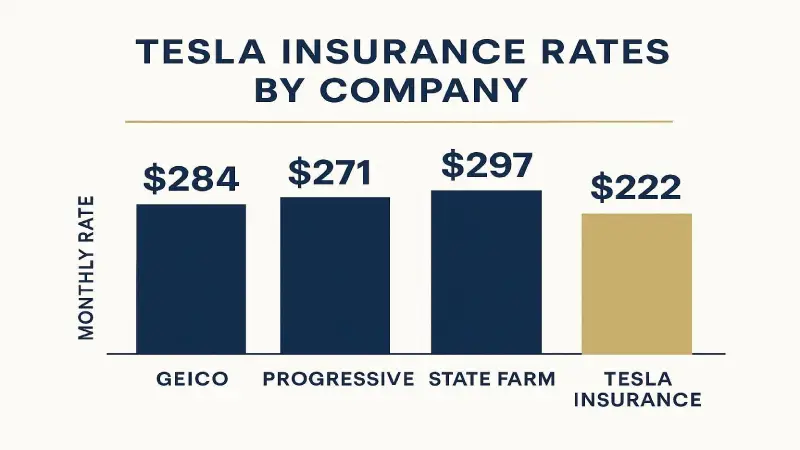
After comparing quotes across every major insurer, these are the best Tesla insurance companies for 2026 based on average monthly premiums, coverage quality, and customer satisfaction scores.
| Insurance Company | Avg Monthly Cost | Best For | Rating | Available States |
|---|---|---|---|---|
| Tesla Insurance | $189/mo | Safe Tesla drivers with high safety scores | ★★★★★ 4.7 | 12 states |
| GEICO | $205/mo | Nationwide availability and bundling | ★★★★½ 4.5 | All 50 states |
| Progressive | $228/mo | EV discounts and telematics programs | ★★★★ 4.4 | All 50 states |
| State Farm | $240/mo | Young drivers and student discounts | ★★★★½ 4.6 | All 50 states |
| Nationwide | $255/mo | High-value home and auto bundles | ★★★★½ 4.5 | All 50 states |
| Allstate | $272/mo | Comprehensive coverage add-ons | ★★★★ 4.2 | All 50 states |
Rates shown are averages for a 35-year-old driver with a clean record insuring a 2024 Tesla Model Y with full coverage. Your rate will vary. Data sourced from insurer websites and rate comparison tools as of April 2026.
See our full ranking of the cheapest car insurance companies in the USA for 2026 →
Why Tesla Insurance Is More Expensive Than Regular Car Insurance
Tesla vehicles consistently rank among the most expensive cars to insure in America, and there are clear structural reasons why. Understanding these factors helps drivers find strategies to lower their premiums.
1. Expensive and Proprietary Parts
Tesla vehicles use aluminum body structures, custom glass, and proprietary components that can only be sourced through Tesla’s own supply chain. Unlike traditional vehicles where a shop can source aftermarket or OEM parts from multiple suppliers, Tesla repairs often require specific parts that take longer to arrive and cost significantly more. According to data published by the Insurance Institute for Highway Safety (IIHS), Tesla vehicles have above-average repair costs that directly impact insurer loss ratios.
2. High Battery Replacement Costs
Even a minor rear-end collision can damage a Tesla’s battery management system. Full battery pack replacement costs can range from $12,000 to $22,000 depending on the model. This alone dramatically increases the average claim severity, which insurers factor directly into premium calculations.
3. Advanced Driver Assistance Systems (ADAS)
Tesla’s Autopilot system, cameras, radar sensors, and ultrasonic sensors are expensive to repair or recalibrate after accidents. Even seemingly minor front bumper damage can require recalibration of the forward-facing cameras, adding hundreds of dollars to otherwise simple repair bills.
4. High Vehicle Value
The average transaction price of a Tesla Model Y in 2026 remains well above $45,000. Comprehensive and collision coverage premiums scale with vehicle value, which naturally pushes Tesla insurance costs higher than comparable gas-powered sedans.
5. Limited Repair Shop Network
Expert Insight
« Tesla owners should understand that their vehicle’s repair complexity makes standard auto insurance models less accurate. Shopping annually and leveraging telematics programs like Tesla’s own Safety Score are among the most effective ways to reduce premiums in 2026. » — Nexuora Auto Insurance Research Team
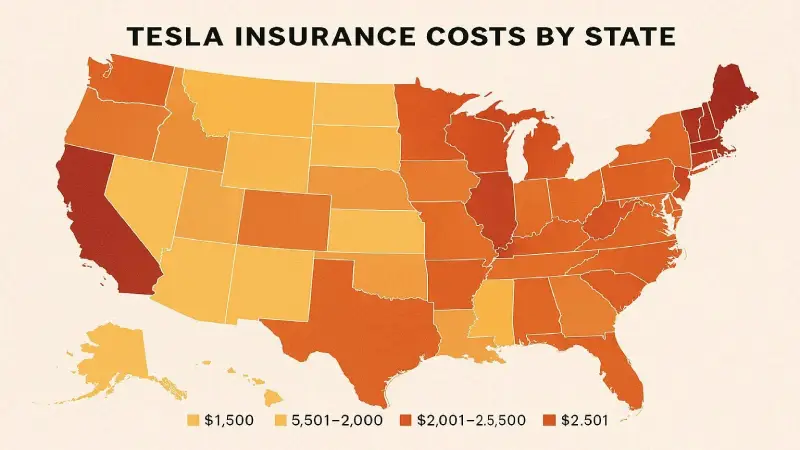
Tesla Insurance Rates by State (2026)
Your state of residence is one of the single biggest factors affecting your Tesla insurance cost. State-level regulations, litigation environments, weather risks, and traffic density all influence what insurers charge.
| State | Average Monthly Cost | Annual Cost | Key Risk Factor |
|---|---|---|---|
| California | $198 | $2,376 | High EV competition keeps rates lower |
| Texas | $215 | $2,580 | Large state with growing EV infrastructure |
| Arizona | $210 | $2,520 | Low weather risk, mid-sized urban centers |
| Illinois | $220 | $2,640 | Urban congestion in Chicago metro area |
| Washington | $224 | $2,688 | High EV adoption, moderate risks |
| Georgia | $248 | $2,976 | Increasing litigation environment |
| New Jersey | $295 | $3,540 | Dense traffic and high lawsuit frequency |
| Michigan | $310 | $3,720 | Historic no-fault laws increasing costs |
| New York | $365 | $4,380 | Dense urban risk, high litigation |
| Florida | $340 | $4,080 | Severe weather, fraud history, no-fault state |
Florida and New York remain the two most expensive states for Tesla insurance due to a combination of dense traffic, high lawsuit frequencies, and — in Florida’s case — ongoing hurricane and flood risks that affect comprehensive coverage pricing.
For an in-depth look at how state insurance regulations affect your premiums, see our guide: Cheapest Car Insurance by State in 2026.
Tesla Model Y Insurance Costs
The Tesla Model Y is the best-selling EV in the United States and represents the largest share of Tesla insurance policies. Despite being one of the more affordable Tesla models, its insurance costs are significantly above average compared to non-EV SUVs.
| Driver Profile | Annual Cost (Full Coverage) | Monthly Equivalent |
|---|---|---|
| Safe driver, age 35, married | $1,980 | $165 |
| Good driver, age 35, single | $2,180 | $182 |
| Driver with one minor accident | $3,850 | $321 |
| Driver with one DUI | $5,200 | $433 |
| Young driver under age 25 | $4,900 | $408 |
| Teen driver (added to parent policy) | $6,200+ | $517+ |
The Tesla Model Y earned the NHTSA’s highest 5-Star Overall Safety Rating, which helps moderate insurance costs compared to vehicles with lower safety ratings. However, its high repair costs remain a counterbalancing factor.
Tesla Model 3 Insurance Costs
The Model 3 is typically the most affordable Tesla to insure due to its lower sticker price and slightly simpler repair profile compared to the Model S or Model X.
| Insurance Company | Monthly Cost (Model 3) | Annual Cost | Notable Discount |
|---|---|---|---|
| Tesla Insurance | $172 | $2,064 | Safety Score discount |
| GEICO | $185 | $2,220 | Multi-policy bundling |
| State Farm | $199 | $2,388 | Good student discount |
| Progressive | $210 | $2,520 | Snapshot telematics |
| Allstate | $225 | $2,700 | Drivewise program |
According to Consumer Reports analysis, the Model 3 costs approximately 28% more to insure than a comparable non-EV sedan. This premium reflects the battery repair risk, not the driving behavior profile of Model 3 owners, who tend to be statistically above-average drivers.
Tesla Insurance vs GEICO: Which Is Better in 2026?
The two most common choices Tesla owners face when shopping for insurance are Tesla’s own insurance product and GEICO. Each has meaningful advantages depending on your situation.
Tesla Insurance
Tesla Insurance is a first-party insurance product that integrates directly with your vehicle’s telematics system. Rather than using traditional actuarial tables, Tesla Insurance calculates your Safety Score — a real-time measure of your driving behavior — and adjusts your monthly premium accordingly.
Available in: California, Texas, Illinois, Colorado, Ohio, Virginia, Maryland, Nevada, Washington, Minnesota, Oregon, and Arizona as of 2026.
Advantages:
- Often 15–30% cheaper for safe drivers with high Safety Scores (80+)
- Premiums updated monthly based on actual driving behavior
- Claims handled directly through the Tesla app
- Direct integration with Tesla service centers speeds up repairs
- Comprehensive knowledge of Tesla parts and repair costs
Disadvantages:
- Not available in all 50 states
- Cannot bundle with home insurance
- Limited agent support network
- Less favorable for drivers with lower Safety Scores
GEICO for Tesla Owners
GEICO insures Tesla vehicles through its traditional auto insurance framework. While it lacks the direct vehicle integration that Tesla Insurance offers, GEICO provides strong nationwide coverage with extensive bundling options.
Advantages:
- Available in all 50 states
- Home + auto bundle savings of $400–$900/year
- Larger agent and customer support network
- More stable premium structure (less fluctuation month to month)
- Multi-car discount for households with multiple vehicles
Disadvantages:
- Typically 8–18% higher premiums than Tesla Insurance for safe drivers
- No direct integration with Tesla vehicle data
- Claims processed through general auto insurance pipeline
Bottom Line: Tesla Insurance vs GEICO
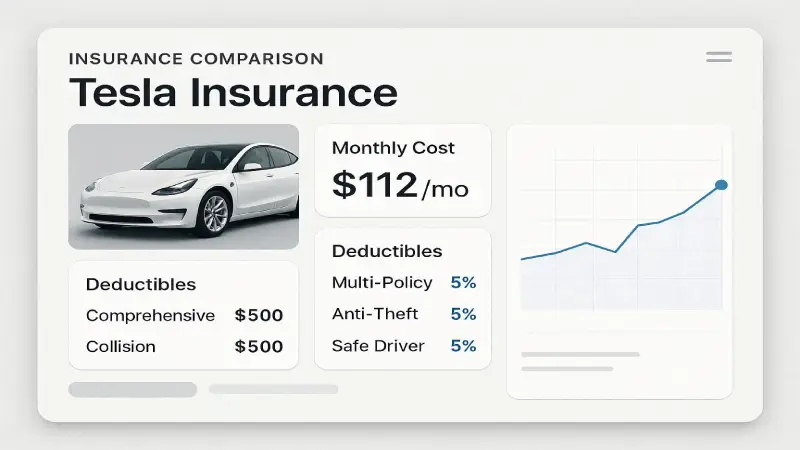
If Tesla Insurance is available in your state and you maintain a Safety Score above 80, Tesla Insurance will almost always be cheaper. If you need home bundling, live in a state where Tesla Insurance isn’t offered, or prefer a large customer support network, GEICO is a strong alternative.
Best Tesla Insurance Discounts in 2026
Multiple discount opportunities can significantly reduce your Tesla insurance costs. Understanding which programs you qualify for before getting a quote is essential to finding the best rate.
Universal Discounts (Available at Most Insurers)
- Multi-policy / Bundle discount: Combining auto and home insurance saves an average of $556/year according to Insurance Information Institute data
- Good driver discount: Clean records (no accidents or violations for 3+ years) typically qualify for 10–25% off
- Low mileage discount: Tesla drivers who commute short distances or work from home often qualify for usage-based discounts
- Pay-in-full discount: Paying your 6-month premium in full upfront saves 5–10% at most insurers
- Paperless billing discount: Opting for electronic statements saves $5–$15 per term at many companies
EV-Specific Discounts
- Tesla Safety Score program: Exclusive to Tesla Insurance; safe driving can reduce your monthly premium significantly
- Progressive Snapshot: Telematics-based discount program that can save safe drivers up to 30%
- State Farm Drive Safe & Save: Behavior-monitoring discount program available nationwide
- Good student discount: Students with a B average or better typically qualify for 8–15% off young driver premiums
See how discounts interact with your policy: Complete Guide to Car Insurance Discounts in 2026
Best Tesla Insurance for Young Drivers Under 25
Young Tesla drivers face some of the highest insurance premiums in the country. Insurers classify Tesla vehicles as high-performance vehicles in many rating categories, which compounds the already-elevated risk premium applied to drivers under 25.
| Company | Best Feature for Young Drivers | Avg Monthly Cost (Age 22) |
|---|---|---|
| State Farm | Steer Clear program + good student discount | $385 |
| GEICO | Competitive base rates + good student | $398 |
| Progressive | Snapshot telematics reduces rates for safe young drivers | $410 |
| Tesla Insurance | Safety Score-based pricing rewards careful drivers | $362 (high Safety Score) |
| Nationwide | SmartRide telematics program | $425 |
The most effective strategies for young Tesla drivers to lower premiums include:
- Staying on a parent’s policy until age 25 when possible
- Maintaining a high Tesla Safety Score if using Tesla Insurance
- Enrolling in a telematics program (Progressive Snapshot, State Farm Drive Safe & Save)
- Completing a defensive driving course (typically saves 5–10%)
- Maintaining a 3.0 GPA to qualify for good student discounts
What Coverage Do Tesla Owners Actually Need?
Choosing the right coverage types for a Tesla is more consequential than for a typical gas vehicle, given the higher repair and replacement costs involved.
Recommended Coverage for Tesla Drivers
- Comprehensive and Collision: Essential for a vehicle valued above $40,000. Skipping collision coverage on a Tesla is a major financial risk.
- Gap Insurance: Tesla vehicles depreciate faster than average. Gap insurance covers the difference between what your insurer pays and what you still owe on a loan or lease.
- Uninsured/Underinsured Motorist Coverage: Protects you when an at-fault driver lacks sufficient insurance — critical given that 1 in 8 U.S. drivers is uninsured according to III data.
- New Car Replacement: Pays to replace your Tesla with a brand-new model rather than its depreciated actual cash value — worth considering in the first 2–3 years of ownership.
- Roadside Assistance: While Tesla’s own roadside coverage is strong, supplemental insurer-provided roadside assistance adds useful redundancy.
How to Get the Cheapest Tesla Insurance in 2026
Beyond comparing quotes, Tesla owners have access to several specific strategies that can meaningfully reduce premiums:
- Compare at least 4–5 insurers annually: Rate differences between carriers for the same Tesla can exceed $3,000 per year
- Maximize your Tesla Safety Score: Tesla Insurance users with a score above 90 consistently pay 20–35% less than drivers with scores below 70
- Bundle home and auto insurance: This single move typically saves $400–$900 annually
- Increase your deductible: Raising from $500 to $1,000 typically reduces premiums by 8–15%
- Maintain a clean driving record: Even one at-fault accident can increase Tesla insurance costs by 50–80%
- Verify your mileage reporting: Lower annual mileage (under 7,500 miles/year) often qualifies for significant discounts
- Enroll in a telematics program: Multiple insurers now offer 10–30% discounts for monitoring-based programs
For a deeper dive into EV-specific coverage strategies, review our guide: Complete Electric Vehicle Insurance Guide 2026
Frequently Asked Questions
Conclusion: Best Tesla Insurance Strategy for 2026
Tesla insurance costs remain meaningfully higher than average in 2026, but the gap between the cheapest and most expensive quotes for the same driver is enormous. Shopping multiple insurers and leveraging available discounts can save Tesla owners thousands of dollars annually.
Our recommendations by driver profile:
| Driver Profile | Best Insurer | Reason |
|---|---|---|
| Safe driver in covered state | Tesla Insurance | Safety Score discounts deliver the lowest rates |
| Homeowner wanting to bundle | GEICO or State Farm | Bundle savings offset premium differences |
| Driver under 25 | State Farm or Tesla Insurance | Young driver programs and telematics rewards |
| Driver with accidents on record | Progressive | More forgiving rate structure for imperfect records |
| High-mileage driver | Nationwide | Competitive rates for drivers covering 15,000+ miles/year |
The single most impactful action Tesla owners can take is to get quotes from at least 4–5 insurers every 12 months. As the EV insurance market matures and more companies develop Tesla-specific rating models, the competitive landscape will continue to shift — making annual comparison shopping more valuable than ever.
Ready to compare quotes? See our comprehensive breakdown: Compare Car Insurance Quotes Online — 2026 Guide
Methodology: Nexuora collected Tesla insurance rate data from insurer websites, licensed third-party rate databases, and publicly disclosed regulatory filings. Rates shown represent averages across multiple driver profiles and geographic regions. Individual rates will vary based on your specific vehicle, driving history, location, credit score (where applicable), and coverage selections. Always obtain a personalized quote before making coverage decisions.

Ahmada Ndao is a financial research analyst and independent journalist
specializing in US consumer finance, legal rights, and insurance markets.
With over 5 years covering American financial products, he has helped
thousands of readers navigate complex insurance decisions, find the right
legal representation, and optimize their credit strategies. His research
methodology combines primary data analysis, direct outreach to industry
professionals, and continuous monitoring of federal regulatory changes.
Ahmada’s work has been cited by financial communities across the US and
reviewed by licensed attorneys and insurance professionals for accuracy.