
Best Umbrella Insurance USA 2026 — $1M Coverage from $150/Year, Top Providers & Who Actually Needs It
A single lawsuit can exceed your auto or homeowners liability limits in seconds. A serious car accident, a guest injured at your home, a defamation claim, or a dog bite — any of these can generate a judgment that wipes out your savings, investment accounts, and future earnings. Personal umbrella insurance provides an additional $1–$5 million in liability coverage above your existing auto and home policies — for as little as $150–$300 per year. It is one of the most cost-effective financial protection products available, yet fewer than 25% of American households carry it. In 2026, with lawsuit settlement amounts at record highs and social inflation driving jury awards to unprecedented levels, umbrella insurance has never been more valuable. We reviewed 22 US umbrella insurance providers and ranked the best by price, coverage breadth, and claims quality.
🏆 Top 10 Best Umbrella Insurance Providers USA 2026
Ranked by premium competitiveness, coverage breadth, underlying policy requirements, claims satisfaction, and financial strength.
| # | Provider | Best For | AM Best | $1M Annual Premium | Standout Feature |
|---|---|---|---|---|---|
| 🥇 1 | USAA | Military & veterans — best value | A++ | $150–$180/yr | Cheapest umbrella nationally · Eligible military only |
| 🥈 2 | Chubb | High-net-worth individuals | A++ | $280–$380/yr | Broadest coverage · Defense costs outside limits · No exclusions |
| 🥉 3 | Amica Mutual | Overall best for non-military | A+ | $190–$240/yr | Highest J.D. Power satisfaction · Dividend policies · Mutual model |
| 4 | State Farm | Bundle with existing SF policies | A++ | $200–$260/yr | Largest agent network · Best bundle discount |
| 5 | Geico | Budget — existing Geico customers | A++ | $180–$230/yr | Competitive pricing · Easy digital management |
| 6 | Progressive | Existing Progressive customers | A+ | $195–$250/yr | Strong auto + umbrella bundle · Snapshot discount applicable |
| 7 | Allstate | Broad add-on options | A+ | $220–$290/yr | Most add-on options · HostAdvantage for Airbnb hosts |
| 8 | Nationwide | Farmers / rural properties | A+ | $210–$270/yr | Strong farm and ranch umbrella · Property-specific endorsements |
| 9 | Travelers | High-risk professions | A++ | $230–$300/yr | Broad professional coverage · Strong financial backing |
| 10 | Erie Insurance | Mid-Atlantic & Midwest regions | A+ | $185–$235/yr | Top regional satisfaction · Competitive regional pricing |
☂️ What Is Umbrella Insurance & How Does It Work?
Personal umbrella insurance is a liability policy that activates when your existing auto, homeowners, or boat insurance liability limits are exhausted. It sits "above" your underlying policies — like an umbrella over your existing coverage — and provides an additional layer of protection for large claims.
How a Claim Works — Step by Step
Imagine you cause a serious car accident that injures another driver. Their medical bills, lost wages, and pain and suffering total $850,000. Your auto insurance carries $300,000 in bodily injury liability. Without umbrella insurance, you pay the remaining $550,000 from your personal assets. With a $1 million umbrella policy:
- Your auto insurance pays its $300,000 limit
- Your umbrella insurance activates and pays the remaining $550,000
- You pay nothing out of pocket — total protection: $1.3 million
The "Social Inflation" Problem in 2026
Social inflation refers to the trend of juries awarding dramatically larger verdicts than the actual economic damages in a case — driven by changing attitudes toward corporations and wealthy individuals, more sophisticated plaintiff attorneys, and "reptile theory" courtroom tactics that appeal to jurors' protective instincts. In 2026, nuclear verdicts (judgments over $10 million) are more common than at any point in US legal history. Standard liability limits of $100,000–$300,000 are increasingly inadequate for serious accidents.
| Scenario | Potential Judgment | Your Auto Limit | Without Umbrella — You Pay | With $1M Umbrella — You Pay |
|---|---|---|---|---|
| Serious car accident — 1 injured | $450,000 | $300,000 | $150,000 | $0 |
| Fatal car accident — wrongful death | $2,800,000 | $300,000 | $2,500,000 | $1,500,000 |
| Guest injured at your home (slip/fall) | $380,000 | $300,000 (homeowners) | $80,000 | $0 |
| Dog bite — serious injuries | $220,000 | $100,000 (homeowners) | $120,000 | $0 |
| Teen driver — serious accident | $680,000 | $300,000 | $380,000 | $0 |
🤔 Who Actually Needs Umbrella Insurance?
The honest answer: almost every homeowner and car owner who has assets worth protecting. But some profiles have particularly elevated risk. Here's a clear framework.
You Strongly Need Umbrella Insurance If:
- You have significant assets — savings, investment accounts, home equity, retirement funds. These are what a plaintiff's attorney targets when your policy limits are exhausted. The more you have, the more you need to protect.
- You have teenage drivers in your household — teen drivers have accident rates 3× higher than adult drivers. A teenager causing a serious accident can generate a judgment that devastates your family's finances for years.
- You own a swimming pool, trampoline, or dog — these are called "attractive nuisances" and dramatically increase your liability exposure. Insurance companies specifically ask about these when underwriting homeowners policies for a reason.
- You have high earning potential or a professional career — future wages can be garnished to satisfy judgments that exceed your current assets. A physician, attorney, or executive has decades of high future earnings at risk.
- You serve on a board, coach youth sports, or volunteer — these activities create liability exposure that your personal policies may not fully cover. Some umbrella policies extend coverage to volunteer activities.
- You rent out property or host through Airbnb — landlord and short-term rental liability creates exposure that standard homeowners policies exclude. Some umbrella policies cover rental activities; others require specific endorsements.
- You boat, ATV ride, or engage in high-risk activities — recreational liability from boats, ATVs, and jet skis is a significant and often underestimated exposure.
- You are active on social media — defamation, libel, and invasion of privacy claims from social media activity are increasingly common and covered by many umbrella policies but not standard homeowners.
You Probably Still Benefit From Umbrella Insurance If:
- You rent your home (no homeowners policy) but own a car
- You have limited current assets but significant future earning potential
- You drive regularly in high-traffic areas
The Assets-at-Risk Calculation
A simple framework: add up everything a plaintiff's attorney could pursue in a judgment against you.
| Asset Type | Protected from Judgment? | Notes |
|---|---|---|
| Primary home equity | ⚠️ Partially — state homestead exemption | Varies by state — TX and FL have unlimited homestead |
| Investment/brokerage accounts | ❌ Not protected | Fully exposed to judgment collection |
| Bank accounts (savings/checking) | ❌ Not protected | Fully exposed — bank levies possible |
| 401(k) / IRA retirement accounts | ✅ Generally protected | ERISA-qualified plans typically protected federally |
| Future wages | ⚠️ Partially — wage garnishment limits | Up to 25% of disposable earnings can be garnished |
| Second home / vacation property | ❌ Not protected | Fully exposed to judgment liens |
| Business assets (if personally owned) | ❌ Not protected | Sole proprietor assets fully exposed |
📋 What Does Umbrella Insurance Cover — and What Doesn't?
Covered by Most Umbrella Policies
- Bodily injury liability — injuries you cause to others in auto accidents, on your property, or elsewhere
- Property damage liability — damage you cause to others' property above underlying policy limits
- Personal liability — slip and fall on your property, dog bites, accidents involving your boat or recreational vehicle
- Libel and slander — defamation claims arising from statements you make (oral or written)
- False arrest, detention, or imprisonment
- Malicious prosecution
- Invasion of privacy
- Liability coverage abroad — most umbrella policies extend worldwide
- Legal defense costs — the insurer provides and pays for your legal defense in covered claims, typically within (and sometimes outside of) the policy limits
NOT Covered by Standard Umbrella Policies
- Your own injuries — umbrella is liability coverage only, not health insurance
- Damage to your own property — umbrella covers damage you cause to others, not your own property
- Business activities — professional liability, business lawsuits, and commercial activities are generally excluded (require separate business umbrella or E&O policy)
- Intentional acts — deliberate, intentional harm is excluded from all liability policies
- Criminal acts — fines, penalties, or restitution from criminal proceedings
- Workers' compensation — injuries to employees you hire (covered by workers' comp insurance)
- Contractual liability — liability you assume under contracts
- Nuclear or war-related losses
| Situation | Umbrella Covers? | Notes |
|---|---|---|
| You cause a car accident injuring others | ✅ Yes | After auto policy limits exhausted |
| Guest falls at your home | ✅ Yes | After homeowners liability limits exhausted |
| Your dog bites a neighbor | ✅ Yes | After homeowners limits exhausted |
| Teen driver causes accident | ✅ Yes | Household members typically covered |
| You post something defamatory online | ✅ Yes (most policies) | Libel and slander typically covered |
| Airbnb guest injured at your rental | ⚠️ Some policies | Check specifically — many exclude short-term rentals |
| Your business causes injury | ❌ No | Business umbrella required |
| You are injured in an accident | ❌ No | Your own injuries — not liability |
| Professional malpractice claim | ❌ No | E&O / professional liability policy required |
💰 How Much Does Umbrella Insurance Cost in 2026?
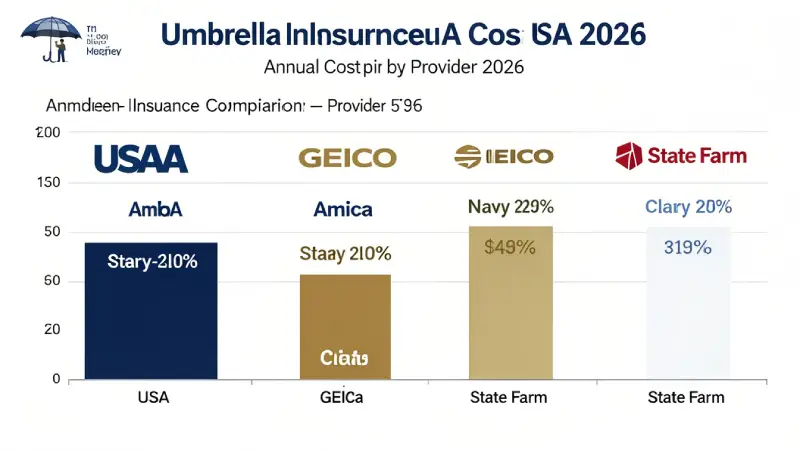
Umbrella insurance is remarkably affordable relative to the coverage it provides. The following are average annual premiums for a $1 million umbrella policy from major insurers in 2026.
| Provider | $1M Coverage | $2M Coverage | $5M Coverage | Additional $1M Increment |
|---|---|---|---|---|
| USAA | $150–$180/yr | $220–$260/yr | $380–$440/yr | ~$75/yr |
| Amica Mutual | $190–$240/yr | $280–$340/yr | $480–$560/yr | ~$80/yr |
| Geico | $180–$230/yr | $260–$320/yr | $440–$520/yr | ~$75/yr |
| State Farm | $200–$260/yr | $290–$360/yr | $490–$580/yr | ~$85/yr |
| Progressive | $195–$250/yr | $285–$355/yr | $480–$575/yr | ~$82/yr |
| Allstate | $220–$290/yr | $320–$400/yr | $540–$640/yr | ~$95/yr |
| Chubb | $280–$380/yr | $400–$520/yr | $680–$860/yr | ~$120/yr |
What Affects Your Umbrella Premium?
| Factor | Premium Impact | Notes |
|---|---|---|
| Coverage amount | High | Each additional $1M adds ~$75–$120/yr |
| Number of vehicles | Moderate | More vehicles = more accident exposure |
| Teen drivers in household | High | Adds $100–$200/yr typically |
| Swimming pool or trampoline | Moderate | Adds $50–$100/yr typically |
| Dog (certain breeds) | Moderate | Pit bulls, Rottweilers, Dobermans — some insurers exclude |
| Rental properties owned | Moderate–High | Each rental property adds risk and premium |
| Boat ownership | Moderate | Depends on boat size and horsepower |
| Prior claims history | High | At-fault accidents and liability claims increase premium significantly |
| Bundling with home + auto | Discount 5–15% | Available from all major insurers |
🔍 Full Provider Reviews — Best Umbrella Insurance USA 2026
1. USAA — Best Value (Military Eligible)
USAA consistently offers the lowest umbrella insurance premiums in the United States — $150–$180/year for $1 million in coverage — a price point no other major insurer approaches. Their umbrella product is comprehensive, their financial strength is A++ (AM Best), and their claims service is consistently rated highest in the industry. The single limitation is eligibility: USAA serves active military, veterans, and their immediate family members only. If you qualify, USAA umbrella should be your first and likely only quote needed.
- ✅ Cheapest umbrella nationally — $150–$180/yr for $1M
- ✅ A++ AM Best — strongest financial rating
- ✅ Best claims satisfaction in the industry
- ✅ Comprehensive coverage including worldwide liability
- ❌ Military and veteran families only — not available to general public
2. Chubb — Best for High-Net-Worth Individuals
Chubb is the gold standard for high-net-worth personal umbrella insurance. Their Masterpiece umbrella policy offers features that standard insurers don't: defense costs paid outside the policy limits (meaning your full $5M or $10M in coverage is available for judgments, not partially consumed by legal fees), worldwide coverage including lawsuits filed in foreign courts, and coverage for personal injury torts that cheaper policies exclude. For individuals with net worth exceeding $2 million, Chubb's more expensive premiums are justified by genuinely superior coverage definitions and the breadth of protection provided.
- ✅ Defense costs outside policy limits — unique and valuable
- ✅ Broadest coverage definitions in the market
- ✅ Worldwide coverage including foreign jurisdiction lawsuits
- ✅ A++ AM Best · Premier claims service
- ✅ Available up to $100M in coverage for ultra-high-net-worth clients
- ❌ Most expensive — 50–100% more than standard insurers
- ❌ Requires bundling home + auto with Chubb or affiliated insurer
Best for: Net worth over $2 million · Multiple properties · High public profile · Board members and executives
3. Amica Mutual — Best Overall for Non-Military
Amica Mutual is the highest-rated umbrella insurer for the general public — holding the #1 J.D. Power customer satisfaction ranking for home insurance (which reflects overall service quality) for 20+ consecutive years. As a mutual insurer, Amica returns profits to policyholders through dividend policies — eligible policyholders receive an annual dividend that can reduce effective premiums by 5–20%. Their umbrella pricing is competitive at $190–$240/year for $1M, and their claims handling reputation is exceptional.
- ✅ #1 J.D. Power satisfaction — 20+ consecutive years
- ✅ Dividend policies — 5–20% return on premiums annually
- ✅ Competitive pricing at $190–$240/yr for $1M
- ✅ Mutual model — aligned with policyholder interests
- ❌ Not available in all states — check availability in your state
- ❌ Requires home and/or auto policy with Amica
Best for: Non-military homeowners seeking the best combination of price, service quality, and coverage for a standard umbrella policy.
4. State Farm — Best for Local Agent and Bundle
State Farm's umbrella policy benefits from the same strengths as their auto and home products — the largest agent network in the country (19,000+ agents), the highest claims satisfaction scores among major insurers, and a strong multi-policy bundle discount. For existing State Farm customers, adding an umbrella policy is straightforward, cost-effective, and provides the meaningful benefit of a single insurer managing all liability claims. Their umbrella covers up to $2 million per occurrence with options to extend.
- ✅ 19,000+ local agents — best in-person support
- ✅ Highest claims satisfaction among major insurers
- ✅ Significant multi-policy bundle discount
- ✅ A++ AM Best
- ❌ Premium pricing — not the cheapest option
- ❌ Requires State Farm underlying auto and/or home policies
5. Geico — Best Budget Option (Non-Military)
Geico's umbrella product is available exclusively to existing Geico auto policyholders and is priced competitively at $180–$230/year for $1M. Their digital management and claims reporting are the best in the mass-market segment, and the umbrella can be added to an existing Geico policy in minutes online. Coverage is standard — not as broad as Chubb — but fully adequate for most middle-income households.
- ✅ Competitive pricing at $180–$230/yr
- ✅ Easiest digital setup of any major insurer
- ✅ Best app for managing umbrella policy alongside auto
- ❌ Must have Geico auto policy — not standalone
- ❌ Coverage breadth below Chubb or Amica
🧮 How Much Umbrella Coverage Do You Need?
The general rule of thumb: your umbrella policy limit should equal or exceed your total net worth. Here's a more specific framework.
| Your Net Worth | Recommended Umbrella | Annual Cost (approx.) | Key Consideration |
|---|---|---|---|
| Under $500,000 | $1 million | $150–$250/yr | Protects future earnings + current assets |
| $500K–$1 million | $1–$2 million | $200–$340/yr | Cover full net worth + buffer |
| $1M–$3 million | $2–$3 million | $280–$450/yr | High earner — future wages at risk |
| $3M–$5 million | $3–$5 million | $380–$580/yr | Consider Chubb for broader coverage |
| Over $5 million | $5M+ / Chubb Masterpiece | $500–$1,500+/yr | Chubb, AIG Private Client, or Berkley One |
Special Factors That Increase Your Coverage Need
- Teen drivers: Add $1M for each teen driver in household
- Swimming pool or trampoline: Add $500K minimum
- Rental properties: Add $1M per rental property
- Boat over 26 feet: Add $1M
- Large dog (high-risk breed): Add $500K
- High public profile or social media: Add $1M for defamation exposure
📋 Underlying Policy Requirements — What You Need Before Getting Umbrella Insurance
Umbrella insurance is a secondary layer — it only activates after your primary policies are exhausted. Insurers require you to maintain minimum liability limits on your underlying policies before they'll issue an umbrella. If your underlying limits are too low, you'd have a gap between your primary policy limit and where your umbrella kicks in.
Typical Underlying Requirements (2026)
| Policy Type | Minimum Required Limits | Recommended Limits |
|---|---|---|
| Auto insurance | $250,000/$500,000 BI · $100,000 PD | $300,000/$500,000 BI · $100,000 PD |
| Homeowners insurance | $300,000 liability | $300,000–$500,000 liability |
| Renters insurance | $100,000 liability | $300,000 liability |
| Boat insurance | $300,000 liability | $300,000 liability |
| Motorcycle insurance | $250,000/$500,000 liability | $300,000/$500,000 liability |
| Vacation/rental property | $300,000 liability | $300,000 liability |
💡 How to Get the Best Umbrella Insurance Deal — 5 Expert Tips
1. Bundle with your existing home and auto insurer first
The simplest path to umbrella insurance is adding it to your existing home and auto insurer — most require you to maintain underlying policies with them anyway. The bundle discount (5–15%) makes the effective cost even lower, and the single insurer benefit means seamless claims coordination. Start by calling your current insurer and asking for an umbrella quote — you may be surprised how low it is.
2. Increase underlying liability limits simultaneously
If your current auto policy carries only $100,000/$300,000 in liability, you'll need to increase those limits to meet umbrella requirements — but this is actually an opportunity. Increasing auto liability from $100K/$300K to $300K/$500K typically costs only $40–$80/year more. The combined cost of the underlying increase plus umbrella premium is usually under $300/year total for $1.3M+ in liability protection.
3. Get competing quotes — don't assume your current insurer is cheapest
Umbrella pricing varies more between insurers than many people expect. USAA (if eligible), Amica, and Geico consistently undercut State Farm and Allstate by $50–$100/year for equivalent coverage. If your current insurer quotes $320/year, spend 20 minutes getting competing quotes — the saving on a product you'll hold for 20+ years is meaningful.
4. For high net worth — consider Chubb despite higher premium
Chubb's defense costs outside limits feature is uniquely valuable in high-stakes litigation. If you face a $3 million lawsuit and your $2M umbrella pays $500,000 in legal fees, you have $1.5M left for the judgment. With Chubb, your full $2M is available for the judgment because defense costs are paid separately. For high-net-worth individuals facing sophisticated plaintiff attorneys, this difference can be decisive.
5. Review your coverage annually
Your umbrella needs change as your life does. Getting married, having children, buying a second property, a teen getting a driver's license, getting a dog — each life event potentially changes your liability exposure and your recommended coverage amount. Review your umbrella limits annually with your insurance agent or broker and adjust accordingly.
❓ Frequently Asked Questions — Umbrella Insurance USA 2026
What does umbrella insurance cover that homeowners insurance doesn't?
Umbrella insurance extends beyond homeowners insurance in two important ways: (1) It provides additional limits above your homeowners liability limit — if your homeowners policy has $300,000 in liability and a judgment against you totals $800,000, your umbrella pays the remaining $500,000; (2) It covers types of liability that homeowners insurance typically excludes — particularly libel, slander, defamation, and personal injury torts arising from statements you make. Umbrella also extends liability coverage to incidents that occur away from your home (car accidents, injuries caused elsewhere) and coordinates with your auto policy as well as your homeowners policy. Think of umbrella as a single layer of protection above all your underlying personal liability policies simultaneously.
Is umbrella insurance worth it if I don't have many assets?
Yes — even if you have limited current assets. Future wages are among the most significant assets at risk in a large judgment. Wage garnishment (up to 25% of disposable earnings) can follow a judgment for years. A 30-year-old with limited savings but 35 years of earning potential at $70,000/year has over $2 million in future earning capacity at risk. Additionally, a judgment can affect your credit, restrict your ability to refinance your home, and create years of financial stress. At $150–$250/year, umbrella insurance is worth it for anyone who earns income, owns a car, or has a mortgage — regardless of current net worth.
Does umbrella insurance cover rental property?
Personal umbrella insurance may cover long-term rental properties (1–4 unit residential rentals) if the rental property is listed on your underlying landlord or homeowners policy. However, short-term vacation rentals (Airbnb, VRBO) are frequently excluded from standard umbrella policies. If you rent property short-term, you need either a specific short-term rental endorsement on your umbrella, a separate vacation rental policy, or Allstate's HostAdvantage add-on. Always disclose all rental activity to your umbrella insurer — failure to disclose rental activity that leads to a claim can result in coverage denial. For multiple rental properties, commercial umbrella coverage may be more appropriate than personal umbrella.
Can I get umbrella insurance without homeowners insurance?
Yes — you can get personal umbrella insurance if you rent your home rather than own it, but you will need renters insurance with adequate liability limits (typically $100,000–$300,000) as the underlying policy. Renters insurance is very affordable ($15–$30/month) and the combination of renters insurance + umbrella provides comprehensive personal liability protection even for apartment dwellers. The umbrella will primarily coordinate with your auto insurance for most liability scenarios — your car represents the largest single source of personal liability exposure for most renters.
How much umbrella insurance do I need?
The general rule is: buy enough umbrella insurance to equal or exceed your total net worth — the amount that plaintiffs could theoretically pursue in a large judgment. A household with $400,000 in home equity, $200,000 in investment accounts, and $150,000 in savings has approximately $750,000 in pursuable assets — a $1 million umbrella policy covers this and provides additional protection for future earnings. However, several factors should increase this baseline: teen drivers in the household (add $1M), owning a swimming pool or trampoline (add $500K), rental properties (add $1M per property), boat ownership, large or high-risk breed dogs, or a high public profile. For most middle-income households, $1–$2 million in umbrella coverage is appropriate and costs $150–$340 per year.
Does umbrella insurance cover me while driving abroad?
Most US personal umbrella policies provide worldwide coverage for personal liability — meaning if you are held liable for an incident in another country, your umbrella applies. However, this typically covers judgments sought in US courts, not necessarily coverage for local legal proceedings in foreign countries. Additionally, your underlying auto policy generally does not cover you while driving abroad (you need a separate international auto insurance policy or rental car coverage in the destination country). Check your specific umbrella policy wording for worldwide liability provisions — Chubb's Masterpiece umbrella has the broadest international coverage of any US personal umbrella product.
✅ Our Verdict — Best Umbrella Insurance USA 2026
For eligible military members and veterans, USAA is the clear choice — the lowest premiums in the country ($150–$180/year for $1M) from the highest-rated insurer for claims satisfaction. For the general public seeking the best value and service quality, Amica Mutual is our top recommendation — 20+ consecutive years of #1 J.D. Power satisfaction, competitive pricing, and dividend policies that partially refund your premium. For high-net-worth individuals with significant assets to protect, Chubb's Masterpiece umbrella product — with defense costs outside policy limits and the broadest coverage definitions available — is worth its premium for the genuine protection superiority it provides.
Whatever provider you choose: get your umbrella policy today. At $150–$300/year, it is the most cost-effective financial protection available — $0.41–$0.82 per day for $1 million in additional liability coverage. The one accident, one lawsuit, or one judgment that exceeds your underlying policy limits will cost you more than a lifetime of umbrella premiums in a single day.
| Your Situation | Best Provider |
|---|---|
| Military / veteran — best value | USAA |
| Best overall — non-military | Amica Mutual |
| High net worth (>$2M) — broadest coverage | Chubb Masterpiece |
| Existing State Farm customer | State Farm |
| Budget option, digital management | Geico |
| Existing Progressive customer | Progressive |
| Farm or rural property | Nationwide |
| Best regional (Mid-Atlantic/Midwest) | Erie Insurance |
| Airbnb / short-term rental host | Allstate (HostAdvantage) |
Disclaimer: This article is for informational purposes only and does not constitute financial or insurance advice. Umbrella insurance premiums and coverage provisions vary by state, underwriter, and individual risk profile. Always obtain quotes from multiple providers and review policy documents carefully before purchasing. Premium figures are averages based on Q1 2026 market data and will vary based on your specific circumstances. Nexuora does not receive referral fees or affiliate commissions from any insurer listed. AM Best ratings current as of April 2026. Updated April 11, 2026.

Ahmada Ndao is a financial research analyst and independent journalist
specializing in US consumer finance, legal rights, and insurance markets.
With over 5 years covering American financial products, he has helped
thousands of readers navigate complex insurance decisions, find the right
legal representation, and optimize their credit strategies. His research
methodology combines primary data analysis, direct outreach to industry
professionals, and continuous monitoring of federal regulatory changes.
Ahmada’s work has been cited by financial communities across the US and
reviewed by licensed attorneys and insurance professionals for accuracy.