

Financial Disclaimer: This article is for informational and educational purposes only. Insurance premiums, state requirements, eligibility rules and filing fees may change. Nexuora does not provide personalized insurance or legal advice. Always verify your state’s requirements and obtain personalized quotes from licensed insurers before purchasing coverage.
Introduction
Finding affordable SR-22 insurance can be challenging for drivers who have experienced a DUI, an uninsured driving violation, a serious traffic offense or a license suspension. In these situations, the cost of auto insurance can increase significantly, and some insurers may decline coverage altogether.
An SR-22 is not a separate insurance policy. It is a certificate of financial responsibility filed by an insurance company with the appropriate state authority to demonstrate that a driver maintains the required insurance coverage.
In 2026, SR-22 insurance costs vary considerably depending on the state, driving history, vehicle, age, coverage level and insurance company. A driver with a recent DUI may pay substantially more than someone who needs an SR-22 following an administrative insurance violation.
According to current insurance comparisons, the annual cost of coverage can vary by thousands of dollars depending on the driver’s circumstances and location. The filing itself is generally a much smaller expense than the insurance premium.
This guide explains SR-22 insurance costs in 2026, examines differences between states, explores insurers and coverage options, and outlines practical ways to compare quotes and manage insurance expenses.
What Is SR-22 Insurance?
SR-22 insurance is a common term for an auto insurance policy accompanied by an SR-22 certificate.
The certificate is generally required by a state motor vehicle department or another authorized authority when a driver must demonstrate financial responsibility following certain driving or insurance violations.
An SR-22 filing may be required after circumstances such as:
- Driving under the influence (DUI).
- Driving without required insurance.
- Certain serious traffic violations.
- An accident involving an uninsured vehicle.
- Repeated violations of financial responsibility requirements.
- A license suspension that requires proof of future insurance.
The exact circumstances vary by state. Not every DUI or traffic violation automatically results in an SR-22 requirement.
When an SR-22 is required, the driver generally needs an insurance company authorized to file the certificate in the relevant state.
How Does an SR-22 Work?
The process typically follows these steps:
- The state or court notifies the driver that proof of financial responsibility is required.
- The driver contacts an insurer that offers the appropriate filing.
- The insurer evaluates the driver’s circumstances and provides a quote.
- The driver purchases the required insurance policy.
- The insurer files the SR-22 certificate with the appropriate state authority.
- The driver maintains the required coverage for the specified period.
The insurer’s filing confirms that the driver has the required insurance coverage. It does not automatically restore a suspended driver’s license.
Drivers may also need to pay reinstatement fees, satisfy court requirements or complete other administrative steps.
How Much Does SR-22 Insurance Cost in 2026?
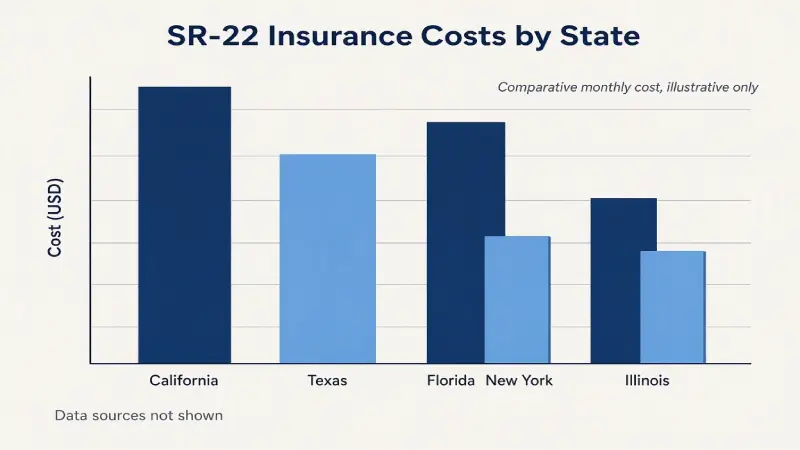
SR-22 insurance does not have one nationwide price. The cost depends on the insurance policy, the underlying driving violation and the driver’s individual risk profile.
NerdWallet’s current SR-22 insurance comparison provides illustrative rates for drivers with different violations, while MoneyGeek’s 2026 analysis also compares insurance costs and filing options. These datasets use different driver profiles and methodologies, so their figures should not be combined as if they represented identical quotes.
The following examples from NerdWallet illustrate the variation in annual premiums for a 35-year-old driver with a DUI and an SR-22 requirement.
| State | Full coverage, annual average | Minimum coverage, annual average |
|---|
| California | $3,790 | $1,018 |
| Florida | $5,586 | $1,327 |
| Texas | $4,941 | $1,538 |
| New York | $3,903 | $1,676 |
| Michigan | $7,748 | $2,486 |
| Ohio | $2,949 | $1,000 |
| Arizona | $4,015 | $1,502 |
| Georgia | $3,694 | $1,464 |
| Illinois | $3,319 | $1,118 |
| Pennsylvania | $3,606 | $902 |
Important: These are illustrative averages from a particular driver profile and dataset, not guaranteed 2026 quotes for every driver. Actual rates can differ significantly based on location, insurer, vehicle, driving record and coverage.
Average Monthly SR-22 Insurance Costs
For budgeting purposes, annual premiums can be converted into approximate monthly amounts.
| State | Full coverage per month | Minimum coverage per month |
|---|---|---|
| California | $316 | $85 |
| Florida | $466 | $111 |
| Texas | $412 | $128 |
| New York | $325 | $140 |
| Michigan | $646 | $207 |
| Ohio | $246 | $83 |
| Arizona | $335 | $125 |
| Georgia | $308 | $122 |
These monthly figures are calculated from the annual averages above. They are not separate insurer quotes and do not include possible installment charges.
The difference between minimum and full coverage can be substantial. However, the cheapest option is not necessarily appropriate for every vehicle or financial situation
SR-22 Insurance Rates by State
Where you live is one of the major factors affecting auto insurance premiums.
States have different minimum liability requirements, insurance regulations, filing procedures and insurance markets. Local accident frequency, repair costs, litigation and other factors can also influence premiums.
States With Different SR-22 Cost Profiles
| State | Illustrative full coverage annual premium after DUI | Minimum coverage annual premium |
|---|---|---|
| Michigan | $7,748 | $2,486 |
| Rhode Island | $5,774 | $2,288 |
| North Carolina | $6,470 | $2,008 |
| Florida | $5,586 | $1,327 |
| Texas | $4,941 | $1,538 |
| Nevada | $4,660 | $1,756 |
| Ohio | $2,949 | $1,000 |
| Alaska | $2,583 | $674 |
| Idaho | $2,771 | $816 |
| Wyoming | $3,553 | $436 |
These examples illustrate how widely premiums can vary. They should not be interpreted as a definitive ranking of the cheapest or most expensive states for every driver.
California
California uses SR-22 certificates for certain financial responsibility and license-related actions.
Drivers may need an SR-22 to satisfy specific reinstatement or restricted-license requirements. The required filing period depends on the circumstances.
The California DMV also provides information about its Low Cost Automobile Insurance Program, which may help eligible drivers who cannot afford standard liability insurance.
Official resource: California DMV — Insurance Requirements
Florida
Florida uses SR-22 and FR-44 certificates for certain financial responsibility requirements.
An FR-44 is generally associated with specified DUI-related circumstances and requires higher liability limits than an SR-22 under the applicable rules.
Drivers should not assume that an SR-22 will satisfy every Florida financial responsibility requirement. The Florida Department of Highway Safety and Motor Vehicles provides information about certificate verification and applicable coverage levels.
Official resource: Florida Highway Safety and Motor Vehicles
Texas
Texas drivers may be required to provide proof of financial responsibility following certain violations or license-related actions.
An SR-22 filing may be necessary in qualifying circumstances. Drivers should verify the requirement directly with the Texas Department of Public Safety or the authority named in their notice.
Official resource: Texas Department of Public Safety
Virginia
Virginia distinguishes between SR-22 and FR-44 financial responsibility certificates.
Its DMV lists circumstances that can require these certificates and explains that FR-44 liability coverage limits are higher than SR-22 limits.
Virginia also provides electronic filing options for insurers.
Official resource: Virginia DMV — Financial Responsibility Certifications
What Determines the Cost of SR-22 Insurance?
Several factors influence how much a driver pays.
1. The Underlying Violation
The reason for the filing can have a major impact on insurance premiums.
For example, a driver with a DUI may receive a substantially different quote from someone with a relatively minor traffic violation.
Insurance companies assess violations according to their underwriting rules and applicable state regulations.
2. Driving History
An insurer may review:
- Previous accidents.
- Traffic violations.
- DUI convictions.
- Insurance cancellations.
- Previous claims.
- License suspensions.
A history of multiple violations can make it harder to obtain affordable coverage.
3. State and ZIP Code
Insurance premiums are affected by the location where the vehicle is primarily kept.
Insurers may consider accident statistics, repair costs, theft exposure, weather risks and other local characteristics.
4. Vehicle Type
The vehicle being insured also matters.
A newer, more expensive vehicle may cost more to insure than an older vehicle, particularly when comprehensive and collision coverage are included.
5. Coverage Level
Minimum liability coverage is generally less expensive than full coverage.
However, full coverage may be necessary for financed or leased vehicles, depending on the lender’s requirements.
6. Age and Driving Experience
Age and driving experience may affect premiums, depending on state regulations and insurer underwriting criteria.
7. Insurance Company
Different insurers evaluate high-risk drivers differently. Consequently, quotes for the same driver and vehicle can vary considerably.
Comparing multiple insurers is one of the most practical ways to identify potentially lower premiums.
Cheapest SR-22 Insurance Companies in 2026
Drivers requiring an SR-22 should compare several insurance companies because eligibility and pricing vary.
MoneyGeek’s 2026 research identifies Erie, GEICO and Travelers among insurers with competitive SR-22 coverage in certain markets. Erie has limited geographic availability, while other companies have different state footprints and underwriting criteria.
| Insurance company | Considerations for SR-22 drivers |
|---|---|
| GEICO | Compare availability and rates in your state |
| Progressive | Check eligibility and available coverage options |
| State Farm | Ask about SR-22 filing availability in your location |
| Travelers | Compare liability and full coverage quotes |
| Erie | Check whether the company operates in your state |
| USAA | Eligibility is generally limited to qualifying military members, veterans and eligible family members |
No insurer is guaranteed to be the cheapest for every SR-22 driver.
A company that offers a competitive premium after a DUI may not offer the same pricing advantage after an uninsured driving violation.
How to Compare Insurance Companies
When requesting quotes, provide consistent information to each insurer.
Compare:
- Liability limits.
- Comprehensive and collision coverage.
- Deductibles.
- SR-22 filing availability.
- Payment plans.
- Policy fees.
- Cancellation terms.
- Claims service and financial stability.
Do not compare a minimum-coverage quote from one insurer with a full-coverage quote from another and assume the lower premium represents better value.
The coverage must be equivalent for the comparison to be meaningful.
SR-22 Filing Fees and Additional Costs
The SR-22 filing itself is usually a relatively small administrative expense compared with the insurance premium.
A filing fee of around $25 is common in many markets, although the actual charge depends on the insurer and state.
Other expenses may include:
| Expense | Possible cost |
|---|---|
| SR-22 filing fee | Often around $25; varies |
| Insurance premium | Depends on driver and coverage |
| License reinstatement | Varies by state and circumstances |
| Court-related charges | Depends on the violation |
| Installment or payment fees | Depends on the insurer |
| Required driver education | Applicable only in certain cases |
The total cost of complying with an SR-22 requirement can therefore be much higher than the certificate fee alone.
Before purchasing coverage, ask the insurer to identify all applicable charges.
Minimum Coverage vs. Full Coverage SR-22 Insurance
The appropriate coverage level depends on your vehicle, financial circumstances and legal obligations.
Minimum Liability Coverage
Minimum coverage is designed to satisfy applicable state liability insurance requirements.
It generally covers eligible bodily injury or property damage claims involving other people, subject to policy limits.
However, it generally does not cover damage to your own vehicle resulting from a collision.
Minimum coverage may be an option for drivers who own an older vehicle outright and can financially manage the risk of damage to their own car.
Full Coverage
Full coverage is a common industry term for a policy that combines liability insurance with comprehensive and collision coverage.
It can provide additional protection for the insured vehicle, subject to the policy’s terms and deductibles.
Full coverage may be particularly important for financed or leased vehicles when required by the lender.
| Feature | Minimum liability | Full coverage |
|---|---|---|
| Required liability protection | Yes, subject to state rules | Yes |
| Damage to another person’s property | Covered up to limits | Covered up to limits |
| Your vehicle’s collision damage | Generally not covered | Covered, subject to deductible |
| Theft and certain non-collision losses | Generally not covered | Often covered through comprehensive |
| Premium | Generally lower | Generally higher |
| Lender requirements | May be insufficient | Often required for financed vehicles |
Before choosing minimum coverage, consider whether you could afford to replace or repair your own vehicle after an accident.

Non-Owner SR-22 Insurance
Some drivers need an SR-22 even though they do not own a vehicle.
A non-owner SR-22 policy may be an option when the driver needs to demonstrate financial responsibility but does not regularly own or insure a car.
Depending on the policy and state, non-owner coverage can provide liability protection when driving eligible vehicles belonging to others.
However, it generally does not cover damage to a vehicle the driver borrows.
Non-owner policies also have important limitations. They may not be suitable for people who regularly use a specific vehicle or own a registered car.
Before purchasing one, verify that the policy satisfies the exact filing requirement imposed by the relevant state.
How Long Do You Need an SR-22?
The required filing period varies by state and the circumstances that led to the requirement.
Some drivers may need to maintain an SR-22 for approximately three years, while other situations may involve different periods.
For example, Virginia’s DMV explains that certain uninsured vehicle penalties require proof of financial responsibility for three years.
California also has specific filing periods for certain financial responsibility actions.
Drivers should obtain the exact start and end dates from the authority that imposed the requirement.
Do not assume that the requirement ends automatically when your insurance policy expires or when you pay your final premium.
What Happens When the SR-22 Period Ends?
When the required period is complete, the driver may be able to discontinue the filing.
However, it is important to confirm that the requirement has actually ended.
Before removing the SR-22, verify:
- The required filing period has been satisfied.
- The state has no outstanding financial responsibility requirement.
- Any license reinstatement conditions have been fulfilled.
- The insurer can safely remove the filing without causing a compliance problem.
If the driver still needs proof of financial responsibility, cancelling the filing prematurely can result in further penalties.
What Happens If Your SR-22 Insurance Lapses?
Maintaining continuous coverage is essential when an SR-22 is required.
If a policy is cancelled, expires or lapses, the insurer may be required to notify the relevant state authority.
Depending on state rules, the driver may face:
- License suspension.
- Registration suspension.
- Additional reinstatement fees.
- A new filing period.
- Higher future insurance premiums.
For example, Virginia’s DMV explains that insurers report certain SR-22 and FR-44 cancellations using an SR-26 certification.
California also imposes specific requirements concerning proof of financial responsibility and certain license actions.
Drivers should contact their insurer before cancelling a policy and ensure that replacement coverage is in place whenever required.

How to Find Affordable SR-22 Insurance
There are several practical ways to manage the cost of SR-22 coverage.
1. Compare Multiple Quotes
Obtain quotes from several insurers authorized to provide coverage in your state.
Use the same coverage limits, deductibles and vehicle details for each quote.
2. Ask About Non-Owner Coverage
If you do not own a car, ask whether a non-owner SR-22 policy satisfies your state’s requirements.
It may cost less than a standard vehicle policy, depending on your circumstances.
3. Review Your Coverage
Make sure your policy provides the required protection without paying for unnecessary coverage.
However, do not reduce coverage below the legal minimum or any lender requirement.
4. Maintain Continuous Insurance
Avoid unnecessary cancellations and gaps in coverage.
A lapse may create additional administrative problems and affect future insurance costs.
5. Ask About Available Discounts
Depending on the insurer and state, discounts may be available for qualifying drivers.
Ask about:
- Multi-policy discounts.
- Multi-vehicle discounts.
- Eligible safe-driving programs.
- Automatic payment discounts.
- Paperless billing discounts.
Not every discount is available to every SR-22 driver.
6. Consider Payment Plans Carefully
Some insurers allow monthly installments.
Before selecting a payment plan, compare the total cost, including installment fees and any down payment.
A lower initial payment does not necessarily mean a lower overall premium.
7. Improve Your Driving Record
Avoiding additional violations and maintaining continuous coverage can help create better conditions for future insurance renewals.
The effect on premiums depends on state laws, insurer rules and the nature of the original violation.
SR-22 vs. FR-44: What's the Difference?
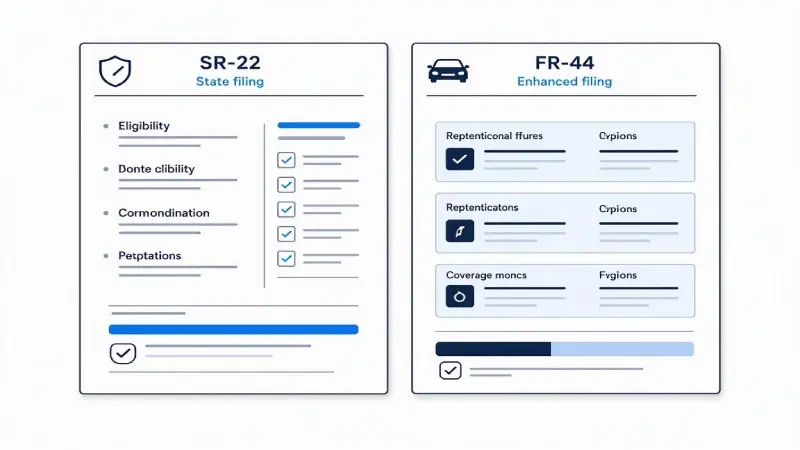
SR-22 and FR-44 certificates both demonstrate financial responsibility, but they are not interchangeable in every situation.
FR-44 certificates are used in certain jurisdictions and circumstances and can require substantially higher liability limits.
| Feature | SR-22 | FR-44 |
|---|---|---|
| Main purpose | Demonstrates required financial responsibility | Demonstrates higher financial responsibility in qualifying cases |
| Typical use | Certain insurance and license violations | Certain serious alcohol- or drug-related driving offenses |
| Coverage limits | Determined by state requirements | Often substantially higher |
| Availability | Used in several states | Primarily associated with Florida and Virginia |
| Filing requirements | Vary by state | Vary by state |
| Insurance cost | Depends on driver and coverage | Can be higher due to required coverage and risk profile |
Virginia explicitly distinguishes SR-22 and FR-44 requirements. Its DMV states that FR-44 liability coverage limits are double the SR-22 limits in the applicable circumstances.
Florida also uses both types of financial responsibility certificates.
Drivers should confirm which certificate is required rather than asking an insurer for an SR-22 automatically.

How Nexuora Evaluates SR-22 Insurance Options
Nexuora’s comparison framework considers several factors that matter to drivers seeking SR-22 coverage.
Affordability: We examine premiums, filing fees and other applicable expenses.
Availability: We consider whether insurers offer SR-22 filings in the relevant state.
Coverage: We examine liability limits and available comprehensive, collision and non-owner options.
Transparency: We consider whether insurers clearly disclose fees, eligibility conditions and policy terms.
Financial reliability: We encourage consumers to verify the financial strength and licensing status of insurers.
Practical usefulness: We consider whether the coverage addresses the driver’s actual requirements.
Insurance prices change frequently. Any comparison should be treated as a snapshot rather than a guarantee of the premium a particular applicant will receive.
Common SR-22 Insurance Mistakes to Avoid
Mistake 1: Confusing SR-22 With Insurance
An SR-22 is a certificate, not an insurance policy. You must obtain an eligible policy that supports the required filing.
Mistake 2: Choosing an Insurer Without Checking Filing Availability
Not every insurance company files SR-22 certificates in every state.
Always confirm availability before purchasing a policy.
Mistake 3: Selecting Coverage Based Only on Price
The cheapest policy may not satisfy your state’s requirements or your lender’s coverage conditions.
Mistake 4: Cancelling Coverage Too Early
Cancelling an SR-22 policy before the filing requirement ends can lead to further consequences.
Mistake 5: Assuming Every DUI Requires the Same Certificate
Some states use FR-44 requirements for certain DUI-related situations. The certificate depends on the applicable state rules.
Mistake 6: Ignoring Additional Reinstatement Requirements
An SR-22 filing may be only one part of the process for restoring driving privileges.
Frequently Asked Questions
How much does SR-22 insurance cost per month in 2026?
The cost varies by state, insurer, coverage level and driving history. Illustrative full-coverage averages after a DUI range from approximately $200 to more than $600 per month in some of the states shown in this guide. Your personal quote may be substantially different.
Is SR-22 insurance more expensive than regular car insurance?
Often, yes. However, much of the additional cost is associated with the underlying violation and the insurer’s assessment of risk rather than the SR-22 filing itself.
Which company offers the cheapest SR-22 insurance?
There is no universally cheapest insurer. Availability and premiums vary by state and driving profile. Compare quotes from multiple licensed insurers using identical coverage limits.
Can I get SR-22 insurance without owning a car?
In some circumstances, yes. A non-owner SR-22 policy may satisfy certain filing requirements for drivers who do not own a vehicle. Eligibility and coverage restrictions vary.
How much does an SR-22 filing cost?
A filing fee of approximately $25 is common, although actual fees vary by insurer and state. The insurance premium is a separate expense.
How long must I maintain SR-22 insurance?
The filing period depends on the state and the reason for the requirement. Some circumstances involve a three-year period, but you should confirm your exact deadline with the relevant authority.
Can I switch insurance companies while maintaining an SR-22?
Generally, switching may be possible, provided the new insurer offers the required filing and coverage. Coordinate the change carefully to avoid a gap in coverage.
Does an SR-22 affect my credit score?
An SR-22 itself is not a credit account and does not automatically create a credit inquiry. However, insurance pricing and the treatment of payment history can vary by state and insurer.
What happens if I move to another state while maintaining an SR-22?
Moving does not necessarily end the original filing requirement. Contact the original state authority and your insurer to determine how to maintain compliance after moving.
Can I remove an SR-22 before the required period ends?
Generally, you should not remove it until the requirement has officially ended. Removing it prematurely can result in penalties or further suspension.
Final Conclusion
SR-22 insurance costs can be substantial in 2026, particularly for drivers with serious violations or expensive coverage requirements. However, comparing insurers, reviewing coverage levels and maintaining continuous insurance can help drivers manage their expenses.
Before choosing a policy, compare the total premium, filing fee, liability limits, eligibility requirements and payment terms. If you do not own a vehicle, check whether a non-owner policy is appropriate. If you have a DUI-related requirement, verify whether your state requires an SR-22 or a different certificate such as an FR-44.
The most important step is to confirm your exact state requirements before purchasing coverage. An informed comparison can help you obtain compliant insurance while avoiding unnecessary costs.

Ahmada Ndao is a financial research analyst and independent journalist
specializing in US consumer finance, legal rights, and insurance markets.
With over 5 years covering American financial products, he has helped
thousands of readers navigate complex insurance decisions, find the right
legal representation, and optimize their credit strategies. His research
methodology combines primary data analysis, direct outreach to industry
professionals, and continuous monitoring of federal regulatory changes.
Ahmada’s work has been cited by financial communities across the US and
reviewed by licensed attorneys and insurance professionals for accuracy.