
Last updated: May 2026 | Reading time: 14 minutes
Why Your Business Credit Card Choice Matters in 2026
The right business credit card does more than separate personal and business expenses — it funds your travel, offsets operating costs, provides working capital flexibility, and delivers tools that streamline accounting. With annual rewards potential ranging from $500 to $5,000+ depending on spending patterns, the choice of card directly impacts your bottom line.
In 2026, the business credit card market has intensified, with issuers competing aggressively on sign-up bonuses, rewards rates on categories like advertising and software subscriptions, and fintech-style expense management tools. This guide cuts through the noise to identify the best card for every business type.
Best Business Credit Cards at a Glance
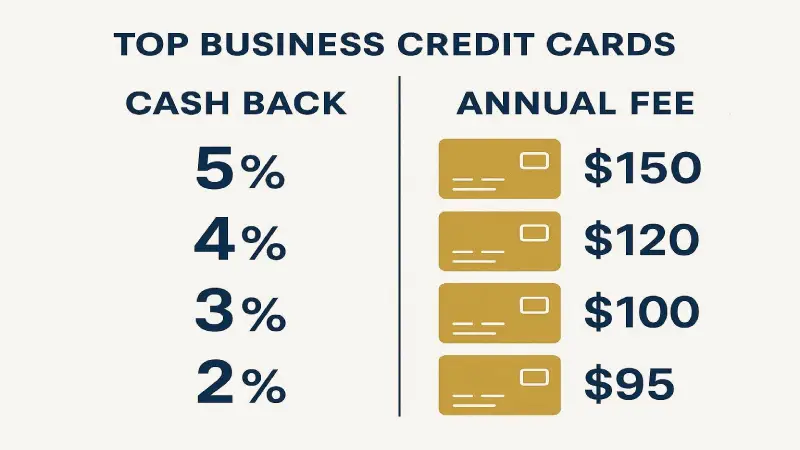
| Card | Best For | Rewards Rate | Annual Fee | Welcome Bonus | Est. Annual Value* |
|---|---|---|---|---|---|
| Ink Business Preferred® | Overall best | 3x on top categories | $95 | 90,000 pts ($900–$1,800) | $1,200+ |
| American Express Blue Business Cash™ | Simple cashback | 2% on all purchases | $0 | $250 statement credit | $600–$800 |
| Capital One Spark Cash Plus | High spenders | 2% unlimited cash | $150 | Up to $1,500 cash | $800–$1,500 |
| The Business Platinum Card® (Amex) | Travel-heavy businesses | 5x flights/hotels via Amex Travel | $695 | 150,000 pts ($1,500–$3,000) | $2,000+ |
| Ink Business Cash® | Low cost, high reward | 5% on office/internet | $0 | $750 cash back | $700–$1,000 |
| Bank of America Business Advantage | Bank relationship users | 3% on chosen category | $0 | $300 statement credit | $500–$700 |
| U.S. Bank Business Triple Cash | No-fee cashback | 3% on gas/office/software | $0 | $500 cash back | $600–$900 |
| Brex Business Card | Startups / no PG | 7x rideshare, 4x travel | $0–varies | Varies | $1,000–$2,000 |
| Ramp Corporate Card | Expense management | 1.5% universal cash | $0 | N/A | Savings-focused |
| Wells Fargo Signify Business | Flat-rate simplicity | 2% on all purchases | $0 | $500 cash back | $600–$700 |
*Estimated annual value based on $50,000 annual spend across typical business categories. Individual results will vary.
In-Depth Card Reviews
1. Ink Business Preferred® Credit Card — Best Overall
Annual Fee: $95 | Rewards: 3x on select categories | Network: Visa
Chase’s Ink Business Preferred remains the gold standard for small business owners in 2026. The card earns 3 points per dollar on the first $150,000 spent annually in combined purchases across travel, shipping, internet/cable/phone services, and advertising purchases made with social media and search engines. All other purchases earn 1x.
Welcome Bonus: 90,000 Ultimate Rewards points after spending $8,000 in the first 3 months — worth $900 in cash or up to $1,800 when redeemed for travel through Chase Travel or transferred to airline/hotel partners.
Standout Benefits:
- Cell phone protection up to $1,000 per claim (max 3 claims/year, $100 deductible)
- Trip cancellation/interruption insurance up to $5,000 per trip
- Purchase protection and extended warranty
- No foreign transaction fees
- Access to Chase’s transfer partners (United, Southwest, Hyatt, Marriott, and more)
-
Ideal Spending Profile: Businesses spending heavily on digital advertising (Google, Meta), cloud services, shipping, or telecom will maximize the 3x rate.
Verdict: At $95/year, the Ink Business Preferred delivers exceptional value. The sign-up bonus alone dwarfs the annual fee for years to come.
2. American Express Blue Business Cash™ — Best No-Fee Cashback Card
Annual Fee: $0 | Rewards: 2% cashback | Network: Amex
For business owners who want simple, predictable rewards without an annual fee, the Amex Blue Business Cash delivers 2% cashback on all eligible purchases up to $50,000 per calendar year (1% thereafter). Cashback is automatically credited as a statement credit — no redemption required.
Welcome Bonus: $250 statement credit after spending $3,000 in the first 3 months.
Standout Benefits:
- Expanded Buying Power — ability to spend above your credit limit when needed (amount varies based on payment history and creditworthiness)
- Employee cards at no additional cost
- Year-end summary for simplified bookkeeping
- Access to Amex’s robust small business resources and OPEN Savings program
-
Ideal Spending Profile: Businesses with diverse spending across multiple categories who want straightforward 2% on everything.
Verdict: The best zero-annual-fee business card for owners who value simplicity over optimized category rewards.
3. Capital One Spark Cash Plus — Best for High-Volume Spenders
Annual Fee: $150 | Rewards: 2% unlimited cash | Network: Visa
Unlike most charge cards, the Spark Cash Plus has no preset spending limit (Capital One evaluates each transaction based on your account history). It earns unlimited 2% cash back on every purchase with no caps and no category restrictions.
Welcome Bonus: Up to $1,500 cash back — $500 after spending $5,000 in the first 3 months, plus an additional $500 each month you spend $50,000 (up to $1,000 total additional).
Annual Fee Rebate: The $150 annual fee is refunded each year you spend $150,000 or more, effectively making it free for high spenders.
Standout Benefits:
- No foreign transaction fees
- Free employee cards with customizable spending limits
- Quarterly and year-end spending summaries
- $200 cash bonus for each additional cardholder who reaches $50,000 in annual spending
-
Ideal Spending Profile: High-revenue businesses ($500K+ annually) with diverse spending that doesn’t fit neatly into bonus categories.
Verdict: The math works strongly in your favor once you cross $100,000 in annual spend — the 2% with no cap beats most category-based cards at that scale.
4. The Business Platinum Card® from American Express — Best for Travel-Heavy Businesses
Annual Fee: $695 | Rewards: Up to 5x on travel | Network: Amex
At $695 per year, the Business Platinum demands justification — and delivers it, but only for the right business. Cardholders earn 5x points on flights and prepaid hotels booked through Amex Travel, 2x on all other eligible travel purchases, and 1.5x on eligible U.S. purchases of $5,000 or more (up to $2 million/year). Everything else earns 1x.
Welcome Bonus: 150,000 Membership Rewards points after spending $20,000 in the first 3 months — worth $1,500–$3,000+ depending on redemption.
At $695 per year, the Business Platinum demands justification — and delivers it, but only for the right business. Cardholders earn 5x points on flights and prepaid hotels booked through Amex Travel, 2x on all other eligible travel purchases, and 1.5x on eligible U.S. purchases of $5,000 or more (up to $2 million/year). Everything else earns 1x.
Welcome Bonus: 150,000 Membership Rewards points after spending $20,000 in the first 3 months — worth $1,500–$3,000+ depending on redemption.
Key Credits (that offset the annual fee):
- $400 Dell statement credits annually ($200 semi-annual)
- $360 Indeed credits annually ($90 per quarter)
- $150 Adobe credits annually
- $695 airline fee credit… wait — it’s actually up to $200 in airline incidental fee credits per year
- Up to $199 CLEAR Plus credit
- Global Entry or TSA PreCheck credit ($120 every 4.5 years)
- Access to Centurion Lounges, Priority Pass, Escape Lounges, and Delta Sky Clubs
-
Ideal Spending Profile: Businesses with frequent business travel, significant tech/software purchases, and team members who fly regularly.
Verdict: If you fly often and can fully utilize the statement credits, the effective net annual fee can fall below $100. For infrequent travelers, the card is hard to justify.
5. Ink Business Cash® Credit Card — Best No-Fee Card with Category Bonuses
Annual Fee: $0 | Rewards: Up to 5% on select categories | Network: Visa
The Ink Business Cash earns 5% cashback on the first $25,000 spent per year at office supply stores and on internet, cable, and phone services; 2% on the first $25,000 at gas stations and restaurants; and 1% on all other purchases.
Welcome Bonus: $750 cash back after spending $6,000 in the first 3 months.
Pro Tip: If you also hold the Ink Business Preferred or Chase Sapphire Reserve, you can transfer your Ink Cash “cash back” to Ultimate Rewards points, potentially doubling or tripling the redemption value.
Ideal Spending Profile: Small businesses with high telecom and office supply bills, or those building a Chase trifecta.
Verdict: One of the most valuable free business cards in existence, especially for businesses paying for cloud software subscriptions that code as “internet services.”
6. Brex Business Card — Best for Startups
Annual Fee: $0 (for qualifying businesses) | Rewards: Up to 7x | Network: Mastercard
Brex has disrupted the business card market by underwriting based on a company’s cash position and investors rather than the founder’s personal credit score. No personal guarantee is required — a rare and valuable feature for startup founders protecting personal credit.
Rewards Structure (with Brex Exclusive):
- 7x on rideshare
- 4x on travel booked through Brex Travel
- 3x on restaurants
- 2x on recurring software and Apple/Google stores
- 1x on everything else
Standout Features:
- Instant card issuance (virtual cards in minutes)
- Real-time expense categorization and receipt matching
- Direct ERP and accounting software integration (QuickBooks, Xero, NetSuite)
- No personal guarantee required
Limitations: Full rewards typically require using Brex as your business’s primary banking relationship or maintaining minimum cash balances. Requirements vary.
Verdict: The best option for funded startups, venture-backed companies, and business owners who want to keep personal and business credit completely separate.
7. Ramp Corporate Card — Best for Expense Management
Annual Fee: $0 | Rewards: 1.5% universal cashback | Network: Visa
Ramp isn’t primarily a rewards card — it’s an expense management platform that happens to offer a card. The value proposition is operational efficiency: Ramp’s AI-powered tools help businesses reduce spending by identifying redundant software subscriptions, flagging policy violations, and automating receipt collection.
Key Features:
- Automated expense reporting — employees photograph receipts; Ramp categorizes and routes for approval
- Vendor management — tracks all subscription spending in one dashboard
- Savings insights — average Ramp customer saves 5% on total spending through optimization
- Physical and virtual cards with granular spending controls
- No personal guarantee required (underwriting based on company financials)
Verdict: If your business spends more than $500,000 annually and expense management is a pain point, Ramp can deliver more value through operational savings than any rewards card on this list.
How to Choose the Right Business Credit Card

Step 1: Identify Your Primary Spending Categories
Pull 3–6 months of business banking statements and categorize spending. Common categories:
- Travel (flights, hotels, car rentals)
- Digital advertising (Google, Meta, LinkedIn)
- Software/SaaS (monthly subscriptions, cloud services)
- Office supplies (Amazon, Staples, office supply stores)
- Restaurants and meals (client entertainment)
- Gas and fleet (vehicles, delivery)
- General merchandise (everything else)
Match your top 2–3 spending categories to cards with the highest rewards rates in those categories.
Step 2: Estimate Annual Rewards Value
Use this formula: Annual Rewards Value = (Spend in Category × Category Rate) + (Spend in Other × 1%)
Example for a business spending $30,000/year on digital ads, $15,000 on travel, $5,000 on other:
- Ink Business Preferred: ($30,000 × 3%) + ($15,000 × 3%) + ($5,000 × 1%) = $900 + $450 + $50 = $1,400 in rewards minus $95 fee = $1,305 net
- Flat 2% card: ($50,000 × 2%) = $1,000 in rewards minus $0 fee = $1,000 net
The category card wins by $305 in this example.
Step 3: Assess the Annual Fee Math
A card with an annual fee is worth it when: Annual Rewards Value + Credit/Benefit Value > Annual Fee + Alternative No-Fee Card Rewards
For the Amex Business Platinum at $695:
- If you use $400 in Dell credits + $360 in Indeed credits + $199 CLEAR + $120 Global Entry + lounge access (valued at $300+) = ~$1,379 in benefits
- Net cost after benefits: $695 − $1,379 = effectively −$684 (you come out ahead if you use the benefits)
Step 4: Check Approval Requirements
| Card Type | Typical Credit Requirements |
|---|---|
| Premium rewards cards | 700+ personal credit score, 2+ years in business |
| Mid-tier rewards cards | 680+ personal credit score |
| Starter/no-fee cards | 640+ personal credit score |
| Fintech/corporate cards (Brex, Ramp) | Company financials (no personal credit check) |
Business Credit Cards vs. Personal Cards for Business Use
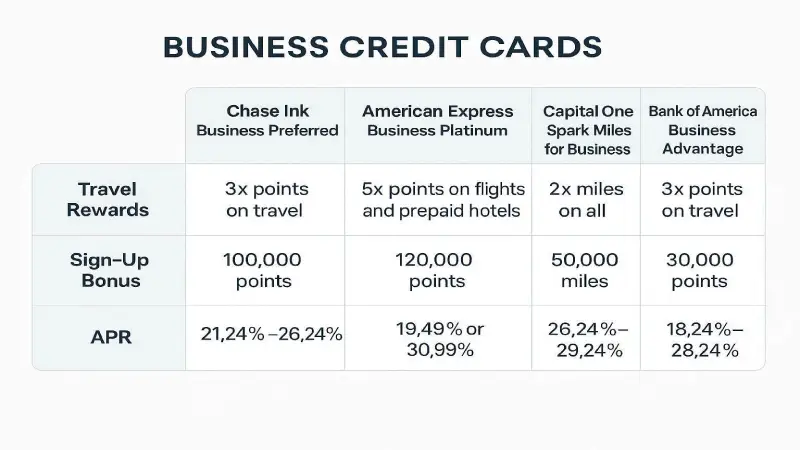
Using a personal card for business expenses is common but :
- Legal liability: Commingling funds can pierce the corporate veil in LLCs and corporations
- Bookkeeping: Personal and business transactions intermixed create tax headaches
- Rewards optimization: Business cards offer higher rates on business-specific categories
- Credit building: Business cards (when reported to business credit bureaus) build your company’s credit profile separately from yours
- Employee cards: Business cards allow employee cards with spending controls; personal cards generally don’t
Bottom line: Open a dedicated business credit card even if you start with a no-fee option.
Frequently Asked Questions
Do business credit cards affect my personal credit score? It depends. Most business credit cards require a personal guarantee and will appear on your personal credit report if you default. However, most major issuers (Chase, Amex, Capital One) do not report regular business card activity to personal credit bureaus unless the account goes delinquent. Cards like Brex and Ramp that don’t require a personal guarantee generally don’t affect personal credit at all.
What’s the minimum credit score needed for a business credit card? Most rewards business cards prefer a personal credit score of 670+. Premium cards (Amex Business Platinum, Ink Business Preferred) typically require 700+. No-personal-guarantee fintech cards underwrite differently.
Can a sole proprietor get a business credit card? Yes. Sole proprietors apply using their Social Security Number instead of an EIN. Income is reported as personal income. Most major issuers accept sole proprietors.
How do I build business credit from scratch? Start with a secured business credit card or a card with low approval requirements. Pay in full monthly. After 6–12 months, apply for trade lines with vendors (Net-30 accounts), then apply for unsecured business cards. Monitor your Dun & Bradstreet PAYDEX score.
Are business credit card rewards taxable? Generally, no. The IRS treats rewards earned from spending as a reduction in the cost of purchases (a discount), not income. However, sign-up bonuses received without spending requirements may be taxable. Consult a tax professional for your specific situation.
Our Methodology

We analyzed over 30 business credit cards based on:
- Rewards value (35%) — Rate across categories, caps, transfer partners
- Welcome bonus (20%) — Value relative to minimum spend requirement
- Annual fee ROI (20%) — Net value after credits and benefits
- Business features (15%) — Employee cards, expense tools, accounting integrations
- Approval accessibility (10%) — Credit requirements, personal guarantee terms
Disclaimer: This content is for informational purposes only. Some links may be affiliate links. Editorial independence is maintained regardless of affiliate relationships. Always verify current terms, rates, and offers directly with the card issuer before applying.

Ahmada Ndao is a financial research analyst and independent journalist
specializing in US consumer finance, legal rights, and insurance markets.
With over 5 years covering American financial products, he has helped
thousands of readers navigate complex insurance decisions, find the right
legal representation, and optimize their credit strategies. His research
methodology combines primary data analysis, direct outreach to industry
professionals, and continuous monitoring of federal regulatory changes.
Ahmada’s work has been cited by financial communities across the US and
reviewed by licensed attorneys and insurance professionals for accuracy.