Last updated: May 2026 | Reading time: 13 minutes
Getting a Personal Loan With Bad Credit: What You Need to Know
A credit score below 580 doesn’t disqualify you from borrowing — but it does mean paying more and doing more homework. The personal loan market for bad-credit borrowers has expanded significantly, with fintech lenders using alternative underwriting criteria (employment history, income, banking patterns, education) alongside traditional credit scores to evaluate applicants.
This guide identifies lenders genuinely willing to work with borrowers in the 500–629 credit score range, the realistic rates you should expect, and the red flags to avoid when you’re in a vulnerable borrowing position.
Best Bad Credit Personal Loans — Quick Comparison
| Lender | Min. Credit Score | APR Range | Loan Amount | Term | Best For |
|---|---|---|---|---|---|
| Upstart | 300 | 7.80%–35.99% | $1,000–$50,000 | 3–5 years | Very low credit scores |
| LendingPoint | 580 | 7.99%–35.99% | $1,000–$36,500 | 2–6 years | Near-prime borrowers |
| Avant | 550 | 9.95%–35.99% | $2,000–$35,000 | 2–5 years | Mid-range bad credit |
| OneMain Financial | None stated | 18.00%–35.99% | $1,500–$20,000 | 2–5 years | In-person service |
| Oportun | 300+ | 11.37%–35.95% | $300–$10,000 | 1–5 years | Thin credit / no credit |
| Upgrade | 560 | 9.99%–35.99% | $1,000–$50,000 | 2–7 years | Debt consolidation |
| Universal Credit | 580 | 11.69%–35.99% | $1,000–$50,000 | 3–5 years | Rebuilding credit |
| NetCredit | 550 | 34.00%–99.99% | $1,000–$10,000 | 6 mo–6 years | Last resort (small amounts) |
| Self | N/A | ~15.65% | $600–$1,800 | 24 months | Credit-builder loan |
| Possible Finance | None | Fixed fee | $50–$500 | Varies | Emergency micro-loans |
Important: All APRs are as of May 2026. Your actual rate depends on your credit score, income, debt-to-income ratio, and state of residence.
In-Depth Lender Reviews
1. Upstart — Best for Very Low Credit Scores Min. Credit Score: 300 | APR: 7.80%–35.99% | Amounts: $1,000–$50,000
Upstart pioneered AI-based underwriting, incorporating over 1,000 data points including education, job history, and field of study alongside traditional credit metrics. This approach allows them to approve borrowers that traditional lenders would automatically decline.
Key Details:
- Accepts credit scores as low as 300 (or no credit history at all)
- Origination fee: 0%–12% of loan amount (deducted from proceeds)
- No prepayment penalties
- Soft credit check for rate inquiry (won’t hurt your score)
- Funds typically disbursed within 1 business day
The Math: On a $10,000 loan at 30% APR over 3 years, your monthly payment would be approximately $390, with $4,040 in total interest paid. Painful but potentially better than credit card debt at 29–35%.
Watch out for: High origination fees that reduce the actual amount you receive. If an 8% origination fee is charged on a $10,000 loan, you receive $9,200 but owe $10,000.
Best for: Borrowers with thin credit files, recent graduates, or those recovering from severe credit events (bankruptcy discharged 1+ years ago).
2. LendingPoint — Best for Near-Prime Bad Credit Min. Credit Score: 580 | APR: 7.99%–35.99% | Amounts: $1,000–$36,500
LendingPoint specializes in borrowers in the 580–680 « near-prime » range who are often overlooked by traditional lenders. Their proprietary scoring system evaluates financial trajectory — meaning a borrower who has improved their score over 12 months may qualify despite a lower current score.
Key Details:
- Origination fee: 0%–10%
- Loan terms: 2 to 6 years
- No prepayment penalty
- Rate discount for setting up autopay
- Credit score updates and tools provided through their portal
Approval Factors They Emphasize:
- Recent payment history trend (improving vs. declining)
- Stable income relative to existing debt
- Time at current address and employer
- Free cash flow in banking statements
Best for: Borrowers with credit scores in the 580–620 range showing signs of financial improvement who want a more flexible loan term.
3. Avant — Best Mid-Range Bad Credit Option Min. Credit Score: 550 | APR: 9.95%–35.99% | Amounts: $2,000–$35,000
Avant has carved out a position as a reliable, mid-market lender for borrowers with credit scores between 550–700. They offer a mobile app for loan management, a clear fee structure, and a track record of transparent lending.
Key Details:
- Administration fee up to 9.99% (deducted upfront)
- Late payment fee: $25 after 10-day grace period
- Dishonored payment fee: $15
- No prepayment penalty
- Offers secured personal loans (vehicle as collateral) in some states
Customer Experience: Avant’s mobile app receives consistently high ratings for ease of payment management, payment scheduling, and document submission — useful when managing a loan is already stressful.
Best for: Borrowers needing $5,000–$15,000 for debt consolidation or emergency expenses with credit scores in the 550–620 range.
4. OneMain Financial — Best for In-Person Service Min. Credit Score: Not publicly stated | APR: 18.00%–35.99% | Amounts: $1,500–$20,000
OneMain Financial operates over 1,400 branches nationwide, making it unique among bad-credit lenders in offering face-to-face service. Loan officers can consider your full financial picture — not just your credit score — in a way that an algorithm cannot.
Key Details:
- Secured and unsecured options (collateral lowers your rate)
- Higher starting APR floor (18%) than competitors, but no origination fee on some products
- Loan officer can manually review edge cases
- Same-day or next-day funding available at branches
- Joint applications accepted (co-borrower can strengthen approval odds)
Secured Loan Option: If you own a vehicle, boat, or other asset, a secured OneMain loan can reduce your APR significantly. This is worth considering if your credit score is near the bottom of their range.
Best for: Borrowers who prefer face-to-face interaction, are considering collateral, or have complex financial situations that benefit from human review.
5. Oportun — Best for No Credit History Min. Credit Score: 300+ (or no history) | APR: 11.37%–35.95% | Amounts: $300–$10,000
Oportun focuses on borrowers who are « credit invisible » — Americans with no credit history or very thin files. Their mission-driven model has extended over $17 billion in credit to underserved communities. Importantly, Oportun reports to all three major credit bureaus, helping borrowers build credit as they repay.
Key Details:
- Available in select states only — check eligibility by state
- Spanish-language service available
- No prepayment penalties
- CFPB-supervised and CDFI-certified
- May require proof of income only (no credit history needed for some products)
Best for: Recent immigrants, young adults with no credit history, or anyone who has been outside the traditional banking system.
6. Upgrade — Best for Debt Consolidation Min. Credit Score: 560 | APR: 9.99%–35.99% | Amounts: $1,000–$50,000
Upgrade’s core value proposition is paying creditors directly when you select the debt consolidation purpose — which increases the likelihood your high-interest credit card balances are actually paid off rather than spent elsewhere. This discipline also improves their approval rates.
Key Details:
- Origination fee: 1.85%–9.99%
- Loan terms: 2 to 7 years (longest on this list)
- Direct payment to creditors (for consolidation loans)
- Free credit score monitoring
- Rate discount with autopay
Debt Consolidation Example: If you carry $12,000 across three credit cards at an average of 27% APR and consolidate into an Upgrade loan at 22% APR over 4 years:
- Credit card minimum payments (at 2%): $240/month, 8+ years to payoff, ~$13,000 in interest
- Upgrade loan: $352/month, 4 years to payoff, ~$4,900 in interest
- Savings: ~$8,100 in interest and 4+ years of debt
-
Best for: Borrowers with multiple high-interest credit card balances looking for a structured path out of revolving debt.
7. Self (Credit-Builder Loan) — Best for Building Credit First No minimum credit score | Effective APR: ~15.65% | Amounts: $600–$1,800
Self offers credit-builder loans — a unique product where you don’t receive the money upfront. Instead, your payments go into a FDIC-insured savings account, and you receive the principal (minus fees and interest) at the end of the term. It’s primarily a credit-building tool, not a borrowing vehicle.
How it Works:
- You apply and are approved (no hard credit pull)
- You make monthly payments ($25–$150/month depending on plan)
- Self reports payments to all three credit bureaus
- At the end of the term (12–24 months), you receive the savings balance
Is it worth it? If your credit score is below 550 and you don’t urgently need cash, Self can help you build credit and save simultaneously. Average users see a 49-point credit score increase within 12 months.
Best for: Borrowers who need to build credit before qualifying for a conventional loan at acceptable rates.
Understanding Bad Credit Loan Costs
APR vs. Interest Rate vs. Total Cost
Bad credit borrowers should focus on total cost of the loan — not just the interest rate or monthly payment.
Example: $5,000 loan over 3 years
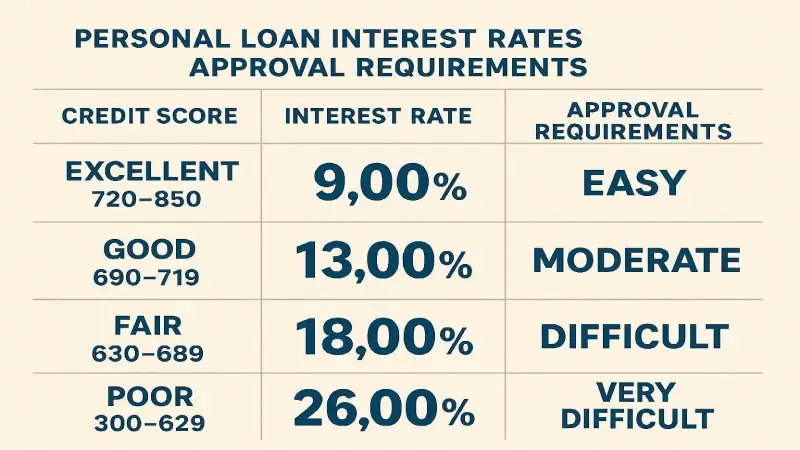
| Credit Score Range | Typical APR | Monthly Payment | Total Interest Paid | Total Repaid |
|---|---|---|---|---|
| 750+ (excellent) | 8%–12% | $157–$166 | $651–$976 | $5,651–$5,976 |
| 680–749 (good) | 14%–20% | $171–$186 | $1,165–$1,696 | $6,165–$6,696 |
| 620–679 (fair) | 22%–28% | $192–$208 | $1,912–$2,488 | $6,912–$7,488 |
| 580–619 (poor) | 28%–32% | $208–$220 | $2,488–$2,920 | $7,488–$7,920 |
| Below 580 (very poor) | 32%–36% | $220–$228 | $2,920–$3,208 | $7,920–$8,208 |
The difference between an excellent-credit and bad-credit borrower on a $5,000 loan: $2,000–$2,500 in additional interest.
How to Improve Your Approval Odds
1. Know Your Actual Credit Score Before Applying
Don’t guess. Pull your free credit reports from AnnualCreditReport.com and check your scores via:
- Credit Karma (TransUnion and Equifax scores)
- Experian free account (Experian score)
- Your existing bank’s free score feature
Knowing your starting point helps you target the right lenders and set realistic expectations.
2. Dispute Errors on Your Credit Report
The Federal Trade Commission estimates 1 in 5 consumers has an error on their credit report. Common errors include:
- Accounts that aren’t yours (identity confusion or fraud)
- Late payments that were actually on time
- Accounts showing as open that were closed
- Debts included in bankruptcy still showing as active
Filing disputes with the credit bureaus directly (Experian, Equifax, TransUnion) can remove errors and potentially increase your score significantly — sometimes within 30 days
3. Consider a Co-Signer
A creditworthy co-signer (family member, trusted friend) who agrees to share responsibility for the loan can:
- Lower your interest rate significantly
- Increase your approval odds
- Allow access to higher loan amounts
Warning: The co-signer is equally liable. If you default, their credit suffers. Only enter co-signer arrangements with full transparency about your ability to repay.
4. Offer Collateral (Secured Loan)
Secured personal loans use an asset — typically a vehicle, savings account, or certificate of deposit — as collateral. The lender can seize the asset if you default, which reduces their risk and often results in lower rates and higher approval odds.
5. Apply to Lenders That Use Soft Pulls for Prequalification
Most reputable lenders on our list offer prequalification with a soft credit check (which doesn’t affect your score). This lets you see your actual rate offer before formally applying. Hard inquiries from formal applications can drop your score 5–10 points each, so prequalify at 3–4 lenders before choosing where to formally apply.
Red Flags & Predatory Lenders to Avoid
The bad-credit lending space attracts predatory operators. Protect yourself by watching for these warning signs:
Guaranteed approval before verifying any information No legitimate lender guarantees approval without reviewing your income or identity. « Guaranteed approval » is a hallmark of advance-fee fraud or predatory operations.
Upfront payment required before loan disbursement Legitimate lenders deduct fees from loan proceeds — they do not require cash payment before giving you money. Any lender asking for upfront payment is committing fraud.
APR above 36% Many consumer advocates and state legislators consider 36% the threshold between high-cost lending and predatory lending. Payday loans (often 300%–400% APR) and some installment loans above 100% APR should be avoided if any alternative exists.
No physical address or NMLS registration Legitimate lenders are licensed in the states where they operate and registered with the Nationwide Multistate Licensing System (NMLS). Search any lender at nmlsconsumeraccess.org before borrowing.
Aggressive contact after initial inquiry Loan scammers often harvest leads and sell to multiple parties who then harass potential borrowers. If you’re receiving calls and texts from multiple « lenders » you didn’t contact, your information may have been compromised.
Alternatives to Bad Credit Personal Loans
Before committing to a high-interest loan, consider these alternatives:
Credit Union Payday Alternative Loans (PALs): Many federal credit unions offer PALs — regulated small-dollar loans capped at 28% APR for amounts up to $2,000. You must be a credit union member, but joining is often easy and low-cost.
Nonprofit Credit Counseling: Organizations like the NFCC (National Foundation for Credit Counseling) offer Debt Management Plans that can consolidate credit card debt at reduced interest rates — often 6%–9% — without taking on new debt.
0% APR Buy Now Pay Later: For specific purchases (appliances, medical, dental), BNPL services like Affirm, Klarna, or CareCredit may offer 0% financing for 6–18 months if paid in full.
Employer Paycheck Advance: Many employers offer emergency paycheck advances at no cost. Apps like DailyPay or Earnin allow early access to earned wages with minimal or no fees.
Family Loan with Formal Agreement: Borrowing from family can be interest-free, but protect the relationship with a formal promissory note (free templates available at Rocket Lawyer or LawDepot).
401(k) Loan: If you have a retirement account with a balance, you can borrow up to 50% of the vested balance (max $50,000) and repay yourself with interest. Risks include loss of investment growth and tax penalties if you leave your employer before repayment.
Frequently Asked Questions
What credit score is considered « bad »? The FICO scale classifies scores as follows: Exceptional (800+), Very Good (740–799), Good (670–739), Fair (580–669), Poor (300–579). « Bad credit » commonly refers to scores below 580, though the 580–629 range is also considered subprime by most lenders.
How fast can I get a bad credit personal loan? Many online lenders disburse funds within 1–3 business days. Some (Avant, LendingPoint) offer same-day or next-day funding. In-person lenders like OneMain Financial can sometimes fund the same day at a branch.
Will applying for a personal loan hurt my credit score? Prequalification uses a soft credit pull and doesn’t affect your score. Formal application triggers a hard inquiry, which typically drops your score 5–10 points temporarily. Scores usually recover within 3–6 months, especially if you make on-time payments.
Can I get a personal loan if I’m unemployed? It’s difficult. Lenders require proof of sufficient income to repay the loan. Alternative income sources (Social Security, disability benefits, alimony, rental income) may qualify. Without income documentation, most lenders will decline.
How can I build credit after getting a bad credit loan? The most powerful credit-building behaviors are: (1) make every payment on time — payment history is 35% of your FICO score; (2) keep credit card utilization below 30%; (3) don’t close old accounts; (4) avoid opening multiple new credit lines simultaneously. A bad credit loan that you repay perfectly over 2–3 years can significantly transform your credit profile.
Our Methodology
We reviewed 20+ lenders offering personal loans to bad-credit borrowers using the following criteria:
- Minimum credit score requirements (25%) — Accessibility to truly poor-credit borrowers
- APR range (25%) — Competitiveness of rates at the bottom end of their credit range
- Fees (20%) — Origination fees, late fees, prepayment penalties
- Transparency & trustworthiness (15%) — NMLS registration, CFPB complaints, BBB ratings
- Loan features (10%) — Flexible terms, prequalification, credit reporting
- Customer experience (5%) — App quality, customer service, funding speed
Disclaimer: The information in this article is for educational purposes only and does not constitute financial, legal, or credit advice. APRs and terms are subject to change. Always verify current offers with lenders directly. If you are struggling with debt, consider speaking with a nonprofit credit counselor at the NFCC (nfcc.org) before taking on new debt.

Ahmada Ndao is a financial research analyst and independent journalist
specializing in US consumer finance, legal rights, and insurance markets.
With over 5 years covering American financial products, he has helped
thousands of readers navigate complex insurance decisions, find the right
legal representation, and optimize their credit strategies. His research
methodology combines primary data analysis, direct outreach to industry
professionals, and continuous monitoring of federal regulatory changes.
Ahmada’s work has been cited by financial communities across the US and
reviewed by licensed attorneys and insurance professionals for accuracy.