
Florida has some of the strictest medical malpractice laws in the United States — and some of the most complex pre-suit requirements before you can even file a lawsuit. The statute of limitations is just 2 years from discovery of the injury — the shortest filing window of any major state. Before you can sue, you must complete a mandatory 90-day pre-suit investigation period under Florida Statute §766.106. Miss either deadline and your case is permanently barred, regardless of how clear the negligence. This 2026 guide covers everything Florida malpractice victims need to know: the exact deadlines and exceptions, the pre-suit process step by step, what the average Florida medical malpractice settlement actually looks like ($519,194 average for pre-suit resolution, $561,600 for litigated cases), the most common claim types in Florida, and how to choose the right attorney — without paying anything out of pocket.
Florida medical malpractice cases average $519,194 in pre-suit settlements and $561,600 in litigated settlements — but only 4% of cases reach a jury verdict. The pre-suit process under Florida Statute §766.106 is mandatory and takes a minimum of 90 days. Source: FLOIR Data & Flores Law Research 202
Table of Contents
- Florida Medical Malpractice — Quick Facts 2026
- Statute of Limitations — The Exact Deadlines
- Pre-Suit Requirements — Step by Step
- Average Settlements — What Florida Cases Are Worth
- Most Common Malpractice Claim Types in Florida
- How to Choose a Florida Medical Malpractice Attorney
- Top Attorneys by City — Miami, Orlando, Tampa, Jacksonville
- What It Costs — Contingency Fees Explained
- Frequently Asked Questions
Key Takeaways
- Florida medical malpractice claims must generally be filed within 2 years of discovering the injury.
- The state requires a mandatory 90-day pre-suit investigation process.
- Average Florida malpractice settlements exceed $500,000 in many cases.
- Florida does not cap non-economic damages against private healthcare providers.
- Most malpractice attorneys work on a contingency fee basis.
- Early legal consultation is critical because missing deadlines can permanently bar a claim.
Florida Medical Malpractice — Quick Facts 2026
| Category | Florida 2026 |
|---|---|
| Statute of Limitations | 2 years from discovery of injury |
| Absolute statute of repose | 4 years from date of incident (most cases) |
| Government healthcare providers (HB 145) | 2 years uniform deadline (effective Oct 1, 2026) |
| Mandatory pre-suit period | 90 days (Florida Statute §766.106) |
| Average pre-suit settlement | $519,194 |
| Average litigated settlement | $561,600 |
| Cases reaching jury verdict | ~4% of all cases filed |
| Non-economic damages cap | None for private healthcare providers ✅ |
| Government provider cap | $200,000 (sovereign immunity) |
| Contingency fee (typical) | 33–40% of settlement/verdict |
| Out-of-pocket cost to hire attorney | $0 (contingency basis) |
Statute of Limitations — The Exact Florida Deadlines
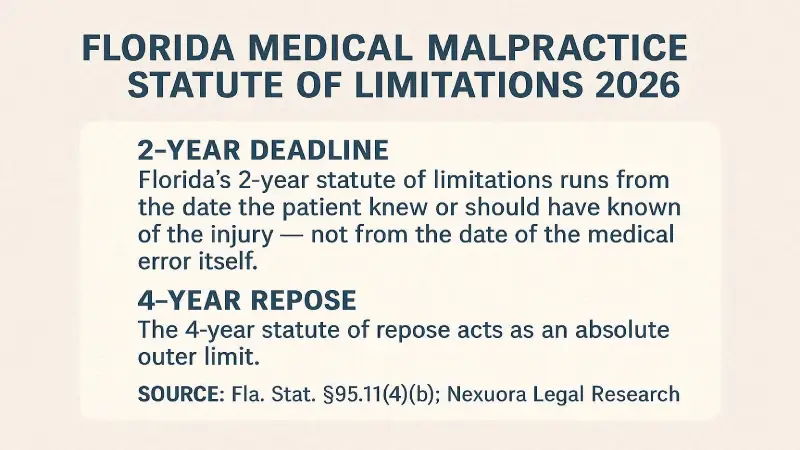
Florida’s medical malpractice statute of limitations is governed by Florida Statute §95.11(4)(b). The core rule: you have 2 years from the date you knew or should have known about the malpractice to file a lawsuit. This is the “discovery rule” — the clock starts when you discover the injury (or when a reasonable person would have discovered it), not necessarily when the medical error occurred.
The 4-Year Statute of Repose
Florida also imposes a 4-year statute of repose — an absolute outer time limit measured from the date of the medical incident, regardless of when you discovered the injury. Even if you only discovered the malpractice after 3 years, you would have just 1 year remaining to file. The 4-year cap cannot be extended by the discovery rule.
Important Exceptions to the Deadlines
Fraud or concealment: If a healthcare provider fraudulently concealed the malpractice — actively hiding evidence or making false statements — the 4-year repose period extends to 7 years. This applies when the provider knew about the error and took steps to prevent the patient from discovering it. Minors: For children injured by medical malpractice, the statute of limitations does not begin running until the child turns 8 years old (or 2 years from discovery, whichever is later). Government healthcare providers: Under HB 145 (effective October 1, 2026), claims against government entities under Florida Statute §768.28 are subject to a uniform 2-year filing deadline — eliminating the prior separate 4-year statute of repose for these cases.
Why the Pre-Suit Requirement Makes the Deadline Even Tighter
This is the most critical practical point that many Florida malpractice victims miss: the mandatory 90-day pre-suit investigation period must be completed before you can file a lawsuit. Because initiating the pre-suit process (by sending notice of intent) does toll (pause) the statute of limitations for up to 90 days plus an additional 30 days — but only if you start the process in time. If you wait until the last month before your 2-year deadline, you may not have time to properly complete pre-suit investigation. Florida attorneys recommend consulting a lawyer no later than 12–18 months after discovering the injury.
Florida Pre-Suit Requirements — Step by Step
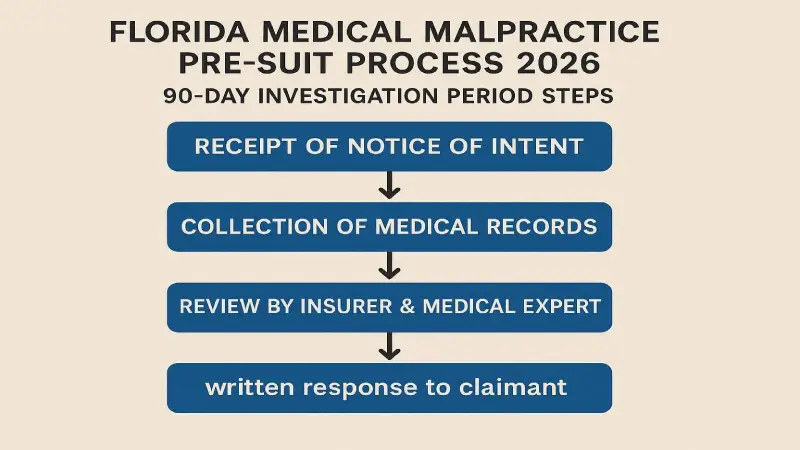
Florida Statute §766.106 requires every medical malpractice claimant to complete a mandatory pre-suit investigation and notice process before filing any lawsuit. This is not optional — courts will dismiss lawsuits filed without completing pre-suit. The process has four mandatory steps.
Step 1 — Reasonable Investigation (Before Notice)
Before sending any notice, your attorney must conduct a reasonable investigation to determine whether there is a valid basis for a malpractice claim. This involves: obtaining all medical records from the treating providers; having those records reviewed by a qualified medical expert who can opine that the standard of care was breached; and drafting a corroborating expert opinion (called a “verified written medical expert opinion”) that supports the claim. This investigation phase typically takes 2–4 months for complex cases.
Step 2 — Notice of Intent to Initiate Litigation
Once the investigation confirms a valid claim, your attorney sends a formal Notice of Intent to Initiate Litigation to each prospective defendant (doctor, hospital, facility). This notice must include: a list of all treating providers, authorization for the defendant to obtain records, and the corroborating expert opinion. Mailing the notice tolls the statute of limitations for the duration of the pre-suit period (up to 90 days plus 30 additional days after the period ends).
Step 3 — 90-Day Pre-Suit Investigation Period
Upon receiving the Notice of Intent, the defendant has 90 days to investigate the claim and respond. During this period, both sides exchange relevant information. The defendant must respond in one of three ways: Reject the claim (requires providing a counter-expert opinion); Offer to settle (the most common resolution — average pre-suit settlement is $519,194); or Admit liability and offer arbitration. A significant percentage of Florida malpractice cases resolve during this 90-day window, making it the most important phase of the case.
Step 4 — Filing Lawsuit (If Pre-Suit Fails)
If the pre-suit process does not resolve the matter — the defendant rejects the claim or the settlement offer is insufficient — you may proceed to file a formal lawsuit in Florida circuit court. From this point, the litigation phase typically takes 18–36 months, with trial-bound cases sometimes extending beyond 3 years.
Average Settlements — What Florida Medical Malpractice Cases Are Worth
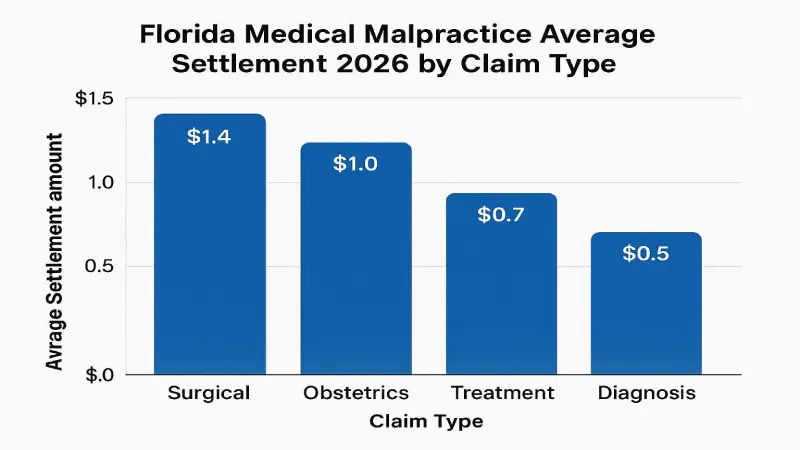
Florida’s FLOIR (Florida Office of Insurance Regulation) data provides the most reliable picture of what medical malpractice cases actually settle for. The numbers may surprise you: the gap between pre-suit and litigated settlements is smaller than most people expect, which is why Florida attorneys almost universally recommend pursuing a strong pre-suit process before committing to years of litigation.
| Claim Type | Average Settlement Range | Notes |
|---|---|---|
| Birth Injury / Cerebral Palsy | $1M – $5M+ | Highest-value claims; lifetime care costs drive value |
| Surgical Error | $500K – $2M | Wrong-site surgery, retained instruments, nerve damage |
| Misdiagnosis / Delayed Diagnosis (Cancer) | $300K – $1.5M | Depends on stage at actual diagnosis vs. when should have been caught |
| Anesthesia Error | $250K – $1M | Brain damage and death cases command highest values |
| Medication Error | $75K – $400K | Wrong drug, wrong dose, harmful interaction |
| Emergency Room Error | $200K – $800K | Failure to diagnose heart attack, stroke, appendicitis |
| Overall Florida Average (pre-suit) | $519,194 | FLOIR 2024–2026 data |
| Overall Florida Average (litigated) | $561,600 | Cases that proceed past pre-suit |
What Drives Settlement Value in Florida
Economic damages — medical expenses past and future, lost wages, future loss of earning capacity — are the foundation of every settlement. These are calculated with actuarial precision. Non-economic damages — pain, suffering, permanent disability, loss of enjoyment of life — are where Florida’s lack of cap on private-sector cases becomes most significant. In catastrophic cases (birth injuries, permanent paralysis, wrongful death of a breadwinner), non-economic damages can exceed economic damages by 2–3x. Critical warning: Insurance companies frequently make early settlement offers that significantly undervalue the true cost of your injuries — often before the full scope of future medical care has been calculated by experts. Accepting an early offer without attorney representation can cost you hundreds of thousands of dollars.
Florida’s Unique Wrongful Death Limitation
Florida is currently the only state that restricts adult children of unmarried, childless decedents and parents of adult decedents from recovering non-economic damages in medical malpractice wrongful death cases (Section 768.21(8)). Governor DeSantis vetoed HB 6017 in May 2025 which would have eliminated this. HB 6003, a narrower reform bill, was being tracked in the 2026 legislative session. This restriction does not affect cases involving minor children or spouses.
Average Settlement By Florida City
| Florida City | Typical Settlement Range |
|---|---|
| Miami | $400,000 – $2,500,000+ |
| Orlando | $300,000 – $1,800,000+ |
| Tampa | $350,000 – $2,000,000+ |
| Jacksonville | $250,000 – $1,500,000+ |
| Fort Lauderdale | $400,000 – $2,200,000+ |
Settlement values vary significantly depending on the severity of the injury, the strength of the expert evidence, future medical costs, and the defendant’s insurance coverage limits.
Most Common Medical Malpractice Claim Types in Florida
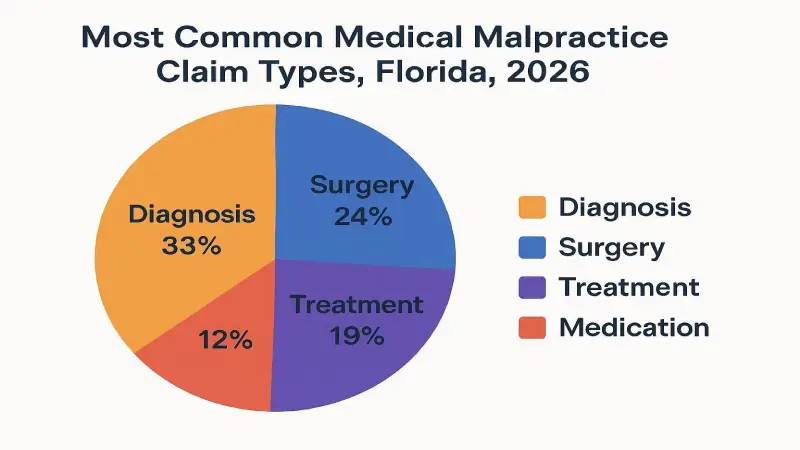
1. Surgical Errors
The most common category of Florida malpractice claims. Surgical errors include wrong-site surgery (operating on the wrong body part or the wrong patient), retained surgical instruments or sponges left inside the patient, damage to adjacent structures (nerves, blood vessels, organs) during an operation, and anesthesia complications during surgery. Florida’s large population of snowbirds and retirees undergoing elective surgeries contributes to the high volume of surgical claims. Settlements typically range from $500,000 to $2 million depending on permanence of injury.
2. Misdiagnosis and Delayed Diagnosis
The second largest category. This includes failure to diagnose cancer (particularly breast, colon, and lung cancer where early detection dramatically changes outcomes), misdiagnosis of heart attack or stroke in emergency settings, and failure to recognize infections including sepsis. The value of these cases is largely determined by how much the delayed or missed diagnosis changed the ultimate outcome — a missed cancer diagnosis that allowed a Stage 1 cancer to progress to Stage 4 is worth dramatically more than a 4-week delay with no measurable impact.
3. Birth Injuries
While less frequent by volume, birth injury cases are the highest-value category in Florida malpractice law. Cerebral palsy caused by oxygen deprivation during delivery, Erb’s palsy from shoulder dystocia, and brachial plexus injuries from improper delivery techniques are the most common. These cases are worth $1 million to $5 million or more because they involve lifetime care costs for a child who may need full-time support for 60-80 years.
4. Anesthesia Errors
Anesthesia errors include administering too much or too little anesthesia, failure to monitor the patient during the procedure, using contraindicated anesthetics given the patient’s medical history, and failure to recognize and respond to anesthesia complications. Brain damage caused by anesthesia-induced hypoxia (oxygen deprivation) is the most catastrophic outcome and produces the highest settlements.
5. Medication Errors
Prescribing the wrong medication, the wrong dose, or failing to check for dangerous drug interactions accounts for a significant percentage of Florida hospital adverse events. Medication errors are more common in inpatient settings but also occur in outpatient pharmacy and prescription contexts. These cases often require pharmacology expert testimony to establish the standard of care.
How to Choose a Florida Medical Malpractice Attorney
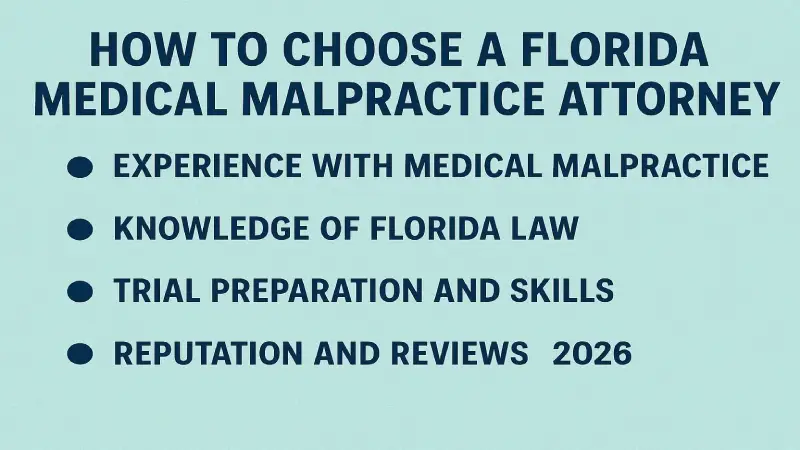
Not all personal injury attorneys handle medical malpractice — and not all malpractice attorneys are equally equipped to handle the type of case you have. Medical malpractice requires specialized knowledge of medicine, Florida pre-suit procedure, expert witness management, and the specific damages calculation methodology used in Florida courts. Here is how to evaluate any Florida malpractice attorney.
| Factor | What to Look For | Red Flag |
|---|---|---|
| Florida Bar Board Certification | Board Certified in Civil Trial Law by The Florida Bar | No board certification or certification in an unrelated area |
| Malpractice-specific experience | Handles ONLY medical malpractice or primarily malpractice | “General personal injury” attorney who also does car accidents, slip & falls |
| Expert witness network | Established relationships with medical experts in relevant specialty | No clear answer about how they find experts |
| Pre-suit experience | Deep familiarity with §766.106 pre-suit process | Attorney who treats pre-suit as a formality |
| Trial experience | Has actually taken cases to jury verdict (not just settled) | Only settles — never goes to trial |
| Contingency fee structure | 33–40% of recovery, with costs advanced by the firm | Upfront retainer fees for malpractice cases |
| Free consultation | Should always be free — no exceptions | Any fee for initial case evaluation |
The Single Most Important Question to Ask
Ask any Florida malpractice attorney: “What percentage of your cases go to trial, and what were your last three trial verdicts?” Insurance companies track which attorneys actually try cases versus which always settle. An attorney with a reputation for going to trial commands larger settlements because the insurer knows they will not back down. An attorney who never tries cases — even with a strong case — has less leverage.
How We Evaluated Florida Medical Malpractice Attorneys
Lorem ipsum dolor sit amet, consectetur adipiscing elit. Ut elit tellus, luctus nec ullamcorper mattis, pulvinar dapi
To evaluate medical malpractice attorneys in Florida, we reviewed several criteria that are critical to successful malpractice litigation.
Our analysis focused on:
- Florida Bar Board Certification
- Medical malpractice case experience
- Trial verdict history
- Settlement record
- Expert witness network
- Client reviews and reputation
- Experience with Florida pre-suit requirements
- Ability to handle complex medical evidence
Because medical malpractice cases are among the most challenging personal injury claims, attorney experience often has a direct impact on case value and outcome.
bus leo.
Finding a Medical Malpractice Attorney by Florida City
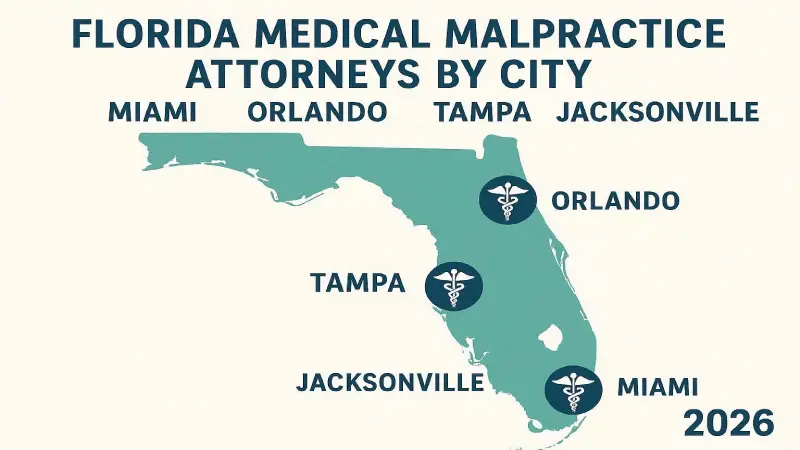
Miami-Dade County
Miami-Dade has the highest concentration of medical malpractice filings in Florida due to its large hospital systems (Jackson Memorial, Baptist Health, UHealth/University of Miami). Cases filed in Miami-Dade Circuit Court tend to take longer to resolve than in smaller counties. Key search terms: medical malpractice attorney Miami, med mal lawyer Miami-Dade, hospital negligence attorney South Florida. Look for attorneys with specific Jackson Memorial or Baptist Health hospital experience if your case involves those institutions.
Orlando (Orange County)
Orlando’s malpractice market is dominated by cases arising from AdventHealth, Orlando Health, and Florida Hospital systems. Orange County Circuit Court has a relatively efficient docket for civil cases. Attorneys practicing in Orlando frequently handle cases from surrounding counties (Osceola, Seminole, Lake). Search: medical malpractice lawyer Orlando, hospital malpractice attorney Central Florida.
Tampa (Hillsborough County)
Tampa General Hospital and BayCare Health System are the primary sources of Hillsborough County malpractice filings. Tampa has a strong plaintiff’s malpractice bar with several firms exclusively handling serious injury cases. Hillsborough juries have historically been receptive to well-documented malpractice cases. Search: medical malpractice attorney Tampa, med mal lawyer Hillsborough County.
Jacksonville (Duval County)
Jacksonville’s largest malpractice cases arise from Mayo Clinic Florida, UF Health Jacksonville, and Baptist Medical Center. Duval County’s legal market has fewer plaintiff’s malpractice specialists than Miami or Tampa, making attorney selection especially important. Cases involving Mayo Clinic require attorneys experienced with large institutional defendants. Search: medical malpractice lawyer Jacksonville Florida, med mal attorney Duval County.
What It Costs — Contingency Fees in Florida Malpractice Cases
In Florida, medical malpractice attorneys work exclusively on a contingency fee basis — meaning you pay nothing out of pocket, ever. The attorney’s fee is a percentage of whatever you recover. If you recover nothing, you pay nothing.
| Recovery Stage | Typical Attorney Fee |
|---|---|
| Pre-suit settlement | 33% of recovery |
| Settlement after lawsuit filed | 33–40% of recovery |
| Settlement after trial begins | 40% of recovery |
| Verdict after full trial | 40% of recovery |
| Case expenses (experts, records, filing) | Advanced by firm; reimbursed from recovery |
Case expenses in complex Florida malpractice cases can be substantial — expert witnesses alone typically cost $5,000–$30,000 per expert, and cases involving multiple specialties may require 3–5 experts. These costs are advanced by the firm and deducted from the recovery alongside the attorney’s fee. On a $519,000 pre-suit settlement with a 33% contingency and $40,000 in expenses, the net recovery to the client would be approximately $307,000.
Frequently Asked Questions — Florida Medical Malpractice 2026
How long do I have to file a medical malpractice lawsuit in Florida?
You have 2 years from the date you knew or should have known about the malpractice injury (Florida Statute §95.11(4)(b)). An absolute 4-year statute of repose applies in most cases from the date of the incident, regardless of when you discovered the injury. For cases involving fraud or concealment by the healthcare provider, this extends to 7 years. Because Florida requires a mandatory 90-day pre-suit process before filing, you should consult an attorney no later than 18 months after discovering the injury.
What is the average medical malpractice settlement in Florida?
Based on FLOIR data, the average Florida medical malpractice settlement is $519,194 for cases resolved during the pre-suit period and $561,600 for cases that proceed to litigation. These are averages — birth injury cases frequently exceed $1 million, while medication error cases may settle for $75,000–$400,000. Settlement value depends primarily on the severity and permanence of the injury, the economic impact (lost wages, future medical costs), and the strength of the expert evidence supporting negligence.
What are Florida’s pre-suit requirements for medical malpractice?
Under Florida Statute §766.106, before filing a medical malpractice lawsuit you must: (1) conduct a reasonable investigation with a qualified medical expert who confirms the standard of care was breached; (2) send a formal Notice of Intent to each prospective defendant; (3) complete a 90-day pre-suit investigation period during which the defendant must respond by rejecting, settling, or offering arbitration. Filing a lawsuit without completing this process will result in dismissal.
Is there a cap on medical malpractice damages in Florida?
No — Florida imposes no cap on non-economic damages (pain and suffering, permanent disability, loss of enjoyment of life) against private healthcare providers. This is a significant advantage for Florida claimants compared to Texas ($250,000 cap) or California (pre-MICRA reform). The only cap in Florida applies to claims against government healthcare providers under sovereign immunity, which limits total recovery to $200,000 per claim or $300,000 per incident.
How much does a Florida medical malpractice attorney cost?
Florida medical malpractice attorneys work on a contingency fee basis — you pay nothing out of pocket. The fee is 33% of the recovery if the case settles during pre-suit, and 33–40% if the case goes to litigation or trial. Case expenses (expert witnesses, medical records, filing fees) are advanced by the firm and deducted from the final recovery. If you recover nothing, you owe nothing. Initial consultations are always free.
What should I do immediately if I think I have a Florida malpractice case?
Take these steps immediately: (1) Request copies of all your medical records from every provider involved in your care — you have a legal right to these and providers must provide them within 30 days; (2) Document everything you remember about what happened, when, and what you were told; (3) Do not sign any documents from the hospital or insurance company without consulting an attorney first; (4) Contact a board-certified Florida medical malpractice attorney for a free consultation — do not wait, as the 2-year clock is running.
What is the average medical malpractice jury verdict in Florida?
While most cases settle before trial, jury verdicts in serious malpractice cases can exceed several million dollars depending on the severity of the injury.
How difficult is it to win a medical malpractice case in Florida?
Medical malpractice cases are complex and require expert testimony, but strong evidence of negligence can lead to significant settlements or verdicts.
Do all Florida malpractice cases require expert witnesses?
Yes. Florida law generally requires qualified medical experts to support malpractice allegations during the pre-suit process.
Can I sue a hospital directly in Florida?
Yes. Hospitals may be liable for negligent employees, staffing failures, or institutional negligence depending on the circumstances.
What is the biggest medical malpractice settlement in Florida?
Some catastrophic injury and birth injury cases have resulted in settlements and verdicts worth several million dollars.
How long does a Florida medical malpractice lawsuit take?
Most cases take between 18 and 36 months if litigation is required after the pre-suit process.
Can malpractice settlements be taxed?
In many situations compensation for physical injuries is not taxable, but victims should consult a tax professional regarding their specific case.
Should I accept the insurance company’s first settlement offer?
Most attorneys recommend obtaining legal advice before accepting any settlement because early offers often undervalue long-term damages.
Research Methodology
This guide was created using publicly available information from:
- Florida Statutes
- Florida Office of Insurance Regulation (FLOIR)
- Florida Bar resources
- Court filings and public records
- Medical malpractice settlement studies
- Legal industry publications
We reviewed Florida-specific malpractice laws, pre-suit procedures, attorney qualification standards, and settlement trends to provide an up-to-date overview for malpractice victims in 2026.
Because every case is unique, actual outcomes depend on the facts, medical evidence, and legal representation involved.
Final Verdict — What Florida Malpractice Victims Need to Know in 2026
Florida’s medical malpractice system has two defining characteristics: strict procedural requirements that can bar your case if missed, and no cap on non-economic damages against private providers that makes well-supported cases highly valuable. The most important actions are: consult an attorney as soon as you suspect negligence, do not accept early settlement offers from insurers, and ensure your attorney has specific Florida pre-suit experience. The average pre-suit settlement of $519,194 reflects that well-prepared cases frequently resolve favorably during the mandatory 90-day period — without years of litigation. Florida’s plaintiff bar is strong, the courts are experienced with malpractice cases, and the absence of a damages cap makes the state one of the most favorable jurisdictions in the country for legitimate malpractice claims.
Disclaimer: This article is for informational purposes only and does not constitute legal advice. Florida medical malpractice law is complex and fact-specific. Consult a licensed Florida attorney about your specific situation. Nexuora is not a law firm and does not provide legal representation. Updated May 26, 2026.
best medicare advantage plans usa
best commercial property insurance usa

Ahmada Ndao is a financial research analyst and independent journalist
specializing in US consumer finance, legal rights, and insurance markets.
With over 5 years covering American financial products, he has helped
thousands of readers navigate complex insurance decisions, find the right
legal representation, and optimize their credit strategies. His research
methodology combines primary data analysis, direct outreach to industry
professionals, and continuous monitoring of federal regulatory changes.
Ahmada’s work has been cited by financial communities across the US and
reviewed by licensed attorneys and insurance professionals for accuracy.