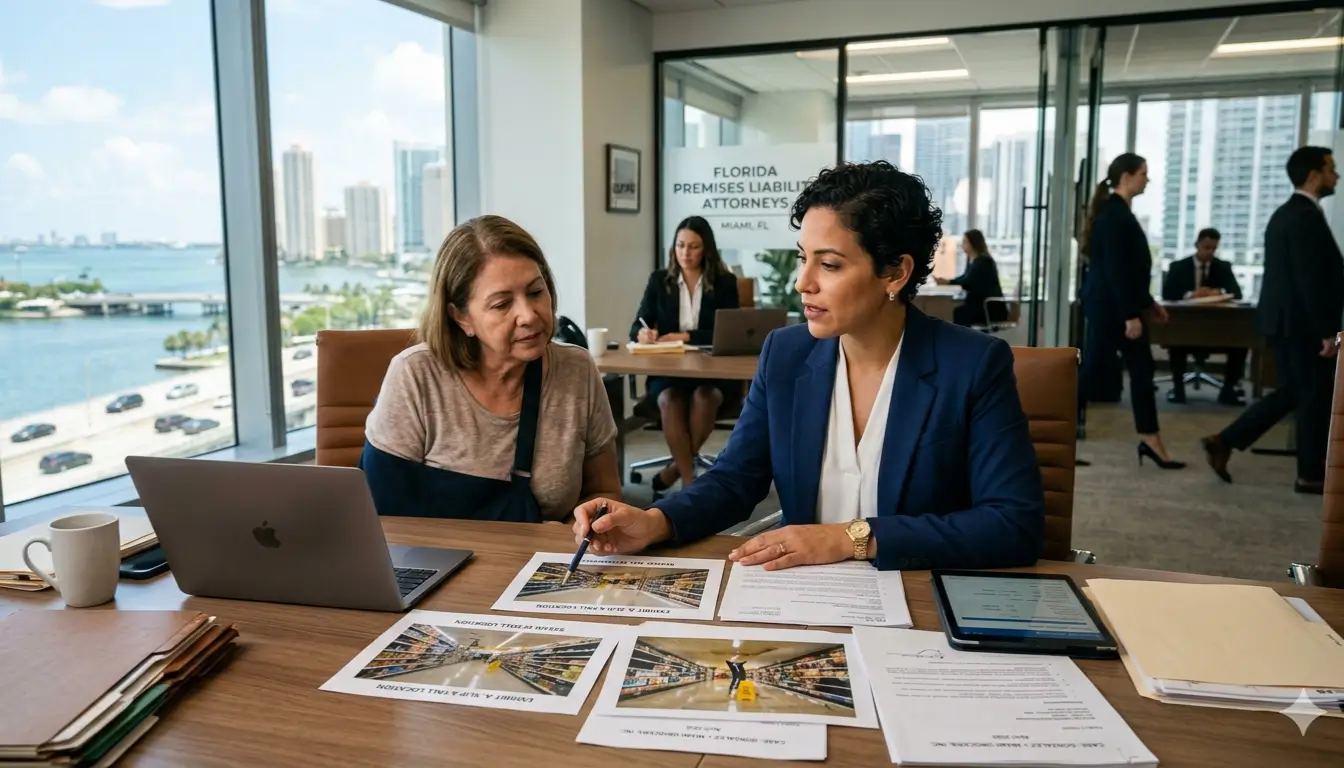
Slip and Fall Lawyer Florida Average Settlement 2026 — What Your Case Is Worth & How to Win
Florida's combination of year-round tourists, elderly population, wet weather, and aggressive hospitality industry makes it one of the most active states in the US for slip and fall personal injury claims. Thousands of Florida residents and visitors suffer serious injuries each year — fractured hips, spinal cord injuries, traumatic brain injuries, and torn ligaments — on wet hotel pool decks, deteriorating supermarket floors, poorly maintained parking lots, and defective restaurant entrances. Yet Florida's 2023 tort reform — HB 837 — changed the rules in premises liability cases significantly, making experienced legal representation more critical than ever before. Understanding what the average Florida slip and fall settlement is worth in 2026, how the new law affects your claim, and how to choose the right attorney can mean the difference between $15,000 and $350,000 — or nothing at all.
💵 What Is the Average Slip and Fall Settlement in Florida 2026?
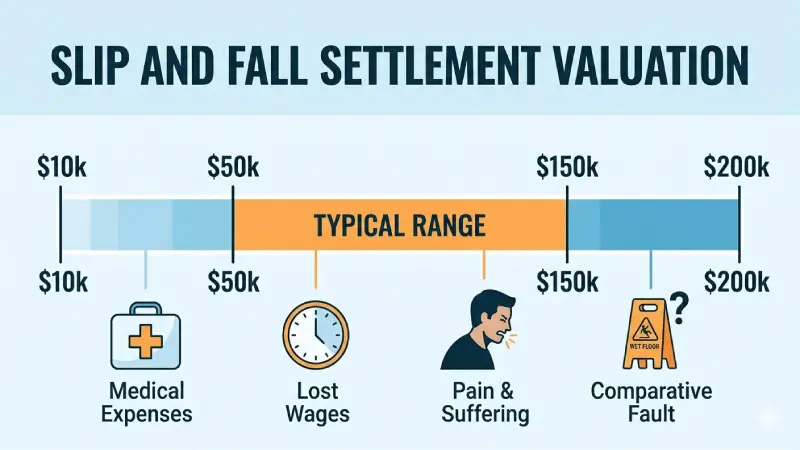
Slip and fall settlements in Florida vary enormously based on injury severity, the clarity of the property owner's negligence, the victim's age and health, the type of property where the accident occurred, and the quality of legal representation. Understanding the ranges and what drives values within each range helps you evaluate whether an insurance offer is fair — or dangerously low.
| Injury Severity | Florida Settlement Range 2026 | Key Factors |
|---|---|---|
| Minor (sprains, bruises, short recovery) | $10,000–$40,000 | Clear liability, quick full recovery |
| Moderate (fractures, ligament tears) | $50,000–$200,000 | Surgery, physical therapy, lost wages |
| Serious (hip fracture, spinal injury) | $150,000–$600,000 | Elderly victims, long recovery, permanent limitations |
| Severe (TBI, paralysis, permanent disability) | $400,000–$3M+ | Lifetime care costs, lost earning capacity |
| Wrongful death from fall | $500,000–$5M+ | Elderly victim, survivorship claims, gross negligence |
| Commercial defendant (hotel, retailer) | Higher end of range | Larger insurance policies, pattern of negligence possible |
Why Florida Settlements Vary So Dramatically
The single most significant factor in Florida slip and fall settlement values is not the injury itself — it is the ability to prove the property owner's actual or constructive knowledge of the hazardous condition that caused the fall. Under Florida's post-HB 837 law, the plaintiff (you) bears a clear burden of proving this knowledge. Cases where the property owner clearly knew about the hazard — a leak reported to management three days before the accident, surveillance footage showing the hazard existing for hours, prior incident reports of similar falls — settle at the high end or go to trial. Cases where the hazard appeared suddenly or the knowledge evidence is thin settle at the low end or may not be viable at all. This knowledge requirement is the central strategic challenge in every Florida slip and fall case, and it is what makes experienced legal representation so critical.
The HB 837 Impact on Settlement Values
Florida's 2023 tort reform reduced average slip and fall settlements in two ways: the new burden of proof on comparative fault makes it easier for defendants to argue you were partially responsible (reducing your recovery proportionally), and the 51% comparative fault bar means cases where the defense successfully argues you were more than half responsible result in zero recovery. Insurance companies' negotiating posture has hardened since HB 837's enactment — they know the new law gives them more tools to minimize or eliminate claims. This hardened posture makes attorney representation — particularly attorneys who have adapted their practice to the post-HB 837 environment — more important than before the reform.
⚖️ HB 837 — How Florida's 2023 Tort Reform Changed Slip and Fall Cases
Florida HB 837, signed into law on March 24, 2023, represents the most significant overhaul of Florida personal injury law in decades. For slip and fall cases specifically, three provisions have the most impact.
Change 1 — Burden of Proof Shift in Premises Liability
Before HB 837, Florida premises liability law under Fla. Stat. § 768.0755 already required plaintiffs to prove the property owner had actual or constructive knowledge of the transitory foreign substance (the hazard that caused the fall). HB 837 did not change this element — but it changed how courts analyze the burden allocation when both sides present evidence of comparative fault. The practical effect: defense attorneys and insurers now more aggressively argue victim comparative fault in every slip and fall case, knowing that assigning 51%+ fault to the plaintiff eliminates the entire claim under the new modified comparative fault system.
Change 2 — Modified Comparative Fault (51% Bar)
Florida's shift from pure comparative fault to modified comparative fault with a 51% bar is the single most consequential change for slip and fall victims. Under the old pure comparative fault system, you could recover compensation even if you were 90% at fault — your recovery was simply reduced by your fault percentage. Under the post-HB 837 system, if a jury finds you 51% or more at fault for your fall, you recover nothing — zero dollars. Insurance companies and defense attorneys now strategically argue for victim comparative fault percentages above 51% specifically to invoke this bar. Common comparative fault arguments in Florida slip and fall cases include: you were distracted by your phone, you were wearing inappropriate footwear, you failed to notice an open and obvious hazard, or you entered an area that was roped off or otherwise marked as restricted. Countering these arguments requires attorney experience with the specific post-HB 837 litigation environment.
Change 3 — Statute of Limitations Reduced to 2 Years
For accidents occurring on or after March 24, 2023, Florida's personal injury statute of limitations — including slip and fall claims — is now 2 years from the date of the accident. This was reduced from 4 years under the prior law. For victims who experienced their fall in 2023 or 2024, this deadline may already be approaching. Missing the statute of limitations permanently bars your claim regardless of its merits. Contact a Florida slip and fall attorney immediately if your accident was within the past 2 years.
What HB 837 Did NOT Change
The core requirement that property owners maintain their premises in a reasonably safe condition, warn visitors of known hazards, and address hazardous conditions within a reasonable time remains unchanged. The ability to recover economic damages (medical bills, lost wages) and non-economic damages (pain and suffering) for serious injuries remains fully available. Large corporate defendants — hotel chains, supermarket chains, retailers — still face significant liability for systematic failures to maintain safe conditions. The key is having an attorney who knows how to build a claim that meets the post-HB 837 standards efficiently and defensively.
📋 Legal Elements of a Florida Slip and Fall Claim
To successfully pursue a Florida slip and fall claim under Fla. Stat. § 768.0755, your attorney must establish four legal elements. Understanding these elements helps you understand what evidence your case needs and why certain actions after a fall are so critical.
Element 1 — Duty of Care
The property owner or occupier owed you a duty of care — which depends on your legal status as a visitor. Invitees — customers in a business, guests in a hotel, patients in a medical office, visitors to a public park — receive the highest duty of care. Property owners must maintain safe conditions, regularly inspect for hazards, and warn of known dangers for invitees. Licensees — social guests, people entering for purposes of their own with the owner's implied permission — receive a lesser duty: owners must warn of known hazards but need not inspect for unknown ones. Trespassers receive only a duty against intentional harm (with special rules for children under the attractive nuisance doctrine). Almost all commercial slip and fall accidents in Florida involve invitees — the highest duty of care category.
Element 2 — Breach of Duty (The Hazardous Condition)
The property owner breached their duty by allowing a hazardous condition to exist that posed an unreasonable risk of harm. In Florida's transitory foreign substance context (the most common slip and fall scenario), this means a liquid or substance on the floor — spilled drink, tracked water, leaking refrigeration unit, cleaning product residue — that created the slip hazard. Other common breach categories include: uneven flooring, broken tiles or pavement, inadequate lighting, defective stairs or handrails, wet pool deck, and torn or raised carpet.
Element 3 — Actual or Constructive Knowledge (The Critical Element)
Under Florida law, the property owner must have had actual or constructive knowledge of the hazardous condition before you fell. Actual knowledge means the owner or an employee knew the hazard existed — a spill that was reported to a manager, a leak that maintenance had been asked to fix, a broken tile that had been noted in an inspection log. Constructive knowledge means the hazard existed long enough that a reasonable inspection process would have discovered and corrected it — a pool of water that had been growing for 2 hours was visible to employees making regular passes through the area, for example. This knowledge element is where most Florida slip and fall cases succeed or fail. Evidence of knowledge — surveillance footage of the hazard's duration, prior incident reports, inspection records, employee testimony about awareness — must be identified and preserved immediately, often before any formal legal process begins.
Element 4 — Causation and Damages
The hazardous condition caused your fall, which caused your injuries. This element is usually straightforward for physical falls — the challenge is ensuring that all injury components are medically documented and connected to the fall with sufficient specificity. Insurance companies commonly argue that pre-existing conditions account for the claimed injuries, that the fall was too minor to cause the claimed severity of injury, or that injuries were caused by subsequent events rather than the fall itself. Your attorney and treating physicians must proactively address these arguments with specific medical documentation from the date of the fall.
🏆 Top 8 Florida Slip and Fall Law Firms 2026
| # | Firm | Google Rating | Location | Best For | Notable Result |
|---|---|---|---|---|---|
| 🥇 1 | Lytal, Reiter, Smith, Ivey & Fronrath | 4.9 ⭐ (580+) | West Palm Beach | Complex premises · Catastrophic injury | $18M — hotel premises catastrophic fall |
| 🥈 2 | Morgan & Morgan (Florida offices) | 4.7 ⭐ (3,200+) | Statewide | All slip and fall types · High volume | $14M — major retailer repeated hazard |
| 🥉 3 | Kelley Kronenberg | 4.8 ⭐ (340+) | Fort Lauderdale | Commercial premises · Hotels | $9.8M — resort hotel pool deck fall |
| 4 | Wolfson & Leon | 4.8 ⭐ (610+) | Miami | Premises liability · Auto + slip and fall | $8.5M — supermarket premises liability |
| 5 | Searcy Denney Scarola Barnhart | 4.8 ⭐ (280+) | West Palm Beach | Catastrophic premises liability | $12M — construction site fall |
| 6 | The Law Offices of Matt Mcconnell | 4.9 ⭐ (420+) | Orlando | Theme park · Tourist premises liability | $7.2M — Orlando theme park negligence |
| 7 | Cohen Injury Law Group | 4.9 ⭐ (380+) | Miami | Fast response · Miami premises cases | $5.4M — restaurant premises liability |
| 8 | Lash & Goldberg | 4.7 ⭐ (190+) | Miami | Complex commercial premises | $6.8M — apartment complex negligence |
For a broader comparison of Florida personal injury attorneys across all case types, see our guide on the best Miami personal injury lawyers with no win no fee. For understanding how Florida's unique insurance environment affects personal injury claims, our umbrella insurance guide explains how commercial liability coverage works.
🏢 Most Common Florida Slip and Fall Case Types
Supermarket and Grocery Store Falls
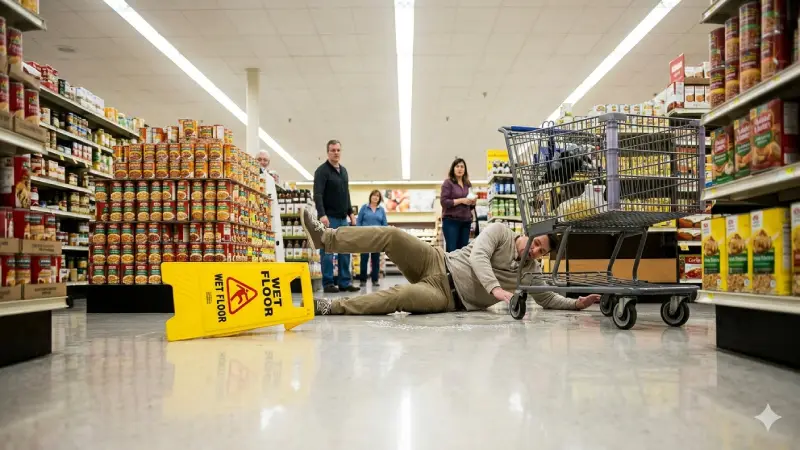
Supermarkets are the most common location for Florida slip and fall accidents. The combination of produce misting systems, leaking refrigeration units, spilled beverages in checkout lanes, and the constant tracking of water from exterior rain creates persistent slip hazards. National chains — Publix, Walmart, Kroger/Winn-Dixie, Target — are the most frequently named defendants in Florida premises liability cases. These large corporate defendants have standardized incident report procedures, surveillance systems, and experienced insurance defense teams. Your attorney must obtain the incident report, the surveillance footage (request it within 24 hours — it is typically overwritten within 30–72 hours), the maintenance and inspection logs, and any prior incident reports showing falls at the same location. Patterns of prior incidents at the same location are the most powerful evidence of constructive knowledge in supermarket cases.
Hotel and Resort Pool Deck Falls
Florida's hospitality industry — particularly in Miami, Orlando, Fort Lauderdale, Tampa, and the Florida Keys — generates significant slip and fall liability from pool deck accidents. Wet pool decks, inadequate non-slip surface maintenance, leaking outdoor shower areas, and pool bar wet floors are common hazard scenarios. Hotel and resort defendants carry commercial general liability policies of $1M–$10M+ — making adequate insurance coverage less likely to be an issue than in residential property cases. The challenge in hotel cases is establishing actual or constructive knowledge: did the hotel's maintenance programme fail to identify and address worn non-slip surfacing, or did the water appear moments before your fall? Surveillance footage and maintenance record subpoenas are critical.
Restaurant and Bar Falls
Restaurants and bars create frequent slip hazards — spilled beverages, tracked grease from kitchen areas into dining rooms, wet entranceways from outdoor rain, and uneven exterior parking lot surfaces. Florida's large restaurant industry — from fast food chains to fine dining establishments — generates substantial premises liability exposure. Restaurant cases often involve shorter hazard duration (spills that occurred just before the fall), making the constructive knowledge element more challenging. However, restaurants with documented prior falls at the same location, insufficient non-slip matting, or inadequate "wet floor" warning sign protocols can be held liable even for relatively recent hazards.
Big Box Retail and Shopping Center Falls
Walmart, Target, Home Depot, Lowe's, and mall common areas generate significant Florida slip and fall claims. These defendants have sophisticated claims management operations — their rapid response teams photograph scenes, collect witness information, and sometimes record statements from injured victims before an attorney is retained. If you fall in a big box retail store, do not make any statement beyond providing your contact information and requesting emergency medical assistance if needed. The retailer's team is not there to help you — they are preserving evidence for their defense.
Theme Park and Attraction Falls
Central Florida's massive theme park industry — Walt Disney World, Universal Orlando, SeaWorld, Busch Gardens — generates a specialized category of Florida premises liability claims. Theme parks invest heavily in safety but also attract millions of visitors annually, creating significant aggregate fall injury volume. Theme park cases have unique characteristics: detailed incident documentation by trained safety teams, large insurance programs, and significant legal resources devoted to defending claims. The best results in theme park premises liability cases come from attorneys with specific experience against these defendants.
Nursing Home and Assisted Living Falls
Florida's large elderly population creates significant nursing home and assisted living fall liability — both as premises liability claims and as negligence claims against the facility for failure to properly supervise and protect high-fall-risk residents. Florida has specific statutory protections for nursing home residents under Chapter 400 and Chapter 429 — and nursing home fall cases can involve both negligence and the enhanced remedies available under the Nursing Home Residents' Rights Act. These cases are among the most emotionally significant and financially substantial in Florida premises liability practice.
💰 What Damages Can You Recover in a Florida Slip and Fall Case?

Florida slip and fall victims can recover both economic (quantifiable financial) and non-economic (subjective experience) damages. Understanding each category helps ensure you and your attorney identify and document every dollar of compensation you are entitled to.
Economic Damages — Your Calculable Financial Losses
Medical expenses cover all costs of accident-related medical treatment: emergency room charges, ambulance fees, hospitalization, surgery (hip fracture repair, spinal surgery, knee replacement from a meniscus tear), physical therapy, occupational therapy, pain management, prescription medications, medical equipment (walkers, wheelchairs, braces), and home health care. For serious injuries with ongoing treatment needs, future projected medical costs — calculated with the help of a life care planner — are the largest component of economic damages and the one most commonly underestimated by unrepresented claimants.
Lost wages and earning capacity compensates for all income lost during recovery from the fall. For employees, this includes regular wages, overtime, bonuses, and paid time off consumed. For self-employed individuals and business owners, it includes lost business revenue and the cost of hiring temporary replacements. For injuries with permanent impairment, the projected lifetime earnings differential — the economic value of reduced earning capacity — can be substantial even for part-time workers or retirees whose economic damages are primarily in the medical and home care categories.
Out-of-pocket expenses include transportation costs to medical appointments, modifications to your home required by mobility limitations, childcare costs you cannot manage due to injury, and any other expenses directly caused by the fall that you would not have incurred if uninjured. Document every one of these expenses with receipts and create a comprehensive expense log from the date of the accident.
Non-Economic Damages — Pain, Suffering, and Quality of Life
Florida does not cap non-economic damages in personal injury cases (only in medical malpractice claims under the 2023 MICRA amendment). Pain and suffering compensation for a Florida slip and fall case includes the immediate physical pain of the injury and any ongoing chronic pain condition, mental anguish (anxiety, depression, PTSD, fear of falling again), loss of enjoyment of life (inability to participate in previously enjoyed activities — particularly important for active individuals whose injury restricts mobility), disfigurement (surgical scars, deformity from poorly healed fractures), and loss of consortium for married claimants whose injury significantly affects their relationship with their spouse.
Punitive Damages — The Exception, Not the Rule
In cases where the property owner's conduct was grossly negligent — not just careless, but recklessly indifferent to the risk of harm — Florida courts may award punitive damages under Fla. Stat. § 768.72. These require a separate evidentiary hearing and a higher proof standard, but when available, they can multiply the total recovery significantly. Common factual scenarios that support punitive damages in Florida slip and fall cases include: a property owner who was repeatedly notified of a dangerous condition and failed to fix it, a retailer whose management directed employees to conceal the existence of a hazard after a prior fall, or a nursing home that knowingly understaffed to a level that made resident falls inevitable despite documented resident fall risk.
📋 The Florida Slip and Fall Claim Process
Phase 1 — Immediate Post-Fall Actions (Hours 1–24)
The actions taken in the first 24 hours after a fall are the most important determinants of whether your case succeeds. Report the fall to the property manager or owner immediately and ensure an official incident report is completed. Request a copy of the incident report before you leave the property — in Florida, property owners are required to provide you with a copy. If one is not provided immediately, note the date, time, location, and who you spoke with. Photograph the hazard that caused your fall before it is cleaned up — a puddle of water, a broken floor tile, a wet pool deck. If possible, video record the scene. Note any witnesses and collect their contact information.
Phase 2 — Medical Documentation (Days 1–30)
Seek emergency medical evaluation on the day of the fall. The emergency room record that documents your injuries on day one is the foundation of your entire claim. Follow up with your primary physician within 2–3 days even if you were seen in the ER. The connection between the fall and your injuries must be established in contemporaneous medical records — delays in seeking care create gaps that insurance companies exploit relentlessly. Follow every prescribed treatment plan completely and document every medical appointment, every prescription filled, and every therapy session attended.
Phase 3 — Attorney Retention and Evidence Preservation (Days 1–14)
Retain a Florida slip and fall attorney within the first week of your accident. Your attorney will immediately: issue evidence preservation letters to the property owner demanding retention of surveillance footage, maintenance records, inspection logs, prior incident reports, and employee communications about the hazard. Surveillance footage in commercial properties is typically overwritten within 30–72 hours — this preservation demand is urgently time-sensitive. Your attorney will also obtain the official incident report, identify all insurance coverage available, and begin investigating the property's maintenance history for patterns of prior hazards.
Phase 4 — Investigation and Expert Development (Months 1–8)
Your attorney's team investigates the property's maintenance programme, staffing levels, prior incident history, and regulatory compliance. They may retain a premises liability expert who can evaluate whether the property's inspection and maintenance protocols met the standard of care for the industry. For serious injury cases, a life care planner is engaged to calculate future medical costs, and a vocational expert quantifies lost earning capacity. This phase typically concludes when your medical condition has reached Maximum Medical Improvement (MMI) — the point at which your condition has stabilized and future medical costs can be projected with reasonable certainty.
Phase 5 — Demand, Negotiation, and Resolution (Months 4–18)
Your attorney sends a demand letter documenting all damages and demanding a settlement figure. Florida's bad faith insurance law (Fla. Stat. § 624.155) provides leverage for claimants whose damages exceed the property owner's policy limits — if the insurer unreasonably fails to settle within limits and a verdict exceeds those limits, the insurer faces personal excess liability. Most Florida slip and fall cases settle during this negotiation phase. For cases that do not settle, your attorney files in the appropriate Florida circuit court and pursues litigation through discovery, mediation (mandatory in Florida civil cases), and trial if necessary.
🔍 Critical Evidence That Wins Florida Slip and Fall Cases
Under Florida's post-HB 837 evidence standards, the quality and completeness of evidence of the property owner's knowledge of the hazard determines whether your case succeeds and what it is worth. Here are the most critical evidence categories and how to preserve them.
Surveillance Footage — The Most Powerful Evidence
Modern commercial properties have extensive camera systems. Surveillance footage that shows the hazard existing for an extended period before your fall is direct evidence of constructive knowledge. Footage that shows an employee walking through the area near the hazard without addressing it is even stronger evidence of constructive (or actual) knowledge. Footage of your fall and its immediate aftermath documents the hazard's exact nature and your injury. Your attorney must demand preservation of all surveillance footage covering the area of your fall for at least 4 hours before the fall. This demand must be made within 24–48 hours of the accident — most commercial properties overwrite footage on a 24–72 hour cycle.
Prior Incident Reports — The Pattern Evidence
If other customers or employees have fallen at the same location or under similar circumstances on prior occasions, this is extraordinarily powerful evidence that the property owner had constructive knowledge of a systematic, recurring hazard. Prior incident reports are obtained through formal legal discovery — your attorney subpoenas the property's complete incident report history. This evidence also supports punitive damages arguments when it shows the property owner knew about a recurring hazard and systematically failed to address it.
Maintenance and Inspection Records
Commercial properties are supposed to conduct regular inspections of high-traffic areas and document these inspections. Inspection records that show either: no inspection was conducted in the hours before your fall, or an inspection was conducted that should have identified the hazard — are both powerful evidence. Records that show the last inspection was 8 hours before your fall in an area that routinely accumulates water support constructive knowledge. Records that show an inspection occurred but failed to note a hazard that existed are evidence of inadequate inspection procedures.
Photographs of the Scene — Taken Immediately
Photographs of the hazard taken immediately after your fall — before the property cleans it up — are direct evidence of its existence. Most smart phones timestamp photos automatically; this timestamp establishes that the photo was taken at the time of the fall. Photograph the hazard from multiple angles, the surrounding area (showing no wet floor signs, no barriers, no warnings), and your injuries. If you cannot take photos yourself due to injury, ask a companion, a bystander, or instruct the 911 dispatcher to note that photographs need to be taken. Your attorney can also hire a private investigator to document the scene and its characteristics in the immediate aftermath of the fall.
Witness Statements
Witnesses who saw you fall, who saw the hazard before you fell, or who overheard property employees' comments about the hazard are critical evidence. Collect full names and phone numbers from every witness at the scene. Witnesses who leave without being identified are often impossible to trace later. Your attorney can take formal witness statements through deposition once litigation is filed — but the initial identification at the scene is entirely your responsibility in the moments after the fall.
📈 How to Maximize Your Florida Slip and Fall Settlement
1. Photograph and video the hazard before it is cleaned up
This is the single most time-critical action after a Florida slip and fall. The hazard that caused your fall will be cleaned up within minutes of the property becoming aware of your injury. Your photograph or video is often the only direct evidence that the hazard existed and the only evidence of its size, location, and characteristics. Take multiple photographs from multiple angles, capture the absence of warning signs, and if possible, record a video while narrating what you see. This evidence alone has been the difference between large settlements and dismissed claims in numerous Florida cases.
2. Report the fall before you leave the property
Always report your fall to a manager or supervisor before leaving the property — even if you feel relatively okay. The incident report this creates is an official record that establishes the fall occurred on that date, at that location, due to a specific hazard. If no incident report is created and no employees are told, the property owner will claim ignorance of the accident — significantly complicating your ability to prove notice and knowledge. The incident report is also evidence in itself: if it acknowledges the hazard, that acknowledgment is admission of the condition's existence.
3. Retain an attorney within the first week
The evidence preservation window in Florida commercial premises cases is extremely narrow. Surveillance footage typically overwrites within 24–72 hours. Maintenance logs may not be retained indefinitely. Employee memories fade and become hostile as the property owner's legal team begins managing them. Your attorney's preservation demand — which carries legal weight and can support sanctions for spoliation if the property owner fails to comply — must be issued within the first days after the fall. An attorney retained a month later may find that the most critical evidence has already been lost.
4. Never accept the first settlement offer
Property owners and their commercial insurers make quick initial settlement offers — sometimes within days of a serious fall — specifically to settle claims before victims understand their full value. A $35,000 offer for a hip fracture requiring surgery in an elderly woman may sound significant, but a fully documented case with future medical costs, home care needs, and non-economic damages may be worth $350,000. Initial offers are almost never the fair value of a well-developed claim. Never accept any offer — regardless of how it is framed as "final" — without your attorney's specific advice that it represents fair value for your documented damages.
5. Document the full impact on your daily life
Florida juries and insurance adjusters are influenced by the human story behind a fall — how has this injury actually changed your life? A daily journal documenting your pain levels, your inability to perform specific activities (cooking, cleaning, walking the dog, playing with grandchildren), your sleep disruption, your emotional state, and your dependence on others creates the personal narrative that makes non-economic damages real and compelling. Medical records document diagnoses and treatments — your journal documents what living with those injuries actually feels like, day after day. This documentation consistently adds value to Florida slip and fall settlements for attorneys who know how to use it.
🎯 How to Choose the Right Florida Slip and Fall Attorney
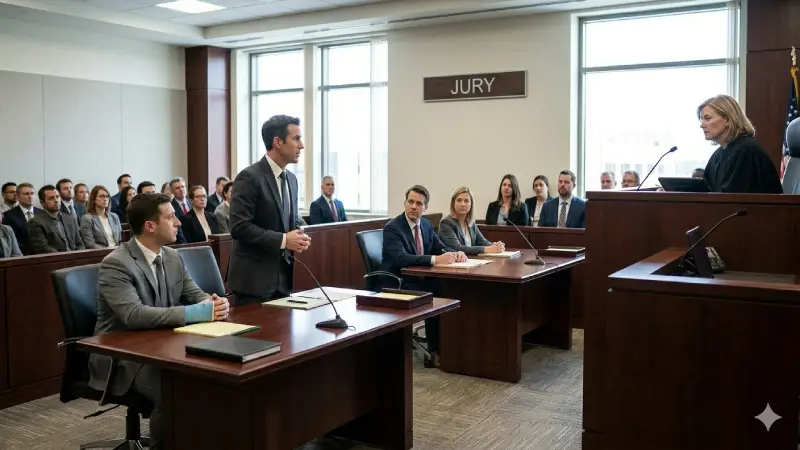
Post-HB 837 Experience is Essential
Florida's 2023 tort reform created a new legal landscape for slip and fall cases. Any attorney you consider must have specific, demonstrable experience handling premises liability cases under the post-HB 837 rules — including the new comparative fault burden, the 2-year statute of limitations, and the hardened insurer negotiating posture that followed the reform. Ask directly: "How has your premises liability practice adapted since HB 837, and how does the new law affect my specific case?" An attorney who cannot give you a specific, detailed answer is not sufficiently current in their knowledge.
Premises Liability Specialization vs General Practice
A general personal injury attorney who handles slip and fall cases as a fraction of their practice will miss case-building strategies that a premises liability specialist applies routinely: the specific discovery requests that reveal prior incidents at the same location, the expert witnesses who most effectively establish commercial property standard of care violations, and the tactics for countering the post-HB 837 comparative fault arguments that insurance defense attorneys now deploy in virtually every slip and fall case. Ask: "What percentage of your personal injury caseload involves premises liability and slip and fall cases?"
Local Knowledge of the Defendant
The best Florida slip and fall attorneys know the insurance carriers and defense firms that represent major Florida commercial defendants — Publix's insurer, Walmart's legal team, the major hotel chains' litigation counsel. This institutional knowledge — understanding the settlement authorization levels, the defense strategies specific to each carrier, and the settlement history with each entity — creates negotiating advantages that newer or less specialized attorneys simply lack. Ask: "Have you previously resolved cases against this specific defendant or their insurer?"
❓ Frequently Asked Questions — Slip and Fall Lawyer Florida Average Settlement 2026
What is the average slip and fall settlement in Florida in 2026?
Florida slip and fall settlements in 2026 range from approximately $10,000–$40,000 for minor injuries with quick full recovery, to $50,000–$200,000 for moderate injuries involving fractures or surgery, to $150,000–$600,000 for serious injuries like hip fractures or spinal injuries with lasting impairment, to $400,000–$3M+ for catastrophic injuries involving TBI or paralysis. The most significant factor determining where within these ranges your case falls is the strength of the property owner's knowledge evidence — actual or constructive knowledge of the hazardous condition. Cases with strong knowledge evidence (documented prior falls, surveillance of the hazard, employee awareness) settle significantly higher than cases where the hazard's duration and the owner's knowledge are uncertain. Florida's HB 837 tort reform modestly reduced average settlements in premises liability cases but did not eliminate viable claims with strong evidence.
How do I prove a Florida property owner knew about the hazard?
Proving a Florida property owner's actual or constructive knowledge of a hazardous condition — required under Fla. Stat. § 768.0755 — relies primarily on: (1) Surveillance footage showing the hazard existing for a significant time before your fall; (2) Prior incident reports of similar falls at the same location; (3) Maintenance and inspection records showing either no inspection was conducted or an inspection failed to identify the hazard; (4) Employee testimony about awareness of the hazard; and (5) Expert testimony from a premises liability expert that the property's inspection programme did not meet industry standards, meaning a proper programme would have discovered and corrected the hazard. Your attorney must demand preservation of surveillance footage within 24–48 hours of the fall and use litigation discovery to obtain maintenance records and prior incident history — which are not voluntarily disclosed by defendants.
How long do I have to file a slip and fall lawsuit in Florida?
For accidents occurring on or after March 24, 2023, Florida's slip and fall lawsuit statute of limitations is 2 years from the date of the fall — reduced from 4 years under HB 837. For accidents before March 24, 2023, the prior 4-year limitations period applies. Claims against government entities (city or county property, public schools, government buildings) require a Government Tort Claim notice filed with the appropriate agency within 3 years of the accident under the Florida Tort Claims Act — with different procedural requirements than private party claims. If you miss the applicable deadline, your claim is permanently barred regardless of its merit. Contact a Florida premises liability attorney immediately if your fall occurred within the past 2 years.
Does HB 837 prevent me from suing for a slip and fall in Florida?
No — HB 837 did not eliminate slip and fall claims in Florida. The right to sue property owners for negligence that causes injury remains fully intact. HB 837 made three specific changes that affect the legal landscape: it reduced the statute of limitations to 2 years; it changed the comparative fault system to a 51% bar (you recover nothing if found more than 50% at fault); and it modestly shifted how courts analyze burden of proof allocation in some comparative fault situations. These changes make cases harder in some respects and make experienced legal representation more valuable — but well-documented slip and fall cases with strong knowledge evidence, serious injuries, and competent representation continue to produce significant settlements and verdicts in Florida in 2026.
Can I sue if I fell in a grocery store in Florida?
Yes — grocery stores are the most common location for Florida slip and fall lawsuits. As an invitee (a customer entering for business purposes), you are owed the highest duty of care. To succeed, your attorney must establish that the store had actual or constructive knowledge of the hazardous condition that caused your fall — typically a liquid on the floor. Constructive knowledge is established by showing the substance was present long enough that a reasonable inspection programme would have discovered it, or that the store's inspections were inadequate or infrequent. Surveillance footage that shows the hazard existing for an extended period before your fall — which your attorney must demand preservation of within 24–48 hours of the accident — is the most powerful evidence in grocery store slip and fall cases.
How much does a slip and fall lawyer cost in Florida?
Florida slip and fall attorneys work on a contingency fee basis — you pay nothing upfront and nothing unless they win your case. The standard contingency fee in Florida follows the sliding scale set by the Florida Rules of Professional Conduct: 33.33% of the first $1M in recovery if the case resolves pre-litigation, and 40% if a lawsuit is filed. Case expenses (expert witnesses, surveillance footage preservation, court costs) are typically advanced by the attorney and reimbursed from your settlement. If your case is unsuccessful, you owe no attorney fee. The no-upfront-cost model ensures that any Florida resident who has been injured in a slip and fall can access quality legal representation regardless of their financial situation. For a deeper comparison of no win no fee representation in Florida, see our guide on Miami personal injury lawyers with no win no fee.
✅ Final Thoughts — Slip and Fall Lawyer Florida Average Settlement 2026
Florida's post-HB 837 premises liability environment is more demanding for claimants than it was before 2023 — but well-documented slip and fall cases with serious injuries and strong knowledge evidence continue to produce substantial settlements and verdicts. The key is early attorney retention, aggressive evidence preservation, and representation by an attorney with specific post-HB 837 premises liability experience.
The firms on our 2026 Florida ranking — led by Lytal Reiter for catastrophic cases and Morgan & Morgan for statewide accessibility — offer free consultations and no upfront cost representation. Contact an attorney within the first week of your fall. The surveillance footage that will win your case is being overwritten as you read this. For related guides, see our articles on Miami personal injury lawyers with no win no fee, wrongful death lawyer Texas payout, and what to do if insurance denies your claim.
Disclaimer: This article is for informational purposes only and does not constitute legal advice. Florida premises liability law changed significantly with HB 837 in 2023 — always consult a licensed Florida attorney for advice specific to your situation. Settlement figures are ranges and averages based on publicly available data — individual outcomes vary significantly. Nexuora does not receive referral fees from any firm listed. Updated April 18, 2026.

Ahmada Ndao is a financial research analyst and independent journalist
specializing in US consumer finance, legal rights, and insurance markets.
With over 5 years covering American financial products, he has helped
thousands of readers navigate complex insurance decisions, find the right
legal representation, and optimize their credit strategies. His research
methodology combines primary data analysis, direct outreach to industry
professionals, and continuous monitoring of federal regulatory changes.
Ahmada’s work has been cited by financial communities across the US and
reviewed by licensed attorneys and insurance professionals for accuracy.