Usage-based insurance programs are exploding across the United States as drivers look for ways to cut rising auto insurance costs in 2026.
Two programs dominate the conversation:
- Progressive Snapshot
- Allstate Drivewise
Both promise personalized rates based on driving behavior, but which one actually delivers the biggest savings?
In this detailed comparison, we break down:
- Real-world discount potential
- Privacy trade-offs
- Mobile app accuracy
- Driving score calculations
- Hidden disadvantages most drivers ignore
- Which drivers should avoid telematics entirely
If you’re comparing auto insurance companies in 2026, you should also read our full comparison of GEICO and State Farm:
👉 https://nexuora.com/geico-vs-state-farm-2026/
What Is Usage-Based Insurance?
Usage-based insurance (UBI) tracks driving habits using:
- Smartphone apps
- Plug-in devices
- Vehicle telematics systems
Insurance companies then calculate risk based on:
- Mileage
- Hard braking
- Speed
- Phone usage
- Time of day
- Acceleration habits
According to the Insurance Information Institute, telematics programs continue growing rapidly because insurers now rely heavily on behavioral data instead of traditional demographics.
External source:
👉 https://www.iii.org/article/what-is-usage-based-insurance
Progressive Snapshot Overview
Progressive Snapshot is one of America’s most popular telematics insurance programs.
Official Snapshot page:
👉 https://www.progressive.com/auto/discounts/snapshot/
Drivers can participate through:
- Mobile app
- Plug-in device
- Connected vehicle data
Snapshot mainly rewards:
- Low mileage
- Smooth braking
- Minimal nighttime driving
Potential savings can reportedly reach 30%, although many drivers receive much smaller discounts.
Allstate Drivewise Overview
Allstate Drivewise uses a smartphone-based tracking system to reward safer driving behavior.
Drivewise monitors:
- Speed
- Sudden braking
- Phone handling
- Driving hours
- Trip consistency
Unlike Snapshot, Drivewise often emphasizes weekly safe-driving streaks and behavioral rewards.
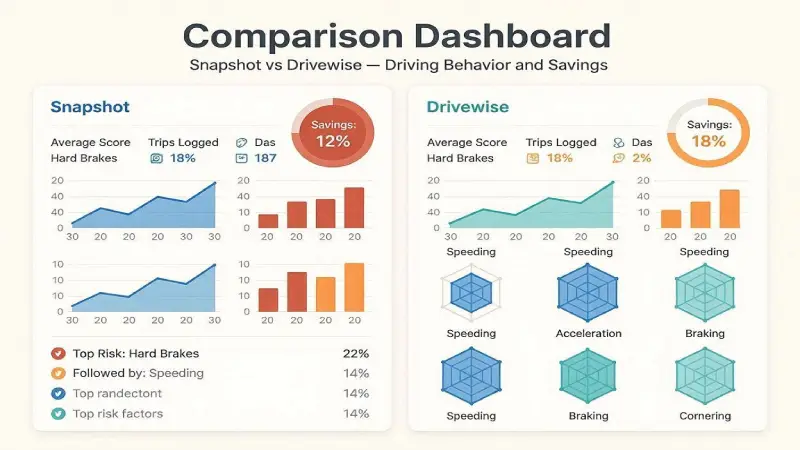
Snapshot vs Drivewise — Key Differences
| Feature | Progressive Snapshot | Allstate Drivewise |
|---|---|---|
| Max advertised savings | Up to 30% | Up to 40% |
| Tracking method | App + device | Mainly app |
| Monitors phone usage | Yes | Yes |
| Penalizes night driving | Strongly | Moderately |
| Available nationwide | Mostly yes | Mostly yes |
| Data sharing concerns | Medium | Medium |
| Mobile experience | Better overall | Simpler setup |
Which Program Gives Bigger Discounts?
The answer depends heavily on your driving style.
Snapshot tends to favor:
- Low-mileage drivers
- Remote workers
- Suburban drivers
- Predictable commuters
Drivewise tends to favor:
- Consistent daytime drivers
- Drivers with smooth acceleration
- Drivers who avoid mobile phone usage
According to Consumer Reports telematics insurance studies, many drivers overestimate their potential savings because insurers heavily penalize risky behaviors like late-night driving and distracted driving.
External authority:
👉 https://www.consumerreports.org/cars/car-insurance/usage-based-car-insurance-review-a5310543914/
The Hidden Privacy Problem Most Drivers Ignore
Many drivers join telematics programs without realizing how much data insurers collect.
Programs may track:
- Exact routes
- Trip duration
- Driving frequency
- Phone movement
- Vehicle location patterns
The National Association of Insurance Commissioners (NAIC) warns consumers to carefully review telematics privacy policies before enrolling.
Official NAIC resource:
👉 https://content.naic.org/consumer/auto-insurance.htm
Who Should Avoid Telematics Insurance?
Usage-based insurance is not ideal for everyone.
You may want to avoid Snapshot or Drivewise if you:
- Drive frequently at night
- Work delivery jobs
- Commute long distances
- Frequently use your phone in traffic
- Live in dense urban areas
Some drivers actually see rates increase after telematics monitoring periods.
Best Alternative for EV Drivers
Electric vehicle owners often face different insurance pricing structures because battery repair costs remain extremely high.
If you drive a Tesla, Rivian, Hyundai Ioniq, or Ford EV, read our full guide here:
👉 https://nexuora.com/best-electric-vehicle-insurance-usa-2026/

Snapshot vs Drivewise for Young Drivers
Young drivers usually pay extremely high premiums in 2026.
Telematics programs can help teenagers and college drivers reduce insurance costs faster than traditional discounts.
However, aggressive driving patterns can backfire.
Parents should monitor:
- Night driving frequency
- Phone distractions
- Sudden acceleration
- Weekend driving
Which Insurance Company Has Better Financial Strength?
Both companies maintain strong financial reputations.
Progressive:
- Strong pricing algorithms
- Large UBI market share
- Competitive claims experience
Allstate:
- Massive nationwide network
- Strong mobile ecosystem
- Multiple bundling discounts
The Real Winner in 2026
Choose Progressive Snapshot if:
You drive less
You avoid late-night trips
You want more accurate trip tracking
You prefer detailed driving analytics
Choose Allstate Drivewise if:
You want easier app setup
You drive mostly daytime routes
You prefer behavioral rewards
You already bundle with Allstate
Final Verdict
For most low-mileage drivers in 2026, Progressive Snapshot generally produces slightly better long-term savings potential.
However, Drivewise may feel less intrusive for casual drivers who dislike constant telematics monitoring.
The most important takeaway is this:
Usage-based insurance only works well for disciplined drivers.
Otherwise, traditional insurance policies may still offer better value.
You can also compare broader insurance options in our related guides:
https://nexuora.com/geico-vs-state-farm-2026/
https://nexuora.com/best-critical-illness-cover-uk-2026/
https://nexuora.com/snapshot-vs-drivewise-car-insurance-2026/
FAQ
Does Progressive Snapshot track location?
Yes. Snapshot may collect trip and driving behavior data depending on your participation method.
Can Drivewise increase insurance rates?
In some cases, risky driving behavior can negatively impact pricing.
Which telematics program is best for remote workers?
Snapshot is usually better for low-mileage remote workers.
Is usage-based insurance worth it in 2026?
It can be worth it for safe drivers with predictable driving habits.

Ahmada Ndao is a financial research analyst and independent journalist
specializing in US consumer finance, legal rights, and insurance markets.
With over 5 years covering American financial products, he has helped
thousands of readers navigate complex insurance decisions, find the right
legal representation, and optimize their credit strategies. His research
methodology combines primary data analysis, direct outreach to industry
professionals, and continuous monitoring of federal regulatory changes.
Ahmada’s work has been cited by financial communities across the US and
reviewed by licensed attorneys and insurance professionals for accuracy.